Britain’s move to a Net Zero economy will cost taxpayers more than £800 billion over the next two decades, the OBR – the UK’s fiscal watchdog – has said. But even this is based on implausibly generous assumptions, say critics. The Telegraph has the story.
The Office for Budget Responsibility (OBR) said Government plans to limit climate change will cost the public purse £30 billion every year until at least 2051, as tax revenue from the sale of petrol and diesel fuel dries up.
This includes nearly £9.9 billion of spending every year on tech investments – for example updating the electricity grid – as well as £20.5 billion in revenue losses from declining fuel duty from petrol cars, as electric vehicles (EV) become more common.
Investments in green technology will initially make up most of the Net Zero cost before lost tax receipts become the bigger factor, the OBR said.
“In the next decade, expenditure accounts for the bulk of the fiscal cost, particularly public investment in residential buildings, removals and surface transport, which start to decline from 2036 to 2037,” it said.
While the sums are significant, the fiscal cost of Net Zero has been revised down from £1.1 trillion since the OBR last reviewed it in 2021. The watchdog said this was because of fuel duty freezes leading to lower lost receipts and a higher-than-expected uptake of EVs.
It also assumes the Government will spend less on the transition after the Climate Change Committee revised down the costs across the whole of the economy.
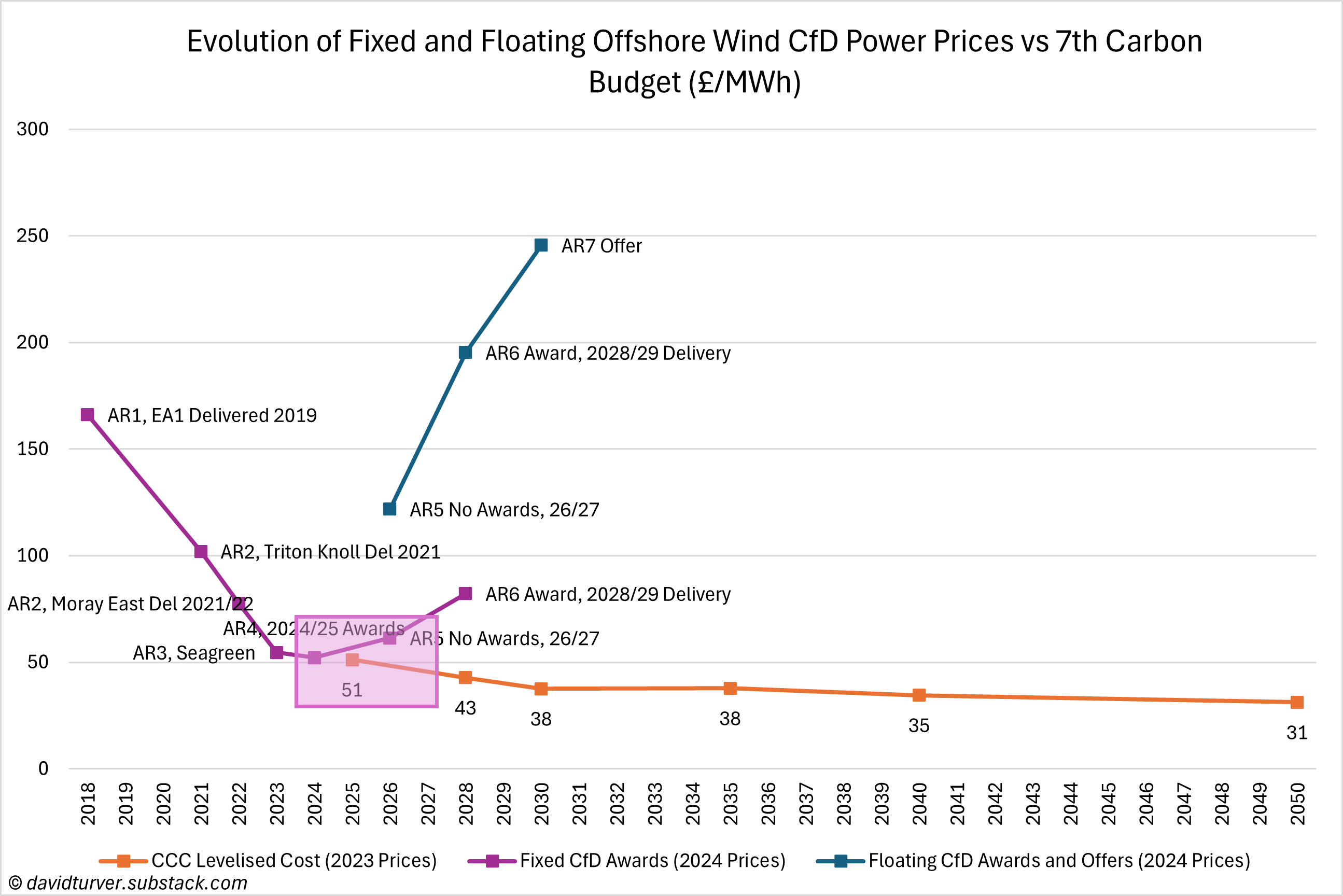
David Turver criticises the OBR for taking the Climate Change Committee’s figures at face value, pointing out that the CCC makes numerous implausible assumptions that lower the apparent cost of Net Zero.
From the numbers they have published, we know the CCC made some highly implausible assumptions about the shifting the costs of renewables on to gas bills as well as the cost and take-up rates of heat pumps. However, the most obvious egregious errors are in the CCC’s erroneous estimates of the cost of renewables.
The CCC assumes that offshore wind in 2030 will cost less than half the value of contracts awarded for fixed bottom offshore wind in last year’s Allocation Round 6. It totally ignores the need for floating offshore wind that costs six times more than its 2030 estimate. The CCC estimates for the cost of solar for 2030 delivery were less than half the prices awarded in AR6 too. It did not even bother to estimate the cost of onshore wind, despite needing to more than double the installed capacity by 2050.
It would lower energy costs. It would create hundreds of thousands of “well-paid green jobs”. And it would turn Britain into a global leader in a series of major new industries.
For more than a decade, we have been lectured that creating a net zero economy would pay for itself many times over.
But hold on. Yesterday, the Office for Budget Responsibility admitted that it would cost £800 billion over the next two decades.
Seriously? The blunt truth is this. For a country already drowning in debt, which can’t even save £5 billion a year in welfare reforms, and where taxes have already been pushed to the maximum limits, that is an impossible sum of money. It is surely now official – we can’t afford it.
The OBR is hardly the home of climate denial fanatics. It represents the mainstream, consensus view of the policy establishment. Even so, its report this week laid bare the real cost of net zero. It reckons it will drain the Treasury of £30 billion a year up until 2015.
It will require huge investments and subsidies, while fuel duty will be lost as electric vehicles replace petrol cars. Add it up, and the total comes to £800 billion. And of course, it may well go a lot higher.
After all, we should keep two points in mind. The OBR, just like any other forecaster, often gets its numbers wrong.
Even worse, projects run by the British government have an established pattern of costing wildly more than anyone initially expected. Indeed, if it is anything like building HS2, the cost will come to more like £3 trillion or even more.
The question we should be asking is this – where the heck is the UK going to find that kind of money?
We have just witnessed the farce of the Labour Government trying to shave £5 billion from the soaring welfare bill, and yet even that failed. How are we planning on raising 160 times that amount? We were going to save £1.4 billion by scrapping the winter fuel allowance, but the backlash was so extreme that the Government scrapped the plan. How can we raise 571 times that sum?
And the £24 billion of tax rises on companies and the wealthy announced in the last Budget have crushed the life out of the economy. How the heck are we going to squeeze 33 times that amount out of business without completely finishing off the few that remain? It simply is not possible.
We have been kidding ourselves. We can’t afford it. That does not mean we have to abandon the objective of reducing our carbon emissions or combatting climate change. It does, however, mean that we have to scrap the current plan.
The Liberty Beacon Project is now expanding at a near exponential rate, and for this we are grateful and excited! But we must also be practical. For 7 years we have not asked for any donations, and have built this project with our own funds as we grew. We are now experiencing ever increasing growing pains due to the large number of websites and projects we represent. So we have just installed donation buttons on our websites and ask that you consider this when you visit them. Nothing is too small. We thank you for all your support and your considerations … (TLB)
••••
Comment Policy: As a privately owned web site, we reserve the right to remove comments that contain spam, advertising, vulgarity, threats of violence, racism, or personal/abusive attacks on other users. This also applies to trolling, the use of more than one alias, or just intentional mischief. Enforcement of this policy is at the discretion of this websites administrators. Repeat offenders may be blocked or permanently banned without prior warning.
••••
Disclaimer: TLB websites contain copyrighted material the use of which has not always been specifically authorized by the copyright owner. We are making such material available to our readers under the provisions of “fair use” in an effort to advance a better understanding of political, health, economic and social issues. The material on this site is distributed without profit to those who have expressed a prior interest in receiving it for research and educational purposes. If you wish to use copyrighted material for purposes other than “fair use” you must request permission from the copyright owner.
••••
Disclaimer: The information and opinions shared are for informational purposes only including, but not limited to, text, graphics, images and other material are not intended as medical advice or instruction. Nothing mentioned is intended to be a substitute for professional medical advice, diagnosis or treatment.
Disclaimer: The views and opinions expressed in this article are those of the author and do not necessarily reflect the official policy or position of The Liberty Beacon Project.







It would lower energy costs. It would create hundreds of thousands of “well-paid green jobs”. And it would turn Britain into a global leader in a series of major new industries.
For more than a decade, we have been lectured that creating a net zero economy would pay for itself many times over.
But hold on. Yesterday, the Office for Budget Responsibility admitted that it would cost £800 billion over the next two decades.
Seriously? The blunt truth is this. For a country already drowning in debt, which can’t even save £5 billion a year in welfare reforms, and where taxes have already been pushed to the maximum limits, that is an impossible sum of money. It is surely now official – we can’t afford it.
The OBR is hardly the home of climate denial fanatics. It represents the mainstream, consensus view of the policy establishment. Even so, its report this week laid bare the real cost of net zero. It reckons it will drain the Treasury of £30 billion a year up until 2015.
It will require huge investments and subsidies, while fuel duty will be lost as electric vehicles replace petrol cars. Add it up, and the total comes to £800 billion. And of course, it may well go a lot higher.