

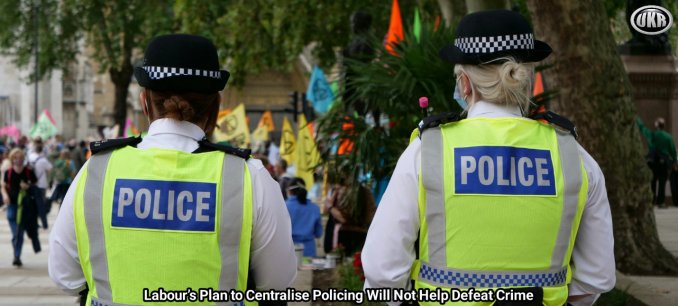
Rupert Matthews: Labour’s plan to centralise policing will not help defeat crime
RUPERT MATTHEWS
Rupert Matthews is the Police and Crime Commissioner for Leicestershire and Rutland.
Labour governments like nothing more than monolithic centralisations. While attention is diverted by the Andy Burnham leadership bid saga, it is now the turn of the Police to fall victim to Labour’s mania.There are currently 43 police forces based on geographic areas, plus a few specialist forces such as the Transport Police and Civil Nuclear Constabulary. If Labour get their way, that will be collapsed down to less than a dozen – the number of nine is the figure most often quoted.
As with the Local Government Reorganisation also being pushed through by this benighted Labour Government, the massive changes are being justified on the grounds of savings to be achieved by economies of scale. The likely costs of such a massive reorganisation are not mentioned, nor are the complexities of trying to amalgamate organisations that have different radio and computer systems, different radio systems and different operational tactics.
From some initial exploratory studies we’ve done, the upfront costs will run into the millions. Even if the promised efficiencies emerge, it will take years for them to add to more than the initial costs.
But there are more costs to be reckoned than those that can be counted in pounds and pence. Huge police forces that sprawl across six or more counties will inevitably be led by management structures that are remote from the communities that they serve. Knowing senior police officers as I do, I predict that resources will be pumped into areas where serious crime is prevalent, and stripped away from communities that face very real challenges from what are viewed as being less serious crimes, such as vandalism, shoplifting and livestock theft. Rural areas will be abandoned to an epidemic of crime as the criminals realise that they can operate with impunity.
We have been here before, of course. The last Labour government also toyed with the idea, before dropping it when the logistical challenges became clear. This time, the Labour government is sidestepping that issue by making it clear that the transitional costs will be paid by the existing police forces, which are to be abolished.
That abortive change apart, British policing was pushed through a similar process of amalgamations by Harold Wilson’s Labour government in the 1960s. Back then, the move was presented as part of Wilson’s drive to modernise the UK – set out in his 1963 conference speech dubbed “The White Heat of Technological Change” speech.
It was argued that the then police forces were too small to take advantage of the advances in police technology and tactics. What was needed was larger police forces that would have the manpower and financial resources to be fully self-supporting in all respects. Here in Leicestershire what had been three separate police forces [Leicester City, Leicestershire and Rutland] became one.
Not everyone welcomed the changes. The then MP for Rutland forced a debate in the Commons on the change. He argued that abolishing a separate Rutland police force would lead to officers and resources being stripped away to be put into the city of Leicester and that the local knowledge needed to deal with local crime would be lost. Government minister brushed his concerns aside. But he was proved correct. With a couple of years the number of officers stationed in Rutland had collapsed and those who remained were moved or replaced at pace.
Without doubt these new proposed amalgamations will lead to similar loss of local knowledge among senior officers and a similar changing of priorities. There will be winners and there will be losers, but it is unlikely that the public most affected will have any opportunity to get things changed since Chief Constables are largely insulated from public opinion by their almost complete independence.
To be fair to our present Labour government, they are not solely responsible for this dreadful idea. The National Police Chiefs Council [NPCC] is dominated by the chief constables of the bigger police forces. They have been vociferous champions of bigger police forces. Indeed the current consultation process is being led by Lord Hogan-Howe, who was Commissioner of the Metropolitan Police from 2011 to 2017.
We do not yet know exactly what shape this massive reorganisation of British policing will take, nor when it will be implemented. But we do know that it will not deal with the real problems facing the British Police.
Accusations of “two tier policing” are brushed off by senior officers even as they sign up to a host of “anti-racist” measures that are themselves driven by critical race theory. The percentage of crimes that result in prosecution has slipped consistently and now stands at under eight per cent. The system for promotions ensures a dearth of talent at the top of Policing. The proposed changes will do nothing to address these structural problems.
Labour boasts that these changes are the biggest reform of British policing in 60 years. But they are simply about changing management structures, and will do nothing to improve policing.
This article (Rupert Matthews: Labour’s plan to centralise policing will not help defeat crime) was created and published by Conservative Home and is republished here under “Fair Use” with attribution to the author Rupert Matthews


Leave a Reply