

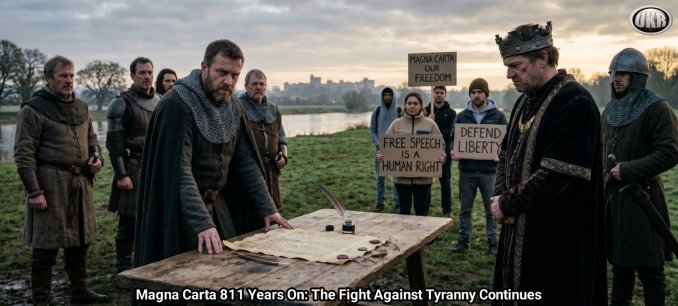
Magna Carta: 811 Years Old Today
And the bulwark against tyranny is still under attack by the ruling class
TOM ARMSTRONG
On this day, 15 June, we mark the anniversary of one of the most audacious acts in human history. In 1215, at a muddy meadow called Runnymede by the River Thames, rebellious barons forced a reluctant King John to set his seal on Magna Carta – the Great Charter. It was no polite petition. It was a raw assertion that even kings are bound by law. No man, however powerful, stands above the ancient liberties of free Englishmen.
Today, as Britain and much of the West slide towards a new totalitarianism engineered by an anti-nation state globalist class bent on erasing borders, traditions, and especially free speech, Magna Carta gains with fresh urgency. It stands as a rebuke to the arrogant elites who believe they can rule by decree, censor dissent, and strip us of our birthrights. This is not ancient history. It is our living inheritance, a weapon against the despotism rising around us.
To grasp the power of Magna Carta, we must understand the man it humbled. King John was a disaster, greedy, treacherous, and cruel. He lost vast lands in France, squeezed his subjects with crushing taxes, and abused his feudal rights. He jailed men without trial, seized property on whims, and treated the Church with contempt. Barons, churchmen, and ordinary freemen had enough.
The barons, many battle-hardened from wars abroad, formed a league against him. They captured London and demanded reform. Archbishop Stephen Langton, a wise scholar, helped draft the charter. On 15 June 1215, at Runnymede, John sealed it under duress. It was a peace treaty, yes, but one written in the language of liberty.
Magna Carta contained sixty-three clauses. Some dealt with feudal dues and forests. Others cut deeper. Clause 1 guaranteed the freedom of the English Church. Clause 13 upheld the ancient liberties of the City of London. Most famous of all were clauses 39 and 40:
“No free man shall be arrested or imprisoned or disseised or outlawed or exiled or in any way ruined, nor will we go or send against him, except by the lawful judgment of his peers or by the law of the land. To no one will we sell, to no one will we refuse or delay right or justice.”
Simple words, but profound meaning. The king could not act arbitrarily. Due process, trial by peers, and the rule of law bound him. This was revolutionary in a world of divine-right kings. Magna Carta declared that power has limits.
John soon reneged, sparking civil war. He died in 1216and his young son Henry III reissued a trimmed version in 1217, and again in 1225. By 1297, under Edward I, it entered the statute book. Only three clauses remain formally on the books today; church freedom, London’s liberties, and the due process right, but its spirit has shaped centuries of struggle.
Magna Carta did not create instant paradise of course. Kings tested its bounds. Yet it became a rallying cry for liberty. In the 13th and 14th centuries, it inspired baronial revolts and parliamentary growth. Parliament itself owes much to the charter’s demand for consent to taxation (clause 14). In the 17th century it ignited the fire against Stuart absolutism. Sir Edward Coke, the great jurist, used Magna Carta to challenge James I and Charles I. He saw it as fundamental law, protecting subjects from royal whim. The Petition of Right in 1628 echoed its principles against arbitrary imprisonment and martial law.
Enter John Lilburne – “Free-born John” – the fiery Leveller and one of England’s greatest champions of liberty of which we wrote yesterday. Lilburne, repeatedly jailed for his pamphlets, rooted his defence in Magna Carta. He argued that its protections were not mere privileges granted by kings but expressions of intrinsic, born rights, natural rights belonging to every free-born Englishman by virtue of being human.
Lilburne took the charter further. In his writings, he spoke of the “Right, Due, and Propriety of all the Sons of Adam, as men.” Rights were not bestowed by government; they were God-given, pre-political and universal in principle. Government existed to secure them, not devour them. He invoked clause 39 (later 29) relentlessly: no man could be deprived of liberty except by lawful judgment of peers or the law of the land. Juries, not judges or kings, were the true guardians. This is as relevant today as it was then, with the likes of lame-brain Lammy, as perfect an advert for the perils of mass immigration it’s possible to imagine, dismissing it as a tradition and seeking to dismiss it on efficiency grounds – as if lengthy waits for trial (unless you are a far right thug) was the fault of the jury and not the incompetence of the system.
Back to Lilburne. The Levellers pushed for broader suffrage, religious toleration, and equality before the law. Though crushed by Cromwell, their ideas endured. Lilburne’s fusion of Magna Carta with natural rights theory influenced the American colonists. When they declared independence in 1776, they echoed the charter’s defiance: governments derive powers from the consent of the governed, and when they become destructive, it is the right of the people to alter or abolish them.
Magna Carta crossed the Atlantic powerfully. It shaped the US Constitution, Bill of Rights, and Fifth and Fourteenth Amendments’ due process clauses. Lord Denning called it “the greatest constitutional document of all times – the foundation of the freedom of the individual against the arbitrary authority of the despot.” Its influence spread to Commonwealth nations, inspiring charters and bills of rights worldwide. From India to Canada, from Australia to nascent democracies, the idea that law stands above rulers took root.
Even in dark times, it flickered. During the English Civil War, the Glorious Revolution of 1688, and struggles against tyranny abroad, Englishmen reached for Magna Carta. It reminded them: we are a free people, not serfs.
Now, in 2026, as we face creeping totalitarianism, Magna Carta is not a dusty relic. It is a blazing indictment of our rulers. Consider the globalist class, the faceless bureaucrats in Whitehall and Brussels, the Davos oligarchs, unaccountable quangos, and captured governments. They erode nation states, flood countries with mass migration without consent, and crush dissent in the name of “hate speech,” “misinformation,” or “public safety.” Free speech, the lifeblood of liberty, is under sustained assault.
In the UK, we see online safety bills, hate crime laws, and policing that targets wrongthink while ignoring real crime. Peaceful protesters face arrest for “wrong” opinions. Juries are sidelined. Administrative detention, asset freezes, and surveillance expand. Taxpayer funds prop up supranational bodies that bypass Parliament. This is the very arbitrary power Magna Carta forbade.
Clause 29 (the due process heart) declares no free man shall be imprisoned or deprived except by lawful judgment of peers or the law of the land. Modern equivalents, like raids on journalists, cancel culture enforced by state pressure on tech firms, or rulings that strip people of livelihoods without fair trial, mock this. When governments partner with corporations to censor, they sell justice and delay it, violating clause forty.
Lilburne would recognise this instantly. He fought Star Chamber tyranny and printing restrictions. Today’s “disinformation” units and regulatory chokepoints on speech are Star Chambers reborn, unaccountable, secretive, hostile to free-born Englishmen. His theory of born rights cuts through the sophistry: rights are intrinsic, not gifts from the state to be rationed by globalist overseers. The anti-nation state project of open borders, net zero zealotry that harms the poor, erosion of sovereignty, treats the English people as obstacles, not sovereign heirs to Magna Carta. In the light of Magna Carta, all this is illegal and thus illegitimate. The charter binds the executive. It demands the law of the land, our common law traditions, not imported human rights conventions twisted to favour the powerful. When ministers or officials act outside these bounds, they forfeit moral and legal authority. Resistance, as the barons showed, is not rebellion but restoration and a moral good.
Parliament itself must answer to these principles. The charter’s demand for consent to taxation and impositions lives in our unwritten constitution. Supranational treaties that cede power without genuine popular consent betray it. The globalist push for digital IDs, CBDCs, and speech codes risks turning freemen into digital serfs, tracked and muzzled.
Magna Carta was sealed in crisis, born of defiance. It survived because ordinary people and bold leaders remembered its truth: power corrupts, and eternal vigilance is the price of liberty. Lilburne, hounded through courts, never bent. He proclaimed the charter as the people’s shield against all tyrants – crown, parliament, or committee.
We face a more insidious, slippery tyranny today, managerial, technocratic, cloaked in fake compassion and expertise. Yet the threat to free speech, national identity, and self-government is very real. Globalist ideology seeks to dissolve the “ancient liberties” Magna Carta affirmed, replacing them with universalist platitudes that empower the tyrants.
On this anniversary, think hard. We need to stand up and be counted. Read the charter. Teach it to the young. Invoke it in courts, in Parliament, in public squares. Demand juries to protect speech. Insist that no regulation curtails liberty and reject the notion that rights are granted by international bodies or Davos summits. They are ours by birth – English, British, and human.
The barons at Runnymede risked everything. Lilburne endured prison and persecution. Their example calls to us. Britain is not doomed to totalitarianism. We are the heirs of Magna Carta. We can reclaim our freedoms, restore sovereignty, and tell the globalist class: thus far, and no further. The Great Charter lives. Long live liberty!
This article (Magna Carta: 811 Years Old Today) was created and published by Free Speech Backlash and is republished here under “Fair Use” with attribution to the author Tom Armstrong

••••
The Liberty Beacon Project is now expanding at a near exponential rate, and for this we are grateful and excited! But we must also be practical. For 7 years we have not asked for any donations, and have built this project with our own funds as we grew. We are now experiencing ever increasing growing pains due to the large number of websites and projects we represent. So we have just installed donation buttons on our websites and ask that you consider this when you visit them. Nothing is too small. We thank you for all your support and your considerations … (TLB)
••••
Comment Policy: As a privately owned web site, we reserve the right to remove comments that contain spam, advertising, vulgarity, threats of violence, racism, or personal/abusive attacks on other users. This also applies to trolling, the use of more than one alias, or just intentional mischief. Enforcement of this policy is at the discretion of this websites administrators. Repeat offenders may be blocked or permanently banned without prior warning.
••••
Disclaimer: TLB websites contain copyrighted material the use of which has not always been specifically authorized by the copyright owner. We are making such material available to our readers under the provisions of “fair use” in an effort to advance a better understanding of political, health, economic and social issues. The material on this site is distributed without profit to those who have expressed a prior interest in receiving it for research and educational purposes. If you wish to use copyrighted material for purposes other than “fair use” you must request permission from the copyright owner.
••••
Disclaimer: The information and opinions shared are for informational purposes only including, but not limited to, text, graphics, images and other material are not intended as medical advice or instruction. Nothing mentioned is intended to be a substitute for professional medical advice, diagnosis or treatment.
Disclaimer: The views and opinions expressed in this article are those of the author and do not necessarily reflect the official policy or position of The Liberty Beacon Project.


Leave a Reply