

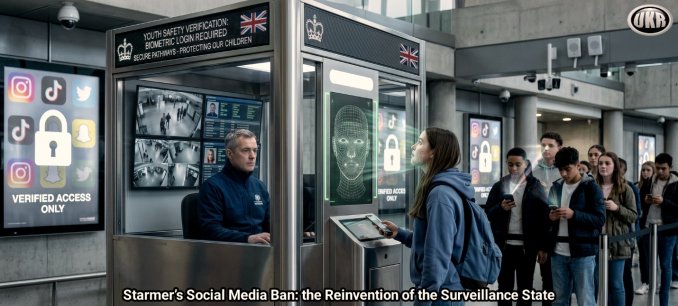
Tyranny masquerading as child safety needs you to feel guilty before you feel suspicious. Downing Street is counting on it.
CAM WAKEFIELD

And what he is building is a country in which you must ask permission to exist online. Not ask the platform. Ask the state. Before you read, post, store a photo, or send a message, you are expected to step up to the booth, show your papers, and prove you are a citizen the government has pre-approved.
The default setting of a free society, that you are left alone until you give the state a reason, is being flipped on its head. The new arrangement is that you are a suspect with a phone until you prove otherwise, and you prove it constantly, because proving it has been welded onto the act of going online and speaking at all.
That is the whole game. Everything else is set dressing.
Monday’s headline was a ban on under-16s using social media which, to some, sounds about as sinister as a wholesome ribbon-cutting until you ask the obvious question nobody in Downing Street wants asked aloud: how, precisely, do you stop a fourteen-year-old from opening Instagram without first checking the age of the forty-year-old?
You don’t. You can’t. So everyone gets carded. Britain is lifting the system wholesale from Australia, where a computer first scans your face and guesses your age from your cheekbones, then, failing that, surveils you to death, studies your browsing habits and the hours you keep, and then, when the algorithm throws up its hands, simply demands your passport.
The face scan is sold to you as the polite option, the velvet rope. It is, in fact, the funnel and, at the bottom of the funnel, sits the national identity check that three million people already told this government, in no uncertain terms, to scrap.
In September 2025 Starmer stood at a lectern and announced a mandatory digital ID scheme with the confidence of a man who assumed it would be popular.
The British public’s response was to reach for the rhetorical equivalent of a cricket bat. Nearly three million signatures on a single petition, the fourth-biggest in parliamentary history.
Public support belly-flopped from positive thirty-five to negative fourteen in the time it takes to renew a passport. Big Brother Watch branded the whole thing “wholly unBritish.” His own MP Rebecca Long Bailey, is warning of “an infrastructure that can follow us, link our most sensitive information and expand state control over all our lives,” which is a sentence you do not expect to hear from the governing party about its own flagship policy.
This was more than the usual rent-a-mob. This was the nation telling its Prime Minister, with rare unanimity, to take a hike.
A normal politician takes that hint. A human rights lawyer, in theory, frames the petition and hangs it on the wall as a cautionary tale. Starmer did something else entirely. He kept the goal and ditched the honesty. The mandatory card was quietly dropped in January, the ambition was not, and the operation simply moved from the front door, which the public had bolted, to the tradesman’s entrance round the back, which they had not thought to lock because who breaks into their own house?
The trick is almost elegant in its cynicism. You cannot sell the public a surveillance dragnet, so you stop calling it a surveillance dragnet and start attaching it to causes that make opposition look like a personality defect.
Don’t ask “may we build a national biometric database?” because the answer is a resounding no. Ask “would you like us to protect children from pornography,” and watch the same people who hated the ID card nod along, because the alternative is being presented as the weirdo at the dinner party defending kids’ access to Pornhub.
Which, by the way, is exactly where the government ran its pilot scheme. Age checks for adult content went live last July, Pornhub’s UK traffic promptly fell off a cliff by 77 per cent (most switched to a VPN), the image site Imgur switched off the entire country rather than play along, and the great public uprising against it amounted to roughly nobody, because marching for your right to watch pornography is not a hill most people will plant a flag on.
Lesson learned, filed away, reused. First, the embarrassing door, then the children’s door, and this week the door to the phone in your actual pocket, where Apple and Google have now been ordered to install spyware that pokes through your photos, on pain of criminal liability if they decline.
Different doormat, same burglar.
Knowing who you are is only act one. Act two is reading what you keep, and here the children conveniently evaporate, because there is no cuddly justification for the next bit, which is why it was done in the dark like most things you would be ashamed of.
The Home Office served Apple with a secret order to tear a hole in iCloud encryption, an order so secret that Apple was forbidden by law from admitting it had even received it.
The ambition is something to behold: a government wanting to force a company to break encryption in secret and then wanting the court case about the secret order to also be a secret.
Apple told them where to go and yanked its strongest encryption from every British user instead, meaning the government reached for one company’s lock and ended up ripping the door off millions of phones.
The French still have the protection. The Germans have it. The Americans have it. Britons do not. If Apple breaks end-to-end encryption for people in Britain, it breaks it for everyone, and the power to do it all again, to any company it fancies, remains fully loaded and pointed at the room.
Act three was already humming along before anyone was paying attention. British police arrested over 12,000 people in a single year for things they typed online, more than thirty a day, and managed to convict fewer than one in ten of them.
When the conviction rate is that feeble, the arrest stops being a step toward justice and becomes the punishment itself, the knock at the door and the phone in the evidence bag doing the work no courtroom ever will.
Over 133,000 “non-crime hate incidents” have been logged since 2014, which is the state’s charming term for keeping a permanent file on something you said that wasn’t actually illegal.
This is what speech policing looks like once the government already knows your name and can read your post. It doesn’t need to win. It just needs you nervous.
Bolt the three acts together and the production reveals itself. A state that checks who you are before you log on, reads what you store once you have, and arrests you for what you say if it doesn’t care for your tone.
Identity, surveillance, punishment, each ushered in through its own tear-jerking side door, each defended by a minister with their hand on their heart, swearing it’s really about the kids.
No single piece is a jackboot. Assembled, they quietly abolish the notion that a British adult can read, think, or speak online without the government’s full knowledge and explicit say-so. And none of it unbuilds. Every future Home Secretary inherits the encryption power. Every future government inherits the identity plumbing and the speech laws. The ratchet has precisely one direction, and Starmer the former prosecutor, knows that better than you do, because prosecutors are the people who get to turn it.
To be scrupulously fair, since the government will not be: there are of course some harms on social media. All true, and all completely beside the point, because a real problem is the finest gift wrapping an illegitimate power ever received. It lets the state answer a question you never asked. “Are children at risk online?” is not the question on the table. “Should the British government be able to identify, monitor, and punish every adult who uses the internet” is the question on the table, and it has already been answered, by three million furious people, which is the entire reason it is never the question they put to you.
None of this was ever really about social media. Starmer tried to sell people the identity state openly, the public broke his fingers in the door, and he came back through the backdoor with a child in his arms.
So here is the only thing worth remembering as the announcements keep coming. Nobody voted for any of this. It was not in the Labour manifesto. No party put facial scanning, biometric databases, broken encryption, and identity checks for the entire population to the electorate and won a mandate for it. There is no democratic permission slip for the biggest expansion of state surveillance in British peacetime history. There is only a government that asked once, got refused, and decided to take it anyway under a friendlier name.
And over the coming weeks, the British people are going to be told, by ministers and by a media that prints the narrative as gospel, that this is about keeping children safe, and that anyone who objects must therefore be on the wrong side of it. That is the trap. Falling for it means handing your government a machine it will never give back, in exchange for a feeling.
The children are the reason you are being asked to stop thinking. They are not the reason this is being built. The moment to notice the difference is now, while saying so still costs you nothing, and not later, when it costs considerably more.
This article (Starmer’s Social Media Ban: the Reinvention of the Surveillance State) was created and published by Reclaim the Net and is republished here under “Fair Use” with attribution to the author Cam Wakefield
See Related Article Below
UK’s Social Media Ban: The Monumental Pretext For Total Digital Surveillance
And the death of anonymity
STEVE WATSON
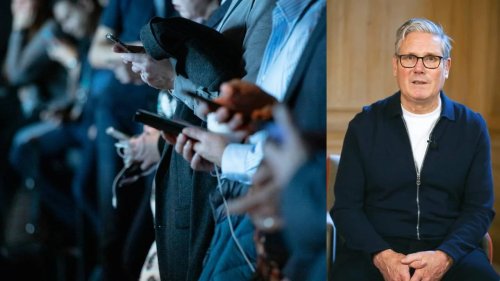
UK Prime Minister Keir Starmer’s announcement of a social media ban for under-16s represents one of the most sweeping advances of the surveillance state in modern British history.
Framed as “giving children their childhoods back,” the policy demands that big tech implement mandatory age verification across major platforms. In reality it forces every adult in the UK to surrender identity documents, facial scans, passports or credit card details simply to post, scroll or communicate online.
What begins as a restriction on minors quickly becomes a national digital ID regime, device-level monitoring on every phone and tablet, and the effective end of anonymous speech.
We are banning social media access for under 16s.
These days kids must find their feet in a world where technology intrudes into every area of their life.
I just can’t let that go on anymore. So we’re giving children their childhoods back. pic.twitter.com/jn7iQrcwk8
— Keir Starmer (@Keir_Starmer) June 15, 2026
The move builds directly on years of incremental power grabs and aligns with identical efforts now rolling out in Canada, Australia and the EU. It ignores the government’s own evidence of no causal harm from social media while accelerating the very infrastructure that hands the state permanent visibility into private lives.
This is not reform. It is the construction of a permissioned internet where access itself requires state-approved identity.
The scale is breathtaking. Age verification will not stop at one app. It will require systems capable of checking every user on Snapchat, TikTok, YouTube, Instagram, Facebook and X.
Additional rules turn off livestreaming and stranger communication by default for under-18s on gaming platforms, and impose overnight curfews plus infinite-scroll ‘breaks’ for under-18s.
🚨 SUMMARY: The UK’s social media ban for children from early 2027:
– “User-to-user” apps where people create, share and interact with content (e.g. TikTok, Instagram, Snapchat, YouTube, X, Facebook) will be banned for under-16s
– WhatsApp, Signal and YouTube Kids will be…
— Politics UK (@PolitlcsUK) June 15, 2026
All of this rests on powers from the draconian Online Safety Act and the Children’s Wellbeing and Schools Act. The government wants regulations in place before Christmas 2026 and full enforcement by April 2027.
The same government has a documented record of failing to protect children from grooming gangs, ideological capture in schools and rushed medical interventions. Now it claims only it can decide what counts as safe online.
The government’s own review found merely a small correlation between children’s social media use and wellbeing, with no evidence of causal effect. That finding sits buried while the policy races forward.
Starmer insists innovators can simply “devise ways to protect our children” and that world leaders must act. The community note attached to his announcement highlights the absence of proof that the measures will deliver the promised benefits.
Critics across platforms immediately pointed out the real target: control.
🚨NEWS: Keir Starmer has announced that due to the under 16’s social media ban he is about to make law. Every adult in the UK will have to prove who they are to use social media.
Anonymity online is now officially dead
— Basil the Great (@BasilTheGreat) June 15, 2026
Big tech’s public statements reveal both resistance and their own power plays. YouTube warned that blanket bans push young people toward anonymous, less safe services and away from curated, educational content that parents and educators value.
Meta went further, arguing that people should not be forced to hand over ID to dozens of separate services. The company instead floated device-level age checks at the operating system level so one verification could serve multiple apps.
These responses sound measured until placed against the broader agenda. The very companies now complaining about fragmented ID collection have long cooperated with governments on data demands. Their proposed “solutions” often centralise verification even more tightly under their own systems or push the burden onto Apple and Google.
🚨NEW: YouTube has released a statement regarding Keir Starmer’s announcement of BANNING social media for under 16s 🇬🇧
“YouTube is a vital resource for young people, educators and parents. Blanket bans push kids out of such curated, supervised, beneficial experiences and… pic.twitter.com/H5IIl1aWPq
— BRITAIN IS BROKEN 🇬🇧 (@BROKENBRITAIN0) June 15, 2026
🚨NEW: Meta, owner of Instagram and Facebook, has said “people shouldn’t be asked to hand over ID to dozens of individual services to prove their age”
— GB Politics (@GBPolitcs) June 15, 2026
The deeper mechanism already moving forward makes the platform-level ban look almost quaint.
A separate device-level system using “nudity detection” and monitoring is scheduled for voluntary rollout by major phone makers around early September this year. If the companies do not comply, legislation will make it mandatory.
This operates directly on phones and tablets. It does not rely on app stores or network traffic. Users who think a VPN solves the problem are missing the architecture: the restrictions sit at the device operating system before any data leaves the hardware.
Once implemented, the phone itself becomes the gatekeeper, reporting or limiting activity according to age-linked rules. This matches earlier warnings about digital ID lockdown on every phone and plans to penalise tech executives who refuse to embed surveillance capabilities.
To clear up any confusion:
There are TWO bans on under 16’s access to social media in the UK. The first is at the app level and this comes into play next year. It will require selected social media apps to prompt for age verification when accessing them.
The second more… pic.twitter.com/afhAT7uwNI
— 🙏🌧🌍 (@godblesstoto) June 15, 2026
Encrypted messaging apps currently remain exempt from the social media ban, yet the same Online Safety Act framework contains provisions that can later demand backdoors. Once the verification infrastructure exists, expanding it to messaging, banking and every other online service becomes a matter of regulatory adjustment rather than fresh legislation.
Meanwhile, an apparent exemption for BlueSky exposes the political character of the entire project. While mainstream platforms face mandatory age gates and identity checks, the left-leaning network popular with progressive activists, and containing open communities of “minor attracted persons,” appears set to escape the same restrictions.
Left-wing social media network could be exempt from Keir Starmer’s mass internet clampdown
https://t.co/nSAW59YahR— GB News (@GBNEWS) June 15, 2026
Multiple observers described the carve-out as a deliberate political decision rather than a technical oversight. The platform’s documented issues with extreme content and grooming-adjacent spaces make the selective enforcement even more glaring.
BlueSky is a far bigger threat to children than X, Facebook or YouTube.
No social media platform is perfect, but BlueSky has serious child safeguarding issues that need addressing.
Yet somehow it’s been left off the ban list.
The Government needs to explain the logic. https://t.co/MpedRkLWVN
— Ben Graham (@BenGrahamUK) June 14, 2026
If the goal were truly uniform child protection, no major service would receive special treatment. The exception instead suggests the rules will be applied most rigorously against platforms that host dissenting or non-progressive voices.
X is banned for under 16s, but Bluesky isn’t.
X is a platform where people regularly share videos of crime, protests, political scandals and government failures.
The other is overwhelmingly left wing and far more sympathetic to the establishment, with no videos of crime, or… https://t.co/dXBvXneHAJ pic.twitter.com/VGV91zCw5o
— Ben Graham (@BenGrahamUK) June 14, 2026
Elon Musk stated “This censorship law is a wolf in sheep’s clothing. The real goal is to enable the UK government to track everyone.”
This censorship law is a wolf in sheep’s clothing. The real goal is to enable the UK government to track everyone. https://t.co/aZKpGDdPmX
— Elon Musk (@elonmusk) June 15, 2026
On the clarification that adults will retain access only by submitting digital IDs, facial recognition, passports or credit cards, his verdict was blunt: “UK is a police state.”
UK is a police state https://t.co/37CoTUnu7S
— Elon Musk (@elonmusk) June 15, 2026
These assessments align with the lived experience of British users who have already seen thousands arrested for online posts. The verification system does not merely confirm age; it ties every account to a verifiable identity that authorities can later subpoena or prosecute.
JUST IN: UK Government clarifies adults will still be able to use social media by verifying their identities with digital IDs, facial recognition, passports and credit cards.
— Polymarket (@Polymarket) June 15, 2026
The policy is not a British outlier. Parallel legislation and regulatory pushes are advancing in Canada, Australia and across the European Union under similar child-safety banners.
Each jurisdiction reaches for slightly different pretexts while constructing the same core capability: verified digital identity standing between citizens and the open internet.
The coordination is too consistent to dismiss as coincidence. Globalist institutions and aligned governments have long promoted digital ID frameworks as solutions to everything from fraud to misinformation.
The UK version simply accelerates the timeline by leveraging parental anxiety and the emotional shield of “protecting children.”
10 June: Canada tables an under-16 social media ban + age checks for everyone.
Five days later, Starmer announces the same for Britain.
Same policy. Same timing. Same “safety” language.
Coincidence – or another piece of the global censorship agenda? pic.twitter.com/l8kpnYAaoQ
— Caroline Farrow (@CF_Farrow) June 15, 2026
One detailed prediction laid out the likely progression with precision:
Once the under-16 ban passes and platforms must verify every user, children will migrate to VPNs. The government will then move to restrict or ban those tools. The age-verification infrastructure already built will expand in scope, becoming more invasive. The Online Safety Act will be used to force backdoors into encrypted messaging, ending meaningful end-to-end encryption. CBDC systems will merge with the internet passport so financial and online activity share the same digital identity. Anonymous accounts posting dissenting views will become instantly identifiable and subject to prosecution. An entire generation will grow up treating constant surveillance as normal. George Orwell’s warnings will have been realised not through sudden dictatorship but through incremental “safety” measures sold to a public conditioned to accept them.
here’s what will happen.
– u16 ban passes, platforms must verify all ages
– kids use VPNs, government bans VPNs
– age verification infrastructure already exists, its scope gets broader, more invasive, more extreme
– Online Safety Act forces backdoors into encrypted messaging,… https://t.co/M47BCACVwh
— CRG (@MacroCRG) June 15, 2026
The scale of existing enforcement already demonstrates the motive. The UK has recorded over 80,000 arrests for social media posts. That figure alone explains why eliminating anonymity ranks higher than any narrow concern about minors.
Once every account requires verified identity, the state gains the ability to connect speech directly to individuals at unprecedented speed.
Dissent that was previously difficult to police at scale becomes routine administrative action. The same government that struggles to control grooming gangs or secure borders now claims it must micromanage every teenager’s screen time and every adult’s online identity.
The UK has made over 80,000+ arrests for social media posts
That’s the real reason why Keir Starmer is banning social media for kids under 16. It requires mandatory ID , so liberals can identify and arrest everyone hiding behind anonymous accounts
— Wall Street Apes (@WallStreetApes) June 15, 2026
The last sentence is the real meat and potatoes of this.
What’s being promoted as a ‘social media ban for children’, is really an ID check for every adult. https://t.co/9H3B9nLZ4h
— Jonathan Pie (@JonathanPieNews) June 15, 2026
Let’s build the full picture of what the UK government has announced this month.
Every device in the country: scanned for nudity.
Signal: ordered to build a backdoor.
Every stolen iPhone: remotely disabled by law enforcement on request.
children: banned from disappearing… https://t.co/QpcMQGigZZ pic.twitter.com/lXVJlmfUt9— IT Guy (@T3chFalcon) June 15, 2026
Nobody voted for this.
Normalising facial recognition, surveillance and zero privacy for the next generation.
I hate this government (and the last) for their weakness in buying all of these controlling measures, sold to them by vested interests @UN &@wef under the guise of…
— Bev Turner (@beverleyturner) June 14, 2026
This fits a longer documented pattern. The UK has pursued digital ID schemes that begin at birth, experiments in mass surveillance sold as modernisation, and plans for government intervention in information flows during declared crises.
The anti-privacy architecture has advanced through successive administrations, each adding layers while claiming limited intent. The current acceleration under Starmer simply removes remaining pretences.
Device-level monitoring, centralised identity checks, backdoors in private communications and penalties for non-compliant technology companies all serve the same end: making private, anonymous activity on the internet impossible without state permission.
The hypocrisy is difficult to ignore. A government with a record of exposing children to ideological content in schools, failing to prosecute industrial-scale grooming networks, and pushing medical interventions with contested evidence now positions itself as the sole guardian of childhood.
It lectures parents about screen time while building the tools to monitor every device in every home. It exempts ideologically aligned platforms while imposing identity gates on others. It cites public support from consultation while downplaying the absence of causal evidence for the claimed benefits.
The pattern is consistent: child safety provides the emotional justification; expanded state and corporate control delivers the actual outcome.
Free societies have always recognised that privacy and anonymity are not luxuries but preconditions for open discourse and individual liberty. Once every post, search, message and transaction requires verified identity, the internet ceases to function as a public square and becomes a monitored enclosure.
The UK’s under-16 social media ban accelerates that transformation under the oldest pretext in the authoritarian handbook.
Other nations watching the rollout will face the same choice: accept the incremental loss of anonymity as the price of ‘safety’, or recognise that the infrastructure now being built will serve whatever purpose future governments assign it.
The technology exists to verify age without destroying privacy for everyone else. The political will to choose that path has so far been absent.
What remains is a clear demonstration that the surveillance state advances not through dramatic coups but through successive “reasonable” measures whose cumulative effect is the elimination of private life online.
The blunt-force censorship campaigns that defined much of the past decade did not produce the compliant silence their architects anticipated. Instead, they produced the opposite: a broad cultural awakening, heightened public skepticism toward institutional narratives, and the single most consequential platform shift in the social media era.
Elon Musk’s acquisition and rebranding of Twitter into X, with its explicit commitment to reduced political moderation, Community Notes, and restored reach for previously throttled voices, became both symbol and engine of that change.
What began as a series of top-down regulatory and institutional assaults on open discourse ultimately backfired, exposing the machinery of control and accelerating demand for alternatives.
Those earlier assaults are now well documented. The EU advanced its Democracy Shield legislation, presented as a democratic safeguard but widely recognized as the end of meaningful freedom of expression across the continent.
The likes of London Mayor Sadiq Khan explicitly called for a government-run social media disinformation unit.
The broader architecture of an information state—the Digital Leviathan—emerged into view, revealing how governments sought to manage perceived reality itself rather than merely respond to it.
[…]
These and parallel efforts across the West did not suppress dissent so much as they spotlighted it. The public saw the coordination between regulators, legacy institutions, and aligned platforms. The result was a decisive shift in cultural momentum toward free-speech absolutism on the reborn X and a growing rejection of curated information diets.
Faced with this new reality, the same institutional forces have not abandoned control. They have adapted. Overt bans, fines, and public demands for ministries of truth proved too visible and too costly once X demonstrated that an alternative model could succeed at scale.
The updated strategy is more subtle and technically embedded: game the algorithms. Non-government-sanctioned narratives—criticism of mass migration, gender ideology, climate policy, or official pandemic and economic records—are to be systematically deboosted, shadow-banned, or buried in recommendation systems.
Simultaneously, state-aligned or legacy-media content is to be amplified through the same black-box mechanisms. This is achieved through regulatory pressure on platforms (Digital Services Act enforcement, Online Safety Act compliance), partnerships with ideologically aligned fact-checkers and AI safety teams, and the continued use of captured mainstream outlets to generate the “authoritative” framing that justifies deboosting.
The goal is an internet that feels open but is quietly curated to favor sanctioned realities.
Central to making algorithmic manipulation effective is the reliable downstream amplification provided by legacy media institutions that no longer operate as independent journalism. These outlets function as propaganda arms, producing the stories, framing, and selective omissions that later supply both public justification for regulatory action and training data for suppression systems.
The BBC stands as a recurring case study. It has been embroiled in multiple scandals involving deceptive editing and fabricated presentation that crossed into outright fake news.
These practices prompted President Trump to file a $10 billion lawsuit, with a trial date now set.
FCC Chair Brendan Carr launched formal investigations into patterns of corruption and systematic news rigging at the broadcaster.
Further revelations continue to emerge, each illustrating how a publicly funded institution can launder politically useful narratives while aggressively attacking dissenting ones.
The same pattern operates in Germany. Public broadcasters ran a fabricated AI-generated clip depicting ICE-style troops arresting a migrant family, a clear attempt to manufacture visual “evidence” for preferred policy narratives.
German state media also conducted systematic campaigns of slander against Charlie Kirk in the period following his assassination.
These are not isolated lapses; they reflect structural alignment with state priorities on immigration, speech restrictions, and political dissent.
When mainstream outlets perform this laundering function, algorithmic gaming becomes far easier to implement and harder to detect. Platforms can point to “reputable sources” when justifying the demotion of independent reporting. “Misinformation” or “hate” flags gain institutional cover.
The closed loop is self-reinforcing: state-aligned media sets narrative boundaries, regulators and platforms enforce them through code changes, and dissenting content simply never reaches most users’ feeds. This is the evolved form of the earlier, more overt censorship attempts that ultimately backfired.
X remains the clearest obstacle to the new algorithmic model precisely because its reduced censorship and transparent features make feed manipulation more visible and contestable. Consequently, efforts to restrict, fine, or ban the platform have continued, now frequently repackaged under the politically potent banner of child protection.
UK government actors have plotted additional attempts to force X offline or impose crippling restrictions, citing Grok’s unfiltered responses and image-generation capabilities—labeled internally as “offensive roasts.”
Previous threats had already surfaced over the so-called “bikini flap” involving Grok image generation.
The evidence, however, demonstrates that the real objections center on X’s refusal to suppress discussion of mass migration realities, crime statistics, cultural cohesion, and government policy failures.
The child-safety framing is a deliberate misdirection; proof has emerged that these ban campaigns have nothing to do with protecting children.
Spain’s far-left government has issued parallel threats to limit access to or effectively ban X, again invoking regulatory and safety language while targeting the platform’s openness on politically inconvenient topics.
These moves represent the direct continuation of earlier regulatory warfare, including the EU’s multimillion-euro fine and repeated Brussels pressure campaigns. The rhetorical shift to child protection is tactical—designed to neutralize public opposition that had grown after the overt attempts of censorship backfired.
The pivot to algorithmic manipulation and media collusion sits inside a still-broader infrastructure of digital control that has continued to advance even as overt platform bans became politically risky.
The EU’s chat-control proposals would require scanning of private encrypted messages, effectively ending meaningful privacy for personal communications across member states.
Privacy advocates at Signal and political voices within the AfD have condemned the measures in the strongest terms as the end of private correspondence in Europe.
In the United Kingdom the trajectory is advanced. Successive governments have advanced mandatory digital ID systems linked to biometric data, creating the technical foundation for tying every online action to a verified identity.
The government’s disinfo units, originally justified during the lockdown period, have been repurposed to monitor and target critics of mass migration.
Internet censorship has grown more pervasive and institutionalized than at any prior point in the digital age.
The Online Safety Act operates in practice as a censors’ charter, granting regulators sweeping powers to fine platforms into algorithmic compliance.
Political and diplomatic counter-pressure is also materializing. The Trump administration has declared open opposition to European-style internet crackdowns and positioned the United States to actively counter UK and EU regulatory overreach.
Concrete measures include consideration of travel bans for officials responsible for these policies.
And formal exclusion of anti-free-speech EU globalists from entry into the United States.
Such steps raise the external cost of exporting censorship models and create protected space for platforms and voices that refuse to comply.
The institutional response to the backfire of overt censorship has been to retreat into the shadows of code—algorithmic deboosting, regulatory capture of recommendation systems, and continued reliance on captured media as narrative enforcers.
This evolution is more insidious precisely because it is less visible to casual users. Yet it is also more fragile. It depends on continued public ignorance of how feeds are actually constructed, on the cooperation of platforms that can still be pressured or competed against, and on the absence of credible alternatives.
The record of the past two years shows that when citizens can see the machinery and when functional alternatives remain available, control erodes.
The technical and political tools to push back—decentralized architectures, platform competition, independent verification, and geopolitical leverage—are already in motion.
The task now is to accelerate those tools before the algorithmic layer hardens into permanent infrastructure. The window created by the original backfire of overt censorship is still open. Whether it closes or widens depends on how quickly and effectively the public, technologists, and political actors committed to open discourse exploit the vulnerabilities the control project has itself created.
Your support is crucial in helping us defeat mass censorship. Please consider donating via Locals or check out our unique merch. Follow us on X @ModernityNews.

••••
The Liberty Beacon Project is now expanding at a near exponential rate, and for this we are grateful and excited! But we must also be practical. For 7 years we have not asked for any donations, and have built this project with our own funds as we grew. We are now experiencing ever increasing growing pains due to the large number of websites and projects we represent. So we have just installed donation buttons on our websites and ask that you consider this when you visit them. Nothing is too small. We thank you for all your support and your considerations … (TLB)
••••
Comment Policy: As a privately owned web site, we reserve the right to remove comments that contain spam, advertising, vulgarity, threats of violence, racism, or personal/abusive attacks on other users. This also applies to trolling, the use of more than one alias, or just intentional mischief. Enforcement of this policy is at the discretion of this websites administrators. Repeat offenders may be blocked or permanently banned without prior warning.
••••
Disclaimer: TLB websites contain copyrighted material the use of which has not always been specifically authorized by the copyright owner. We are making such material available to our readers under the provisions of “fair use” in an effort to advance a better understanding of political, health, economic and social issues. The material on this site is distributed without profit to those who have expressed a prior interest in receiving it for research and educational purposes. If you wish to use copyrighted material for purposes other than “fair use” you must request permission from the copyright owner.
••••
Disclaimer: The information and opinions shared are for informational purposes only including, but not limited to, text, graphics, images and other material are not intended as medical advice or instruction. Nothing mentioned is intended to be a substitute for professional medical advice, diagnosis or treatment.
Disclaimer: The views and opinions expressed in this article are those of the author and do not necessarily reflect the official policy or position of The Liberty Beacon Project.


Leave a Reply