

Put Not Your Trust In Streeting
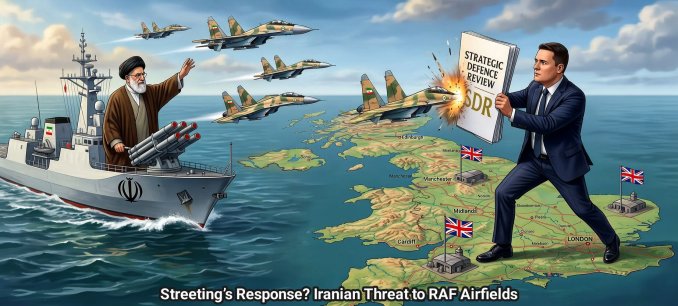
The Iranians are threatening to strike RAF Airfields in the UK; What’s Wes doing about it?
VIEWS FROM MY CAB
No doubt Wes Streeting was feted last week at Farnborough Air Show, the biennial aviation industry boondoggle where big deals are announced and exotic aviation hardware put through its paces. Although the £8.6 billion commitment to the Global Combat Air Programme (GCAP) had already been announced, Wes will have felt the glow of a major customer being pampered by some of the most effective salespeople on the planet.
He gave a speech announcing a further £750 million spending on StormFighter, a collaborative drone that will work with the RAF’s Typhoon fighters. The first flights are due next year. Indeed, the RAF has done rather well out of the Defence Investment Programme, with some £16 billion committed to aircraft programmes over the next four years. That’s excellent news for BAe Systems shareholders and the UK’s substantial aerospace industry.
In the United States things are pretty good for the aerospace industry too. The conflict in the Middle East is consuming missiles at a prodigious rate; they must be replaced and stockpiles rebuilt, which will consume a fair proportion of the additional $65 billion that Pete Hesketh sought from Congress last week. Much of whatever he gets will flow into the profit lines of the US military-industrial complex, which includes British firms – notably BAe Systems, whose shares have risen by some 400% since 2021.
But is the spending good value for taxpayers, be they British or American?
Certainly it is almost impossible to win on a conventional battlefield where the enemy owns the skies; the examples of the Falaise Gap (World War Two) and the Mutla Ridge (Gulf War One) make the point. It’s not just on land. Warships are equally vulnerable to air attack, as the sinking of HMS Repulse and HMS Prince of Wales demonstrated in the Second World War, as did all the Royal Navy’s losses in the Falklands War.
However, that doesn’t mean that airpower alone can win a war. In World War Two, the Germans weren’t bombed into submission. Nor were the North Vietnamese, despite being bombed more heavily than Germany was in WW2. The Japanese surrendered because of atomic weaponry, not bombing per se. (The firebombing of Tokyo in March 1945 killed more Japanese than Hiroshima or Nagasaki). It is possible that the 1999 NATO bombing of Serbia (which focused on military and infrastructure targets) ended the Serbian occupation of Kosovo. If it did (and historians argue), it’s an outlier.
Air power can destroy key facilities, the Israeli attack on the Iraqi Osirak nuclear reactor being the exemplar. It ended Iraq’s nuclear ambitions but, crucially, it did not remove Saddam Hussein from power or destroy his regime. It wasn’t intended to. The initial Israeli/US strikes on Iran were similarly focused on its atomic weapons programme, which it more or less destroyed.
The second campaign stuck nuclear and missile targets again, plus military installations. It’s a reasonable bet that the Iranian armed forces are seriously depleted. However, as President Trump is discovering, depleted is not a synonym for impotent. Whether the current tit for tat bombing will open the Straits of Hormuz is uncertain.
The Iranian regime’s air defences are now inadequate to protect the country and its infrastructure. Retaliation against US and other assets in the region is not preventative per se and, of course, complicates Iran’s future post conflict. Iran has therefore upped the stakes, stating that British airbases used by the Americans to attack Iran are fair game.
That makes perfect sense. Modern jets are very difficult to find, let alone shoot down, when they’re in the air. When they’re on the ground it’s a different story – they move slowly on predictable routes and are easily damaged. Attacking airfields has therefore been a primary task for air forces since military air combat began. The Battle of Britain began with attacks on radar stations and RAF airfields; there were times when the RAF was running out of airfields. Later in the war, the Special Air Service was founded to attack German airfields in North Africa, which it did with gusto, destroying many more German aircraft than any single RAF unit.
During the Cold War airfields were priority targets for early strikes, including nuclear ones. Combat aircraft and their crews operated from hardened aircraft shelters (HAS), protected from chemical weapons, nuclear radiation and nearby high explosive. This, of course, was tough on personnel and less efficient than keeping the jets maintained. It did ensure that they would survive to fight thought. The F-35s at RAF Marham have HAS, but of course the planes still must taxi from the HAS to the runways. During that time they are vulnerable to everything from a nuke to a sniper bullet.
Larger jets, like the B1 Lancer bomber, the Voyager refuelling/transport aircraft and the Wedgetail airborne early warning (AEW) aircraft, do not operate from HAS. Instead they park in the open, which may or may not be surrounded by some protective earthworks but definitely doesn’t have the overhead protection and blast survivability of a HAS. That seems like a significant oversight – presumably due to cost. Wes might want to ask an air marshal to walk him through the logic of protecting an F-35 but not the supporting aircraft it depends on.
Protecting RAF bases from ground threats is the role of the RAF Regiment, which comprises about 1,500 personnel organised into seven squadrons, each about 170 strong. In the Cold War the RAF Regiment also provided air defence, using the Rapier surface-to-air missile. That capability was cut. (Rapier is being replaced by Sky Sabre, but only the Army is getting it). The RAF Regiment is currently operating the Martlet lightweight multi-role missile as part of the Rapid Sentry system. The Regiment has shot down at least 20 Iranian drones and Rapid Sentry is being sent to Kuwait. The United States is developing and deploying similar systems.
Airbases are also guarded by the armed Military Provost Guarding Service and the uniformed but unarmed MOD Guard Service as well as the Ministry of Defence Police. The bouillabaisse of organisations smacks of administrative confusion and apparatchik empire building around the legal complexities of managing the interfaces between the civil population, police officers (who have powers of arrest) and service personel (who don’t).
Airfields are big and vulnerable, in as much as they have long perimeters, which are (or should be) fenced. Last year a bunch of eco-loons penetrated the fence at RAF Brize Norton (the RAF’s busiest airfield). That they broke in was embarrassing; that they managed to damage military aircraft was a disgrace. That no-one has yet been found culpable for this lapse remains a scandal. The threat to airfields has been significantly increased by Iran; if I were Wes I would be asking about airfield security.
Eco-loons aside, the threats to an airfield include ballistic missiles, air-launched cruise missiles and other natures. Nowadays all sorts of drones can strike at airfields. On the ground any place with a line of sight to the ends of the runway(s) is a suitable place for engaging jets as they wait to take off with sniper rifles, heavy machine guns or missiles. On top of that come mortars and car/truck bombs.
The good news is that Iran is not thought to have missiles capable of hitting the UK, although it can hit Romania. Whatever is left of its air force can’t get here either.
The bad news is that there are around 114,000 Iranians living in the UK. Some were part of the diaspora following the fall of the Shah; some 63,000 applied for asylum since 2016 and 30,000 have arrived by small boat since 2018. While many will be escaping the regime, some are probably agents of the Iranian Revolutionary Guard Corps (IGRC). Other UK domiciled Iranians can no doubt be pressured into cooperation by the IGRC threatening their relatives still in Iran.
According to Iran Wire, the Iranian Embassy in London is recruiting Iranian patriots to support the “popular defence of the Iranian homeland”. Destroying or disabling some of the bombers that are pummelling Iran would be an effective move. It doesn’t take many people to mount an effective surprise attack.
Getting weaponry into the UK is simple enough for a state actor; firing drones from a vessel outside UK territorial waters is even easier. Iran has, or had, a very effective drone industry, producing thousands (or more) of sophisticated drones despite sanctions. The Shahed 131 and 136 drones pack a 20 kg warhead, are GPS-guided and can travel 1,500 km. They’re proving effective in Ukraine (Russia uses them).
The Iranians have specifically threatened US air bases, which the media has interpreted as meaning RAF Fairford. In fact, there are twelve RAF stations used by the USAF with permanently stationed air operations units. These exist under the NATO Status of Forces agreement of 1951, which was incorporated into English law in 1952.
RAF Fairford is used by B-1 and B-2 bombers. RAF Lakenheath is home to a USAF strike wing of F-15s and F-35s, which might have struck Iran. RAF Mildenhall is home to a USAF air refuelling tanker wing which almost certainly supports strikes on Iran. They’re all now targets. According to a recent parliamentary briefing, base security inside the perimeter is USAF responsibility; outside the perimeter is British. That’s fine for day-to-day administration but adds a layer of significant complexity should someone strike at the airfield from outside the perimeter, as Iran is now threatening to do.
A government spokesman said, “Our Armed Forces are ready to keep the United Kingdom safe from any kind of attacks, whether it’s on our soil or from abroad. The UK stands ready 24/7 to defend itself. This includes through operating a layered approach to air and missile defence, provided by Royal Navy, British Army and Royal Air Force assets equipped with a range of advanced capabilities, working closely with our NATO allies. The UK’s approach to the conflict remains the same – we are committed to defending our people, our interests and our allies, acting in accordance with international law and not getting drawn into the wider conflict.”
Quite how that squares with the reality of the Iranian threat and the complexities of USAF defending itself on British soil is hard to deduce. Wes might want to ask his officials about that too. The RAF’s Air Surveillance and Control System (ASACS) might struggle to detect incoming drones; it needs an update and drones are tricky targets anyway, being largely non-metallic and flying low and slow. While much of the ASACS system is mobile, it has historically been orientated to the north and east because that’s where Soviet bombers would have come from. According to Mark Rutte, Secretary General of NATO, Russia might be a threat from 2030 onwards. According to the IGRC Iran is a threat to the UK today, and a serious one.
Writing in the Spectator, Tim Shipman says that Wes Streeting asked to be Minister of Defence and has already thrashed out an agreement on funding with the new chancellor and former defence minister John Healey. If that is correct, it is likely to be more of a Westminster fix than a confrontation of the reality that the Realm is poorly defenced at best, no matter what some MOD mouthpiece might allege. There is no money and the Strategic Defence Review requires tens of billions, or more.
Wes Streeting is an ambitious, ruthless, career politician. His interest in defence is recent and probably more related to advancing his prospects of becoming prime minister in time than actually dealing with military matters. He has inherited a dysfunctional department whose problems go far beyond procurement. There is now a current threat from Iran which, should an attack on a US airbase in the UK succeed, will further damage the UK’s relationship with the United States (still our largest export market).
Defending airfields is far less exciting than expensive new weaponry like GCAP and StormFighter, but it’s vital. Streeting should be asking the questions and demanding solutions in a way that his predecessor failed to. If the Iranians are serious (why wouldn’t they be?), Streeting doesn’t have time on his side. Neither do we.
If you enjoyed this article please remember that Views From My Cab is a reader-supported publication and subscribe, which costs you nothing but makes the SubStack bots more helpful.
Alternatively you could make a small, one off donation to defray my production costs. I am hugely grateful for every donation. The simplest method is via Buy Me a Coffee.
This article (Put Not Your Trust In Streeting) was created and published by Views From My Cab and is republished here under “Fair Use”

••••
The Liberty Beacon Project is now expanding at a near exponential rate, and for this we are grateful and excited! But we must also be practical. For 7 years we have not asked for any donations, and have built this project with our own funds as we grew. We are now experiencing ever increasing growing pains due to the large number of websites and projects we represent. So we have just installed donation buttons on our websites and ask that you consider this when you visit them. Nothing is too small. We thank you for all your support and your considerations … (TLB)
••••
Comment Policy: As a privately owned web site, we reserve the right to remove comments that contain spam, advertising, vulgarity, threats of violence, racism, or personal/abusive attacks on other users. This also applies to trolling, the use of more than one alias, or just intentional mischief. Enforcement of this policy is at the discretion of this websites administrators. Repeat offenders may be blocked or permanently banned without prior warning.
••••
Disclaimer: TLB websites contain copyrighted material the use of which has not always been specifically authorized by the copyright owner. We are making such material available to our readers under the provisions of “fair use” in an effort to advance a better understanding of political, health, economic and social issues. The material on this site is distributed without profit to those who have expressed a prior interest in receiving it for research and educational purposes. If you wish to use copyrighted material for purposes other than “fair use” you must request permission from the copyright owner.
••••
Disclaimer: The information and opinions shared are for informational purposes only including, but not limited to, text, graphics, images and other material are not intended as medical advice or instruction. Nothing mentioned is intended to be a substitute for professional medical advice, diagnosis or treatment.
Disclaimer: The views and opinions expressed in this article are those of the author and do not necessarily reflect the official policy or position of The Liberty Beacon Project.


Leave a Reply