

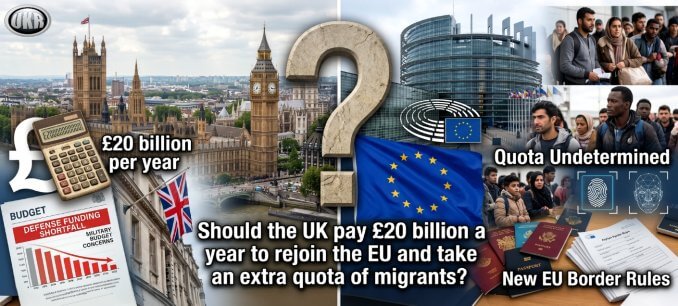
A question that organisations like IPSOS will not put to Brits – “should the UK pay £20 billion a year to rejoin the EU? and take a quota of extra migrants?
Would you like a noisy heat pump? – better question “would you like a heat pump that is noisy and costs £15,000???”
PETER HALLIGAN
From Brave AI:
“Recent Ipsos polling indicates that 43% of Britons now believe the UK’s interests are completely or mostly the same as the EU’s, a significant increase from 29% in 2022, while only 16% see interests as at odds.
“ The EU is increasingly viewed as the most important trade partner (43%), surpassing both the US and China, a shift observed across all major voting groups including Reform UK supporters.”
A decade post-referendum, 48% believe Brexit is going worse than expected, and only 27% would vote for Labour if the status quo were maintained, suggesting significant pressure for policy change.
These percentages fail to provide the full context.
The EU is a bureaucratic monolith that is funded from taxes levied on the 27 member countries.
“The EU’s 2028–2034 long-term budget proposal of approximately €1.8 trillion (€1.76 trillion in 2025 prices, or roughly €1.82 trillion excluding €165 billion in NextGenerationEU debt repayments) is funded through a combination of traditional Own Resources and new proposed revenue streams.
The primary financing sources include:
- Gross National Income (GNI) Contributions: Over half of the budget is derived from direct contributions from EU member states, calculated as a percentage (around 1.26% of total EU GNI) of their national economies.
- New Proposed Revenue Sources: To maintain contribution levels while covering increased spending and debt repayments, the European Commission has proposed new income streams, including:
- Revenue from the Emissions Trading System (carbon trading).
- A Carbon Border Adjustment Mechanism (CBAM) levy on imported goods.
- Contributions based on reallocated corporate profits of very large multinational companies.
- Additional proposals include duties on e-waste, e-commerce, tobacco, and a levy on crypto asset capital gains.
- Traditional Own Resources: Existing sources such as customs duties on imports from outside the EU and a small percentage of Value Added Tax (VAT) collected by member states continue to contribute to the budget.
- Non-Recycled Plastic Waste Contribution: A fee based on the amount of non-recycled plastic packaging waste generated by each member state.
The budget also accounts for the repayment of debt incurred by the NextGenerationEU recovery instrument (€806.9 billion borrowed on capital markets), with member states guaranteeing the loan component and contributing to grant repayments via the new own resources.” (€25.8bn),
Here are the 2023 budget contributions:
“In 2023, the largest contributors to the EU budget were Germany (€33.8bn), France (€25.8bn), Italy (€18.8bn), and Spain (€13.6bn). Germany remains the top contributor by share, accounting for 23.60% of member state contributions, followed by France (18.55%) and Italy (12.77%).”
GNI’s for leading countries ar :
Based on the 2024 Gross National Income (GNI) per capita data from the German Federal Statistical Office (Atlas method, US dollars):
- Germany: $54,960
- United Kingdom: $48,610
- France: $45,180
- Italy: $38,290
It is likely that the UK contribution were it to rejoin the EU would be the same as that of France – that is (€25.8bn) or around £22 billion pounds A YEAR,
This coincidentally is a large part of the shortfall in the defence budget over the next few years of 1% of GNI.
Even the Germans are baulking at the EU budget.
Germany rejects ‘unaffordable’ EU long-term budget plan
That is not the only issue. The EU has just changed its border policies which the UK would have to comply with.
From here:
What to know about the EU’s new migration and asylum reforms as they come into effect
“A major reform of European migration rules aimed at hardening border procedures and overhauling the asylum process comes into force on Friday.
“For the first time we have a comprehensive European system,” said Magnus Brunner, the European Union’s migration chief, adding that the reform would hand EU nations more control over their borders.”
“Migrants irregularly entering the European Union will undergo identity and security checks in a process lasting up to seven days.
Identity documents and biometric readings of their faces and fingerprints will be recorded in a database.”
Sounds good – will it impact the UK’s £15 billion annual immigrant cost?
Here’s the rub:
“Under EU rules, the country in which an irregular migrant first sets foot is responsible for handling their case.
That places stress on Italy, Greece and Malta, which have received the bulk of land and sea arrivals in recent years.
To ease that burden, the reform introduces a solidarity mechanism compelling member states to take in a certain number of asylum-seekers arriving in other countries.
“Alternatively, they can pay €20,000 euros per asylum-seeker to the countries under pressure.
At least 30,000 asylum-seekers a year will come under this relocation system.”
“Asylum-seekers considered a security risk or with lower chances of receiving refugee status – those coming from countries such as Morocco and Bangladesh whose nationals are declined protection in at least 80% of cases – will be processed faster.
Their applications would be processed in centres close to the EU’s “external borders” – meaning land frontiers, ports and airports – in a process taking up to 12 weeks.”
“The package establishes an emergency response in the event of unexpected migration surges, the same sort of crisis the EU faced in 2015-2016 when more than two million asylum-seekers entered the bloc, many from war-torn Syria and Afghanistan.”
Companies like IPSOS are asking political questions without providing the full context of the issue being addressed.
How about framing the question as “would you be happy rejoining the EU – or moving closer to it if the UK had to pay £20 billion EVERY YEAR and take in a ‘yet to be determined quota of asylum seekers/refugees:
“The EU Pact on Migration and Asylum establishes a flexible solidarity system rather than a single fixed quota, requiring each member state to assume responsibility for a designated proportion of asylum seekers based on population, GDP, and historical numbers.
Key components of the current framework include:
- Annual Resettlement Target: The regulation stipulates that at least 30,000 people should be resettled every year, typically from frontline states (like Greece, Italy, Spain, and Cyprus) to other member states.
- Solidarity Pool: For 2026, EU member states agreed to a “Solidarity Pool” consisting of 21,000 relocations and €420 million in financial contributions, which is below the Commission’s initial proposal of 30,000 relocations and €600 million.
- Financial Compensation: If a member state refuses to accept refugees, it must pay approximately €20,000 to €250,000 per non-admitted asylum seeker (sources vary on the exact figure, with one citing €20,000 and another ~€250,000) to support frontline states or fund integration projects.
- Exemptions: Certain countries, such as Czechia, Estonia, Croatia, Austria, and Poland, may be granted total or partial exemptions from their quotas if they face significant migratory pressures or specific national circumstances.
This system replaces the failed compulsory sharing proposals of the 2015–2016 crisis, allowing states to choose between physical relocation, financial contributions, or other supportive measures like providing personnel or building reception centers.
Onwards!
Please take a (paid or unpaid) subscription or forward this article to those you think might be interested.
You can also donate via Ko-fi – any amount from three dollars upwards. Ko-fi donations here:
https://ko-fi.com/peterhalligan
This article (A question that organisations like IPSOS will not put to Brits – “should the UK pay £20 billion a year to rejoin the EU? and take a quota of extra migrants?) was created and published by Peter Halligan and is republished here under “Fair Use”

••••
The Liberty Beacon Project is now expanding at a near exponential rate, and for this we are grateful and excited! But we must also be practical. For 7 years we have not asked for any donations, and have built this project with our own funds as we grew. We are now experiencing ever increasing growing pains due to the large number of websites and projects we represent. So we have just installed donation buttons on our websites and ask that you consider this when you visit them. Nothing is too small. We thank you for all your support and your considerations … (TLB)
••••
Comment Policy: As a privately owned web site, we reserve the right to remove comments that contain spam, advertising, vulgarity, threats of violence, racism, or personal/abusive attacks on other users. This also applies to trolling, the use of more than one alias, or just intentional mischief. Enforcement of this policy is at the discretion of this websites administrators. Repeat offenders may be blocked or permanently banned without prior warning.
••••
Disclaimer: TLB websites contain copyrighted material the use of which has not always been specifically authorized by the copyright owner. We are making such material available to our readers under the provisions of “fair use” in an effort to advance a better understanding of political, health, economic and social issues. The material on this site is distributed without profit to those who have expressed a prior interest in receiving it for research and educational purposes. If you wish to use copyrighted material for purposes other than “fair use” you must request permission from the copyright owner.
••••
Disclaimer: The information and opinions shared are for informational purposes only including, but not limited to, text, graphics, images and other material are not intended as medical advice or instruction. Nothing mentioned is intended to be a substitute for professional medical advice, diagnosis or treatment.
Disclaimer: The views and opinions expressed in this article are those of the author and do not necessarily reflect the official policy or position of The Liberty Beacon Project.


The EU made Brexit expensive for the UK. Now the EU wants to make re-joining expensive? His Majesty’s Government (not ours, his) cannot see this? produces nothing, nada, zilch; fails to protect its citizens, and wants you to continue to pay for its failures. IMF please assist! Yes, HMG is that bad. So much for The Law: only narrative written by lawyers.