

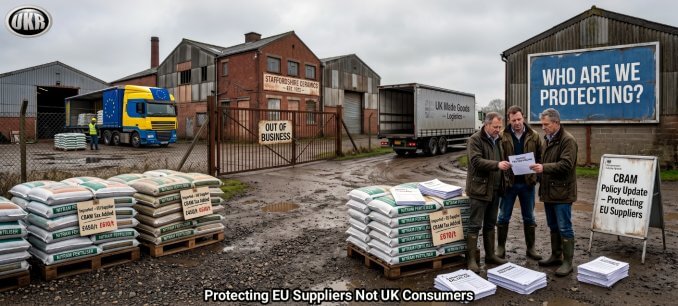
Protecting EU suppliers not UK Consumers
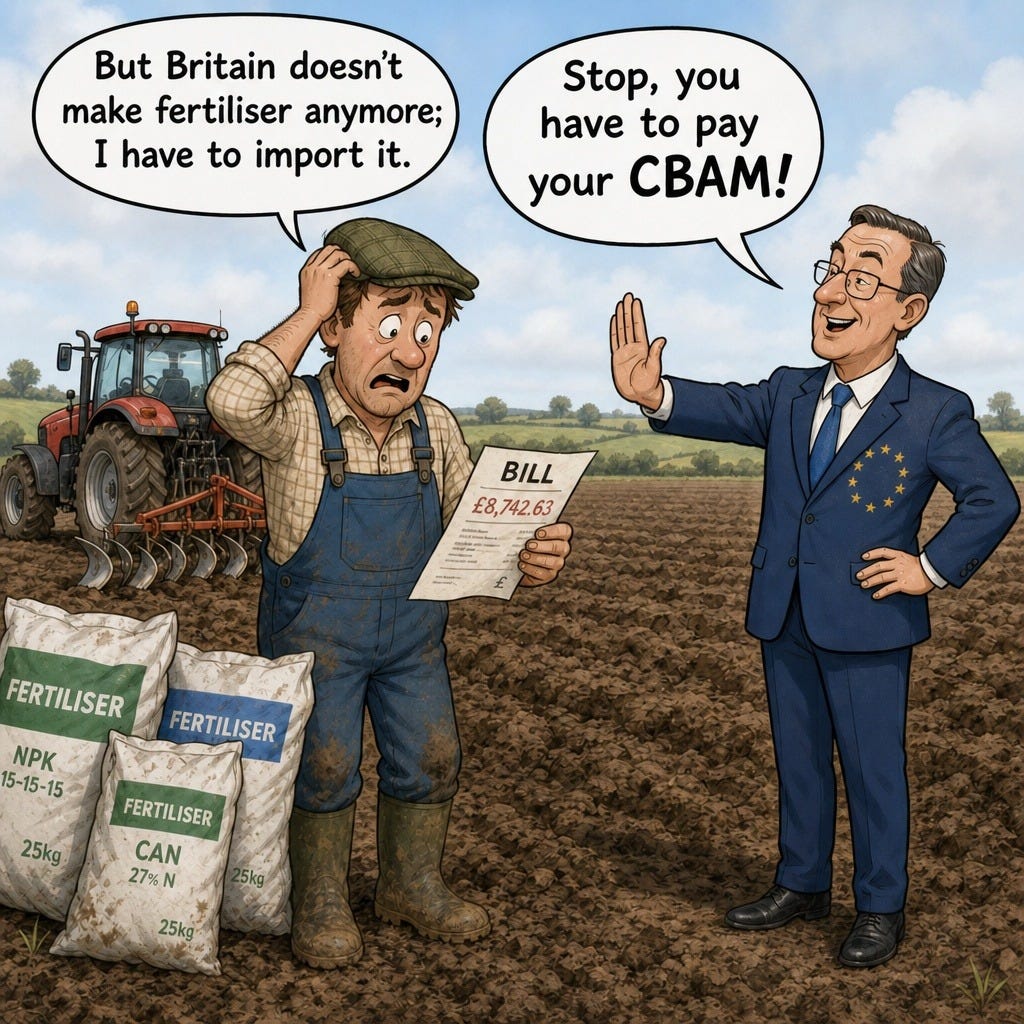
Aligning with the EU’s CBAM will force UK farmers to pay higher fertiliser costs to protect EU producers!
CATHERINE MCBRIDE
Since 2022, at least six major UK ceramics manufacturers have entered administration or liquidation: Wade Ceramics, Johnson Tiles, Heraldic Pottery, Royal Stafford, Moorcroft Pottery, and Denby Pottery. The overwhelmingly cited reason for these closures was energy costs. Ceramic Kilns are highly energy-intensive, and gas accounts for about 85% of their energy use. Competition from cheaper imports was also cited as a problem, but imports are often cheaper because their energy is cheaper. If the UK also had cheaper energy, UK companies would find it easier to compete.
Despite this, the government has decided to ‘level the playing field with imported goods’ by adding Carbon Border Adjustment Mechanism (CBAM) charges to industries where the UK is uncompetitive or no longer produces these goods and has become a major importer, rather than on industries such as glass and ceramics that are still viable in the UK or in the case of the ceramics manufacturers – clinging on for dear life.1
Unfortunately, the UK’s high carbon taxes from the Emissions Trading Scheme (ETS), the Carbon Price Support (CPS), and the Climate Change Levy have driven so many UK producers out of business. Applying a CBAM now will be too late to correct this. Joining the EU’s ETS will also increase costs for UK manufacturers, as the UK’s ETS has consistently been cheaper than the EU’s since the two schemes decoupled in 2021. But for some inexplicable reason, the Government has decided to join the EU’s scheme, thereby increasing costs for UK producers while retaining the UK’s other carbon taxes – CPS and CCL. Carbon taxes that do not apply to the UK’s EU competitors.
CBAM industry choices with little domestic production
The previous Conservative government proposed to apply a CBAM to Aluminium, Cement, Ceramics, Fertiliser, Glass, Hydrogen, and Iron and steel. The current Labour government’s CBAM proposal excludes Ceramics and Glass, two important UK energy-intensive industries in which the UK remains a competitive producer.
While it can be argued that a CBAM would protect UK industries from imports from countries without carbon taxes, it would be more helpful for the economy as a whole if the UK simply removed its carbon taxes on these industries rather than adding additional costs to imports.
If domestic production is negligible or very small, as is the case in the UK for fertilisers, aluminium, and steel, there is no need to impose a CBAM on imports at all, as there is no longer a domestic industry to protect.
The EU is in a different position to the UK, because it still has large producers of its CBAM products: Aluminium, Cement, Fertilisers, Hydrogen, Iron and steel, and electricity.2
Should we be surprised that the UK’s revised CBAM product list so closely resembles that of the EU? Is the UK government regulating to protect our EU suppliers to the detriment of UK producers?
In the case of fertiliser, that would appear to be undoubtedly true.
Fertilisers
The latest UK CBAM proposal covers imports of the fertilisers: Nitric acid: Sulphonitric acids; Ammonia, anhydrous or in aqueous solution; Nitrates of potassium; Mineral or chemical fertilisers, nitrogenous; Mineral or chemical fertilisers containing 3 of the fertilising elements nitrogen, phosphorus and potassium; and Mineral or chemical fertilisers containing 2 fertilising elements.3 Exactly the same 8-digit HS code products as the EU.4
However, the UK produces less than 30% of the fertiliser it uses each year, but even this production relies on imported raw ingredients, most importantly, ammonia.5 CF Fertilisers’ Billingham plant ceased ammonia production permanently in July 2023 after being temporarily idled in August 2022. This was the UK’s last major ammonia producer. Adding a CBAM to imported ammonia and imported Nitric acid made from it, would increase costs for UK fertiliser mixers, which would be passed on to farmers and eventually raise the price of domestically produced food.
It is also strange that Sulphonitric acids, Nitrates of Potassium and mineral or chemical fertilisers containing either 2 or 3 fertilising elements are on the UK’s CBAM list of products in scope, as they are not currently produced on a large scale in the UK. Fertilisers containing 2 or 3 fertilising elements used to be made at the CF Fertilisers Ince site, which closed in 2022. Adding a CBAM to imported products when there is no alternative domestic supplier will necessarily increase agricultural production prices. Why is the government proposing to do this?
Compared to 2000, UK fertiliser output has halved, and the product mix has shifted away from broad-spectrum fertilisers toward nitrogen-only and imported blends, driven by plant closures, energy costs, environmental regulation, and global market restructuring.6 UK fertiliser use has fallen by 19.3% in the ten years up to 2024.7
CF Fertilisers closed its plant in Ince, Cheshire, in 2022, when European gas prices spiked.8[5] Fertiliser production is gas-intensive, so fertiliser production has moved to regions with cheaper gas. UK ETS allowances, as well as strict nitrogen-emissions regulations, have made domestic fertiliser production less competitive with imported fertiliser. The CF Fertiliser plant was one of the dominant industries in Ince, employing hundreds of people directly and many more indirectly.9
Most fertilisers are made from ammonia (NH₃), which is in turn made from natural gas. It takes about 0.9 tonnes of natural gas (methane, CH4) to produce 1 tonne of ammonia. The process requires high temperatures (400–500°C) and pressures (>100 bar), typically generated by coal or gas combustion, although it can also be powered by electricity. Conventional production emits about 2–3 tonnes of CO₂ per tonne of nitrogen fertiliser, plus nitrous oxide (N₂O) emissions from nitric acid production, which can add another 0.2–2 tonnes of CO₂-Equivalent (CO2e) per tonne, depending on abatement technology.
In the UK, fertiliser use typically increases arable crop yields by 30–50% and grassland productivity by 40–60% compared to unfertilised systems. Without fertiliser, most soils cannot supply sufficient nitrogen, phosphate, and potash to sustain high yields; therefore, fertiliser is critical for both food security and livestock forage production.10 Making fertiliser more expensive than it needs to be by adding an ETS on production or a CBAM on imports makes UK-produced foods more expensive.
Fertiliser production is emissions-intensive, and fertilisers are applied annually to land; therefore, it could be argued that it is appropriate to include a CBAM on imported fertilisers, but this would require UK farmers to have an alternative domestic supplier that is competitive in all respects except the cost of ETS allowances.
However, only nitrogen fertiliser production remains in the UK; the government could argue that it seeks to protect this remaining production by applying a CBAM to imported nitrogen fertilisers, but then why is it also adding a CBAM to imported ammonia, which is needed to make nitrogen fertilisers in the UK?
In 2024, the UK imported 3.22 million tonnes of the fertiliser products that will be covered by the latest update to the UK’s proposed CBAM.11 Almost all of which will be charged for both their CO2 and their nitrous oxide emissions. Making the CBAM doubly expensive.
US ammonia is cheaper because US gas is cheaper
Most of the UK’s ammonia imports come from the US, but they are not cheaper than UK-produced ammonia due to differences in ETS costs. The biggest price differential comes from the difference in natural gas prices between the US and the UK, and from the UK’s additional CPS and CCL charges on the energy used to make ammonia. The UK should be an efficient producer of ammonia, but instead, we import it from the US, where natural gas prices are a third to a quarter of those in the UK.
Almost all ammonia (2NH3) is produced by the Haber-Bosch process, which uses natural gas and air at high pressure and a medium industrial temperature. Instead of adding a CBAM to imports that the UK doesn’t make any more, the UK would be better to: encourage UK gas production and exploration in the North Sea; allow hydraulic fracturing for gas on land; and remove the additional 38% ‘Windfall’ tax on North Sea gas production, thereby lowering the cost of the UK’s domestic natural gas feedstock for fertiliser production.
The UK already has an ETS on energy used for combustion, an ETS charged on the production of ammonia and nitric acid, as well as the CPS and CCL. This is triple taxation, which adds to the UK’s high gas prices, making UK fertiliser uncompetitive with imported fertiliser. Removing these additional energy taxes would reduce the cost of an essential input for food production and food security.
But that is not the point of CBAM – it is just about aligning with the EU!
There is no need for the UK to impose a CBAM on fertiliser or on imported ammonia used to make fertiliser because there are no longer any UK producers to protect. However, if we compare the UK’s revised CBAM with that of the EU, shown in Figures 1 and 2 below, it is clear that the UK’s CBAM is intended to protect the EU’s fertiliser producers from cheaper international producers, even though the EU has to import almost all of its natural gas feedstock – which is tariff and CBAM free.
The UK adding a CBAM to fertiliser is just an example of the Government aligning with EU regulation, without a remit or going through the parliamentary process, even though the EU regulations are not applicable to the UK industry as the UK does not have a fertiliser industry to protect. This CBAM is intended to protect the EU’s fertiliser industry by making the UK a captured market. The result? UK farmers will be forced to pay higher costs to protect EU fertiliser producers, and these costs will be passed on to UK shoppers.
Figure 1: Products covered by the UK CBAM on Fertilisers

Figure 2: Products covered by the EU CBAM on Fertilisers

In the long run, protection doesn’t work
No protected industry ever benefits in the long term from protectionism. Nor does the economy benefit from protecting industries that are failing due to government policy. Destroying an industry with one set of regulations and then offering it a bail out with another only helps to employ more public servants: one group to administer the destructive regulations and then other to administer the ameliorating protections. A better solution would be to simply remove the destructive regulations. The government should look at why an industry is uncompetitive and, if the cause is within the government’s remit, fix the cause. In the case of UK fertiliser production, it would be far more beneficial to scrap the UK’s three carbon taxes and encourage more gas.
European Union, Regulation – 2023/956 – EN – CBAM regulation – EUR-Lex
Carbon border adjustment mechanism (CBAM): Policy Summary – GOV.UK
Annex: Commodity codes within scope of CBAM (Link)
This article (Protecting EU suppliers not UK Consumers) was created and published by Catherine McBride and is republished here under “Fair Use”


Leave a Reply