

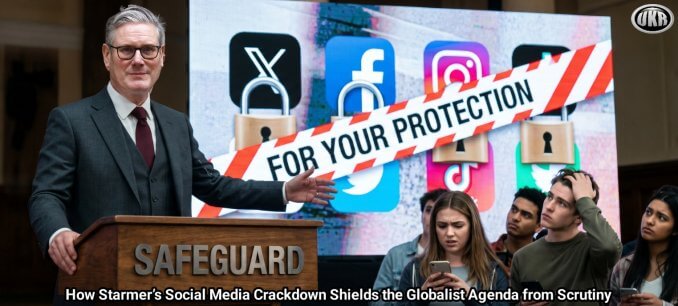
The Child Protection Pretext
How Starmer’s Social Media Crackdown Shields the Globalist Agenda from Scrutiny
STEVEN BARNES
In the name of safeguarding children, Keir Starmer and his Labour government are advancing a suite of restrictions on social media that threaten to reshape Britain’s digital public square. Proposals include a potential ban on under-16s accessing mainstream platforms, enhanced age verification measures (potentially involving facial scans and ID checks), curbs on “addictive” features like infinite scrolling, restrictions on AI chatbots, and efforts to block VPN circumvention. These build on the anti-free speech Online Safety Act 2023, with fresh powers to impose functionality limits and fines on non-compliant platforms. Ostensibly driven by concerns over mental health, exploitation, and harmful content, the rhetoric from Downing Street is “the status quo can’t continue.”
Yet, as ever with this and recent governments, a closer examination reveals a more cynical project: these measures less about shielding vulnerable youngsters from predators and more about insulating the globalist ruling class—and their cultural and ideological agenda—from the disruptive force of unfiltered free speech. In an era where legacy institutions, mainstream media, and state-aligned education have lost public trust, social media has become the primary conduit for dissenting voices. Labour’s push represents a concerted effort to recentralise narrative control, particularly over the young, whose votes they have conveniently made available at 16.
The timing and framing are telling. Starmer has met bereaved parents and vowed “game-changer” action amid alleged public anxiety. Of course, there are valid concerns about social media’s impact on youth mental health. Studies link excessive use to anxiety, depression, and distorted body image. However, the solution proposed of state-mandated platform redesign and access barriers, conveniently aligns with broader patterns of elite discomfort with populist challenges. Platforms like X have amplified criticism of mass migration, net-zero policies, gender ideology, and institutional failures. Restricting access serves to create an information environment more amenable to Labour’s worldview.
Even if framed as child-specific, these restrictions will inevitably spill over to adults. Age verification systems require robust enforcement that cannot be surgically precise. The Online Safety Act already compels platforms to assess and mitigate “harmful” content, a vague category ripe for mission creep. Ofcom, the woke regulator, gains sweeping powers, and history shows regulators err on the side of caution, even authoritarianism, or political expediency when defining harm.
Users may face ID uploads, biometric scans, or third-party verification to access sites, creating a chilling effect. Privacy erosion is profound: centralised databases or facial recognition for everyday internet use normalises surveillance. What begins as “protecting children from infinite scrolling” evolves into algorithmic identification of “misinformation, “a term flexibly applied to challenges to official narratives on climate, COVID, immigration, or cultural issues. Adults seeking unvarnished debate will encounter friction, while platforms over-censor to avoid fines up to 10% of global revenue.
Critics rightly note the contradiction with lowering the voting age to 16. Labour’s manifesto commitment deems 16 year olds mature enough for the ballot box because “if you can work, if you can pay tax…” yet simultaneously argues they are too immature for social media at 15. This is not coherent child protection; it is selective infantilisation. By shielding 15-year-olds from alternative viewpoints online while exposing them to state-approved curricula in schools, usually steeped in identity politics, critical race theory derivatives, and progressive orthodoxies, Labour is attempting to ensure a captive group primed for their electoral base. Reduced critical exposure to “non-woke” perspectives (critiques of multiculturalism’s failures, biological sex realities, or economic scepticism toward green transitions) preserves ideological hegemony. Schools become the default information place, where dissent is policed far more effectively than on open platforms.
This is no accident. Labour’s cultural alignment with globalist priorities of open borders, supranational climate commitments, and expansive diversity, equity, and inclusion frameworks, benefits from limiting youthful access to contrarian content. Social media, for all its flaws, democratises information: parents and teens encounter data on grooming gang statistics, two-tier policing, or economic impacts of migration that mainstream outlets often downplay. Ban or heavily restrict it, and the perverted, woke propaganda in many classrooms faces less or no competition. The real aim is dependency on institutional gatekeepers.
These proposals are unlikely to succeed on their own terms. Tech-literate youth will circumvent bans via VPNs (which Labour also seeks to restrict), private networks, or emerging decentralised platforms. Australia’s similar efforts have faced evasion and enforcement headaches. Predators adapt; harmful content migrates to encrypted apps or the dark web. We also need to remember that mental health issues in young people stem from broader societal factors like family breakdown, screen addiction across ages, economic problems not only algorithms, but what is the British state doing about those issue? Making them worse, most likely.
Failure will not prompt retraction. Instead, expect the classic authoritarian ratchet: more stringent measures, expanded scope to “harmful” adult content, demands for client-side scanning, or outright platform liability for “misinformation. What starts as child safety becomes comprehensive digital governance, with Ofcom or successors wielding tools against political inconvenient speech. Free speech for adults is not collateral but a target, as “protecting democracy” from “disinformation” becomes the justification.
The crowning indictment is the hypocrisy. The politicians posturing as child protectors are mostly the same criminals – and I use the word carefully – that systematically covered up the ‘grooming gang’ scandals for decades. In Rotherham alone, an estimated 1,400 children, mostly white working-class girls, were sexually exploited by predominantly Pakistani Muslim gangs between 1997 and 2013. Similar horrors unfolded in Rochdale, Oxford, Telford, and beyond, with estimates running to tens of thousands nationally. It is inconceivable that Labour (and Tory) politicians were unaware of this, Starmer especially, but chose to stay silent.
Labour-dominated councils, police, and social services repeatedly ignored evidence, intimidated whistleblowers, and prioritised “community relations” over victim safety. Fear of “racism” accusations paralysed action; reports were suppressed to protect the Establishment’s multicultural narratives. The 2014 Jay Report laid bare the scale and the institutional deceipt. Some resignations followed, but accountability was limited. Keir Starmer, as Director of Public Prosecutions from 2008-2013, oversaw a Crown Prosecution Service during key years of these failures, later defending aspects of the system amid scrutiny.
Tand these are the same political forces now claiming moral authority to regulate speech in children’s name. The ruling class that turned a blind eye to real, horrific abuse of thousands of children, facilitated by cultural taboos they enforced, now seeks to “protect” the next generation by restricting their digital diet. The selective outrage is grotesque. Real predators exploited vulnerabilities created by policy failures and ideological blind spots; today’s restrictions target the platforms exposing those failures.
This is not protection; it is projection and power consolidation. By restricting free inquiry online, Labour safeguards its “sick agenda” that downplays integration failures, biological realities, and working-class concerns, while children in schools receive unchallenged indoctrination. The globalist elite, comfortable in their gated ideological enclaves, fear the unmediated voices of the public. Social media democratised dissent; regulation seeks to re-monopolise it.
Britain stands at a crossroads. Genuine child welfare demands parental empowerment, technological literacy, family strengthening, and honest confrontation of cultural problems, not top-down censorship. Starmer’s proposals are, in my opinion, illegal and come from a criminal government and will, if enacted, diminish free speech for all, entrench elite narratives, and betray the very children they purport to save. The politicians who failed grooming victims now lecture on safety. Their record demands scepticism and total opposition, not deference. The public must reject this pretext before the ratchet tightens further, lest Britain’s vaunted liberties erode under the guise of compassion.
And that means action. Write to your MP and write to Nigel Farage and Rupert Lowe and demand that they pledge to repeal these sinister laws if ever elected. If you won’t, you know which side they are on.
This article (The Child Protection Pretext) was created and published by Free Speech Backlash and is republished here under “Fair Use” with attribution to the author Steven Barnes

••••
The Liberty Beacon Project is now expanding at a near exponential rate, and for this we are grateful and excited! But we must also be practical. For 7 years we have not asked for any donations, and have built this project with our own funds as we grew. We are now experiencing ever increasing growing pains due to the large number of websites and projects we represent. So we have just installed donation buttons on our websites and ask that you consider this when you visit them. Nothing is too small. We thank you for all your support and your considerations … (TLB)
••••
Comment Policy: As a privately owned web site, we reserve the right to remove comments that contain spam, advertising, vulgarity, threats of violence, racism, or personal/abusive attacks on other users. This also applies to trolling, the use of more than one alias, or just intentional mischief. Enforcement of this policy is at the discretion of this websites administrators. Repeat offenders may be blocked or permanently banned without prior warning.
••••
Disclaimer: TLB websites contain copyrighted material the use of which has not always been specifically authorized by the copyright owner. We are making such material available to our readers under the provisions of “fair use” in an effort to advance a better understanding of political, health, economic and social issues. The material on this site is distributed without profit to those who have expressed a prior interest in receiving it for research and educational purposes. If you wish to use copyrighted material for purposes other than “fair use” you must request permission from the copyright owner.
••••
Disclaimer: The information and opinions shared are for informational purposes only including, but not limited to, text, graphics, images and other material are not intended as medical advice or instruction. Nothing mentioned is intended to be a substitute for professional medical advice, diagnosis or treatment.
Disclaimer: The views and opinions expressed in this article are those of the author and do not necessarily reflect the official policy or position of The Liberty Beacon Project.


Leave a Reply