

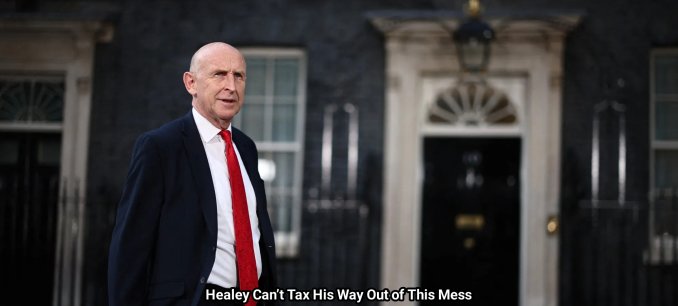
Healey can’t tax his way out of this mess
DR GERARD LYONS
- The new Chancellor should cut spending, not chase new taxes
- A land value tax may work in theory. Practice is different
- The new Government talks stability. The reality may prove very different
John Healey is the eleventh chancellor since the 2008 global financial crisis. Some of his predecessors served only briefly, but the direction of travel has been clear, regardless of who occupied Number 11. Growth has been modest, living standards have stagnated and the public finances have deteriorated.
The pandemic made matters worse, but the direction was already set. Even after a previous period of austerity, the trend has been towards higher spending, a rising tax burden and persistently high borrowing. Public debt has climbed sharply.
Financial markets continue to demand a premium to lend to the UK Government. That reflects not only the scale of debt issuance but also sticky inflation and doubts about the future course of the public finances.
The real answer is not to keep searching for new taxes but to control public spending, simplify the tax system and improve incentives
It is far too early to judge the new Government. The economy is growing at a modest pace and would benefit from a genuine end to the war in Iran if it led to lower energy prices. But the initial policy signals are cause for concern.
The first is fiscal credibility. Healey rightly stressed his commitment to the fiscal rules. Markets will welcome that. But investors expect chancellors to say the right thing. The real test is whether policy matches the rhetoric.
Earlier comments from the Prime Minister about exploiting flexibility within the fiscal rules have unsettled markets. One of the first steps Rachel Reeves took was to change the way public debt was measured, to capture more public assets as well as liabilities. While it improved the presentation of the figures, it did not alter the need to fund the deficit.
I would not be surprised if there were further changes to how public debt is measured to create more room for public investment within the fiscal rules, on the basis that more borrowing today will boost future growth. This might have been the flexibility the PM was referencing. We will have to wait and see. This could include making the National Infrastructure and Service Transformation Agency (NISTA), created only last year to oversee major public spending projects, a standalone body.
Despite Healey’s reassuring tone on the fiscal rules, the issue is whether he can match words with actions. Defence spending is expected to rise, rightly so. The question is how it will be funded. Special long-term defence bonds are one possibility.
There was also talk of raising the income tax allowance. Reversing this stealth tax could cost around £4 billion a year. The Labour Manifesto pledged not to raise income tax, VAT or national insurance. Whether that pledge survives remains to be seen. The spirit was already breached by the rise in employers’ national insurance in Reeves’s first Budget, which hit job creation. Capital gains tax may therefore come under renewed scrutiny now, even though higher rates will not maximise revenue.
This leads to the wider tax debate. If spending is not brought under control, the pressure for new taxes will intensify. Wealth taxes do not work, have repeatedly disappointed abroad and fall hardest on the middle class.
The same caution applies to a land value tax. Stamp duty is a poor tax because it discourages mobility. But there is no guarantee that a land value tax would replace existing property taxes rather than add to them. Nor is there any guarantee that it would work as well in practice as it might in theory.
As far as possible, taxes should be linked to a taxpayer’s ability to pay. This critical issue is being overlooked in the present debate. And in a large modern state, high public spending must be financed by taxes on recurrent flows, whether that be on income, spending or profits, through income tax, National Insurance, VAT and corporation tax. A recurring tax on land is different. It risks imposing liabilities on people with valuable assets but limited incomes. It will also punish people in modest homes in urban areas where land values are high. Deferral schemes may sound attractive, but it is far from clear that they will work smoothly in practice. It is unlikely to prove a sustainable source of revenue.
The real answer is not to keep searching for new taxes but to control public spending, simplify the tax system and improve incentives. The UK has had a mixed economy throughout the post-war period. Public spending of around 35-40% of GDP was seen as acceptable and it was at the high end of that at the end of the Thatcher era and has risen to more than 45% today. This is very far from a neoliberal economy that the PM references and provides little justification for higher state control.
The second issue is growth. When debt is high, the relationship between growth and interest rates becomes crucial. Growth needs to be high, while inflation and interest rates need to be low for the trajectory of debt to improve and also for living standards to improve. It means that the desires of the general public to boost living standards and of the markets to improve the public finances are actually very aligned. They depend on the same outcome.
Whether the Government can deliver stronger growth remains uncertain. Starmer and Reeves never produced a convincing economic plan. Burnham and Healey are, in contrast, promising a new economic model, a ten-year plan and for this policy to be a circuit breaker. History suggests caution. Previous postwar Labour governments also promised new economic models, with mixed results. Devolution is likely to be central, alongside greater state intervention and regulation. The rhetoric is one of stability. The reality may prove very different.
The immediate priority is reducing the cost of living. Yet the first major policy announcement on cutting VAT on domestic electricity bills already appears to have been unfunded. That is hardly an encouraging start. The way to reduce costs is also not to pass the bill on through higher taxation.
The UK remains a high spending, high tax and high borrowing economy. It also has low growth, low productivity and low wages. None of this will change by looking back to the 1970s rather than forward to the middle of the 21st century. The priority should be to boost competitiveness, improve incentives through smart regulation and simpler taxes, embrace wealth creation, raise growth and restore confidence in the public finances.
Dr Gerard Lyons is a research fellow at the Centre for Policy Studies
This article (Healey can’t tax his way out of this mess) was created and published by CapX and is republished here under “Fair Use” with attribution to the author Dr Gerard Lyons

••••
The Liberty Beacon Project is now expanding at a near exponential rate, and for this we are grateful and excited! But we must also be practical. For 7 years we have not asked for any donations, and have built this project with our own funds as we grew. We are now experiencing ever increasing growing pains due to the large number of websites and projects we represent. So we have just installed donation buttons on our websites and ask that you consider this when you visit them. Nothing is too small. We thank you for all your support and your considerations … (TLB)
••••
Comment Policy: As a privately owned web site, we reserve the right to remove comments that contain spam, advertising, vulgarity, threats of violence, racism, or personal/abusive attacks on other users. This also applies to trolling, the use of more than one alias, or just intentional mischief. Enforcement of this policy is at the discretion of this websites administrators. Repeat offenders may be blocked or permanently banned without prior warning.
••••
Disclaimer: TLB websites contain copyrighted material the use of which has not always been specifically authorized by the copyright owner. We are making such material available to our readers under the provisions of “fair use” in an effort to advance a better understanding of political, health, economic and social issues. The material on this site is distributed without profit to those who have expressed a prior interest in receiving it for research and educational purposes. If you wish to use copyrighted material for purposes other than “fair use” you must request permission from the copyright owner.
••••
Disclaimer: The information and opinions shared are for informational purposes only including, but not limited to, text, graphics, images and other material are not intended as medical advice or instruction. Nothing mentioned is intended to be a substitute for professional medical advice, diagnosis or treatment.
Disclaimer: The views and opinions expressed in this article are those of the author and do not necessarily reflect the official policy or position of The Liberty Beacon Project.


Leave a Reply