

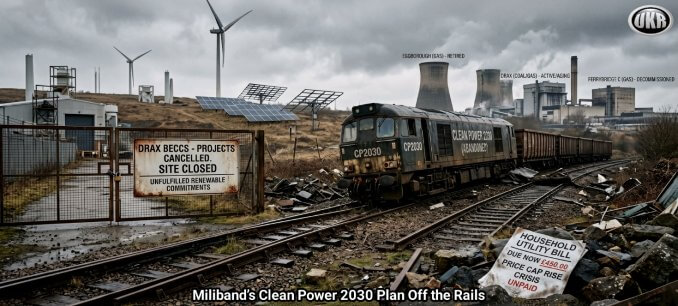
Soaring costs, failure to deliver wind and solar capacity and Drax withdrawal from BECCS show Miliband’s CP2030 plan is off the rails.
DAVID TURVER
Introduction
Back in 2024 NESO and DESNZ outlined their Clean Power 2030 (CP2030) plan. That plan called for a big increase in grid spending, an ambitious rollout of wind and solar capacity and also relied on negative emissions from Bio-Energy with Carbon Capture and Storage (BECCS) to meet emissions targets. NESO claimed CP2030 “can be delivered without increasing costs for consumers”. DESNZ claimed that CP2030 would “build an energy system that can bring down bills for households and businesses for good”.
Recently, DESNZ released new data (ET6.1) showing the installed capacity of wind and solar at the end of 2025 and Drax announced it had got cold feet about investing in BECCS. So what does these developments mean for Miliband’s CP2030 plan? Time to look at how well CP2030 is going against the plan. It is customary to analyse projects through three different dimensions: cost, time and quality.
Costs Going Up
Remember NESO claimed CP2030 can be delivered without increasing costs for consumers and DESNZ claimed the project would bring down bills for good. There are several pieces of evidence to show these claims were false.
Grid Integration Costs Increasing
NESO has provided a forecast of grid balancing costs and a forecast of transmission costs. The OBR forecasts the future costs of the Capacity Market that backs up intermittent renewables. Combining those forecast shows grid integration costs are set to rise by £17bn from £8bn in 2024/25 to £25bn in 2030/31 as shown in Figure 1.

According to the Government’s own figures, the UK already had the highest industrial electricity costs in the developed world in 2024 and the second highest domestic electricity costs. CP2030 is going to add a further £3bn of subsidy costs and £17bn of integration costs and push energy bills up by the equivalent of £700 per household. Of course, this figure will be split across businesses and households, but increasing costs to businesses will be passed on to households.
Generation Costs Going Up
When NESO was calculating the cost of generation for the CP2030 report, NESO used figures from the government’s Generation Cost Report 2023, adjusted for the strike prices in renewables auction Allocation Round 6 (AR6). Although the headline strike prices in AR7 for onshore wind and solar (expressed in common 2024 prices) were relatively close to NESO assumptions, offshore wind was more expensive. However, these raw comparisons do not take into account that AR7 contracts were extended by 5 years to 20 years. In its impact analysis of the contract extension the Government estimated that fixed bottom offshore wind strike prices would reduce by 12%, onshore wind by 11% and solar by 13%. This pushes up the like-for-like comparison as shown in Figure 2.

On a like-for-like basis, offshore wind is up 24% from the CP2030 estimate, onshore wind 23% and Solar 6%. Moreover, CP2030 used cost of capital estimates from the 2023 Generation Cost report but these have increased in the 2025 report as shown in Figure 3.

This change will increase “annuitised costs” (another way of expressing annualised costs) used by NESO in their report.
Schedule Slipping
Not only are the costs rising, but time is also slipping away to deliver the required renewables capacity. This section compares how the delivery of each major technology is faring compared to the plan.
Offshore Wind Delivery
The backbone of renewable generation capacity in the CP2030 plan was supposed to be offshore wind. In the Further Flex scenario, capacity was supposed to more than triple from 14.7GW in 2023 to over 50GW in 2030. Figure 4 shows the performance to date against that plan.

The CP2030 Further Flex scenario was supposed to install 5.1GW offshore wind capacity per year, every year from 2024 to 2030. In reality just 1.2GW was installed in 2024 and 0.7GW in 2025. The end 2025 result was 8.4GW short of target. If the installation rate continues at the trend rate since 2009, CP2030 will be 29.5GW short by 2030. This is the Reality Gap annotated on the chart. The New Dispatch scenario was less aggressive, but on current trends they would still be short 21.9GW by 2030.
Onshore Wind
Onshore wind was less important in CP2030, but still capacity was supposed to almost double from 15.4GW in 2023 to 29GW in 2030. Figure 5 shows that onshore wind capacity has also fallen behind plan.

The CP2030 Further Flex scenario was supposed to install 1.9GW of onshore wind capacity per year, every year from 2024 to 2030. In reality just 0.7GW was installed in 2024 and 0.3GW in 2025. The end 2025 result was 2.9GW short of target. The current installation rate is below trend and even if the installation rate rises to trend levels, CP2030 will still be 6.9GW short by 2030. Again, this chart shows the Further Flex scenario which is identical to New Dispatch.
Solar Power
Solar Power was also expected to triple capacity from 16.2GW in 2023 to 48.5GW in 2030. Figure 6 shows that solar installations have also fallen behind plan.

The CP2030 plan called for 4.6GW of solar capacity to be installed each year from 2024 to 2030. In reality, 2.5GW was installed in 2024 and 2.8GW in 2025. The end 2025 result was 3.7GW short of target. If solar installations continue at the trend rate since 2009, CP2030 will be 21GW short by 2030. The chart for solar shows the Further Flex scenario which is identical to New Dispatch.
Clearly all three technologies have fallen behind Miliband’s CP2030 grand plan and the schedule looks even less likely to be achieved.
Emissions Targets At Risk
Not only are costs being exceeded and the schedule slipping but the quality of the project as measured by the emissions targets is also at risk.
Drax Power station has been receiving subsidies to burn biomass for many years. The subsidies it currently receives are from a mix of Renewables Obligation Certificates (ROCs) and Contracts for Difference (CfDs). However, the RO scheme is due to expire in March 2027 so last year it entered into an agreement with the Government to replace the ROCs with a new CfD out to 2031. Part of the thinking was that by then, Drax would have figured out how to deliver Bioenergy with Carbon Capture and Storage (BECCS) and would presumably be eligible for an entirely new set of subsidies.
However, last month Drax announced that its BECCS project was unlikely to proceed and wrote off the spending to date of £47.6m saying:
“Whilst UK BECCS is still an attractive option for the Group in the long term, the current political environment and absence of an appropriate regulatory framework has led to a reduction in the likelihood of the project proceeding in the short- to medium-term. Accordingly, the capitalised value has been impaired”.
In other words, they no longer think they will get enough subsidy to make BECCS viable. On this Substack we have always viewed BECCS as an expensive crime against thermodynamics and considered plans to develop it as absurd.
NESO’s CP2030 Workbook shows in CP17 they expect 3.8-4GW of Biomass and BECCS capacity to be in place in 2030. Their 2030 emissions plan shows they expect a significant proportion of this capacity to come from BECCS (or CCS Biomass), banking on alleged negative emissions from this technology to meet their targets (see Figure 7).

The zero emissions from biomass without carbon capture means that the carbon dioxide emitted from burning wood is simply ignored. Negative emissions from BECCS requires us to believe burying these supposedly non-existent emissions leads to net negative emissions. Now Miliband is short of between 3.4 and 6.9MtCO2 per year to meet his emissions target. This is another big hole in the CP2030 plan.
Conclusions
The Clean Power 2030 plan is failing on all three dimensions of cost, time and quality. Grid integration costs are soaring, undermining claims that CP2030 can bring down bills or can be achieved without costs to consumers. Wind and solar installations are way behind schedule and now Drax has kiboshed the main element that was supposed to deliver supposedly negative emissions to meet the CP2030 emissions targets. It is clear the CP2030 project is off the rails.
The shortfall in wind and solar is probably going to have to be met from reliable power stations. As we have covered before, the nuclear fleet is being retired and the gas fleet is aging, so it is unclear where this capacity is going to come from.
There must now be strong grounds to launch a Parliamentary investigation into CP2030 to get the project cancelled before any more damage is done. Perhaps a Parliamentary question along the following lines is appropriate:
“Analysis of official forecasts by NESO, the OBR and DESNZ shows that renewables subsidy costs are going to rise by £3.3bn to £15.2bn/yr by 2030/31 compared to 2024/25 and grid integration costs in the form of the Capacity Market, grid balancing and transmission costs are going up £17bn/yr over the same period. A total increase of over £20bn/yr. Does the minister stand by the claim that CP2030 can bring bills down?
“The delivery of wind and solar capacity is well behind the CP2030 plan and Drax has cancelled its BECCS project putting the emissions target out of reach. Does the minister agree the CP2030 project is off the rails and will the project be submitted to the National Audit Office for an independent value for money audit?”
Eigen Values now has well over 5,300 subscribers and is growing fast. If you enjoyed this article, please share it with your family, friends and colleagues. Please consider signing up for or gifting a paid subscription.
This article (Miliband’s Clean Power 2030 Plan Off the Rails) was created and published by David Turver and is republished here under “Fair Use”
See Related Article Below
The climate scaremongers: Red Ed is about to cause irreversible energy damage
PAUL HOMEWOOD
A NEW analysis by the Institute of Economic Affairs has found that the cost of subsidising renewable energy will double to £40billion by 2030 under Ed Miliband’s plans to decarbonise the electricity supply.
Their analysis is all based on official projections from the Office for Budget Responsibility (OBR) and the National Energy System Operator (Neso).
First of all we have the various direct subsidies for renewables, which will increase from £11.8billion in 2024/25 to £15.2billion in 2031/31:

.
Some of the renewables obligation bill is being funded out of general taxation for the next three years, but as they are still a cost they are included in the analysis.
On top of this bill, the cost of grid upgrades and balancing will also increase massively because of the rollout of wind and solar power.
Neso confirmed last September that transmission charges would increase to £13.6billion in 2030/31, from £4.2billion in 2024/25:

https://www.neso.energy/document/367801/download
Neso also estimate that grid balancing costs, such as constraint payments and the cost of reserve provisions, will triple to £7.3billion.
On top of that is added the cost of running the Capacity Market, paying for standby capacity. The OBR say this will increase from £1.3billion to £4.4billion.
Adding the three elements together, the total cost of grid integration will rise from £8billion in 2024/25 to £25billion in 2030/31:

.
In total, including direct subsidies, Net Zero will increase the cost of electricity by £20.3billion:

.
That is equivalent to about £750 for every household in the country, of which about a third will feed through on to our energy bills.
The rest, of course, the public will still have to pay for one way or another, whether through higher taxes, higher prices or lost jobs.
The full IEA analysis can be downloaded here:
https://insider.iea.org.uk/p/cost-of-renewables-to-double-by-2030
The graphs are courtesy of David Turver here:
https://davidturver.substack.com/p/reform-tory-policies-not-enough-reverse-miliband-net-zero-madness
Sleepwalking to disaster
Last month Ben Habib published Advance’s draft plan to scrap Net Zero. It’s pretty much identical to the Conservative and Reform Parties’ proposals, including:
· Abolish green levies
· Drill for oil and gas
· Abolish the ban on petrol and diesel cars
But the real problem is that Ed Miliband will have done so much damage by the time of the next election that much of it will be irreversible.
New subsidy contracts for wind and solar farms, for example, will be legally enforceable. So too will the income streams guaranteed by Ofgem for the grid operators which are spending tens of billions on Net Zero upgrades. That £40billion mentioned above will be set in stone before we can do anything about it.
That is why he is so desperate to force through his plans while he has the chance.
Meanwhile the suicidal, factional splintering of the right opens up the very real possibility of a left-wing dictatorship after the next election.
If you think Labour is now unelectable, think again.
This article (The climate scaremongers: Red Ed is about to cause irreversible energy damage) was created and published by Conservative Woman and is republished here under “Fair Use” with attribution to the author Paul Homewood
***
Yesterday, while political attention focused on the shocking Nowak case, Ed Miliband confirmed to Parliament what had long been expected. He said the Government intends to legislate for the Seventh Carbon Budget (CB7), committing Britain to cut emissions by 87% below 1990 levels…
— Maurice Cousins (@MDC12345678) June 3, 2026

••••
The Liberty Beacon Project is now expanding at a near exponential rate, and for this we are grateful and excited! But we must also be practical. For 7 years we have not asked for any donations, and have built this project with our own funds as we grew. We are now experiencing ever increasing growing pains due to the large number of websites and projects we represent. So we have just installed donation buttons on our websites and ask that you consider this when you visit them. Nothing is too small. We thank you for all your support and your considerations … (TLB)
••••
Comment Policy: As a privately owned web site, we reserve the right to remove comments that contain spam, advertising, vulgarity, threats of violence, racism, or personal/abusive attacks on other users. This also applies to trolling, the use of more than one alias, or just intentional mischief. Enforcement of this policy is at the discretion of this websites administrators. Repeat offenders may be blocked or permanently banned without prior warning.
••••
Disclaimer: TLB websites contain copyrighted material the use of which has not always been specifically authorized by the copyright owner. We are making such material available to our readers under the provisions of “fair use” in an effort to advance a better understanding of political, health, economic and social issues. The material on this site is distributed without profit to those who have expressed a prior interest in receiving it for research and educational purposes. If you wish to use copyrighted material for purposes other than “fair use” you must request permission from the copyright owner.
••••
Disclaimer: The information and opinions shared are for informational purposes only including, but not limited to, text, graphics, images and other material are not intended as medical advice or instruction. Nothing mentioned is intended to be a substitute for professional medical advice, diagnosis or treatment.
Disclaimer: The views and opinions expressed in this article are those of the author and do not necessarily reflect the official policy or position of The Liberty Beacon Project.


Leave a Reply