


An Indefensible State of Affairs
The UK Defence resignations.
JUPPLANDIA

Yesterday, the (now former) UK Defence Minister John Healey resigned from the government. Armed Forces Minister Al Carns (who represented UK Veterans) followed hours later. The resignations come in reaction to the Defence Investment Plan the Prime Minister and the Treasury asked the defence ministers to accept.
The problem, however, is that the DIP does not meet the commitments to NATO that the government have already declared. In earlier defence analysis, combined with a pledge to increase defence spending to 5% of annual GDP, the Ministry of Defence and the defence ministers seem to have been been led to believe that an additional £38 billion on UK defence would be provided. The DIP funding that came back with Treasury approval committed to just half of that figure.
Healey set out his complaints in his resignation letter:

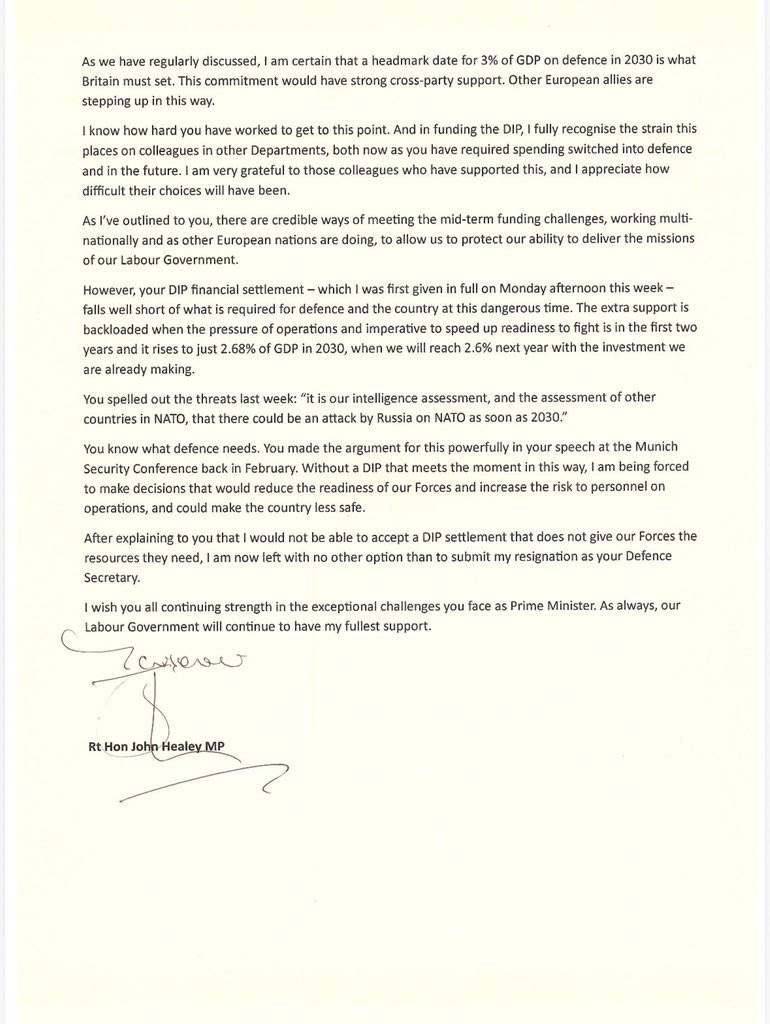
As is now standard for these resignation letters, the above is a mixture of fact and fiction, self congratulation and recrimination in equal measures. We can ignore the puffing bullshit at the start about Labour’s incredible successes, and the obligatory resignation absurdities such as highly praising the personal qualities of the leader you are saying you can no longer follow.
The factual content is in the central complaint that the DIP fails to adequately protect the UK, and that UK defence spending is too low. Over recent years decades of defence cuts and reductions of the size of the Armed Forces have come home to roost. Recent conflicts have exposed the truly pathetic depths to which the UK, once the owners of the greatest Navy and Army on the planet, has sunk.
Stockpiles have been sent to Ukraine as part of the lunatic fetish for interference there that has seized the British political Establishment and the affluent, metropolitan middle class voters on whom they largely depend and from whom they are largely drawn. This together with financial support (much of which however ends up stolen by Ukrainian fraud) has to some extent propped up the Zelensky regime, along with similar contributions from others. But in the UK case it has dangerously exposed our present limitations. It led, for instance, to an admission that if the UK were to enter a full war against Russia (in Ukraine or elsewhere) the munitions and supplies we have available would last about 10 days.
Russian responses to our Ukraine interventions have also been humiliating to us. The Russians have operated near or in our territorial waters, with little effective response beyond a sort of minimal escorting and monitoring of them and belligerent commentary that appeared to be exactly what it was-a feeble leadership rattling an empty scabbard.
The truth is that if any serious foreign force tried to invade the UK, certainly if the US, China, Russia or possibly a few others wanted to do so, there is almost nothing conventionally that we could do to stop them. The only deterrent we have is our nuclear capacity. If we confined ourselves to conventional warfare, we simply don’t have the men, the stockpiles, the planes, the ships, and the industrial base to resist.
Beyond that, fresh plans for subsuming the UK forces in an EU controlled Army have just exposed the Europhile fetishes and lack of awareness of our government, at a time when the capacity to act independently is more important than ever and the EU’s essential contempt for Britain as a putative ‘ally’ has been exposed again and again.
By contrast with our servile attitude to the EU nations, we have been the feckless ungrateful ally when it comes to the US and even more to Israel, concerned far more with appeasing the Muslim vote at home than with helping our two strongest traditional allies of the Cold War years. We have been a mewling, complaining, unhelpful and serially dishonest ‘ally’ of the US in ways which have destroyed for instance the previously strong intelligence links between the old Five Eyes nations.
As Hellish 2050 outlines in an excellent short Substack article today, the UK governments Dhimmi submission to an increasingly rapid Islamic conquest has caused severe security alarms in the US administration, only exacerbated and confirmed by measures such as opposing US action on Iran, constantly castigating Israel for defending itself from Iran and Iranian terror proxies, and ‘recognising Palestine’. Hellish 2050 is one of a very few voices to accurately outline the nuclear dimension of these issues:
“The UK has a nuclear weapon system. The warhead is made in the UK, however the missile that carries the warhead is called “Trident”. It is manufactured and maintained in the USA.
Two years ago Vice President JD Vance warned about an Islamic UK with nuclear weapons.
The US National Defence Strategy document did not state the same quite so specifically, however for anyone with eyes to see, that is indeed what it is strongly suggesting.
The UK has a binary choice:
EITHER nuclear weapons OR Islam.
BOTH is not a valid answer. The US will not stand for it. “
No mainstream media of course will touch any of that aspect of current UK defence issues, any more than it will address our slide towards sectarian conflict and the possibility of civil war in honest terms placing blame where it really belongs (firmly with our treasonous Establishment and Muslim imports).
Instead, like Healey, they will continue fantasising about crushing Russia in Ukraine when we can barely field 15,000 men at the fullest stretch of our resources, who will run out of bullets in about two weeks.
It takes Hellish 2050, or US Vice President JD Vance, to address the really big issue regarding UK security which is ultimately domestic now rather than anything relating to foreign conflicts:
“What is the first truly Islamist country that will get a nuclear weapon? … maybe it’s actually the UK, since Labour just took over.”
Our greatest security threats are internal and entirely created by the prejudices, ideology and fixations of our ruling elite, by their desire to welcome the world to Britain no matter how savage and backwards those arrivals may be. This has directly impacted our trustworthiness as an ally of the US, making us a potential nuclear threat to the most clear eyed assessments from the US and Israel.
Perhaps the only reassurance, perversely, that our old allies have is how incompetently we are managing our few remaining resources, such that if they do fall into the hands of a fully Islamist future British government, they might not be able to use them. Of our nuclear subs only one can put to sea, and that’s a generous assessment given that our sole remaining sufficient docking facility for repairs is itself out of commission (being repaired).
These factors-domestic Islamic conquest, increasing sectarian violence, potential for a collapse into civil war already being presaged by events in Northern Ireland, borderline UK bankruptcy (motivating Treasury reluctance on defence spending increases), lack of stockpiles, men, material and sheer numbers or the industrial base able to quickly provide them, all testify to a State that has long neglected the basic functions of defence and security. Being obsessed with other people’s borders and wars, while never defending our own citizens from threats but rather inviting those threats in, has put Britain in a truly perilous position.
One tenth of the SAS, one of our few remaining areas of excellence, come from the fighting men of Ulster, from Northern Ireland. A fairly large number of our remaining infantrymen in the regular Army do so as well. The kind of people in saner days we would have been recruiting into the Army are currently outraged, as they have every right to be, by the generation long betrayal of Northern Ireland, of which the peace process submissions to the IRA, the court pursued persecutions of Northern Ireland Troubles veterans, the acceptance of an EU demanded border fudge regarding whether or not Northern Ireland is even part of the UK, and the current dumping ground policy of placing asylum hotels and properties there and the people of Belfast having beheading-practising Sudanese on their streets, all form the backdrop of protest riots.
Healey therefore is correct in saying our Forces are undermanned and underfunded, but like the rest is wildly inaccurate on what they are for and what their priorities should be.
While it’s true that in many ways Russia is an enemy nation, this is partly of our doing, as well as being consequent on a long standing Russian enmity and contemporary Duginism that sees us as a mini US to be more easily swept aside by the particular, Russian resurgence new world order they are looking for. Regardless of whether we should be on guard against Russia, the fact remains that Ukraine interventionism is an absurd tilting at windmills while our own domestic security situation (and the current collapse of our military capacity too) is so perilous and in such self-inflicted disarray.
As with every other sphere, our leaders are good at wasting money, creating problems, degrading British safety, security, power and influence, and utterly hopeless at acknowledging their own guilt or changing their own priorities.
This article (An Indefensible State of Affairs) was created and published by Jupplandia and is republished here under “Fair Use”
See Related Article Below
Politics: uncertain times
RICHARD NORTH
I’m not going to get excited about the resignation of John Healey as defence secretary, even if he has been joined by Al Carns and parliamentary secretary Pamela Nash.
Although the political impact may be profound, in the shorter-term, Healey’s passing will not make the slightest bit of difference to our defence status. He has already been replaced by former Para officer Dan Jarvis, but the task confronting him is more than any one man can deal with.
Structurally, our armed forces are a mess. Years of flawed forecasting, inadequate procurement, poor leadership and recruitment practices, on top of a sustained decline in our defence industries, has left our armed forces incapable of fighting a serious war.
No amount of money will fix that within a decade, even if there were the political will and a leadership with the vision and ability to drive through the necessary changes. And there’s no sign of either.
More to the point, though, I see no point in spending taxpayer’s hard-earned money on shiny new toys for the military, ostensibly for use against some future enemy, when the real enemy is with us, here and now, invading our shores in rubber dinghies and flying in from all quarters of the globe as legal immigrants.
When it comes to defence funding, it is germane to note that the cost of public support for asylum seekers over the last decade has topped £20 billion, while Universal Credit payments to non-British nationals (immigrants) – households with at least one non-UK or Irish citizen – over the last three years reached £24.79 billion.
Add in other benefits (such as social housing) and you are looking at north of £50 billion as a very conservative estimate, compared with the core deficit of £28 billion in defence spending over the next four years. We are scrimping on our defence to pay for our own replacement and the destruction of our society.
The irony is that, if the current unrest in Northern Ireland turns out to be more than a flash in the pan, and takes on the form of a protracted rebellion, we could see what’s left of the defence budget devoted to sending in the Army to put down the White indigenous population in order to protect the head choppers, throat slitters, stabbers and rapists in what the Guardian gleefully calls “race riots”.
And, if that was not enough in the irony stakes, last time we had to subdue the Irish, 30,000 troops were needed at the height of the Troubles. As it stands now, our enfeebled Army could not actually deploy that many men and, if it tried, most soldiers would probably resign rather than face the prospect of prosecution by Lord Helmer and his friends in the CPS.
As for the moment, the BBC was reporting in the early hours that the night had passed off without major incident in Belfast following a “robust” police response. Tensions remain high, though. There are reports of violence outside the city, and some targeted house clearance apparently continues.
If, however, the violence does subside and everybody goes back to sleep (until the next head chopper strikes), it could be that the sobering assessment of Eric Schwalm must be looked at.
He is an American and a retired Green Beret with 34 years in special forces. He has spent a career studying how insurgencies begin, sustain themselves, or collapse. He has trained others in unconventional warfare and counterinsurgency and knows what it takes for a population to move from grievance to organised resistance and what usually stops them.
He paints a picture in the UK where large rallies form. Tens of thousands turn out for events like the recent Unite the Kingdom marches in London. Anger spills into the streets after knife attacks or policy failures tied to mass immigration and governance. Social media amplifies every clip.
Commentators on both sides then declare that something fundamental has shifted but, within days or weeks, the crowds thin. People return to work. The news cycle moves on. Life resumes its normal rhythm on a purely voluntary basis. The underlying issues, runaway net migration, grooming gang scandals that still echo, two-tier policing, and collapsing trust in institutions, remain largely unaddressed or are met with new restrictions rather than solutions.
When another outrage spills into public consciousness, the cycle repeats, but each time it does so, it carries a hidden cost that should frighten anyone who still values ordered liberty.
Successive flare-ups supply the government with fresh justification for expanded powers. New public order legislation, broader definitions of extremism, restrictions on protest near sensitive sites, facial recognition expansion, and speech regulations move forward under the banner of preventing disorder.
Thus, the ratchet turns. What begins as a response to unrest becomes normalised infrastructure for managing dissent. The next time anger rises, the legal and technological tools for suppression are stronger, the precedent is thicker, and the population is more habituated to backing down.
Half-measures, says Schwalm, do not preserve options. They close them. A people that protests loudly and then returns to its routines hands its adversaries both the pretext and the time to make future resistance far more difficult and far more costly.
From this, he concludes that Britain is not on the verge of a successful popular uprising that resets the country on healthier foundations. It is, he says, drifting toward a managed decline in which unresolved contradictions, mass low-skill immigration without assimilation, elite disconnect, fiscal strain, and collapsing social trust, erode the very capacity of the state to maintain order or provide the services people have grown dependent upon.
When the dependencies can no longer be met and the grievances have no legitimate outlet, the result is unlikely to be a clean or heroic rebellion. It is more likely to be fragmentation, sporadic violence, economic failure, and a hollowed-out nation that has lost both its historic character and its ability to govern itself effectively. That outcome, he says, would be a tragedy for the British people and a warning for the rest of the West.
On the other hand – to the disgust of people such as John Harris in the Guardian – David Betz is still banging the drum for civil war.
He warns against being seduced by “hot takes” on matters of the day. The churn of the daily news cycle should not drive the analysis. The legacy media, the government, and the police have all forfeited any claim to credibility; they lie routinely, by omission and commission, and they are actively shaping the narrative to protect a failing political order.
Instead, he says, fix your gaze on the structural factors. Demography, geography, economics, and the hollowing-out of institutional legitimacy matter far more than whatever grainy mobile-phone clip is being waved at us this week.
Britain has imported, at scale and with minimal integration, populations whose cultural distance from the native majority is large and, in important respects, growing rather than shrinking. Parallel societies, concentrated in particular towns and cities, now possess the critical mass to sustain sustained low-level conflict and, when conditions align, more organised violence.
The state’s monopoly on force is visibly fraying; its willingness to use what remains of that monopoly is selective and therefore delegitimising. Trust in the police, courts, and political class is in the basement and still falling. Economic stagnation and housing pressure sharpen every grievance.
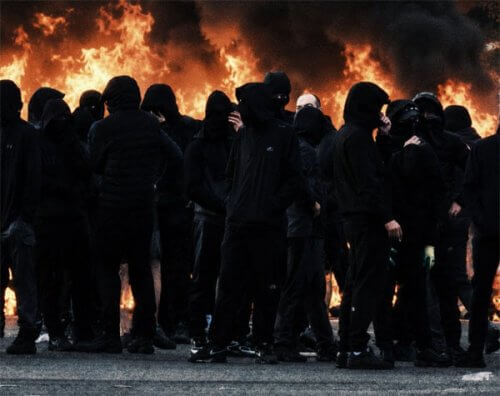
These, says Betz, are not transient conditions; they are the terrain on which coming events will play out. On the Belfast attacks specifically: the operators are clearly more security-conscious than has been the case with the migrant hotel and other protests over the last couple of years – masked, disciplined about visuals, limiting the evidential trail.
Thus, he is wary of firm day-to-day pronouncements precisely because reliable, on-the-ground reporting is so thin. He is not in Belfast, the journalistic desert in this country is real, nearly every dead-tree media and teevee pundit is a literal know-nothing.
However, what he will say – with higher confidence on account of his reading of such conflicts elsewhere in the world – is that certain escalatory dynamics are now highly probable: One is police over-reaction that produces a martyr or martyrs, further radicalising elements on all sides. Another is targeted assassination of a judge, prominent politician, or influential voice.
There could be a spectacular, Christchurch-style mass killing when some individual or cell concludes that only dramatic, indiscriminate violence will break the equilibrium. And stabbings and gang rapes will continue at their grim baseline; they are already normalised enough that they barely shift the political dial.
The deeper pattern, he argues, is polarisation, erosion of restraint, and the slow emergence of organised ethnic and ideological blocs willing to use force to defend or advance their interests. All of that is in accordance with the rules of the game of identity politics, which were created by the very same people now most frantic about the perilous consequences of their own ideology.
From this, he concludes that the centre is not holding because it has spent years delegitimising itself and disarming its natural supporters. Betz thus tells us to watch the structural trends – demographic momentum, institutional decay, the diffusion of effective small-group tactics, the collapse of shared reality – more than the latest headline.
The news will keep lying, he says. The underlying physics of the situation will not. But what the result will be, we cannot tell.
This article (Politics: uncertain times) was created and published by Turbulent Times and is republished here under “Fair Use” with attribution to the author Richard North

••••
The Liberty Beacon Project is now expanding at a near exponential rate, and for this we are grateful and excited! But we must also be practical. For 7 years we have not asked for any donations, and have built this project with our own funds as we grew. We are now experiencing ever increasing growing pains due to the large number of websites and projects we represent. So we have just installed donation buttons on our websites and ask that you consider this when you visit them. Nothing is too small. We thank you for all your support and your considerations … (TLB)
••••
Comment Policy: As a privately owned web site, we reserve the right to remove comments that contain spam, advertising, vulgarity, threats of violence, racism, or personal/abusive attacks on other users. This also applies to trolling, the use of more than one alias, or just intentional mischief. Enforcement of this policy is at the discretion of this websites administrators. Repeat offenders may be blocked or permanently banned without prior warning.
••••
Disclaimer: TLB websites contain copyrighted material the use of which has not always been specifically authorized by the copyright owner. We are making such material available to our readers under the provisions of “fair use” in an effort to advance a better understanding of political, health, economic and social issues. The material on this site is distributed without profit to those who have expressed a prior interest in receiving it for research and educational purposes. If you wish to use copyrighted material for purposes other than “fair use” you must request permission from the copyright owner.
••••
Disclaimer: The information and opinions shared are for informational purposes only including, but not limited to, text, graphics, images and other material are not intended as medical advice or instruction. Nothing mentioned is intended to be a substitute for professional medical advice, diagnosis or treatment.
Disclaimer: The views and opinions expressed in this article are those of the author and do not necessarily reflect the official policy or position of The Liberty Beacon Project.


Leave a Reply