

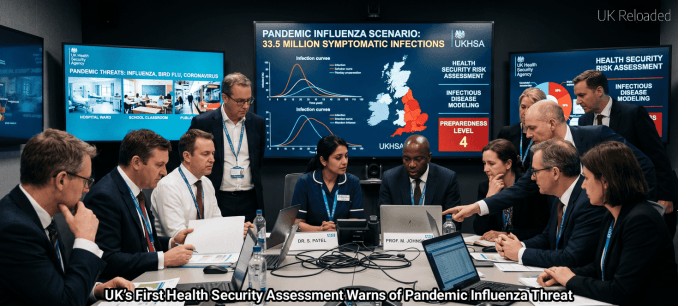
First-Ever UK ‘Health Security Assessment’ Primes Public for Pandemic Influenza Scenario Involving 33.5 Million Infections
Government messaging to convince institutions of future pandemic threats and orchestrate planning across healthcare systems, schools, universities, and businesses.
JON FLEETWOOD
The UK government is using its first-ever Health Security Risk Assessment to place pandemic influenza at the center of future health-security messaging, promoting a scenario involving 33.5 million symptomatic infections while elevating bird flu and coronavirus as the dominant pandemic threats facing Britain over the next five years.
Published last week by the UK Health Security Agency (UKHSA), the assessment is intended to orchestrate planning across government agencies, healthcare systems, schools, universities, businesses, researchers, and public-health institutions.
While the report is presented as a technical assessment of health risks, it also provides a revealing look at the narratives government institutions are choosing to elevate through official messaging.
Among all risks examined in the report, respiratory pandemics occupy the most prominent position.
The report comes as the UK claims it is performing lab experiments on bird flu pathogens.
In one experiment, the UK, with China, used gain-of-function to create airborne bird flu viruses capable of infecting humans and other mammals.
In another experiment, the UK engineered two brand-new bird flu viruses with neurological and transmission gains.
In another, the UK created chimeric “Frankenstein” H7N7 bird flu hybrids that could spread asymptomatically.
The new UK assessment comes as the U.S. Centers for Disease Control and Prevention (CDC) recently framed avian influenza as a future pandemic threat, with President Donald Trump in April nominating a military-grade influenza pandemic architect to lead the agency.
The U.S. is also performing gain-of-function experiments on bird flu pathogens.
Congress, the White House, the Department of Energy, the FBI, the CIA, and Germany’s Federal Intelligence Service (BND) all acknowledged that the deadly COVID-19 pandemic was “likely” the result of a laboratory incident involving engineered pathogens.
The overlap raises an obvious question: why are many of the same government institutions warning about a future bird flu pandemic, building preparedness frameworks around bird flu, and directing public attention toward bird flu also conducting experiments designed to alter bird flu viruses in the laboratory—particularly after COVID-19 was widely argued to have originated from research-related activities?
Pandemic Influenza Takes ‘Risk 1’ Top Billing
According to UKHSA:
“The 2 scenarios with the highest assessed risk are respiratory infections: an influenza pandemic (Risk 1) and a novel coronavirus pandemic (Risk 3).”
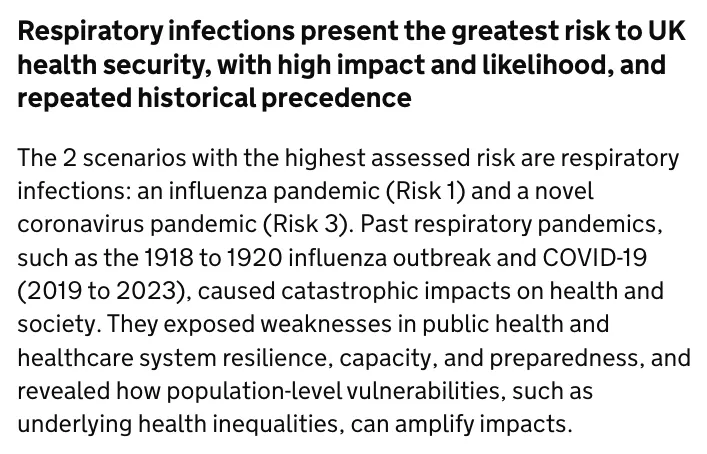
The pandemic influenza scenario is the centerpiece of the assessment.
Officials describe:
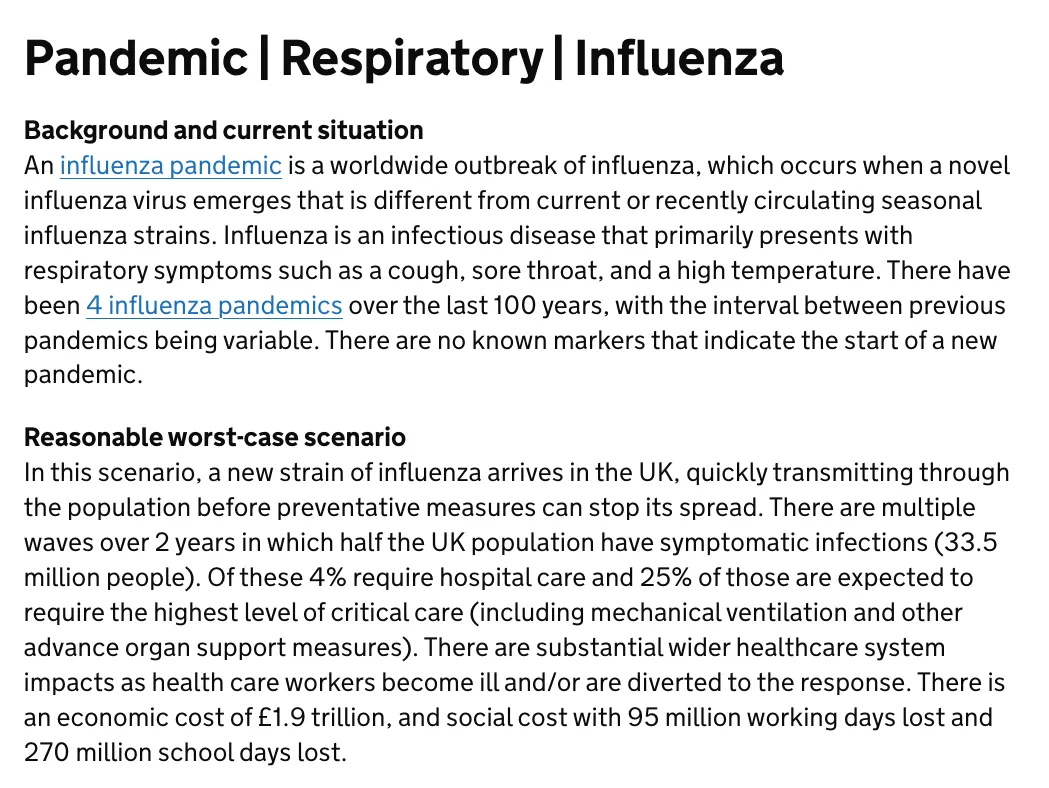
“multiple waves over 2 years in which half the UK population have symptomatic infections (33.5 million people).”
The scenario also includes:
- 33.5 million symptomatic infections
- 4% requiring hospital care
- £1.9 trillion in economic costs
- 95 million working days lost
- 270 million school days lost
Elsewhere, the report explicitly states:
“Respiratory infections present the greatest risk to UK health security.”
The significance of the document is not simply the projections themselves.
The significance is that the government is devoting analytical resources, planning efforts, and messaging capital toward establishing pandemic influenza as the central health-security concern around which future emergency planning should be organized.
Risk assessments can quantify hazards, but they also communicate priorities.
By repeatedly modeling, discussing, and emphasizing specific threats, governments help shape what institutions, policymakers, researchers, journalists, and the public focus on.
Bird Flu Influenza Elevated as a Major Pandemic Narrative
The report devotes an entire section to avian influenza (H5N1), placing bird flu among the most prominent future pandemic scenarios discussed in the assessment.
The government’s scenario models:
- 2,000 human H5N1 cases
- 500 deaths
- livestock culling
- trade restrictions
- poultry export bans
According to the document:
“In this scenario, a highly pathogenic avian influenza (HPAI) virus, A(H5N1), becomes widespread within the native bird population in the UK, including farmed poultry. The virus is transmitted from poultry to farm workers and some scavenger animals who feed on poultry and is therefore able to establish both a mammalian and human reservoir. These spillover events, coupled with human-to-human transmission, results in a 6-month outbreak during which there are 2,000 human cases of avian influenza A(H5N1), and 500 deaths. As a result, people avoid work and social activities due to anxiety about the illness, especially in areas with active outbreaks. Farmers face economic losses from livestock culling, trade restrictions, and bans on poultry exports.”
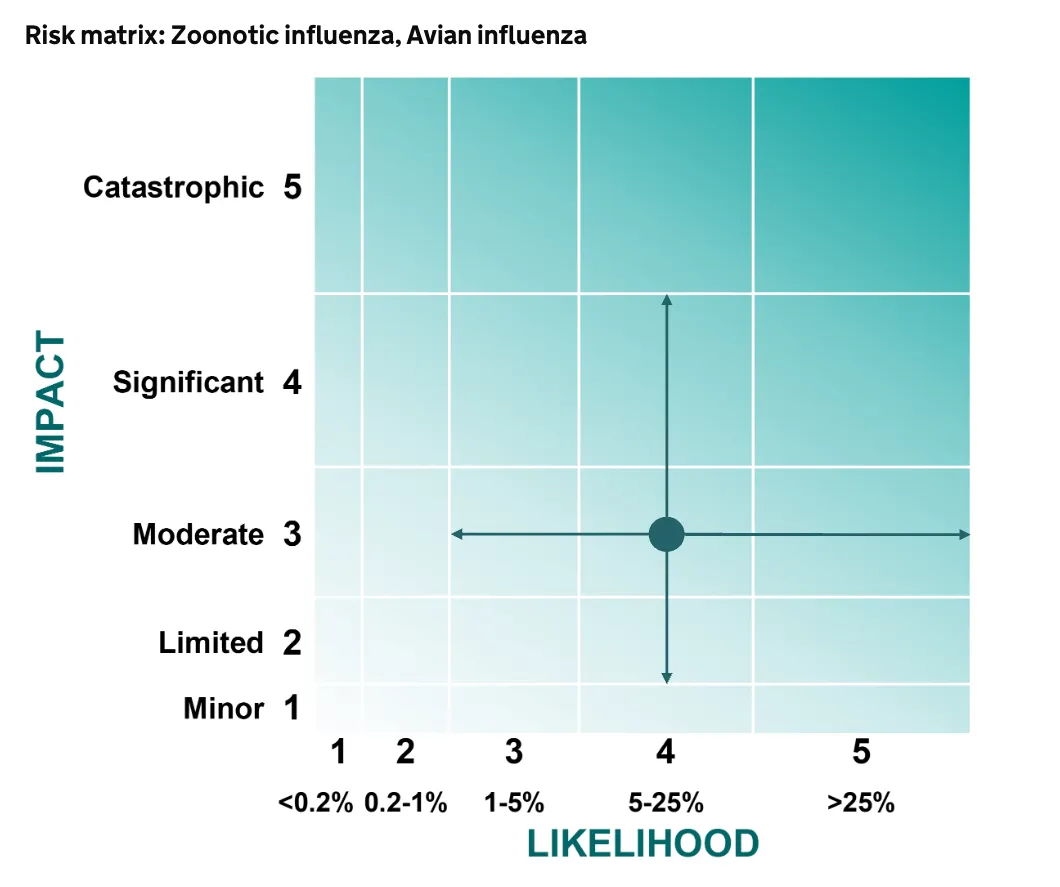
Notably, bird flu appears throughout a broader influenza-centered framework in which officials repeatedly discuss spillover events, reservoirs, pandemic preparedness, vaccine deployment, surveillance systems, and outbreak response measures.
The effect is to position H5N1 as one of the most visible pathways through which a future influenza pandemic could emerge.
The Report Insists These Are ‘Not Predictions’
Perhaps the most interesting line in the entire document is also one of its most defensive.
UKHSA repeatedly emphasizes that:
“These scenarios are not a prediction of what is most likely to happen.”
The disclaimer appears throughout a report that spends 57 pages modeling pandemic influenza, bird flu, coronavirus outbreaks, mass infections, deaths, economic disruption, vaccine deployment, surveillance systems, testing programs, and emergency response measures.
In other words, officials devote enormous analytical effort to constructing detailed pandemic scenarios while simultaneously insisting those scenarios should not be viewed as predictions.
The contradiction is difficult to ignore.
If the purpose of the document were merely to catalog hypothetical possibilities, there would be little need to repeatedly stress that readers should not interpret the scenarios as forecasts.
Yet the report does far more than list possibilities.
It ranks threats.
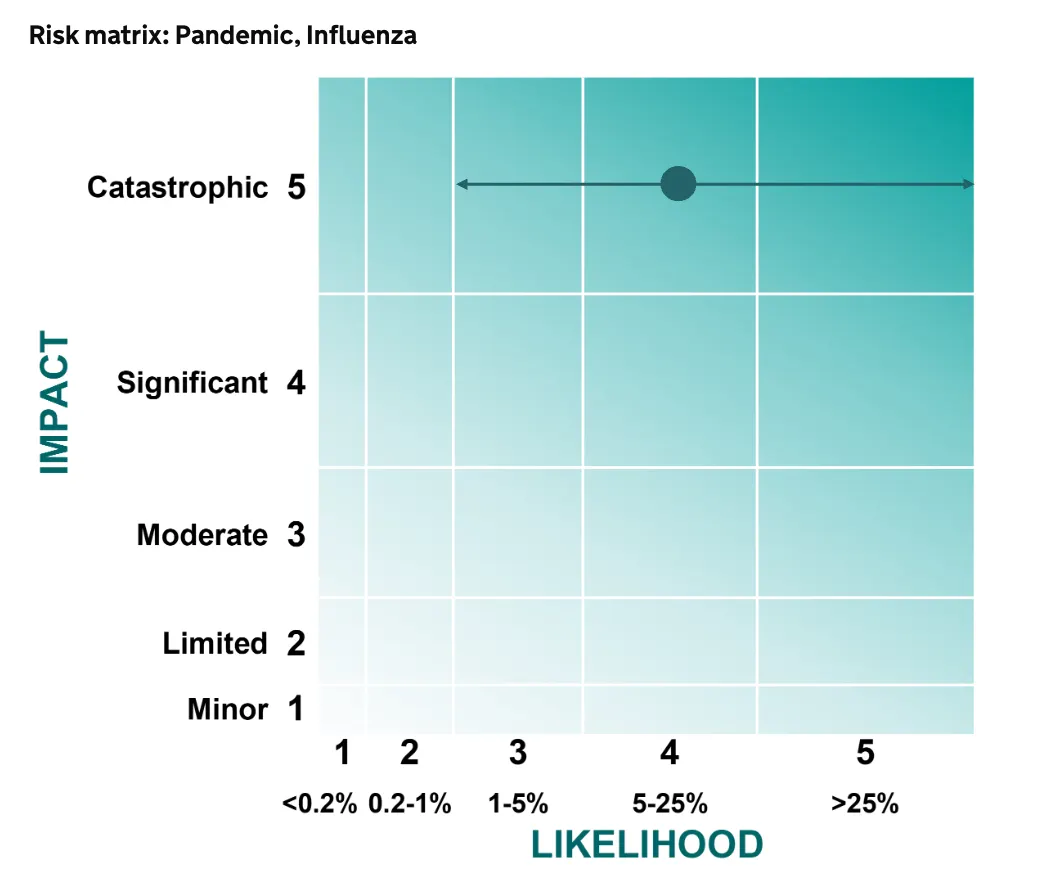
It assigns likelihood scores.
It quantifies infections and deaths.
It directs preparedness planning across government agencies, healthcare systems, schools, universities, businesses, researchers, and public-health institutions.
Most importantly, it places pandemic influenza at the center of Britain’s future health-security narrative while elevating bird flu and coronavirus as the most prominent supporting scenarios.
Whether the scenarios materialize is ultimately beside the point.
The report provides a clear look at what government institutions are investing their attention, planning efforts, and messaging capital into getting the public and institutions to focus on.
And in Britain’s inaugural Health Security Risk Assessment, that message is unmistakable: pandemic influenza is being positioned as the dominant health-security concern of the years ahead.
Bottom Line
The report’s most important message is not its projections but its priorities.
By placing pandemic influenza at the top of Britain’s health-security agenda, elevating bird flu as a leading pandemic pathway, and repeatedly modeling purported catastrophic respiratory outbreak scenarios, the UK government is signaling what it wants major institutions to prepare for, plan around, and focus on.
Whether those scenarios occur is ultimately secondary to the fact that influenza now sits at the center of Britain’s official pandemic narrative.
This article (First-Ever UK ‘Health Security Assessment’ Primes Public for Pandemic Influenza Scenario Involving 33.5 Million Infections) was created and published by Jon Fleetwood and is republished here under “Fair Use”


Yeh, right.