

MARY GILEECE
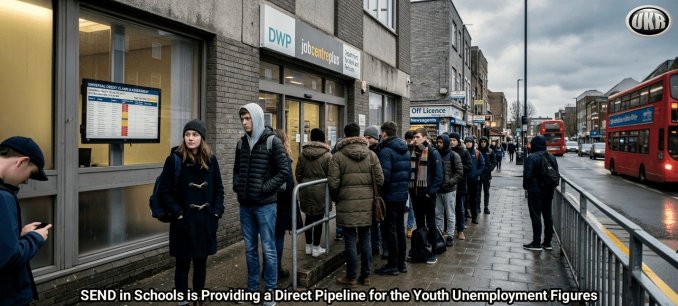
A concatenation of dreadful tax and welfare choices with misplaced attempts to help educationally challenged children has emerged to create inevitably high youth unemployment figures: 16.2% with nearly one million 16-24 year-olds classified as NEET (not in employment or education). As Michael Simmons reports for the Spectator:
Between December 2022 and the end of last year, 333,000 16 to 24 year-olds lost payrolled employment – a 4.3 percentage point decline. Relative to the pre-crisis trend, that compares with a 6.5 percentage point decline during Covid and 5.4 percentage points during the financial crisis.
Quite rightly, significant blame is placed on Rachel Reeves’s hike in employer National Insurance and rise in the youth minimum wage. Anecdotes about the strangulating effect this has had on hiring are littered all over the High Street. Today, a florist told me she’s really needs to employ another young worker but can’t afford to. A plumber explained he used to take on apprentices but now doesn’t bother: “It’s too much of an expensive fucking ball ache,” were his exact words. I am a victim too of such employer’s squeeze. The education company I work for, hired by an almost bankrupt county council, has taken half its staff off the payroll and put them, like me, on a zero hours contract in an effort to reduce its employer National Insurance liability.
But what is being overlooked in the discussions about this very troubling development in the decline of Britain part #94 is the gushing pipeline that is flowing from the SEND generation to the youth unemployment graveyard. Now that one in five children are being treated in education as having special education needs, expect the national youth unemployment figures to continue to rise to match this 20% incapacity. Already 40-50% of NEETs were diagnosed as SEND at school.
Whenever I write about this issue, I issue a caveat that none of this concerns children and young people who have serious mental or physical disabilities. I am concerned only with the millions of children who have been debilitated by medical, educational and welfare systems that confect illness out of ordinary childhood behaviours. The figures now must be familiar: there are now 562,450 open referrals at the end of December 2025 for ADHD assessments and a more than five-fold increase in open referrals since 2019 for autism. Similar figures are available for Generalised Anxiety Disorder, depression, Social Anxiety Disorder, borderline personality disorder, OCD and so on. I expect most people reading this will have a family member or friend of the family who has been thus diagnosed.
Now, if such medical involvement in childhood resulted in tremendous benefits for those so diagnosed, then great. If all those coloured reading sheets for dyslexics helped foster a life-long love of reading, then fantastic. If having a teaching assistant sit alongside a child who has been diagnosed with sensory processing disorder and doesn’t like writing allows ‘other pathways to knowledge’, then wonderful. If the five year-old wearing headphones in class because he ‘doesn’t like the noise’ develops brilliant analytical skills, then tremendous.
None of this happens. There are no benefits to this SEND over-diagnosis, only obstacles to a child’s ability to learn, socialise and become employable in the future. Instead such children are sent straight from SEND to the youth unemployment spreadsheet of doom.
Less than 8% of children with an Education Health Care Plan (EHCP) achieve good passes in English and Maths GCSE (compared to a still hopeless 45% for ‘ordinary’ students). And this is only an academic metric, what is harder to quantify is the insidious damage that is being done to SEND children’s ability to socialise, contribute or even exhibit the most basic agency over their own lives. No-one should be surprised that children so shackled find themselves unable to work.
It is not just saddened writers for the Daily Sceptic who rail against such things, but also life-long neuro-development experts. The legendary autism expert Professor Uta Frith is doing the podcast rounds saying that the diagnosis for autism is now so baggy it has lost its meaning. As Professor Suzanne O’Sullivan, author of The Age of Diagnosis writes:
The minute you label somebody, they can unconsciously take on the features of that label. It doesn’t matter how you present it to them.
I work with such children and I shall now attempt to convey how unhelpful a loose mental health or neurodevelopment diagnosis manifests in daily life. It is strange to witness and difficult to forgive those ‘experts’ who have encouraged it. This week I saw a child, let’s call her Naomi, aged 15. She didn’t enjoy the transition to secondary school and received aged 12 an autism diagnosis. She told her mum the canteen was too noisy and she didn’t like the way the chairs scrapped on the floor in lessons. She started staying home and stopped attending entirely a year ago. I visit and attempt to teach her basic English. Last week we tried to find words that rhyme. I explained the task, gave an example, ‘pear and bear’, and then asked her to think of something that rhymes with ‘cat’. She frowned, shook her head and said she didn’t know. She wasn’t being sassy or belligerent, she genuinely didn’t know.
She is not unusual in this behaviour. Regularly I attempt a simple task with a student: imagine you are King or Queen for the day, what would you do? Often the children instantly shrug and say ‘I dunno’. At first I wondered if they were so disenchanted with school they wanted to avoid all work, and then I realised they had never entered the habits of thinking, of conjuring ideas, of creating things or exhibiting any agency over their own thoughts or behaviours.
The refrains are repetitive and dispiriting: I can’t read because I’m dyslexic, I can’t go out because I have anxiety, I can’t socialise because I’m autistic, I can’t tell the time because I’ve got dyscalculia, I can’t go to town because I’ve got sensory processing disorder, I can’t go to school because I’ve got Emotional Based School Avoidance.
If a teacher, a parent, a doctor, an EdPsych or the school SEND co-ordinator tells a child she has something wrong with her brain, it should come as no surprise that she stops using it. No-one should be surprised that by encouraging educational and social incapacity, a generation of children is heading straight to state dependency. It is self-fulfilling prophecy writ large across the public finances.
Mary Gilleece is an education support worker and her name is a pseudonym.
This article (SEND in Schools is Providing a Direct Pipeline for the Youth Unemployment Figures) was created and published by The Daily Sceptic and is republished here under “Fair Use” with attribution to the author Mary Gilleece


Leave a Reply