
White pupils will be a minority in most schools, government figures reveal
MATT GOODWIN
IF you want to see the future of a nation, look at what’s happening in its schools.
A few days ago, the Department for Education quietly released figures on the characteristics of school pupils in England from the 2025-2026 year. While you’re unlikely to hear them discussed on BBC Verify, the results are striking.
They not only paint a detailed picture of what is now unfolding at speed in England’s state nurseries, primary schools and secondary schools but reveal how the country in the years ahead will be radically transformed. Because what is visible in our schools today will inevitably reshape the nation tomorrow.
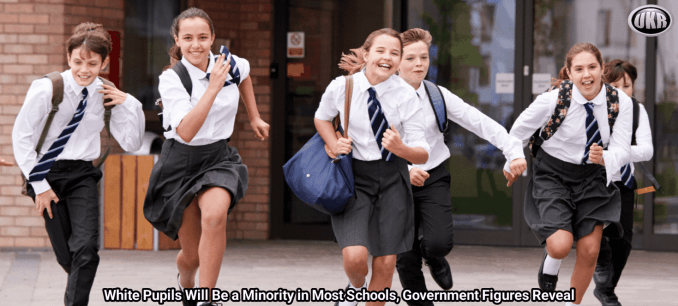
Consider the sheer pace of change that’s sweeping through England’s schools. For the first time in history, the share of school pupils across all types of school who are white British has fallen below 60 per cent, while the share from minority ethnic backgrounds has surged to a record high of nearly 39 per cent. A decade ago, during the 2015-2016 school year, 70 per cent of all school pupils were white British. Today, only ten years later, it’s already fallen to 59.7 per cent.
Over the last ten years, in state-funded secondary schools, the share of pupils who are white British has fallen from 71 to 59 per cent. In primary schools, it’s down from 68 to just below 60 per cent. In state nurseries, it’s down from 69 per cent in the 2016-17 year (earlier data was not available) to just 47 per cent today, meaning that in England’s nurseries white British children are already a minority.
In particular areas of England, the very latest figures are even more astonishing. In Blackburn, just 38 per cent of all school pupils are white British. In Bradford it’s 37 per cent. In Manchester it’s 28 per cent. In Birmingham it’s 23 per cent. In Leicester it’s 19 per cent. In Luton it’s just 13 per cent. For the first time in the history of England, white British school pupils are now a minority in every single one of the 33 local authorities in London (last year this wasn’t true for Bromley but now white Brits are a minority there too).
Clearly, this isn’t only about London and the major cities. Far from it. Today, in a rapidly growing number of areas that lie outside of the major cities — in areas such as Walsall, Sandwell, Bedford, Peterborough, Thurrock, Bexley, Milton Keynes, Reading and Bolton – white British kids are now a minority in schools.
In state primary schools, the white British are now not only a minority in every single local authority in London but are also a minority in one-third of all local authorities for which the government has data. They represent only 19 per cent of primary school children in Leicester, 34 per cent in Nottingham, 24 per cent in Birmingham and just 9 per cent in Slough.
Ten years ago, during the 2015-2016 school year, white British primary school pupils were a minority in 39 local authorities in England. Today, they are a minority in 53 local authorities in England.
The picture is even more striking in state nurseries. Of the 101 local authorities for which the Department of Education has data, the white British are now a minority in more than half of them. In some areas, such as Luton, Coventry, Slough, Wolverhampton and parts of Birmingham and Bradford, the white British now represent only about 10 per cent of all nursery pupils or less.
These demographic changes go hand-in-hand with something else that is hidden away in the latest figures but which is also rapidly reshaping our nation: profound changes to language. Across schools, the share of school pupils whose first language is not English has reached a record high of nearly 22 per cent, up from 18 per cent a decade ago. In other words, more than one in five of all pupils in England no longer speak English as their first language. In the next few years, it will be one in four.
Already, in Leicester, Luton, and Slough more than half of all school children do not speak English as their main language. In Coventry, Nottingham, Birmingham, Sandwell, Wolverhampton, Peterborough, Milton Keynes, Reading and Southampton about a third or more pupils do not speak English as their first language.
In Middlesbrough, Newcastle upon Tyne, Liverpool, Rochdale, Salford, Trafford, Kirklees, Leeds, Sheffield, Northampton, Stoke-on-Trent, Thurrock and Bedford, among many others, about a quarter of school pupils do not speak English as their main language.
Ten years ago, there were 42 local authorities where at least one in four school pupils did not speak English as their first language. Today, there are 57.
What we are witnessing, therefore, is not just the continuation of the profound demographic and linguistic changes that I charted in my book, Suicide of a Nation, but the acceleration of those trends. England increasingly is becoming a place where the historic majority is sliding into minority status while a rapidly growing number of people in England no longer speak English as their first language, with these trends especially visible in our schools. Indeed, everything I have just pointed to is entirely consistent with the projections and general direction of travel that I’ve outlined in Suicide of a Nation, with these and other recent figures strengthening my argument.
The question, as always, is whether anybody in Westminster is even looking at these trends at all and debating what they might mean for the future of the country. Because one thing is clear. If we do not start to discuss what all this means then we might soon discover that the very things that have long held nations together – a majority group, a shared language, a shared culture and a shared way of life – are no longer visible at all.
This article appeared in Matt Goodwin on June 8, 2026, and is republished by kind permission

••••
The Liberty Beacon Project is now expanding at a near exponential rate, and for this we are grateful and excited! But we must also be practical. For 7 years we have not asked for any donations, and have built this project with our own funds as we grew. We are now experiencing ever increasing growing pains due to the large number of websites and projects we represent. So we have just installed donation buttons on our websites and ask that you consider this when you visit them. Nothing is too small. We thank you for all your support and your considerations … (TLB)
••••
Comment Policy: As a privately owned web site, we reserve the right to remove comments that contain spam, advertising, vulgarity, threats of violence, racism, or personal/abusive attacks on other users. This also applies to trolling, the use of more than one alias, or just intentional mischief. Enforcement of this policy is at the discretion of this websites administrators. Repeat offenders may be blocked or permanently banned without prior warning.
••••
Disclaimer: TLB websites contain copyrighted material the use of which has not always been specifically authorized by the copyright owner. We are making such material available to our readers under the provisions of “fair use” in an effort to advance a better understanding of political, health, economic and social issues. The material on this site is distributed without profit to those who have expressed a prior interest in receiving it for research and educational purposes. If you wish to use copyrighted material for purposes other than “fair use” you must request permission from the copyright owner.
••••
Disclaimer: The information and opinions shared are for informational purposes only including, but not limited to, text, graphics, images and other material are not intended as medical advice or instruction. Nothing mentioned is intended to be a substitute for professional medical advice, diagnosis or treatment.
Disclaimer: The views and opinions expressed in this article are those of the author and do not necessarily reflect the official policy or position of The Liberty Beacon Project.


Leave a Reply