

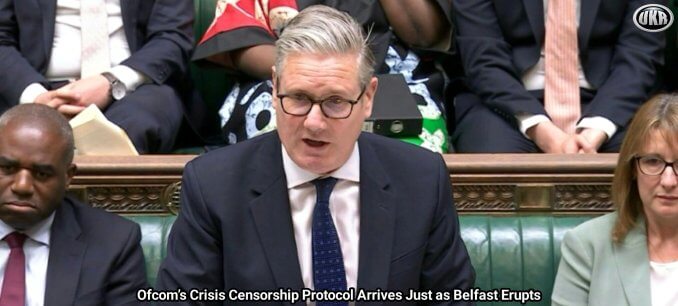
Ofcom’s Crisis Censorship Protocol Arrives Just as Belfast Erupts
A direct hotline between police and platform moderation desks is just a state-to-delete pipeline without the paperwork or a court order.
CAM WAKEFIELD
The timing is so perfect it almost looks scripted. On June 8, 2026, a 30-year-old Sudanese asylum seeker named Hadi Alodid stabbed a man named Stephen Ogilvie on Belfast’s Shankill Road, slashing his eyes, face, and back in what witnesses and police described as an attempted beheading.
Ogilvie, 44, is in hospital. By the following evening, the Northern Ireland city was on fire.
Cars, houses, and a bus were torched. Masked protesters kicked in doors along the Lower Newtownards Road. Riots spread to Portadown, Antrim, and more. Protests erupted in Glasgow, Edinburgh, Southampton, and outside Parliament in London.
And on that very same day, June 9, Britain’s speech regulator Ofcom published its finalized “crisis response protocol,” a new set of rules pressuring every major platform in the country to build censorship infrastructure that activates whenever someone at Ofcom or in government decides a “crisis” is happening or about to happen.
The protocol was written because of the 2024 Southport riots. If you wanted a clearer illustration of how these powers will be used, you couldn’t commission one.
The Official Response Tells You Everything
Within hours of the Belfast stabbing, the political class was already running the Southport playbook.
PSNI Chief Constable Jon Boutcher warned: “The challenge we face with today’s online toxic nature is that people are incited by people who are faceless and know nothing about this brilliant, vibrant place. Do not be fooled or duped by people online.”
First Minister Michelle O’Neill said: “of those people out there who are stoking up tensions in that social media space who are happy to raise tensions, they do not represent us. We are good people and I don’t want to see anybody living in fear.” Justice Minister Naomi Long blamed “bad faith actors” online for stoking tension.
UK Prime Minister Keir Starmer called the stabbing “sickening” and made clear there was “no tolerance” for street violence.
Notice the pattern. The question of why people are angry gets replaced by the question of who shared the video. The people who are upset about the attack online become the problem and a censorship target.
And the regulator that just published new tools for suppressing online speech during exactly this kind of event gets to look prescient instead of opportunistic.
The script never changes. The censorship methods, though, keep growing.
What the Protocol Actually Does
Ofcom’s crisis response protocol, added to its Codes of Practice under the Online Safety Act (OSA), pressures social media platforms, messaging apps, forums, dating services, and essentially any website where humans can talk to other humans to build standing censorship systems for “crisis” situations.
The OSA’s Codes aren’t technically mandates. Platforms can theoretically ignore them and “use other effective measures to protect users from illegal content and activity.” This is like saying you don’t have to wear a suit to court. Technically true; inadvisable if you plan on winning.
Under the protocol, covered platforms must build systems to identify and respond to spikes in “illegal” content and “content harmful to children” during what Ofcom defines as an “extraordinary situation in which there is a serious threat to public safety in the United Kingdom.”
They should deploy a temporary crisis response team “as soon as reasonably practicable if the provider determines that a crisis is occurring or is likely to occur.” They should run post-crisis reviews to evaluate how effective the censorship was. And large platforms should open a dedicated communication channel with law enforcement, so police can phone in their content complaints on a priority line during the crisis.
A direct hotline between police and a platform’s moderation desk, activated during civil unrest, is a state-to-delete pipeline. There’s no court order, just a cop calling a content moderator and saying “this one,” and the post vanishes.
“Likely to Occur” Is a Loaded Gun Pointed at Every Trending Topic
The most dangerous word in the entire framework is “likely.” Platforms don’t need an actual crisis and they don’t even need burning cars. They need a feeling that trouble might be on the way.
Ofcom expects them to activate the protocol when a crisis is “likely to occur,” which is a subjective, future-tense judgment call being outsourced to private companies with every financial incentive to over-comply.
Think about what this means in the context of Belfast. A video of a stabbing goes viral. People start posting angry reactions. Some of those reactions call for protests. Under this protocol, a platform looking at rising engagement around the Belfast attack could decide that a crisis is “likely,” activate its response team, and start suppressing content before a single car has been set on fire.
The censorship arrives before the crisis. By the time anyone asks whether the deleted posts were actually illegal, the moment has passed.
And the definition of “crisis” is elastic enough to be meaningless. Ofcom says an “extraordinary situation” can include “local or regional crises” and even “an overseas event.” A protest in one neighborhood. A political incident in another country. Something trending on X that makes a regulator nervous. Ofcom gave itself a rubber stamp that reads “CRISIS” and left the ink bottle open.
Who Gets Caught?
Three categories of “user-to-user services” are expected to comply: large platforms rated high-risk for “terrorism, hate, harassment, stalking, threats and abuse, and foreign interference;” large platforms “likely to be accessed by children” rated medium-risk for “abuse, hate, and violent content;” and any platform of any size “likely to be accessed by children” rated high-risk for those categories.
The OSA covers basically any website where one human can communicate with another. Social media, messaging apps, forums, dating apps, video and photo sharing, online marketplaces, multiplayer games, and AI services whose output can be shared. The exemptions are email, SMS, MMS, and one-to-one voice calls. So the technologies of 1995 are exempt. Everything invented since is in scope.
If you wanted to design a system where the government could control what people say during the exact moments when free speech is most essential, you’d build something very close to what Ofcom just published. And you’d probably have the nerve to call it a safety measure, too.
This article (Ofcom’s Crisis Censorship Protocol Arrives Just as Belfast Erupts) was created and published by Reclaim the Net and is republished here under “Fair Use” with attribution to the author Cam Wakefield
See Related Article Below
MINISTRY OF TRUTH: Government To BLOCK ‘False Information’ During ‘Crisis Events’
Surveillance grid expands
STEVE WATSON
Vague new rules will allow UK regulators to pressure platforms over “legal but harmful” content whenever government ministers declare a crisis, while the same government ploughs ahead with mandatory phone scanning, digital ID lockdowns, and jail threats for tech bosses who refuse to spy on every device.
The latest move from Northern Ireland Secretary Hilary Benn makes explicit what privacy campaigners have long warned: the Online Safety Act is being weaponised far beyond any child-protection claim.
Benn confirmed that the internet regulator will now wield enhanced powers to tackle “false information” online during “times of crisis,” directly tying the recent Belfast unrest to this framework. The regulator has already contacted platforms, with ministers asserting that violence “appears to have been incited online.”
‘If we are living in a country where you cannot report the truth, we are living under a dictator.’
Adam Brooks warns of government censorship as Labour announces a social media crackdown ‘in times of crisis’ after the Belfast unrest. pic.twitter.com/6yyNDXqWNh
— GB News (@GBNEWS) June 11, 2026
Benn stated that if people put online ‘false information,’ “it is not acceptable and it may well be a criminal offence depending on the circumstances as the chief constable made clear yesterday.”
When asked how a “time of crisis” would be defined, Benn said it “will be set out in due course.”
The unrest followed a serious knife attack on a local man by an asylum seeker and escalated into protests involving vehicle fires, arson attacks on homes, and clashes with police that injured a dozen officers.
In addition, Ofcom, the UK’s regulator for communications, responsible for overseeing broadcasting, telecommunications and — since the passage of the Online Safety Act — the major online platforms, is now using its powers to direct platforms toward enhanced, crisis-specific moderation measures whenever it or ministers identify spikes in ‘illegal ‘harmful’ content during whatever it deems a ‘crisis’ event.
An Ofcom open letter published this week directly addresses the Belfast situation. It states: “Following a serious knife attack that took place in Belfast on Monday night, we have seen civil unrest in the city, some of which appears to have been incited online. This has included racially motivated incidents of violence, arson attacks on homes and vehicles, and attacks against police.”
The letter goes on to remind online service providers of their duties under the Online Safety Act 2023 to assess and mitigate risks of ‘illegal’ content, including material amounting to offences of stirring up hatred or provoking violence.
It emphasises that “previous crises have shown how a sudden increase in the amount of illegal content circulating online can manifest in hate crime and violence in the real world” and that “usual content moderation systems and processes may not be sufficient in such circumstances.”
Crucially, Ofcom confirmed new measures added to its online safety codes of practice under which platforms “should have procedures in place to respond to spikes in illegal content during a crisis.” These measures, confirmed the day before the letter, are expected to be enacted by platforms immediately, without waiting for parliamentary approval. The letter stresses that services must “act now to address illegal content” and follow existing crisis protocols where they exist.
This directly engages the core claim in widely shared analysis on X that the Online Safety Act — repeatedly sold to the public as a child-protection measure — is now being applied to adult content and civil unrest with no reference to children in the regulator’s own crisis guidance.
The government said the Online Safety Act was about protecting children. We were called conspiracy theorists for saying it wasn’t!
Well er … Ofcom is writing to platforms about “crisis situations”, civil unrest and enhanced moderation measures. (Blocking posts they don’t like)… pic.twitter.com/7oJybQORhQ
— Bernie (@Artemisfornow) June 11, 2026
Given that the government and it’s mouthpiece media has spent the entire week claiming Elon Musk and Nigel Farage, along with anyone commenting on the latest savage migrant attack, is inciting violence, you can see exactly where this is going.
Murderous migrants beheading innocent people in their home town is what’s making people angry, not “social media”!
— Elon Musk (@elonmusk) June 10, 2026
According to the UK government, you’re considered a terrorist if you believe that Western culture is under threat from mass migration.
Yes, this is really on their website. pic.twitter.com/XLh2X6Hri3
— iamyesyouareno (@iamyesyouareno) June 9, 2026
Awaiting Labour creating a Ministry of Information. pic.twitter.com/cjwQOHmTSd
— Lord Highland (@Fasgadh27) June 11, 2026
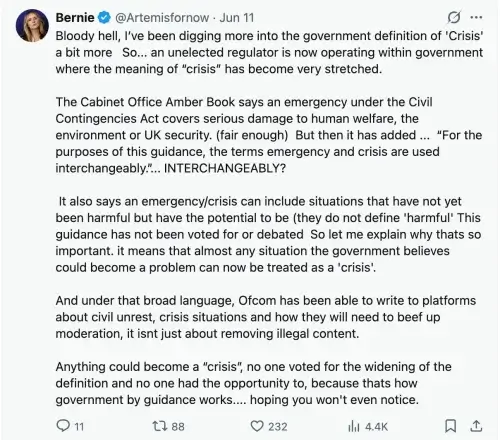
The same analysis highlights how the definition of crisis has been stretched. Cabinet Office guidance in the Amber Book states that the terms “emergency” and “crisis” are used interchangeably under the Civil Contingencies Act 2004.
An emergency covers events or situations which cause or may cause serious damage to human welfare, the environment or UK security — explicitly including situations that “have not yet been harmful but have the potential to be.” No fresh parliamentary debate or vote was required for this expansive interpretation to underpin regulatory action during the Belfast unrest
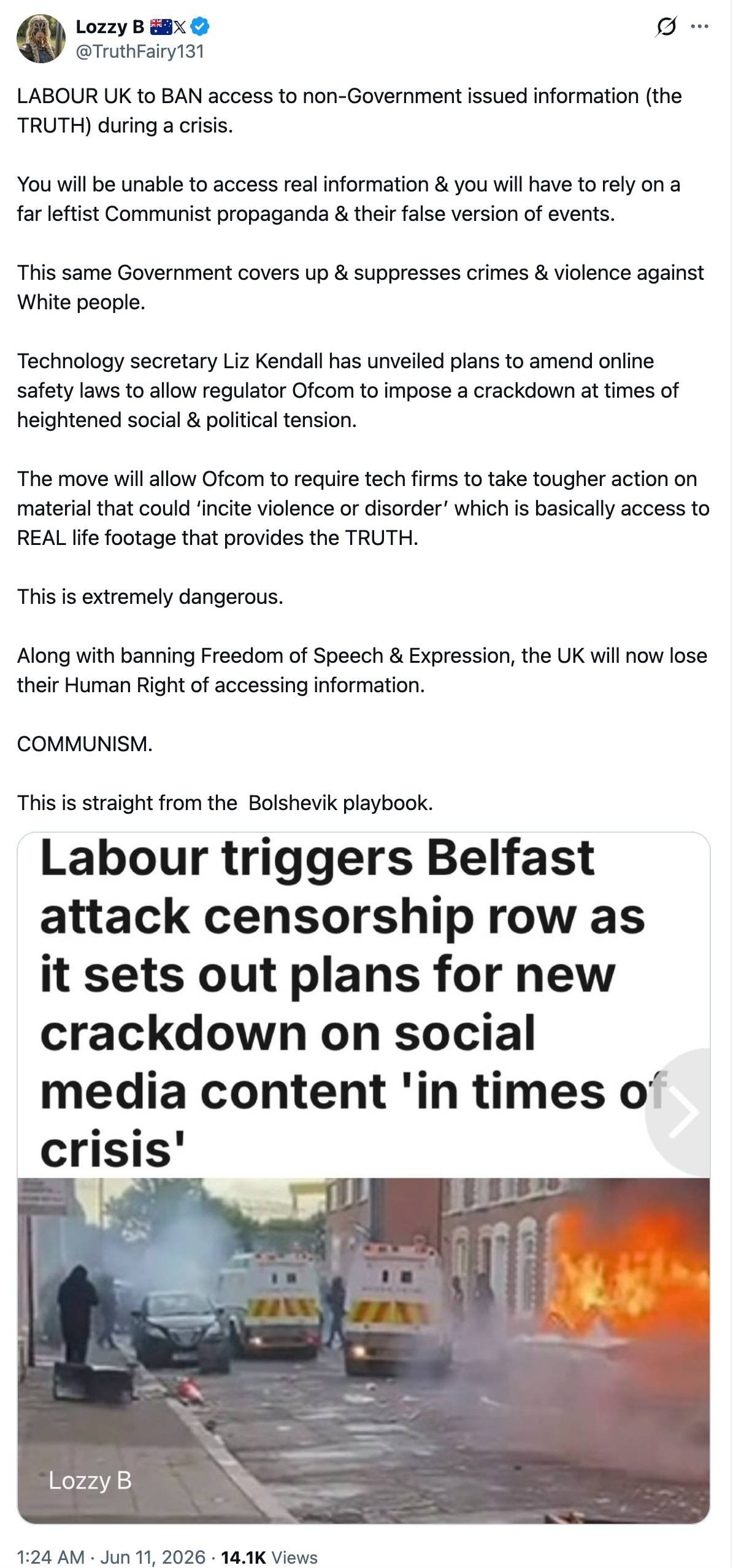
Statements from Technology Secretary Liz Kendall also indicate that the government intends to amend online safety laws to give the regulator stronger powers to require platforms to take tougher action on material that it says could incite violence or disorder during periods of “heightened social and political tension.”
Those who use social media to incite violence and disorder are breaking the law.
Next week we will lay in Parliament an update to the Online Safety Act requiring services to take quicker action to remove illegal content circulating during times of crisis.— Liz Kendall (@leicesterliz) June 10, 2026
Critics argue this effectively allows the state to restrict access to real-time footage and non-government sources of information during such periods, framing it as a direct threat to freedom of expression and the public’s ability to access unfiltered information.
.
These concerns sit alongside the Ofcom letter’s call for platforms to have crisis response plans ready for spikes in ‘illegal’ content, including content that the government decrees could stir up hatred or provoke violence.
Further reports emerged of the UK government contacting journalists covering the Northern Ireland events to instruct their reporting, attributed to an anonymous government source.
🚨BREAKING: The UK Government are contacting JOURNALISTS covering the event in Northern Ireland to INSTRUCT their REPORTING
Attributed to an unspecified and anonymous ‘GOVERNMENT SOURCE’
We live in dangerous times
Keir Starmer is a tyrant pic.twitter.com/uqDg811iu4— Basil the Great (@BasilTheGreat) June 11, 2026
According to the communications shared online, journalists were reportedly directed on the preferred framing of the unrest, including how to characterise the protests and the underlying causes.
This intervention occurred as Ofcom was simultaneously issuing its crisis guidance to platforms, prompting concerns that the government is attempting to align coverage across both traditional media and online spaces to limit unapproved narratives during periods of public disorder.
Alongside the new regulatory powers, the UK government is rolling out something called PoliceAI, a new National Centre for AI in Policing launched with £115 million in funding. This centralised body consolidates AI development and deployment across all 43 forces in England and Wales, focusing on tools such as live facial recognition, predictive analytics, automated data analysis and deepfake detection.
The government states that it is designed to speed up investigations and automate routine policing tasks while creating a single national framework for testing and rolling out the technology.
The UK is so cooked, man… The UK government’s policing office has launched PoliceAI, a new centre that will develop and provide AI tools for police forces across the country.
>These tools are designed to help officers deal with changing crime by making their work faster and… pic.twitter.com/7gcAbikslf
— Pirat_Nation 🔴 (@Pirat_Nation) June 11, 2026
In the context of the new crisis powers, PoliceAI provides authorities with automated systems capable of scanning vast amounts of online content and communications in real time. These tools can flag material deemed to spread “false information” or incite disorder during government-designated crisis events, enabling rapid coordination with Ofcom for content removal.
Combined with facial recognition and predictive capabilities, the system allows police to identify and target individuals posting or sharing information the authorities wish to suppress, turning AI into a powerful mechanism for narrative control and the blocking of inconvenient facts.
I bet they plan on evaluating every social media post with this AI.
After all, AI is just a search engine.
A redditified search engine…Not even Orwell could come up with this. https://t.co/cjOAIIlkRf
— Ironsmit2323 (@YorkSmit2323) June 11, 2026
These developments do not come in isolation. They connect directly to the surveillance architecture we’ve relentlessly detailed: plans to jail tech CEOs for up to five years if they refuse to build client-side scanning systems capable of reviewing every photo, video and message on user devices before encryption.
The same framework underpins the coming digital ID lockdown on every phone, under which biometric verification and government-issued ID would be required for full smartphone functionality, with non-compliant devices restricted to limited “child mode.”
Encrypted messaging service Signal is resisting the wider demands for phone screening and content scanning. President Meredith Whittaker has stated Signal would “absolutely, 100% walk” from the UK rather than weaken its end-to-end encryption.
#UK: The head of Signal has threatened to pull the company out of the UK entirely rather than weaken its encryption protocols to satisfy government regulators. This would be a serious blow to privacy. The government must protect end-to-end encryption: https://t.co/gKww7NcnXS 1/2
— Index on Censorship (@IndexCensorship) June 11, 2026
Signal and Mullvad warn about the UK’s plans to scan people’s phones#Signal #Mullvad #UK https://t.co/Zhkfg2whIn
— CyberInsider (@CyberInsidercom) June 10, 2026
Big Brother Watch director Silkie Carlo has warned that the plans “will only result in population-wide ID checks for all of us to use our phones, tablets and laptops” and amount to “ID checks for the internet.” She described the requirement as invoking “the death of anonymity and internet privacy” and the overall approach as “a crossing of the Rubicon that would make the UK one of the most authoritarian internet regimes in the world.”
The UK digital ID scheme is the lynchpin of a dystopian mass surveillance grid to be implemented for all from cradle to grave.
The government is pressing ahead to expanded regulatory powers over online content during vaguely defined “crisis events,” with platforms told to implement special moderation protocols immediately. At the same time the government is advancing device-level scanning, embedding digital ID requirements on every phone, and threatening executives with prison for non-compliance. Instructions to journalists and pressure on platforms complete the picture.
This is nothing less than the construction of a complete surveillance control grid that monitors devices, verifies identity for basic access, and suppresses inconvenient information whenever those in power declare an emergency.
Free speech, privacy and access to unfiltered reality are the direct targets. Resistance from platforms willing to exit rather than comply, and from citizens who refuse to accept the pretext, remains the only obstacle to its full dystopian implementation.
Your support is crucial in helping us defeat mass censorship. Please consider donating via Locals or check out our unique merch. Follow us on X @ModernityNews.
This article (MINISTRY OF TRUTH: Government To BLOCK ‘False Information’ During ‘Crisis Events’) was created and published by Modernity News and is republished here under “Fair Use” with attribution to the author Steve Watson

••••
The Liberty Beacon Project is now expanding at a near exponential rate, and for this we are grateful and excited! But we must also be practical. For 7 years we have not asked for any donations, and have built this project with our own funds as we grew. We are now experiencing ever increasing growing pains due to the large number of websites and projects we represent. So we have just installed donation buttons on our websites and ask that you consider this when you visit them. Nothing is too small. We thank you for all your support and your considerations … (TLB)
••••
Comment Policy: As a privately owned web site, we reserve the right to remove comments that contain spam, advertising, vulgarity, threats of violence, racism, or personal/abusive attacks on other users. This also applies to trolling, the use of more than one alias, or just intentional mischief. Enforcement of this policy is at the discretion of this websites administrators. Repeat offenders may be blocked or permanently banned without prior warning.
••••
Disclaimer: TLB websites contain copyrighted material the use of which has not always been specifically authorized by the copyright owner. We are making such material available to our readers under the provisions of “fair use” in an effort to advance a better understanding of political, health, economic and social issues. The material on this site is distributed without profit to those who have expressed a prior interest in receiving it for research and educational purposes. If you wish to use copyrighted material for purposes other than “fair use” you must request permission from the copyright owner.
••••
Disclaimer: The information and opinions shared are for informational purposes only including, but not limited to, text, graphics, images and other material are not intended as medical advice or instruction. Nothing mentioned is intended to be a substitute for professional medical advice, diagnosis or treatment.
Disclaimer: The views and opinions expressed in this article are those of the author and do not necessarily reflect the official policy or position of The Liberty Beacon Project.


When tyranny becomes law, rebellion becomes duty.