

UK government to appoint “anti-Muslim hostility tsar” in an effort to entice Muslim voters to support Labour
RHODA WILSON
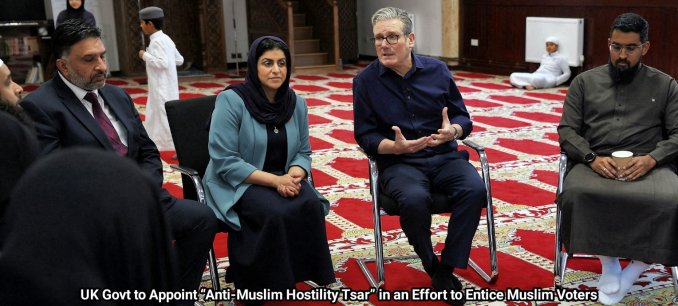
On Monday, the UK government announced the creation of a new “anti-Muslim hostility tsar,” a special representative tasked with tackling hostility and hatred directed at Muslims and those perceived to be Muslim.
The tsar’s appointment is part of a £4 million strategy to tackle “anti-Muslim hostility.” The Government’s new non-statutory definition of “anti-Muslim hostility” covers violence, harassment, prejudicial stereotyping and unlawful discrimination against Muslims or those perceived to be Muslim.
The role is to improve the recording and response to “hate crimes.” The Ministry of Housing, Communities and Local Government, Steve Reed, emphasised at a meeting of faith leaders that the definition is designed to protect freedom of speech. He told the Press Association there will be no “blasphemy laws by the back door” and that “freedom of speech and the right to criticise religion in general, or any religion in particular, is an absolute.”
However, the move has sparked debate. Critics, including political commentators and former officials, warn that the tsar could inhibit free speech, potentially silencing legitimate criticism of Islamic extremism or controversial practices within Muslim communities. Some argue the focus should be on Islamism, not Islamophobia, and question whether the role will be effective or counterproductive.
The Government’s counter-terrorism tsar, Jonathan Hall, said the Prime Minister’s proposed definition could stop people from freely criticising Islam. “The worry will be with loose language, people will feel inhibited about talking about things that they do think which are genuinely important today,” he said. He also warned that it could fail to stop anti-Muslim attacks just as a similar definition for anti-Semitism had failed to prevent a rise in attacks on Jews.
Rod Liddle pointed out in The Spectator, “The syntax [of ‘anti-Muslim hostility tsar] suggests to me that this will be someone who oversees anti-Muslim hostility and that, as a kind of ombudsman, he or she might be petitioned to encourage more of it.”
5Pillars argued that the Labour government’s “anti-Muslim hostility” initiative is linked to votes and its dwindling support. “Muslims across the UK have actively campaigned for a Muslim boycott away from Labour, traditionally a political home for Muslims, as punishment for their support for Israel” when Israel responded to Hamas’ terrorist attack on Israel on 7 October 2023.
“Labour was crushed in the recent by-election fight for Gorton and Denton, coming in third place while the Green Party was propelled to a strong victory. It is widely believed that local Muslims voting for the Greens played a massive role in securing them a win over Labour,” 5Pillars said.
Political commentator Khadija Khan agrees. Speaking to GB News on Saturday, she said, “This appears to be yet another bizarre and desperate effort by the Labour Party aimed at saving the Muslim vote … they appear driven by an overwhelming anxiety about losing a crucial segment of their vote base.”
The announcement of the tsar’s appointment follows a leaked draft of the Government’s ‘Protecting What Matters’ strategy, which also highlights rising anti-Semitism and allocates £800 million over 10 years to 40 areas of social cohesion considered to be “under pressure.”
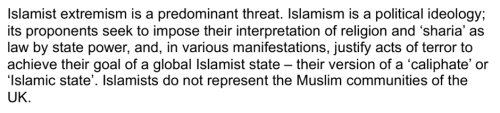
The draft, now published, identifies Islamist extremism as the principal terror threat in Britain and the most serious threat to social cohesion. Yet, the “anti-Muslim hostility tsar” will not address the divisiveness of Islamism and risks derailing their Muslim/non-Muslim social cohesion strategy. You couldn’t make it up.
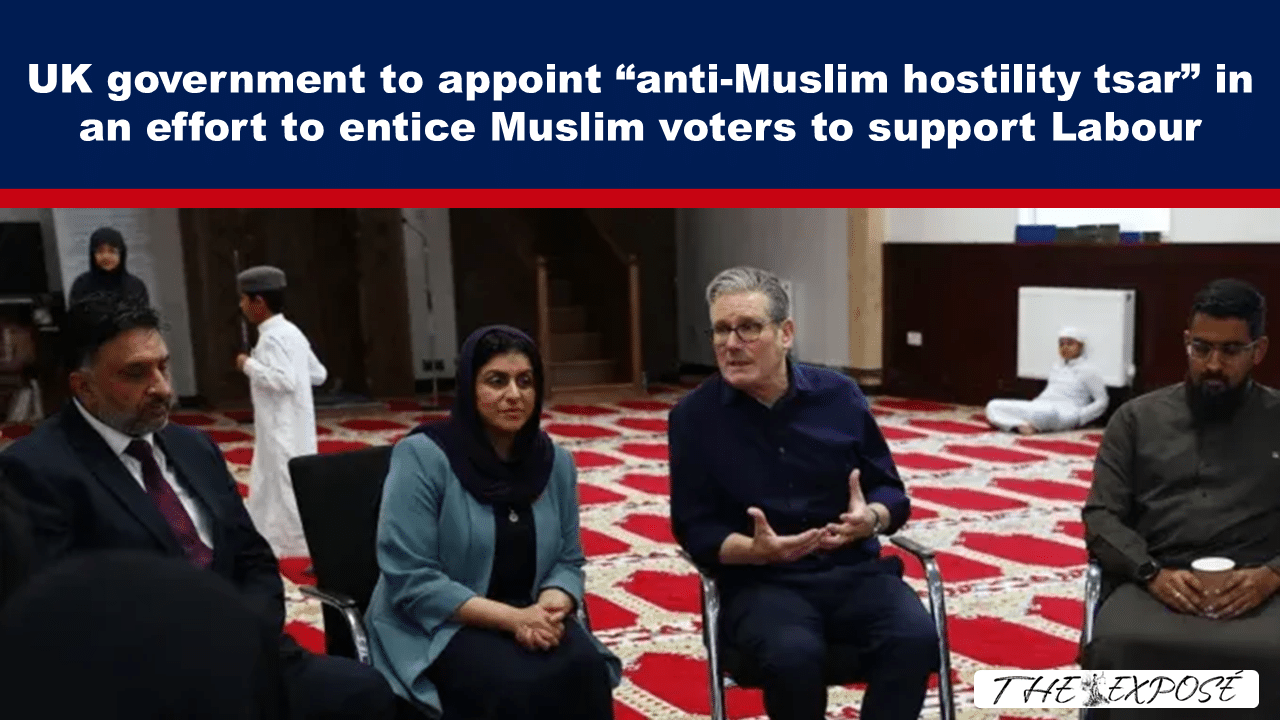
Featured image taken from ‘UK To Appoint An ‘Anti-Muslim Hostility Tsar’, Planet Today, 7 March 2026
This article (UK government to appoint “anti-Muslim hostility tsar” in an effort to entice Muslim voters to support Labour) was created and published by The Expose and is republished here under “Fair Use” with attribution to the author Rhoda Wilson
See Related Article Below
Labour’s New “Anti-Muslim Hostility” Definition Is a Dangerous Mistake
Another assault on our free speech has arrived

The Labour government has just introduced a new official definition of what it calls “anti-Muslim hostility.”A definition that will now be imposed from above on taxpayer-funded institutions, including our schools, universities, local government, health service, and more.
And in a telling sign that ministers already realise how controversial this move is, the definition is accompanied by another 1,400 words of explanation which, we are told, “must be read together” with it.
Those additional pages repeatedly reassure readers that the policy – a policy we have long warned about – will not threaten freedom of speech.
It will not, Labour assures us, restrict criticism of religion. It will not interfere with debate. It will not limit discussion.
But whenever a government feels compelled to repeat these assurances, it usually means something deeper is going on. And the warning signs are flashing.
Jonathan Hall KC, the government’s independent reviewer of terrorism legislation, warns the definition could “inhibit” free speech and lead to widespread self-censorship, where people self-censor their views and stay silent because they fear being punished or ostracised if they say what they really think.
If institutions across Britain — our universities, councils, libraries, charities, museums and businesses — are encouraged to adopt this vague definition without clear guidance, warns Hall, then “nothing good will come of it.”
Why? Because when organisations are left navigating unclear political rules about what can and cannot be said, they tend to respond in one predictable way.
They censor themselves. Events get cancelled. Speakers are quietly disinvited. Research becomes more cautious. Genuine free debate disappears. The public square narrows. And our freedoms, slowly but steadily, are removed.
Not because the law demands it — but because nobody wants to risk crossing an undefined line.
Jonathan Hall captures the danger perfectly when he asks whether taxpayer-funded public institutions will now have the “strength and inclination” to resist becoming “organs of self-censorship.”
Nor are these voices alone in raising concerns. Yesterday, Lord Walney, the government’s former anti-extremism adviser, warned the definition could actually empower Islamist activists by allowing them to “deflect scrutiny from their quest to undermine our values”.
In other words, rather than confronting extremism, the policy risks giving extremists a new political tool.
Put it this way, if fears about being called a “racist” were enough to warn people off looking at the grooming gangs for decades then it’s not hard to see how similar fears about being branded “hostile to Muslims” could warn people off looking into Islamist networks, gangs, practices, and more.
And that matters because the government’s own social cohesion strategy — Protecting What Matters — acknowledges a difficult truth.
Islamist extremism remains the dominant terrorism threat facing Britain; it is responsible for two-thirds of all terrorist casework and 94 per cent of all deaths that have been caused by terrorism in the UK over the last twenty-five years.
There is simply no equivalence between the “far-right” and Islamism – it is the latter that poses the primary if not overwhelming threat to our way of life and we would do very well to remember it.
Yet by imposing this definition of anti-Muslim hostility, and entrenching it by also appointing a new “tsar” for anti-Muslim hostility, somebody whose sole job will now be to hunt out anything they perceive to be “hostile” to Muslims, the Labour Party and the British state have lost all perspective.
Britain, it should be remembered, already has strong laws against hate crimes and religious discrimination.
It is already illegal to threaten or harass somebody because of their religion.
So what is this new definition supposed to achieve, aside from creating a entirely new layer of special protections for Muslims that are not available to other groups?
Or perhaps that is indeed the point, accepted by a Labour Party that is haemorrhaging its traditional Muslim votes to the Greens and pro-Gaza Muslim ‘independents’.
The end result is that public debate about Islam and Muslims in Britain, irrespective of what Keir Starmer and Labour MPs are currently claiming, will be tightly regulated, edited, controlled, and curtailed.
Even some of those working to combat anti-Muslim hatred have warned about the potential consequences. Fiyaz Mughal, founder of the anti-hate organisation Tell MAMA, warns that the new policy could produce “the worst of both worlds.”
Extremists, he warns, like Lord Walney, could weaponise the definition to silence debate. Meanwhile, victims of genuine hatred might feel unsupported.
He offers a revealing example.
If somebody raised concerns about the role of Pakistani Muslim men in grooming gang scandals, Mughal warns, the definition – which states that ‘prejudicial stereotyping’ is a form of anti-Muslim hostility – could potentially be used against them on the basis that somebody might claim they are ‘stereotyping’ Muslims.
In other words, a policy that was designed to combat prejudice could end up discouraging honest discussion about serious social problems.
And there is another serious problem, too.
By introducing a special definition that protects one religious group over others — and despite existing laws already covering religious hatred — the government risks fuelling accusations of two-tier policymaking.
Hatred against Muslims is wrong. But so too is hatred against Jews, Christians, Hindus, Sikhs, atheists or anybody else.
The law already treats them equally. Introducing special definitions for one group risks strengthening grievance politics rather than reducing tensions.
All this definition will do, I suspect, is put an existing grievance politics and feelings of victimisation within Muslim communities on steroids.
Every criticism, every challenge, every uncomfortable observation about what might be going on within Muslim communities will now be met with the cry: “Anti-Muslim hostility!”
And that matters because Britain is already struggling with fragile community relations. Prime Minister Keir Starmer himself admits that social cohesion is facing what he calls an “emergency” (though he still cannot bring himself to explore why).
But social cohesion cannot be rebuilt through vague speech codes, expanding definitions and government-appointed “tsars”.
It requires something much simpler — and much harder – including many of the things we champion right here, in this newsletter.
Honest debate. Open discussion about extremism. Clear expectations around integration. And the confidence to talk openly about the challenges Britain faces.
If Labour’s new strategy encourages that conversation, it could do some good.
But if the new definition of anti-Muslim hostility becomes another tool used to police speech, silence critics and shut down uncomfortable discussions, then it will achieve the opposite.
It will deepen the divisions that are already tearing our country apart.
And that would be a very dangerous mistake indeed.
****
Free Speech Union Launches Legal Action Against Labour’s Islamophobia Definition

The Free Speech Union is launching a legal challenge against the Government over Labour’s plans to introduce an official definition of “anti-Muslim hostility”, warning it could become a “blasphemy law by the back door”. GB News has the story.
Campaigners warn the outcome of the case could shape the future boundaries of free speech in Britain, particularly when it comes to discussion of religion, belief and cultural issues.
The challenge is being mounted by the Free Speech Union, which says the proposal risks silencing legitimate debate about religion and could lead to tens of thousands of complaints every year.
The group is also challenging the Government’s decision to appoint an “anti-Muslim hostility tsar” tasked with overseeing how the definition is applied.
Critics fear the move could suppress free speech by encouraging organisations and institutions to punish people accused of offending Muslims – even when no law has been broken. They say existing legislation already protects people from discrimination.
The union’s Director, Lord Toby Young, warned the policy represents a major threat to open debate.
“This is the most serious threat to free speech the Government has come up with so far – the only area in which it’s achieving any success,” he said.
“If we don’t win this fight, tens of thousands of people a year could lose their jobs at the say-so of a Labour-appointed ‘tsar’. It’s dystopian.”
The Government has said the new definition – previously discussed under the label ‘Islamophobia”’– is intended to help identify and respond to discrimination and hostility directed at Muslims.
But campaigners argue that the wording being proposed is too vague and subjective, and could be used to shut down criticism of religion or discussion of issues relating to Islam.
The Free Speech Union claims the definition includes unclear language such as “negative and prejudicial stereotyping of Muslims”, which it says lacks a precise legal meaning and could easily be misused.
The organisation argues that once the definition is adopted by Government departments, councils, universities and other institutions, it could lead to people being put through disciplinary processes and losing their jobs, even though it has no formal legal status.
Campaigners point to the rapid growth in police recording of ‘non-crime hate incidents’ (NCHIs) – cases where speech is logged despite no criminal offence being committed.
Under current guidance, police can record incidents if someone perceives words or behaviour to be motivated by hostility linked to a protected characteristic.
Free speech advocates say the system has already led to hundreds of thousands of reports being logged over lawful comments.
The Free Speech Union fears the new definition could lead to a surge in complaints.
It has been estimated the new plan could result in around 20,000 reports of “anti-Muslim hostility” each year – a huge increase compared with the current number of recorded anti-Muslim hate crimes, which stands at roughly 4,000 a year.
Campaigners say the risk is that organisations will adopt the definition in order to demonstrate they are tackling discrimination – even if doing so means disciplining staff or investigating people over lawful speech.
The group argues that in a democratic society no religion should be protected from criticism or debate.
Worth reading in full.

••••
The Liberty Beacon Project is now expanding at a near exponential rate, and for this we are grateful and excited! But we must also be practical. For 7 years we have not asked for any donations, and have built this project with our own funds as we grew. We are now experiencing ever increasing growing pains due to the large number of websites and projects we represent. So we have just installed donation buttons on our websites and ask that you consider this when you visit them. Nothing is too small. We thank you for all your support and your considerations … (TLB)
••••
Comment Policy: As a privately owned web site, we reserve the right to remove comments that contain spam, advertising, vulgarity, threats of violence, racism, or personal/abusive attacks on other users. This also applies to trolling, the use of more than one alias, or just intentional mischief. Enforcement of this policy is at the discretion of this websites administrators. Repeat offenders may be blocked or permanently banned without prior warning.
••••
Disclaimer: TLB websites contain copyrighted material the use of which has not always been specifically authorized by the copyright owner. We are making such material available to our readers under the provisions of “fair use” in an effort to advance a better understanding of political, health, economic and social issues. The material on this site is distributed without profit to those who have expressed a prior interest in receiving it for research and educational purposes. If you wish to use copyrighted material for purposes other than “fair use” you must request permission from the copyright owner.
••••
Disclaimer: The information and opinions shared are for informational purposes only including, but not limited to, text, graphics, images and other material are not intended as medical advice or instruction. Nothing mentioned is intended to be a substitute for professional medical advice, diagnosis or treatment.
Disclaimer: The views and opinions expressed in this article are those of the author and do not necessarily reflect the official policy or position of The Liberty Beacon Project.


Leave a Reply