

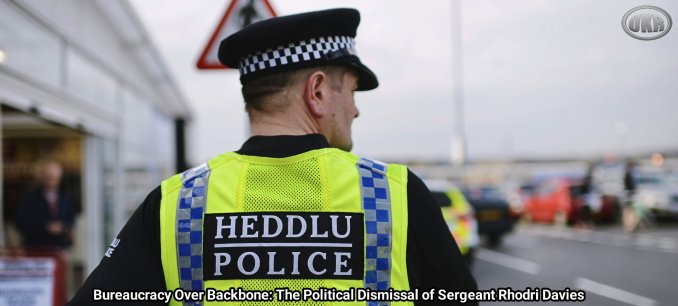
Bureaucracy over backbone: the political dismissal of Sergeant Rhodri Davies
A police disciplinary process which should involve proportionality and context has been abandoned in favour of optics
PAUL BIRCH
A version of this article appears in Spiked
Recently, we saw another unjustified dismissal of a conscientious police officer. Custody sergeant Rhodri Davies was sacked by South Wales Police after striking a violent offender whilst attempting to restrain him on the ground. The 6ft 7in suspect, Tariq Evans, who was already under arrest for affray, came to no physical or mental harm. But a misconduct panel concluded that Davies’ decision to strike him three times should cost him his twenty year career in policing.
As is often the case with police misconduct processes, the whole affair was hanging over Davies and his loved ones for a long time, no doubt accumulating the stress and anxiety for all. The original incident occurred in 2022 and the final misconduct appeal hearing (at which four other findings of misconduct against Davies were overturned) was only in January 2026.
The sacking of Rhodri Davies is not about misconduct. It is about institutional cowardice. About a policing establishment more concerned with reputational risk and bureaucratic self-preservation than it is with backing its own officers when violence erupts at the sharp end. The situation is very much reminiscent of the dismissal of PC Lorne Castle in 2025 by Dorset Police, for not treating a knife wielding suspect with enough “courtesy or respect”. Indeed, the dismissal of Davies is so unmerited that even a local Labour MP has expressed disquiet. Tonia Antoniazzi, the MP for Gower, said the force’s disciplinary procedures were “deeply flawed” and had “failed” the former officer.
Rhodri Davies was not a problem officer. He was not a repeat subject of complaints, nor a man skating on thin disciplinary ice. He had an unblemished professional record. The incident itself was exactly the kind of confrontation the public demands that the police handle; a violent suspect, physically intimidating and resisting restraint on the ground. This was not a compliant detainee. It was a live struggle, unpredictable, dangerous and potentially lethal if control was not secured quickly. In that moment, Davies struck the suspect three times.
Not with a baton. Not with a weapon. Not in a prolonged assault. Three strikes delivered by hand in the chaos of restraint – what officers are trained to use as distraction techniques to gain compliance when size, strength and resistance create an immediate physical risk. Despite what the media would have us believe, the police are still permitted (just) to strike people, using techniques taught in training and which are regularly refreshed. The suspect in this case suffered no physical injury. No lasting harm. No mental trauma. And yet Davies lost his career.
If that outcome seems disproportionate, it’s because it is. Modern police discipline in Britain has drifted away from judging actions based on necessity in the moment and towards judging them based on how they look in hindsight to the chattering classes. CCTV footage has replaced real-time threat perception as the moral yardstick. Officers are expected to display utopian levels of restraint while grappling with violent individuals in confined environments, settings where hesitation can genuinely put lives in danger. This is the absurdity of contemporary policing oversight – officers are authorised to use force but punished when force looks too forceful.
The appeal hearing in January exposed further fragility in the case against Davies. Four additional misconduct findings were overturned. That should have triggered at least a degree of institutional humility, a recognition that the original disciplinary net had been cast too wide with an eye towards constructing a narrative rather than uncovering the truth. Instead, the system doubled down.
With the ancillary allegations gone, the panel rested the entire weight of dismissal on the remaining finding: the three hand strikes. Context, record, and outcome were subordinated to symbolism. The message was clear – someone had to pay in order that South Wales Police senior management could come across as virtuous to the wider world.
This is a textbook case of risk management masquerading as accountability. Large public institutions behave predictably under pressure; they sacrifice individuals to protect the brand. Police leadership today operates in a climate shaped by activist scrutiny, media sensationalism and political hostility towards the use of force. The safest administrative move is not to defend officers; it is to distance the organisation from them and protect the careers of the higher echelons. Davies became a liability ledger entry. Dismissal allowed the force to signal moral seriousness, to reassure critics and to point to “robust standards.” But it is all theatre. And theatre has consequences.
Frontline policing depends on decisiveness. Officers must act without paralysis when violence erupts. If they begin to believe that any physical assertiveness (no matter how justified) may end their careers, behavioural drift is inevitable. Coppers will hesitate longer. They will wait for backup that may not arrive. They will prioritise procedural defensibility over immediate control. That hesitation does not make policing safer. It makes it more dangerous for officials and the public alike, and the consequences can be deadly.
There is also an ideological asymmetry embedded in cases like this. The modern disciplinary process scrutinises police force more harshly than civilian violence. A 6ft 7in suspect violently resisting restraint is treated as a situational factor; an officer’s strikes become the moral focus. Overall responsibility shifts from the aggressor to the responder.
When state agents are stripped of practical authority while still being expected to maintain order, the results are power without backing and responsibility without protection. Accountability is, of course, necessary. But accountability must be bound to proportionality and reality. There is a vast ethical gulf between punitive brutality and controlled force used to subdue a violent detainee. Davies’ case collapses that distinction.
The absence of injury should have mattered. Davies’ prior record should have mattered. The suspect’s size and violence should have mattered. The overturning of the other allegations should have mattered. Instead, the deciding factor appears to have been reputational; how the incident might look to oversight bodies, campaign groups and headline writers. What we see repeatedly today is not policing guided by principle. It is policing governed by risk aversion. Possibly the only positive consequence of stories such as these is that the officers on the receiving end are now much more prepared to go public.
Risk-averse policing produces demoralised officers, recruitment crises and declining pro-active enforcement. And these are trends already visible across much of the country. Dismissal, the profession’s ultimate sanction, should be reserved only for the most serious of allegations; for corruption, cruelty or sustained abuse of power. Deploying it against an officer engaged in a violent ground restraint – where no injury occurs – cheapens its meaning and signals institutional ingratitude toward those expected to confront danger on the public’s behalf.
When bureaucracies fear criticism more than they value courage, they cease to function as instruments of public protection and, instead, become engines of self-preservation. Rhodri Davies’ career ended not because policing failed, but because police leadership lacked the conviction to defend the realities of policing itself.
This article (Bureaucracy over backbone: the political dismissal of Sergeant Rhodri Davies) was created and published by Paul Birch and is republished here under “Fair Use”
See Related Article Below
If police officers can’t use force, we’ll all be at the mercy of criminals
The uncomfortable truth is that not all violence is immoral. Applied lawfully, our society depends on it
Britain appears increasingly ruled by a lanyard-wearing, HR-compliant class who have never had to arrest a violent, non-compliant man, yet are perfectly content to sit in harsh judgement of those who do.
This week, former sergeant Rhodri Davies of South Wales Police lost his appeal against dismissal following his decision to take a 6ft 7in suspect to the floor in a custody suite.
Now, policing is not a seminar. It is physical. It is unpredictable. It is often ugly. You cannot arrest a violent suspect without laying hands on them – unless you are content to let them walk away and wreak more havoc.
The law recognises this. The statutory framework governing police use of force was not originally drafted to hold officers to an impossible standard of clinical perfection. It held them to a reasonable one – what was honestly and reasonably believed necessary in the circumstances, as they perceived them at the time.
Yet you would be forgiven for thinking that the standard had quietly shifted.
When sergeant Rhodri Davies tackled the suspect, none of the officers or staff present raised concerns. When statements were first taken, none identified misconduct. Investigators were “directed to take a second account” – a peculiar approach that the appeal also found “unusual”. Even then, the appeal report itself highlights inconsistencies in expert analysis and a failure to consider all relevant material.
No one argues that corrupt or criminal officers should be shielded. They should not – and there are plenty of examples of those who don’t deserve to wear the uniform being rightly dismissed and even prosecuted.
But accountability is not the same as ritual sacrifice.
In Davies’ case, a 20-year veteran was dismissed in circumstances where alternative outcomes – management action, written warnings or reflective practice – were plainly available. Instead, the most punitive option was chosen.
We are increasingly seeing officers subjected to prolonged, career-ending investigations for quick decisions made in volatile situations. Too many of these cases resemble moral theatre rather than professional scrutiny.
[…]
The cumulative effect is predictable. Officers hesitate and members of the public think twice before intervening. Crime and disorder goes unchallenged – emboldening the criminal and disorderly. The streets do not become calmer; they become less governed.
The Telegraph: continue reading

••••
The Liberty Beacon Project is now expanding at a near exponential rate, and for this we are grateful and excited! But we must also be practical. For 7 years we have not asked for any donations, and have built this project with our own funds as we grew. We are now experiencing ever increasing growing pains due to the large number of websites and projects we represent. So we have just installed donation buttons on our websites and ask that you consider this when you visit them. Nothing is too small. We thank you for all your support and your considerations … (TLB)
••••
Comment Policy: As a privately owned web site, we reserve the right to remove comments that contain spam, advertising, vulgarity, threats of violence, racism, or personal/abusive attacks on other users. This also applies to trolling, the use of more than one alias, or just intentional mischief. Enforcement of this policy is at the discretion of this websites administrators. Repeat offenders may be blocked or permanently banned without prior warning.
••••
Disclaimer: TLB websites contain copyrighted material the use of which has not always been specifically authorized by the copyright owner. We are making such material available to our readers under the provisions of “fair use” in an effort to advance a better understanding of political, health, economic and social issues. The material on this site is distributed without profit to those who have expressed a prior interest in receiving it for research and educational purposes. If you wish to use copyrighted material for purposes other than “fair use” you must request permission from the copyright owner.
••••
Disclaimer: The information and opinions shared are for informational purposes only including, but not limited to, text, graphics, images and other material are not intended as medical advice or instruction. Nothing mentioned is intended to be a substitute for professional medical advice, diagnosis or treatment.
Disclaimer: The views and opinions expressed in this article are those of the author and do not necessarily reflect the official policy or position of The Liberty Beacon Project.


Leave a Reply