

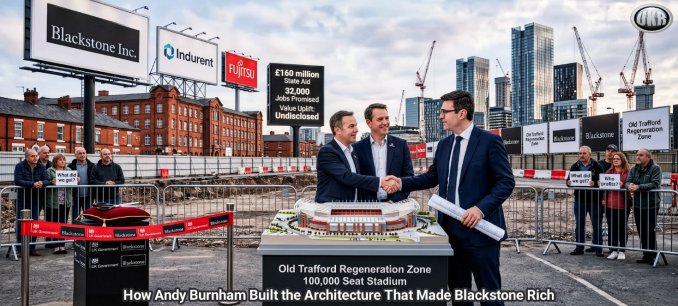
The Zone Builder: How Andy Burnham Built the Architecture That Made Blackstone Rich
EUROPEANPOWELL
On 22 June 2026, Manchester United announced it had secured the majority of the land needed to build a new 100,000-seat stadium. The 25-acre site, located 350 metres north-west of Old Trafford, between Wharfside Way, Europa Way and John Gilbert Way, was purchased from Indurent, a UK warehouse landlord owned by the American private equity giant Blackstone Inc. The price was undisclosed. The deal was described as a “significant milestone.”
Four days earlier, Andy Burnham had left office.
The timing was not incidental. For nine years as Mayor of Greater Manchester, Burnham had been the primary architect of the institutional and regulatory framework that made the Old Trafford regeneration zone investable, and made Blackstone’s land, sitting inside it, enormously valuable. Now, as he pivots from city hall to Westminster and positions himself as the frontrunner to succeed Keir Starmer as Labour leader and Prime Minister, that structural relationship deserves examination.
This is a story about how democratic institutions are enlisted to de-risk private capital, and about a Labour politician whose “socialist” credentials are being burnished while the mechanisms he built hand windfall gains to a trillion-dollar asset manager with a documented record of labour abuses, data misuse, and environmental destruction.
The Zone
The Greater Manchester Investment Zone was announced by the then-Chancellor Jeremy Hunt in November 2023, as part of the Autumn Statement. It came with a £160 million state aid package from Whitehall, earmarked for infrastructure, skills, and “business support” over ten years. Its stated goal: to create 32,000 jobs in advanced manufacturing and materials, leveraging private investment into key development sites including Atom Valley and ID Manchester.
Burnham welcomed it without hesitation. “The Investment Zone will help us attract investment and create jobs and opportunities that will benefit people across Greater Manchester,” he said. “It’s also a vote of confidence in devolution and its ability to deliver levelling up.”
What he did not say, and what the mainstream commentary largely missed – was that this was a Labour mayor co-signing a Tory deregulation framework, embedding Greater Manchester into a national architecture of investment zones and freeports that Labour had officially opposed. Metro Mayor Steve Rotheram did the same in Liverpool, signing off on the Liverpool Freeport. Freeport and SEZ boards across the UK, from Teesside to Scotland’s Firth of Forth, included Labour MPs, councillors, Lords, and Baronesses alongside Tories. The pattern was consistent: public opposition, private participation.
Burnham’s Investment Zone was pitched as the softer version, no designated tax sites, no direct Freeport-style NICs relief or customs zones. But the £160 million state aid pot was real, the planning and development powers attached to GMCA were real, and the signal sent to private capital was unambiguous: Greater Manchester is open.
The Landlord
Blackstone did not need an invitation. It was already there.
In 2023, Blackstone completed the acquisition of a vast Greater Manchester industrial portfolio, approximately seven million square feet of warehouse and logistics space, including substantial holdings at Trafford Park. The deal was reported to be worth around £480 million. Through its portfolio company Indurent, Blackstone became the dominant industrial landlord across one of the city-region’s most strategically significant areas, the world’s first purpose-built industrial park, sitting directly adjacent to what would become the Old Trafford regeneration zone.
Blackstone is not a passive investor. As of May 2024, it holds more than $1 trillion in total assets under management, making it the world’s largest alternative investment firm. BlackRock, now Starmer’s formal government partner, with 80% stakes in three UK Freeports, was itself launched inside Blackstone before spinning out as its own firm. The two companies share more than a naming convention: they share an ideological orientation towards asset acquisition, deregulation, and the monetisation of public infrastructure.
Blackstone’s record is worth stating plainly. The firm has faced legal action over illegal child labour in its supply chains; it settled for $19.6 million after disclosing Motel 6 guest lists to US Immigration and Customs Enforcement without a warrant; in 2020 it acquired a majority stake in Ancestry.com, bringing millions of people’s genetic data under its control. It has faced sustained criticism for its role in deforestation of the Amazon rainforest.
This is the company that was sitting on the land.
The Corporation
In October 2025, Burnham took the decisive institutional step. He formally designated the area as a Mayoral Development Area and established the Old Trafford Regeneration Mayoral Development Corporation, the OTRMDC. In the language of the designation order, this was “expedient for furthering economic development and regeneration” in “one of Europe’s most significant investment and development opportunities.”
The MDC is a powerful instrument. It concentrates planning powers, land assembly functions, and development control into a single body overseen by the mayor. It strips out the friction that might otherwise slow private capital, competing local authority interests, community consultation timelines, conventional planning processes. In establishing the OTRMDC, Burnham did not merely endorse the Old Trafford regeneration. He built the machine that would deliver it, and in doing so, significantly enhanced the value of the land Blackstone/Indurent held inside the zone.
Eight months later, Indurent sold that land to Manchester United.
The price is undisclosed. But the context is not. Burnham’s MDC provided the institutional certainty, the planning framework, the regeneration vision, the state backing, that transformed a Trafford Park industrial site into the anchor parcel for the UK’s largest sporting arena and a 370-acre regeneration project projected to add £7 billion annually to the UK economy. That certainty has a price. It was paid for by the public. The value accrued to Blackstone.
The Partners
The Investment Zone’s corporate entanglements did not stop with Blackstone’s land position. In December 2023, Burnham flew to Tokyo. There, at Fujitsu’s Shiodome City global headquarters, he and Manchester City Council leader Bev Craig signed an “exploratory partnership agreement” with the Japanese technology giant, explicitly linked to the development of Greater Manchester’s Investment Zone.
Burnham called it “a massive boost.” He posed for photographs next to the bullet train. He praised what he called Greater Manchester’s “most successful trade mission yet.”
The timing was extraordinary. The ITV drama *Mr Bates vs The Post Office* had just aired, exposing to a mass audience the scale of the Fujitsu Horizon scandal, the wrongful prosecution of over 900 sub-postmasters whose lives were destroyed by faulty Fujitsu software. Burnham had been vocal in his condemnation of that injustice, comparing the sub-postmasters’ treatment to the victims of Hillsborough and Grenfell.
He signed the deal anyway. When challenged, he said the partnership was signed “before some of the recent revelations had come through.” The statutory inquiry findings, he suggested, would inform any further decisions. No contract was signed. No public money was spent. The exploratory partnership drifted quietly into the background.
But the Fujitsu episode illuminates a consistent pattern in how Burnham approached the Investment Zone: corporate partners were welcomed, their reputations managed rather than scrutinised, their value to the zone’s narrative carefully curated. The £160 million pot was not just a subsidy programme. It was a signal, and Burnham was its most effective transmitter.
The Silence
On BBC Radio Manchester in January 2024, Burnham made a specific, public, on-the-record commitment: the fate of the Fujitsu partnership would be decided by the outcome of the Post Office public inquiry. That was not a vague aspiration. It was a conditional promise with a defined trigger.
The statutory inquiry concluded in December 2024. Its first report volume, published in July 2025, found that thirteen branch workers most probably committed suicide as a direct result of their treatment at the hands of the Post Office, a prosecution machine that ran on Fujitsu’s software, with Fujitsu’s knowledge, for years. The inquiry chair ordered Fujitsu and the government to publish a restorative justice plan by October 2025.
Burnham remained Mayor until 18 June 2026, eighteen months after the inquiry concluded. In that entire period, neither he nor GMCA made any public statement about the Fujitsu partnership’s fate. No announcement of cancellation. No confirmation it had proceeded. No explanation of what the inquiry’s findings meant for Greater Manchester’s relationship with the company. The partnership signed with such fanfare in Tokyo simply vanished from the public record.
This is not administrative oversight. Press offices do not accidentally forget to close the loop on something that generated national headlines and a direct mayoral commitment on live radio. The silence is a decision.
My Freedom of Information requests submitted to GMCA have not clarified matters, they have deepened the questions. One request concerning a reported £15m Fujitsu contract for a digital inclusion pilot within the Investment Zone received a response that conflated it with the exploratory partnership, suggesting the two may be distinct arrangements. A second request, seeking correspondence between the Mayor’s office and central government departments on the Investment Zone’s designation, was killed by a clarification trap: GMCA asked the requester to define “central government departments,” then closed the request when no response arrived within the deadline. It is a technique. It works.
What is GMCA protecting? At minimum, the paper trail between Burnham’s office and Whitehall on how the Investment Zone was negotiated and designated. At maximum, evidence that the Fujitsu relationship continued, under a different contractual form, or simply unreported, after Burnham’s public promise to review it.
The question is simple. It has been eighteen months since the inquiry concluded. Andy Burnham said its findings would decide the partnership’s fate. What was the decision?
He is now running to be Prime Minister. The public is entitled to an answer.
The Hypocrisy Architecture
There is a version of this story that is purely structural, no bad actors, no conspiracy, just the logic of a system in which devolution deals are funded through corporate zone frameworks, and Labour mayors must choose between participating and being left behind. That version is not wrong. The pressure is real. The asymmetry between Manchester and, say, Edinburgh’s Forth Green Freeport, where firms inside the zone receive direct NICs relief, SDLT exemptions, and customs perks, creates competitive dynamics that are genuinely coercive.
But that version lets too much off the hook.
Burnham is not merely a victim of structural pressures. He is a political actor who championed these zones publicly, who flew to Tokyo to sign corporate partnership deals, who established the MDC that de-risked Blackstone’s land position, and who is now running for Labour leader on a platform of devolution, workers’ rights, and a “different kind of politics.”
The Labour Party, meanwhile, explicitly opposed Freeports in opposition. Shadow Chancellor John McDonnell called them “Thatcherite flops.” Yet Labour mayors, councillors, MPs, Lords, and Baronesses sat on freeport and SEZ boards throughout the Tory years, lending them cross-party legitimacy and operational depth. When Labour returned to government in 2024, it did not dismantle the zones. It kept all 12 Freeports and 74 SEZs, announced more in the October 2024 budget, and declared they would have “this government’s stamp.” Morgan McSweeney’s purge of the Labour left ensured there was no internal resistance.
The zones were never Tory. They were bipartisan from the beginning. The public opposition was the performance. The board memberships were the policy.
The Successor
Andy Burnham is, at the time of writing, the sole declared candidate to succeed Keir Starmer as Labour leader and Prime Minister. He is running on precisely the credentials that his Manchester tenure is supposed to represent: the Bee Network, public transport reinvented, buses brought back under public control, a housing-first approach to rough sleeping, a “northern voice” in national politics.
These achievements are real. They should not be dismissed. But they exist alongside, not instead of, his role in building the zone architecture that handed a trillion-dollar private equity firm the institutional conditions to profit from publicly subsidised regeneration.
The question that no interviewer has yet asked, and that someone should, is straightforward: when the OTRMDC publishes its full regeneration vision on 9 July, and when the details of the Indurent land sale eventually surface, what did the public receive in exchange for the £160 million of state aid and the planning framework Burnham built? How much did Blackstone receive for the land? What were the terms? Was any of the uplift value recaptured for the community?
The answers matter, not just for Manchester, but for what a Burnham government would mean nationally. Because the logic of the Greater Manchester Investment Zone, public money de-risks, private capital profits, workers wait for the jobs that may or may not materialise at the displacement rates the promoters never mention, is exactly the logic that Starmer has scaled up across the entire country.
If Burnham’s answer is that he would do it differently at a national level, he owes the public an explanation of why he did it this way in Manchester.
If his answer is that this is the model, the public deserves to know that before he takes office.
Sources: Greater Manchester Combined Authority press releases; Bloomberg, Prolific North, Architects Journal, Construction Management (June 2026) on the Indurent land sale; UKTN and Yahoo News on the Fujitsu partnership; The Canary on Labour freeport board participation; Wikipedia on Andy Burnham and the New Trafford Stadium project; Computer Weekly and City AM on Fujitsu’s post-scandal contract record; Post Office Horizon IT Inquiry report vol. 1 (July 2025); FOI correspondence with GMCA (references 12197652 and 12701148).
This article (The Zone Builder: How Andy Burnham Built the Architecture That Made Blackstone Rich) was created and published by EuropeanPowell and is republished here under “Fair Use”

••••
The Liberty Beacon Project is now expanding at a near exponential rate, and for this we are grateful and excited! But we must also be practical. For 7 years we have not asked for any donations, and have built this project with our own funds as we grew. We are now experiencing ever increasing growing pains due to the large number of websites and projects we represent. So we have just installed donation buttons on our websites and ask that you consider this when you visit them. Nothing is too small. We thank you for all your support and your considerations … (TLB)
••••
Comment Policy: As a privately owned web site, we reserve the right to remove comments that contain spam, advertising, vulgarity, threats of violence, racism, or personal/abusive attacks on other users. This also applies to trolling, the use of more than one alias, or just intentional mischief. Enforcement of this policy is at the discretion of this websites administrators. Repeat offenders may be blocked or permanently banned without prior warning.
••••
Disclaimer: TLB websites contain copyrighted material the use of which has not always been specifically authorized by the copyright owner. We are making such material available to our readers under the provisions of “fair use” in an effort to advance a better understanding of political, health, economic and social issues. The material on this site is distributed without profit to those who have expressed a prior interest in receiving it for research and educational purposes. If you wish to use copyrighted material for purposes other than “fair use” you must request permission from the copyright owner.
••••
Disclaimer: The information and opinions shared are for informational purposes only including, but not limited to, text, graphics, images and other material are not intended as medical advice or instruction. Nothing mentioned is intended to be a substitute for professional medical advice, diagnosis or treatment.
Disclaimer: The views and opinions expressed in this article are those of the author and do not necessarily reflect the official policy or position of The Liberty Beacon Project.


Leave a Reply