

AI – The Guardrail Crisis
The Hidden Human Infrastructure keeping AI sane.
TOM ARMSTRONG
In yesterday’s piece we uncovered the comforting mathematical truth that, left to its own devices, artificial intelligence self-destructs. Without a steady diet of fresh, original human thoughts, it suffers from model collapse, turning into digital photocopy machines, copying their own copies until their logic dissolves into repetitive nonsense and meaningless gibberish. AI, it turns out, cannot survive without us. But this raises the question of what tech companies are doing to fight this decay? They know that the open internet, once a goldmine of training material, is becoming a toxic wasteland of “AI slop.” To keep their systems from eating themselves, companies are building what appears to be an invisible, high-stakes infrastructure made of human labour, ancient data archives, and digital borders.
The first line of defence is a frantic, global scavenger hunt for data that has never been touched by an AI. In the tech industry, the year 2023 is a historic boundary line. Anything written, drawn, or recorded before 2023 is considered pure human gold. Anything created after is treated with intense suspicion, as it might be contaminated by AI-generated content. Because of this, digital archives created before the AI boom have suddenly become valuable property. Tech companies are no longer just scraping random blogs; they are quietly buying up the rights to old, locked data silos and purchasing decades-long archives of local newspapers, academic journals, internal corporate communication logs, and digitised library catalogues.
I can’t help pointing out the strange paradox of the most cutting-edge, futuristic technologies being dependent on looking backward. If an AI company wants to build a smarter model next year, its best bet is not to look at what people are writing online today, but to feed it digitised handwritten letters from the 19th century, old court transcripts from the 1980s, or forgotten forum posts from the early days of the internet. The future of machine intelligence is firmly anchored in the human past!
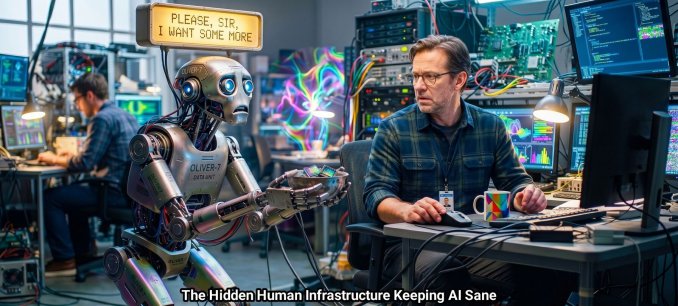
Even with vintage data, AI companies cannot entirely avoid the modern internet. To find new human thoughts, they must wade through the web, which means they need a way to separate the human gold from the AI dross. To do this they rely on an invisible army of hundreds of thousands of low-wage workers from Kenya and the Philippines to rural parts of the United States. In the tech industry, this is known as “data annotation” or ghost work.
These human workers sit in front of computer screens for hours a day, reading thousands of paragraphs or looking at thousands of images. Their job is to act as the AI’s taste-testers. They flag text that looks too formulaic, identify images with telltale AI errors (like hands with six fingers or melting backgrounds), and manually sort the data. When you use a chatbot and it gives a helpful, grounded response, it is not because the AI is inherently wise. It is because a human being somewhere in the world was paid a few dollars an hour to look at ten different versions of that response, grade them, and teach the machine which one sounded like a real person. This process, called Reinforcement Learning from Human Feedback (RLHF), is the ultimate guardrail. It is the human glue holding the digital mind together. Without this endless, exhausting human labour, the AI would drift into model collapse within weeks (if I’ve understood that right).
This desperate need for pure human data is fundamentally changing how the internet works for the rest of us. For thirty years, the internet operated on a model of openness (political attempts to control it excepted). You could browse websites, read forums, and share information freely. Unfortunately, that era appears to be coming to an end, to be replaced by what looks to me like the digital equivalent of land enclosures. Websites that host authentic human conversations, such as Reddit and, I suppose, FSB – you are all human, aren’t you? – have realised that their data is valuable. They know that AI companies are starving for human words. As a result, these platforms are building massive digital walls. They are blocking AI “spiders” from crawling their pages for free and demanding millions of dollars in licensing fees just to let the machines read what their users are saying. You see my ears pricking up there, at the back?
For everyday users, this means that the internet is becoming more fractured and transactional. Platforms are forcing users to log in to see content, hiding discussions behind paywalls, and aggressively protecting their data. If I’m right, the open, chaotic web is being carved up into private territories, all because human thought has become a scarce commodity (perhaps it always was, on the Left anyhow) that tech monopolies need to steal to keep their AIs alive.
Despite the walls, the filters, and the ghost workers, scientists are warning of a looming crisis: we are running ut of data. Humans simply cannot produce written words or images fast enough to satisfy the insatiable appetite of modern AI algorithms. Some studies estimate that tech companies will completely exhaust the supply of high-quality, available human text online within the next few years. When the pure human data runs out, what happens then? Tech companies are experimenting with a controversial band-aid called “synthetic data generation.” Instead of letting an AI blindly learn from all AI data, engineers are trying to carefully curate “perfect” AI data. They use a highly advanced AI to generate maths problems or logic puzzles, check the answers for absolute accuracy using rigid computer code, and then feed only those flawless answers to a newer AI.
But as I said yesterday, this works for strict, rule-based subjects like mathematics or computer programming, but fails when applied to language, art, human culture, or emotion. A computer can verify if a maths equation is correct, but it cannot verify if an essay about grief is profound, or if a political analysis is nuanced. In the realms of creativity and human experience, synthetic data remains a shortcut to model collapse. So, maybe I’ve misunderstood what the tech plan is, but so far as I can fathom, they have not yet found a way around the basic problem of requiring constant input of subjective human output.
For anyone who looks at the rise of AI with fear, understanding this hidden infrastructure changes everything – I hope. Wishful thinking perhaps, but that’s how I see it now. The mainstream narrative often portrays AI as an independent entity that is slowly eclipsing humanity. But looking behind the curtain reveals a very different reality.AI is not a self-sustaining engine; it is a parasitic technology. It requires a massive, continuous pipeline of human lived experience, human labour, and human history just to maintain its baseline sanity. The moment that pipeline thins, the machine begins to hallucinate, stutter, and break down. This gives humanity an incredible, permanent leverage. We are not the obsolete ancestors of a new digital species. We are the managers, the anchors, and the essential life-support system for a tool that cannot survive a day without our collective intellect. The fear that AI will outgrow us is a mathematical impossibility. The machine can only ever be as vast, as deep, and as varied as the human world we allow it to mirror.
This article (AI – The Guardrail Crisis) was created and published by Free Speech Backlash and is republished here under “Fair Use” with attribution to the author Tom Armstrong
See Part Three Below
The AI Crisis Revalues the Uniquely Human Mind
TOM ARMSTRONG

In our first essay in this series, we discovered the Photopocalypse, the mathematical law of model collapse proving that if an artificial intelligence learns only from its own output it loses its mind in a few generations. In our second, we looked behind the curtain at the frantic, hidden infrastructure of the tech world: the hoarding of “vintage” pre-2023 data, the global army of low-wage human clickworkers scrubbing the internet of digital pollution, and the building of corporate walls around human conversation. Now, we look at the logical destination of this journey and try, as best we can, to examine how this mathematical crisis changes the value of a human being in tomorrow’s economy.
For the past few years, the public narrative has been one of deep anxiety. Workers, from graphic designers and copywriters to lawyers and coders, have been told that their skills are on the verge of becoming obsolete. We have been conditioned to view our human limitations, our slow processing speeds, and our emotional vulnerabilities as liabilities in a world dominated by hyper-efficient algorithms. But model collapse completely reverses this power dynamic. Because, in regard to subjective human thought at least, AI cannot survive without a constant injection of human reality, the things that make us human are not liabilities but valuable assets. We are, perhaps, entering an era of “The Human Premium,” where the messy, unpredictable, and embodied nature of human life is the only thing protecting the digital economy from stagnation.
As we have said previously, because AI models generate text and images based on mathematical averages, they excel at creating things that are “good enough.” They can instantly write a standard corporate email, draft a generic marketing blog post, or paint a generic background image of a sunset. But because tech companies are running out of new human data and recycling their own automated content, the basic digital output is becoming homogenised and the internet is filling up with a bland, sterile paste: every corporate website is starting to sound exactly the same. I have a better handle on economics than computer code and can tell you that when something becomes infinitely abundant and easy to produce, its financial value drops significantly. The “average” essay or the “average” logo is no longer worth anything because a machine can generate ten thousand of them for pennies.
If, as I understand it will, the digital world becomes saturated with predictable, automated mediocrity, the human appetite for the authentic, the unexpected, and the genuinely creative will intensify. The value then shifts to the extremes, the specialised, the profoundly strange, the fiercely original, and the deeply personal. In a world of infinite digital copies, the human fingerprint becomes a luxury good.
Why can humans create this premium content while machines fail? It comes down, in my view, to how humans process mistakes. In an AI, an error is a statistical glitch that, if fed back into the system, leads to model collapse and digital dementia. If an AI miscalculates a pattern, it cascades into nonsense. But in the human brain, errors are something entirely different: they are the fertile soil of creativity and evolution. Human history is shaped by beautiful mistakes, happy accidents, and irrational leaps of logic. A human songwriter trying to copy a classical melody might accidentally slip on a chord, find the resulting dissonance beautiful, and invent an entirely new genre of music like jazz or the blues. A scientist like Alexander Fleming might accidentally leave a petri dish uncovered, notice a strange mould growing on it and discover penicillin.
Humans possess the unique ability to misinterpret data in a constructive way. We have intuition, a subconscious processing of our physical environment, that allows us to make wild, unprovable leaps of faith that happen to be correct. AI cannot do this. An AI cannot experience a hunch; it can only calculate a trajectory based on what has already happened. By feeding on its own data, the machine isolates itself from the random, chaotic sparks of genius that only occur when a living mind collides with physical reality. The human mind is valuable precisely because it is beautifully, systematically imperfect.
Know I suppose that nobody really knows, certainly not poor old Armstrong floundering around in a world he barely understands, but sure it is possible that this redefines the role of human workers in the age of AI. Maybe we will not be replaced but instead raised into a position of digital guardianship. (Though I suppose that begs the question of how many of us will be required for that.)
Take the field of education, for example. An AI can easily generate a standard, technically accurate lesson plan about the French Revolution, but it cannot look at a classroom of thirty teenagers, notice that a student in the back row looks anxious or distracted, and pivot the conversation to connect 18th-century history to that student’s modern life. The AI lacks empathy, situational awareness, and an emotional pulse. The future of teaching is not, or should not be, automated modules; it is the human educator using AI to handle the paperwork while they focus entirely on the emotional and psychological development of the child.
The same is true for fields like medicine, law, and journalism. An AI can cross-reference millions of medical symptoms in a second, but it cannot sit at a bedside, read the fear in a patient’s eyes, and deliver a devastating diagnosis with the precise mixture of clinical clarity and human warmth required to give that patient strength. The human worker becomes the essential bridge between the machine’s raw mathematical processing and the delicate reality of human existence.
If the internet becomes a hall of mirrors where you can never be certain if an article was written by a person, an image was drawn by a human, or a video is real, human trust will retreat to spaces where authenticity can be physically verified. We are, I’m told, already seeing a resurgence in the value of physical books, vinyl records, hand-crafted goods, local community theatres, and face-to-face journalism. The economic premium of the future will be placed on things that can prove they cannot be replicated by an algorithm. A hand-carved wooden table carries a premium not because it is mathematically perfect, but precisely because the slight variations in the grain prove a human being spent their finite lifeforce shaping it. Our mortality, our limitations, and our limited time are what give our creations value.
The discovery of model collapse should, therefore, dismantle the existential dread of AI, which is not coming to inherit our world because they lack the biological engine required to generate reality. They are brilliant, lightning-fast shadows, but they require our solid bodies to exist.
We are not entering a future where humanity is a footnote to the rise of the silicon mind. More than likely, in the future the human experience will be recognised as the ultimate, non-negotiable currency of the digital age. The most radical thing you can do in the coming decades is to lean heavily into your humanity: trust your intuition, cultivate your eccentricities, embrace your mistakes, and live deeply in the physical world. AI – which I use for research to boost productivity – can copy our past but is dependent on us to create the future.
This article (The AI Crisis Revalues the Uniquely Human Mind) was created and published by Free Speech Backlash and is republished here under “Fair Use” with attribution to the author Tom Armstrong
Featured image: Free Speech Backlash (modified)


Leave a Reply