

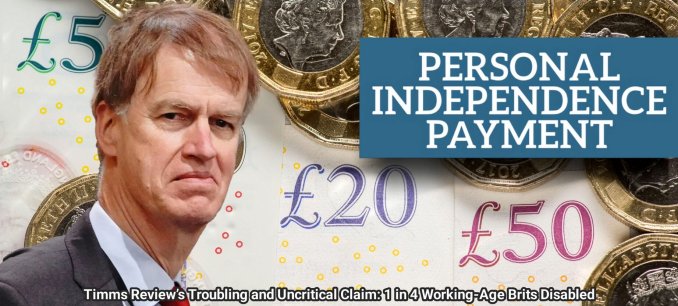
The Timms Review’s Credulous Acceptance That One in Four Working-Age Brits Are Disabled Spells Trouble
MARY GILLEECE
The Timms Review into Personal Independence Payments (PIP) has made great strides in stating the bleeding obvious:
Our message is simple: PIP is not working. It is not working for the people that go through the process, nor for a Government committed to supporting disabled people.
Co-chaired by Minister of State for Social Security and Disability Sir Stephen Timms, Sharon Brennan and Dr Clenton Farquharson CBE, more than 38,000 people and disability groups responded to its call for evidence. The report is proudly “co-produced by disabled people”.
For those readers who are unaware of PIP, the report helpfully explains that:
People may be entitled to PIP if:
- they’re 16 or over
- they have a long-term physical or mental health condition or disability
- they have difficulty doing certain everyday tasks or getting around
- they expect the difficulties to last for at least 12 months from when they started
No diagnostic tests are required but rather assessment is made based on capacity to function normally. I have written before of the sad story of a young woman who receives PIP because she is overweight and says she cannot wash below the waist nor walk to a bus stop without getting puffed out. This sort of claimant is by no means rare.
The press release supporting the review places sensitivities around those living with disabilities front and centre. Jon Sparkes OBE, Chief Executive of learning disability charity Mencap, is amongst those quoted as stating:
This report shows clearly that that the current claims process is not fit for purpose and places an unfair administrative and emotional burden on people with a learning disability and their families. This chimes with our experience: the application process is not accessible, assessments end up being a needless fight and unnecessary re-assessments create distrust in the decision-making process.
What has been explored in the review but not trumpeted by the press release is the financial burden of PIP on the wider taxpayers. The review states:
In financial year ending (FYE) 2020, total PIP expenditure was around £15 billion (£13 billion for working-age claimants) in 2026 to 2027 prices. As of spring 2026, this spending is forecast by the Department for Work and Pensions (DWP) to increase to over £41 billion (£34 billion for working-age claimants) in FYE 2031. This has occurred alongside a reduction in expenditure on other working-age welfare benefits, when measured in percentage of GDP terms.
Oddly, Sir Stephen Timms told the BBC’s Today: “My view is the current level of spending is not a great concern.”
Alas “this interim report does not provide recommendations”. We have to wait until autumn for those. But from Timms’s comments, don’t expect any suggestion of the moral imperative of reducing expenditure.
In the meantime, I do wonder if the whole approach to PIP and other welfare overspend is being examined through the wrong end of the telescope. There is one glaring contention of the report that, to my mind, needs to be thoroughly and rapidly interrogated. The opening sentence of the report is foundational to everything that follow. It states:
Disability can impact any one of us at any stage in our lives whether through illness or health conditions, accident or ageing. Almost one in four people of working age have a disability. [Footnote: This figure is based on the number of people reporting they have a disability.]
Can this figure of one in four people being disabled possibly be true? Statistics relentlessly suggest this is indeed the case. The review explains:
From 2009 to 2024, disability benefit prevalence (the percentage of the population receiving a disability benefit) has increased for all age groups and sex. Most of the increase in prevalence occurred in the last five years of the period, with growth between 2019 and 2024 nearly double that seen over the previous decade.
The increases in prevalence have been most marked amongst those aged 16 to 19 and for those aged in their 30s. Prevalence has increased more among women than men. While women are less likely to receive disability benefits in their teens and 20s, the difference between men and women at those ages has narrowed, while from the 30s upwards, the prevalence of receipt among women has increased faster than for men.
This bears repeating: “Increases in prevalence have been most marked amongst those aged 16 to 19 and for those aged in their thirties. Prevalence has increased more among women than men.”
If it is indeed true that one in four people are disabled and that disabilities are rocketing amongst 16-19 year-olds and amongst women generally, it will become logically impossible to dismantle any sort of welfare system. If there is a ballooning supply of disabled people there will necessarily be a growing welfare budget regardless of whether such financial support is supportive or inimical to personal flourishing.
Perhaps in his autumn report, Timms ought to address this aspect of things: is it true that 25% of the population is disabled? I’m not sure the vast numbers of disability charities and support groups co-producing the review would like the answer.
This article (The Timms Review’s Credulous Acceptance That One in Four Working-Age Brits Are Disabled Spells Trouble) was created and published by The Daily Sceptic and is republished here under “Fair Use” with attribution to the author Mary Gilleece

••••
The Liberty Beacon Project is now expanding at a near exponential rate, and for this we are grateful and excited! But we must also be practical. For 7 years we have not asked for any donations, and have built this project with our own funds as we grew. We are now experiencing ever increasing growing pains due to the large number of websites and projects we represent. So we have just installed donation buttons on our websites and ask that you consider this when you visit them. Nothing is too small. We thank you for all your support and your considerations … (TLB)
••••
Comment Policy: As a privately owned web site, we reserve the right to remove comments that contain spam, advertising, vulgarity, threats of violence, racism, or personal/abusive attacks on other users. This also applies to trolling, the use of more than one alias, or just intentional mischief. Enforcement of this policy is at the discretion of this websites administrators. Repeat offenders may be blocked or permanently banned without prior warning.
••••
Disclaimer: TLB websites contain copyrighted material the use of which has not always been specifically authorized by the copyright owner. We are making such material available to our readers under the provisions of “fair use” in an effort to advance a better understanding of political, health, economic and social issues. The material on this site is distributed without profit to those who have expressed a prior interest in receiving it for research and educational purposes. If you wish to use copyrighted material for purposes other than “fair use” you must request permission from the copyright owner.
••••
Disclaimer: The information and opinions shared are for informational purposes only including, but not limited to, text, graphics, images and other material are not intended as medical advice or instruction. Nothing mentioned is intended to be a substitute for professional medical advice, diagnosis or treatment.
Disclaimer: The views and opinions expressed in this article are those of the author and do not necessarily reflect the official policy or position of The Liberty Beacon Project.


Leave a Reply