

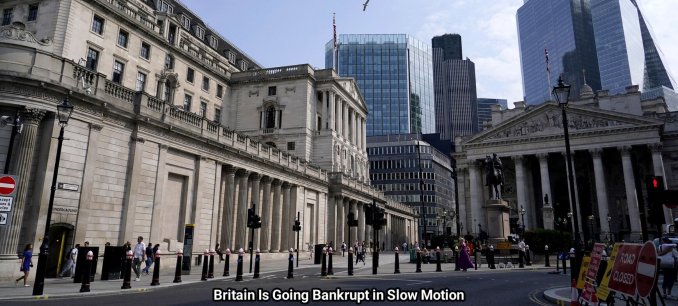
Britain is going bankrupt in slow motion
DANIEL HERRING
- The OBR says UK debt is on course to hit 300% of GDP by 2075
- If politicians wait until 2052 to act, the spending cuts needed more than double
- Sooner or later, taxes rise, spending falls or growth accelerates – duck all three, and we face fiscal catastrophe
The OBR’s latest Fiscal Risks and Sustainability report, published this week, gives a blunt assessment of the UK’s public finances: we can’t go on like this. If nothing changes, government debt will rise to an unsustainable 300% of GDP in 50 years’ time.
How did things get so bad? Well, there’s one big demographic challenge driving that number: the UK is an ageing society, with the median age projected to rise from 40 in 2025 to 49 in 2075. An older society is expensive; as each year passes, demands on the state by retirees gets larger, while the workforce that has to pay for it all gets smaller (first in relative terms, and eventually in absolute terms as well).
Sooner or later, taxes rise, spending falls or growth accelerates – duck all three, and we go bankrupt
But this is a forecast, not a prophecy. The OBR’s figures show that the course we are currently on ends in economic disaster only if our politicians keep punting hard choices down the road. If they – and we – are willing to face reality, things can still be turned around.
The report highlights three big choices the next government needs to make.
1. When to cut the deficit
The OBR says that just to hold debt at around 95% of GDP over the next 50 years, the government needs to permanently cut its primary deficit by 3.8% of GDP no later than 2031-32: meaning significant spending cuts or tax rises. But debt at 95% of GDP is still high by historical standards, and leaves the economy vulnerable to external shocks. Returning it to a pre-financial-crisis level of around 40% of GDP would require an even larger permanent reduction in the primary deficit of 4.9% of GDP, again from 2031-32 onwards.
Here’s the catch: delay costs money – lots of money. Wait until 2052-53 to face the music, and the government will have to cut spending by almost 8% of GDP instead.
There’s an additional benefit to cutting earlier. A credible commitment to cut the deficit increases confidence for buyers of government debt because a future risk of default is lower. It also increases business confidence: if the finances are sound, they know future tax rises are less likely.
The OBR doesn’t give a view about whether the deficit should be reduced by cutting spending or raising taxes. However, UK taxes are already at a post-war high and the economic literature suggests that cutting spending is usually the better option. For example, ‘Austerity: When it works and when it doesn’t’, a book by leading economists Alesina, Favero and Giavazzi, looks at data around fiscal consolidations from 1980 to 2015 and finds that cutting expenditure is much better for economic growth than raising taxes to eliminate a deficit.
2. How to spend our taxes
This leads us onto the second choice – how government spends taxpayer money. In the OBR’s baseline scenario, pension spending increases from 5% to 9% of GDP, health spending from 8% to 13% and adult social care from 1.2% to 1.8%. Much of this increase is driven by demographics, but there are choices available which can reduce their impact.
The pension triple lock is partially responsible, and should be replaced with a more sensible uprating mechanism, alongside a higher age of eligibility. On health, much of this is driven by an assumption that health productivity growth is slower than other areas of the economy, as well as by the assumption that when people’s incomes rise, they demand more healthcare. But policy choices can make a clear difference: for example, encouraging innovation and new models of healthcare could lower the cost. Over time, policymakers and the general public may have to face up to the fact that increasing individual responsibility for health costs – through insurance and savings, like most of the rest of the world – would ensure demand is met from personal as well as state resources, and allocated more efficiently as a result.
3. What to do about productivity
The third choice is on productivity growth, which the OBR rightly states is the ‘single most important determinant of living standards in the long term’. One of the starkest charts in the report shows that for someone born in 1961, GDP per capita has grown three and a half times over their lifetime. For those born in 1991, if growth continues as it has for the last 15 years, it will only double.
The OBR remains optimistic. Despite annual growth in output per hour of just 0.4% since 2009, it assumes that it will revert to 1.4%. But if productivity growth stays at the level of recent years, the economy would be one third smaller than the baseline scenario in 2075, and to maintain debt at current levels the government would need to reduce the deficit by an eye-watering 8.6% of GDP.
On the other hand, if we can get higher growth, many problems disappear. Higher growth of 1.9% means GDP is 17% larger and means that, if the government wanted to maintain government debt at the level it is today, it would need to cut the primary deficit by just 1.8% of GDP.
We can’t know where the next wave of economic growth will come from. But we do know how government can set the preconditions for growth: smaller government, flexible labour markets, a pro-growth tax structure, liberal planning laws and cheap energy. Get this right, and the medicine is far easier to swallow.
The OBR report highlights the challenges an ageing population poses for the UK: sooner or later, taxes rise, spending falls or growth accelerates – duck all three, and we go bankrupt. How painful the correction turns out to be remains a political choice.
The UK is sick – but far from terminal. It needs medicine now: cuts to public spending, less reliance on the state and a relentless focus on growth. Prompt action will restore a healthy economy and sound public finances. Waiting will make things much worse.
This article (Britain is going bankrupt in slow motion) was created and published by CapX and is republished here under “Fair Use” with attribution to the author Daniel Herring


Leave a Reply