

TOM ARMSTRONG

This article is the result of an encounter with HMRC, who contacted me recently demanding money with menaces. I got a letter from them saying that I owed them a couple of grand from 2024, referring to a letter I had not received. I called them, and eventually got through to a woman with a very hard to understand India accent, who more or less said the same thing as the letter and advising me what to do, obviously spending as little time as possible with me.
It proved impossible to do what she had advised, fortunately, as it would have cost me even more money, so I called again. This time another – very helpful woman – gave me the correct info and we got it sorted out alright. I then asked her why the other woman had not been able to help and the answer was, ‘well, she probably just consulted the algorithm in the machine’. On looking into it a bit, this seems to be the norm now in the public sector, where AI increasingly makes the decisions.
And so,taking it to it’s logical conclusion, it seems to me that there is a distinct, unsettling feeling that the traditional levers of democracy no longer work (assuming they ever did). We change the politicians at the top, yet the vast machine of the state remains entirely unbothered, continuing along the exact same path. Taxes rise, surveillance expands, free speech shrinks, and the productive citizen is squeezed. Most people blame incompetent ministers or ideological capture within the Civil Service. All true, but a large, quieter transformation is also taking place. The British state is outsourcing its actual, daily governance power to artificial intelligence.
Without a single roar of protest, our ancient system of human judgment and common law is being replaced by black-box algorithms. The mainstream media ignores this, blinded by a naive worship of technological efficiency, if it knows about it which, given its odd lack of curiosity, is doubtful. Yet for the independent mind, this is the serious threat. We are not only losing our historic liberties to a foreign’ army’ and an openly tyrannical dictator but also losing them to a ghost in the machine.
We are raised on the once comforting but now sinister constitutional myth that Parliament is supreme. We are told that the individuals we elect go to Westminster to debate, draft, and enact the rules that govern our lives. This has become an illusion. Today, the day-to-day administration of Britain is controlled by an intricate network of automated software systems. When a modern bureaucrat, a tax official, or a police officer makes a pivotal decision about your life, they rarely consult their own reason, conscience, or common sense. Instead, they feed your personal data into a computer programme. The software uses a hidden, proprietary mathematical formula to produce a verdict. If the algorithm flags your tax return as an anomaly, your bank account is frozen without warning. If it decides your child does not fit the criteria, a school place is denied.
The politicians we elect do not understand how these algorithms work. They do not know what code is written inside them. This means the people we vote for are no longer truly in charge. The programmers and global software conglomerates hold the real power. We are left with the hollow theatre of voting, while an invisible machine governs the realm.
To understand how dangerous this is, we must look at how British freedom was built. Our liberties were never granted by benevolent governments; they were won through fierce resistance to unaccountable power. In the seventeenth century, Charles I attempted to bypass the common law courts by using the Star Chamber. This was a court where the King’s inner circle met in secret, using arbitrary rules without a jury to crush political dissenters. The English people revolted because they recognised that secret, unchecked power is the very definition of tyranny.
A century later, in the 1760s, the Crown used General Warrants to arrest critics of the government. These warrants did not name specific suspects or list specific evidence; they gave state messengers the blanket power to search any home and seize any property. In the landmark case Entick v Carrington, Chief Justice Charles Pratt ruled that the state cannot simply invent powers for its own convenience. If it is not found in our established laws, he declared, it is an unjustified trespass.
Our ancestors understood a fundamental truth: for a law to be legitimate, it must be visible, it must be human, and it must be contestable. Algorithms are the modern incarnation of the Star Chamber and the General Warrant. They operate in total secrecy, they profile entire populations without specific evidence, and they leave the individual with no meaningful right of appeal.
For nearly a millennium, the bedrock of British life has been Common Law. This system relies entirely on the human element. It is built on human reason, trial by jury, the presumption of innocence, and the right to face your accuser. Algorithms completely destroy this legacy. An artificial intelligence system has no soul, no concept of mercy, and no capacity for contextual wisdom. When the state uses a machine to judge a citizen, the right to face one’s accuser is wiped out. You cannot cross-examine a line of proprietary code. You cannot ask a piece of software to explain its bias.
When you object to an algorithmic decision, the human staff behind the desk will simply shrug and tell you, “The system says no.” This is a profound violation of the Magna Carta, which promised that no free man would be stripped of his rights except by the lawful judgment of his peers or by the law of the land. Human justice is being replaced by bureaucratic mathematics.
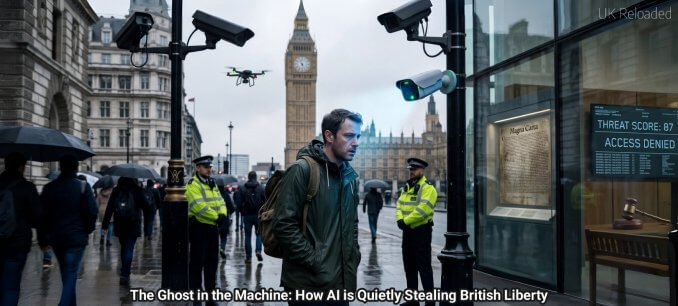
The most terrifying deployment of this technology is happening across British policing. Forces across the country are rapidly adopting predictive policing models. These tools scrape vast oceans of data from social media, public cameras, tax records, and vehicle movements. The software attempts to predict who will commit a crime before any offence has actually occurred. It generates a threat score for ordinary citizens. If you attend a peaceful but controversial protest, express traditional conservative opinions online, or simply associate with people who dislike the regime, the machine subtly adjusts your profile.
This completely inverts our legal tradition. We are moving from a system that punishes bad actions to a system that monitors potential threats. Live Facial Recognition cameras now scan crowds in our major cities, matching faces against watchlists whose entry criteria are hidden from public view. If the algorithm makes an error and flags your face, the burden of proof instantly shifts to you. You are guilty until you can prove the computer made a mistake.
Why is this existential shift ignored by the grand institutions of the mainstream press? The answer lies in the total capture of the media class. First, legacy media outlets are deeply dependent on government advertising revenue and official access. They have no desire to criticise the structural mechanics of the state. Second, the modern journalist is conditioned to view technological modernization as inherently progressive. They see AI as a marvellous tool for efficiency and public safety, completely lacking the philosophical depth to see how code erodes ancient constitutional protections.
Finally, the Silicon Valley corporations that build these algorithmic tools spend millions of pounds lobbying Westminster and funding influential think tanks. They have successfully established a wall of corporate secrecy around their software. If an independent journalist asks to examine the code, they are rebuffed on the grounds of intellectual property. The media establishment accepts this excuse because they belong to the very same globalist ecosystem.
We cannot expect the current political class to rescue us from this digital trap. Both major parties are thoroughly enamoured with centralisation, surveillance, and control. The defence of British liberty must begin with the individual. We must campaign for a strict legal framework ensuring that if any public body uses an AI tool to make decisions about citizens, the exact criteria and code must be placed in the public domain. Furthermore, we must intentionally protect our privacy by defending the use of physical cash, opting out of digital public services wherever a paper alternative exists, and rejecting the smart home devices that map our daily routines. We must also try to educate our local communities about our historic rights. We must boldly remind our local authorities that our freedoms do not originate from a state computer, but from a profound legal heritage that explicitly forbids automated tyranny.
The battle for the future of Britain is no longer a conventional only a debate between left and right, globalists and patriots, it is also an existential conflict between the human soul and the digital machine. If we allow algorithms to quietly run our nation, we are trading our birthright as free Britons for a corporate spreadsheet. It is time to pull back the curtain, expose the ghost in the machine, and demand a return to a human, accountable, and free British society.
This article (The Ghost in the Machine: How AI is Quietly Stealing British Liberty) was created and published by Free Speech Backlash and is republished here under “Fair Use” with attribution to the author Tom Armstrong


But it’s not your government, it’s his majesty’s, remember. Says so on the tin. What Solar System? Canute?