

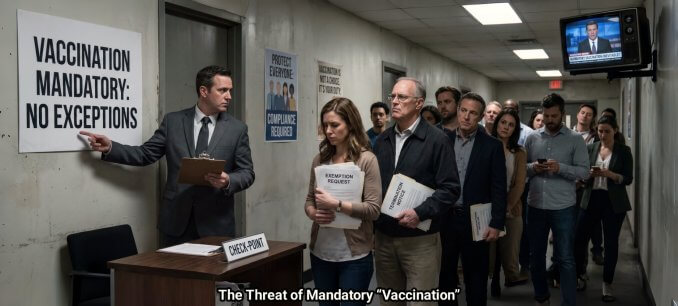
Why was mandatory “vaccination” for all made to seem inevitable?
DAVID A. HUGHES
Introduction
There are powerful ethical, political, and scientific arguments against mandatory vaccination, especially en masse.
No such considerations were evident, however, in the drive to inject as many people as possible with undisclosed substances masquerading as “Covid-19 vaccines” (Hughes, 2024, pp. 236-248). Rather, governments and the legacy media resorted to every trick in the book to maximise “vaccine” uptake.
Although not everyone was injected, a precedent was set that helped to normalise the idea of mass vaccination. Most people (ca. 77% of UK adults, skewed towards older age ranges [UKHSA, 2022b, Table 5]) got at least one shot, regardless of whether they really wanted to and of whether they actually needed to do so.
One important tactic in driving “vaccine” uptake was to create the misimpression that vaccination could be made mandatory for everyone. This began by seeding the idea of mandatory vaccination while denying that it would happen, then offering the jab to at-risk groups, before unnecessarily rolling it out to all age groups with the clear expectation that everyone (unless granted a medical or religious exemption) should roll up their sleeves.
The threat of unemployment was dangled over those who refused, even though there was no legal basis for this in most cases. In the UK, “vaccine” mandates for care home workers, plus the announcement that similar mandates would be introduced in the NHS (the world’s fifth largest employer) created an ominous sense that it would only be a matter of time before “Covid-19 vaccines” were mandated for everyone.
That sense of inevitability no doubt prompted some people to receive the injections who otherwise would not have done so — and should not have done so.
Ethical and Political Arguments Against Vaccine Mandates
After details emerged of Nazi medical experiments and murders in concentration camps, often involving the use of syringes (Lifton, 1986, p. 269; Hughes, 2024b, pp. 142-147), the Nuremberg Code (1947) enshrined the principle of informed consent at the heart of medical ethics. This was confirmed by subsequent frameworks, such as the Declaration of Helsinki (1964) and the Belmont Report (1979).
Vaccine mandates, however, violate the principle of informed consent, and thus the Nuremberg Code and attendant frameworks. They mean that those who do not wish to be vaccinated can be injected against their will.
Professor David Feldman defines bodily integrity as “a right to be free from physical interference.” This includes
freedom from physical assaults, torture, medical or other experimentation, immunization and compelled eugenic or social sterilization, and cruel or degrading treatment or punishment. It also encompasses some positive duties on the state to protect people against inference by others. (Feldman, 2002, p. 241).
When the state assumes the right to violate the bodily integrity of those within its jurisdiction, it effectively assumes legal ownership over their bodies, turning them into slaves (Davis, 2021).
This is consistent with Italian philosopher Giorgio Agamben’s (1998) notion of “biopower,” i.e., direct control over human bodies without recourse to the rights of citizenship. As the nation-state breaks down, Agamben predicted, biopower, which was witnessed in Nazi concentration camps, would emerge as “the fundamental biopolitical paradigm of the West,” whereby “the state decides to assume directly the care of the nation’s biological life as one of its proper tasks” (1998, pp. 175–181).
The attack on bodily autonomy during Covid (Hughes, 2026), along with the advent of so-called “mRNA vaccines” allegedly capable of “programming” human cells to produce specific proteins (Hughes, 2024b, p. 144), are consistent with the rise of biopower. Mandatory vaccination for all would mark the advent of a totalitarian society in which individuals are no longer sovereign over their own bodies.
Scientific Reasons Not to “Vaccinate” Everyone
Regardless of “safe and effective” propaganda, the risk posed by “Covid-19 vaccines” was substantial because of the lack of any safety data beyond just a few months. As the former Vice President and Chief Scientific Officer of Pfizer’s Allergy & Respiratory Research division, Mike Yeadon (2020b), stated two months before the rollout began, “You do not vaccinate people who aren’t at risk from a disease. You also don’t set about planning to vaccinate millions of fit and healthy people with a vaccine that hasn’t been extensively tested on human subjects.”
There was no point in “vaccinating” those who had already had “Covid-19” (Shrestha et al., 2022). There was no benefit, only risk.
Although certain medical exemptions were allowed, the drive to inject as many people as possible must have meant that, in many cases, previous medical history was not adequately taken into account. The “Covid-19 vaccines” were not suitable for everyone, yet everyone was encouraged to take them.
To illustrate this point with an analogy, 2% of Westerners have a peanut allergy (Lieberman et al, 2021), possibly because of peanut oil having been put in vaccines (Rojas, 2023). If everyone had been forced to eat a spoonful of peanut butter in 2021, the number of serious adverse reactions would have been in the tens of millions. No product should be pushed on the entire population.
The US CDC in 2021 redefined “vaccination” to exclude all reference to immunity: alleviation of symptoms, rather than preventing infection or transmission, was sufficient (Hughes, 2022, p. 210). But if the “vaccines” only alleviated symptoms, why give them to asymptomatic people? People without HIV are not given HIV medication, for instance.
According to Doctors For Covid Ethics (2023), mRNA vaccines are harmful from first principles, so should never have been administered. The authorities must have known this.
Legal Arguments Against Mandatory Vaccination
In Montgomery vs Lanarkshire Health Board (2015), the UK Supreme Court ruled that “an adult person of sound mind is entitled to decide which, if any, of the available forms of treatment to undergo, and her consent must be obtained before treatment interfering with her bodily integrity is undertaken.” This set a clear legal precedent defending bodily integrity and informed consent.
A House of Commons Library briefing document from May 2021 notes that vaccinations in the UK are not mandatory, even during a pandemic, and that consent to vaccination must always be given (Rough & Powell, 2021, p. 70). It adds that, whilst section 45C of the Public Health (Control of Disease) Act 1984 provides for a “public health response to the incidence or spread of infection or contamination,” it explicitly excludes “requiring a person to undergo medical treatment,” including vaccination.
The Coronavirus Act 2020 created temporary emergency powers (e.g., for managing healthcare staffing, postponing elections, and enforcing quarantine), but it did not amend or repeal Section 45C(6) of the 1984 Act. Nothing in the Act authorises compulsory vaccination.
The Health Protection (Coronavirus) Regulations 2020, pertaining to “lockdown” measures, were made, in part, under Section 45C, as their opening line makes clear: “The Secretary of State makes the following Regulations in exercise of the powers conferred by sections 45C(1), (3)(c), (4)(b), (4)(d), 45F(2) and 45P of the Public Health (Control of Disease) Act 1984).”
UK politicians should, therefore, have been aware that vaccine mandates for the general population were without foundation in UK law.
Where vaccination was later mandated (for care home workers and NHS workers, though the latter mandate was never implemented), this was done through employment regulations, not public health regulations under Section 45C.
Tactical Arguments Against Mandatory Vaccination
Arguments against mandatory vaccination were well established even by pro-vaccine advocates when the “Covid-19 vaccine” rollout began.
It was known, for instance, that the element of coercion risks turning people against vaccination (Salmon et al., 2015). There is no evidence that mandatory vaccination has been effective in increasing vaccine uptake; on the contrary, it risks alienating people (Bedford & Elliman, 2019). Preferable to mandatory vaccination is to improve vaccination rates through education (Hadjipanayis et al., 2020). The risks and harms of removing personal choice must be taken into account (Hadjipanayis & Efstathiou, 2020, p. 206). Mandatory vaccination undermines personal freedom and autonomy (Patryna & Zagajaa, 2016, p. 2204). A system of medical, religious, and/or philosophical exemptions should be considered (Pierik, 2017, p. 220).
All of these studies are pro-vaccination and seek to combat “vaccine hesitancy,” especially among parents on behalf of their children, yet they all draw the line at mandatory vaccination. They are all cited in a House of Commons Library briefing document titled UK Vaccination Policy, dated January 21, 2021 (Rough, 2021).
UK politicians should have known, therefore, that mandatory vaccination was not something to be considered, not even for tactical reasons.
Summary
Vaccine mandates in the UK cross every conceivable line. They violate the principle of informed consent, they violate bodily integrity, they make no scientific sense as applied to the general population, they are illegal under public health regulations, and even pro-vaccination advocates recognise that they are tactically inadvisable.
Nevertheless, as we will see in the next section, the UK authorities, as elsewhere, went all in on trying to convince the population that almost everyone – even pregnant women and children – could and should be “vaccinated.”
References
Agamben, G. (1998). Homo sacer. Stanford University Press.
Bedford, H.E., & Elliman, D.A.C. (2019). Should measles vaccination be compulsory? BMJ, 365, Article l2359. https://www.bmj.com/content/365/bmj.l2359/.
Davis, I. (2021, December 22). COVID jabs: Ineffective, oppressive and dangerous. https://iaindavis.com/covid-jabs/
Doctors for Covid Ethics. (2023). mRNA Vaccine Toxicity. https://doctors4covidethics.org/mrna-vaccine-toxicity/.
Feldman, D. (2002). Civil liberties and human rights in England and Wales, 2nd ed. Oxford University Press.
Hadjipanayis, A., Dornbusch, H.J., Grossman, Z., Theophilou, L., & Brierley, J. (2020). Mandatory vaccination: A joint statement of the ethics and vaccination working groups of the European Academy of Paediatrics.” European Journal of Pediatrics, 179(4), 683–687. https://pubmed.ncbi.nlm.nih.gov/31773329/.
Hadjipanayis, A., & Efstathiou, E. (2020). Editorial commentary on the paper, “Mandatory vaccination in Europe.” Translational Pediatrics, 9(3), 206-208. https://tp.amegroups.com/article/view/43960/html.
Hughes, D. A. (2022a). “Covid-19 vaccines” for children in the UK: A tale of establishment corruption. International Journal of Vaccine Theory, Practice, and Research, 2(1), 209–247. https://doi.org/10.56098/ijvtpr.v2i1.35.
Hughes, D.A. (2024a). “Covid-19,” psychological operations, and the war for technocracy. Palgrave Macmillan.
Hughes, D.A. (2024b). Wall Street, the Nazis, and the Crimes of the Deep State. Skyhorse.
Hughes, D.A. (2026). “Covid-19” and the attack on bodily autonomy. https://davidahughes.net/covid-19-and-the-attack-on-bodily-autonomy/.
Lieberman, J.A., Gupta, R.S., Knibb, R.C., Haselkorn, T., Tilles, S., Mack, D.P., & Pouessel, G. (2021). The global burden of illness of peanut allergy: A comprehensive literature review. Allergy, 76(5), 1367-1384. https://doi.org/10.1111/all.14666.
Lifton, R.J. (1986). The Nazi doctors. Basic Books.
Montgomery v Lanarkshire Health Board [2015] UKSC 11; [2015] 1 A.C. 1430. https://www.supremecourt.uk/cases/docs/uksc-2013-0136-judgment.pdf.
Patryna, R.K., & Zagajaa, A. (2016). Vaccinations—Between free will and coercion. Human Vaccines & Immunotherapeutics, 12(8), 2204–2205. http://europepmc.org/article/MED/27070840#free-full-text.
Pierik, R. (2017). On religious and secular exemptions: A case study of childhood vaccination waivers.” Ethnicities, 17(2), 220–241. https://journals.sagepub.com/doi/10.1177/1468796817692629.
Rojas, J. (2023, July 22). Where did the Peanut allergy epidemic come from? THE RISE OF VACCINES. “The big change came with vaccines. Peanut oils […] [Tweet]. X.
Rough, S. (2021, January 21). UK vaccination policy. Briefing Paper Number CBP 9076. https://commonslibrary.parliament.uk/research-briefings/cbp-9076/.
Rough, E., & Powell, T. (2021, September 15). Coronavirus: Covid-19 vaccine roll-out frequently asked questions.” House of Commons Library. https://commonslibrary.parliament.uk/research-briefings/cbp-9081/.
Salmon, D.A., MacIntyre, C.R., & Omer, S.B. (2015). Making mandatory vaccination truly compulsory: Well intentioned but ill conceived. The Lancet, 15(8), 872-3. https://www.thelancet.com/journals/laninf/article/PIIS1473-3099(15)00156-5/fulltext.
Shrestha, N.K., Burke, P.C., Nowacki, A.S., Terpeluk, P., & Gordon, S.M. (2022). Necessity of coronavirus disease 2019 (COVID-19) vaccination in persons who have already had COVID-19. Clinical Infectious Diseases, 75(1), e662–e671. https://doi.org/10.1093/cid/ciac022.
UK Health Security Agency. (2022). Weekly national influenza and Covid-19 surveillance report, week 27. https://assets.publishing.service.gov.uk/government/uploads/system/uploads/attachment_data/file/1088929/Weekly_ Flu_and_COVID-19_report_w27.pdf.
Yeadon, M. (2020, October 16). What SAGE has got wrong. Lockdown Sceptics. https://lockdownsceptics.org/what-sage-got-wrong/.
Support My Work
If you valued this content and are not a paid subscriber, please consider leaving a one-off tip for an amount of your choosing.
This article (The Threat of Mandatory “Vaccination”) was created and published by David A. Hughes and is republished here under “Fair Use”


Leave a Reply