

MICHAEL RAINSBOROUGH
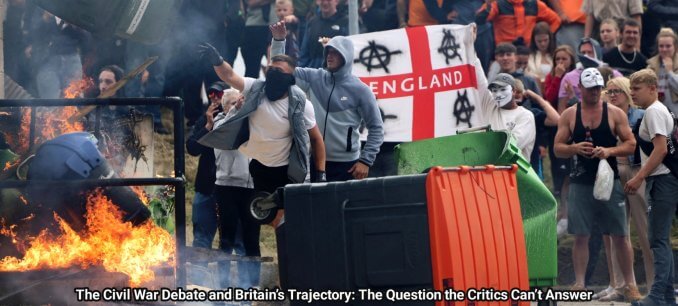
For an idea routinely dismissed as “dubious” or an “obsession” of the political Right, the suggestion that Britain is embarked on the road to civil war has proved stubbornly resilient. Each new episode of disorder seems only to revive it. The disturbances that followed the Henry Nowak trial, the attempted beheading in Belfast and the rioting that erupted afterwards again forced questions of social cohesion, public order and political legitimacy into public view, renewing the argument over whether Britain is moving in the direction of open conflict.
The question almost asks itself: if the idea is really so ridiculous, why does it keep coming back? The headlines might fade, but the underlying issues fuelling the debate clearly do not.
What has changed, however, is the willingness of mainstream political figures to address the issue openly. Kemi Badenoch observed that the disturbances in Southampton and Belfast spoke to degrees of political fractiousness that, if left unchecked, would bode ill for the future, warning that “in the long term, that’s how you end up with civil war.” Here was the Leader of the Opposition articulating a concern that, until recently, had largely been treated as beyond the limits of respectable political discourse.
Among the most prominent critics of the civil-wars idea have been the Guardian columnist John Harris and the economist Jonathan Portes. In 2025, Harris argued that civil-war rhetoric revealed more about the anxieties of those promoting it than about the actual state of Britain. In a commentary for the UK in a Changing Europe website, in April this year, Portes similarly rejected such prognostications as supposedly inconsistent with “the political science literature”. Harris, meanwhile, returned to his theme following the Belfast riots, with the focus shifting even further to the personalities discussing civil war rather than to the events that had brought the debate back into public view.
Although Harris and Portes approach the issue from different angles, they arrive at much the same conclusion: namely, that warnings of civil war are fundamentally misplaced. Harris concentrates on the people making the argument, their motivations and the politics surrounding it. Portes, by contrast, argues that Britain does not exhibit sufficiently destabilising features, before shifting emphasis to what he regards as the more important issue: why the language of civil strife is being used at all.
Both criticisms miss the more intellectually valid question about what kind of path Britain, and other Western countries, are embarked upon. Despite their different approaches, Harris and Portes direct attention away from the evidentiary question on which the civil-wars thesis stands or falls. The crucial issue is not why commentators have come to speak in terms of civil war, nor whether Britain already resembles Bosnia, Lebanon or Syria. It is whether trends around increasing communal fragmentation and political instability support the contention. That is an empirical question. It cannot be settled by examining the personalities advancing the argument or reduced to matters of political rhetoric. Nor can it be countered by saying that Britain is not yet facing a state of wholesale disintegration. It can only be tested against the evidence.
The civil-wars thesis is not an argument about where Britain presently exists. It is an argument about trajectory. It does not contend that Britain is destined for civil war. It asks whether the evidence is consistent with that trajectory. Those who reject the thesis must therefore do more than assert that Britain has not reached that terminus. They must show that the trajectory itself has been misread.
That, in the end, is the point at issue. If the civil-wars thesis is to be refuted, it cannot simply be dismissed as alarmist, nor answered by observing that Britain is unlikely to become another Lebanon or Bosnia. It has to be judged on its own terms.
And that is the difficulty confronting its critics: to refute the civil-wars thesis, they must refute the trajectory.
Following the Evidence
The proposition that Britain is travelling a path that leads towards civil war does not rest upon any single event. In isolation, riots in Belfast, or violent disturbances in Southampton or Southport prove very little. The civil-wars thesis derives its force not from individual episodes, but from the pattern they collectively reveal.
Social cohesion provides the obvious starting point. Governments themselves have spent years worrying about it. Polling organisations like More in Common measure it, with 64% of respondents describing Britain as a divided country. As long ago as 2001, the Cantle Report warned of communities living increasingly “parallel lives”. Since then, successive governments have produced reports, funding programmes and bureaucratic structures, including the Ministry of Housing, Communities and Local Government, to strengthen cohesion and integration.
Despite such sustained intervention, problems have become more acute, not less. It should be recalled too that leaders one does not readily associate with the ‘far-Right’ – such as Angela Merkel in 2010 and David Cameron in 2011 – publicly declared the policies of multiculturalism to have “utterly failed”. And, of course, who can forget Sir Keir Starmer’s May 2025 “Island of Strangers” speech?
In fact, a broader question follows: why does any healthy society need to produce a national strategy for social cohesion, as the UK Government did in April 2026, if the multicultural state has been so successful? The question itself is evidence that something has gone wrong.
Statistics and Politics
The consequences of where it is going wrong are visible in the data. Official statistics point to sustained increases in categories of offending, particularly serious violence and sexual offences. The latest Office for National Statistics figures record more than 209,000 reported sexual offences in England and Wales in the year ending March 2025, an increase of 11% on the previous year. The Crime Survey for England and Wales estimates that around 900,000 adults experienced sexual assault during the same period.
These figures do not, in themselves, establish the causes of rising violence, nor do they prove the civil-wars thesis. They do, however, provide the context in which public confidence is shaped. Against that backdrop, a succession of high-profile crimes involving migrants, asylum seekers or members of established ethnic communities (such as the Pakistani grooming gangs) inevitably assume political significance, particularly where official statistics reveal differences in levels of offending and arrest rates across ethnic groups.
Such occurrences have become symbolic of wider concerns about immigration, border control, integration and the capacity of the state to maintain public order. These are not inventions of social media or rhetorical exaggeration; they are rooted in events that many have witnessed for themselves.
What gives the evidence its force is the convergence of statistical data with lived experience. Together they energise the sense that the state now polices along racial lines, applying differential standards of justice in law enforcement and sentencing that discriminates against the majority white population. The cumulative effect is to deepen communal antagonisms. It is in that context that tensions of the kind that exploded in Belfast cease to look like isolated events and instead become flashpoints in a wider struggle over identity, with the potential to spill beyond criminal justice into overt political conflict.
When Democracy Stops Responding
Political legitimacy thus provides the next important indicator. Across Britain, and indeed much of the Western world, declining confidence in political institutions has become a defining feature of contemporary public life. Stable societies depend upon consent rather than coercion. Citizens obey laws, accept electoral outcomes and tolerate political disagreement because they believe institutions remain aligned to democratically expressed preferences. Once trust starts to weaken, politics becomes increasingly fraught.
Against such a background, immigration has become a combustible issue because it exposes a much wider failure of democratic responsiveness. For over six decades, governments of every political complexion promised lower or controlled immigration while consistently delivering the opposite. Party manifestos, government statements and political pledges point one way; immigration figures point another. On one of the most important political issues of the age, electoral preferences exercised almost no influence over policy. This is not a matter of opinion. It is a matter of public record. Large-scale immigration has repeatedly been pursued without democratic endorsement.
The consequences extend well beyond the negative socio-economic effects of immigration. The absence of democratic accountability strikes at the legitimacy of representative government, and its political effects are becoming plainly visible. Electoral mobilisation is occurring more frequently along ethnic, religious and communal lines, as illustrated in the 2024 General Election and, more recently, the Gorton and Denton by-election in February this year. Candidates increasingly appeal to confessional and communal loyalties rather than broader civic constituencies. Strong, cohesive, high-trust societies do not drift towards sectarian politics. Britain increasingly does.
The Last Warning
Rates of politically motivated violence are, of course, the clearest indicator of serious instability. Few measures provide a starker picture. The Global Terrorism Index recorded an 11% increase in terrorism-related fatalities worldwide and a 63% increase in terrorist attacks during 2024. In Britain, this general pattern has found expression in multiple attacks, large and small, from the July 7th London Transport bombings in 2005, the murder of Lee Rigby, attacks carried out at Leytonstone Underground station, Westminster Bridge, Manchester Arena, London Bridge and Borough Market, London Bridge again in 2019, Streatham, Reading and Heaton Park, together with the murders of MPs Jo Cox and Sir David Amess. The list excludes the many non-fatal and foiled attacks. Along with more recent disturbances from Southport to Belfast, they reveal the direction of travel: a society becoming increasingly entangled in conflicts over identity, belonging and political legitimacy, in which violence and ethno-religious confrontation are becoming familiar features of the national terrain.
This is the evidential challenge confronting the critics. The issue is not whether Britain remains comparatively peaceful, prosperous and democratic, but whether the evidence is consistent with the trajectory emerging from these developments. Contesting the thesis therefore requires more than reassurance or assertion. It requires showing that the developments identified here are either illusory, insignificant or point elsewhere. Until then, critics are arguing against a conclusion rather than the evidence that produced it.
Missing the Point, Changing the Question
The empirical case is one thing. The critique of it is another. Having largely sidestepped the evidence, the principal objections rest instead on a series of conceptual misunderstandings. Portes, for example, rejects the proposition because he defines civil war as “sustained, organised violence between the state and non-state actors” and concludes that Britain plainly does not meet that description. Britain is not Lebanon, Liberia or the United States, circa 1863. Well, yes. But that is not the point. It mistakes the civil-wars thesis for a diagnosis of Britain’s present condition rather than an assessment of the direction in which present conditions are moving.
The civil-wars thesis does not contend that Britain already has armed factions controlling territory or that the state is engaged in open conflict with organised insurgents. It asks a different question altogether: whether the preconditions of civil conflict are becoming more pronounced. These include diminishing trust in established institutions, communal mobilisation, growing estrangement between state and society and an increasing sense that lawful politics no longer delivers political change.
Portes acknowledges several of these developments that give rise to the civil-wars thesis. Trust in institutions has declined. Economic inequality and wider social pressures are real, he admits. Yet these observations are treated as incidental background rather than indicators demanding sustained analysis. They are acknowledged individually but never considered collectively, still less as part of a larger pattern.
Portes’ principal objection is that discussing civil war is itself undesirable because it “distracts from underlying issues, while contributing to a more polarised and less constructive political environment”, making it “ultimately less helpful for understanding the challenges the UK actually faces”. Yet he never explains why this should be so. Whether a diagnosis is politically uncomfortable or rhetorically inconvenient has no bearing on whether it is empirically correct. Naming a condition is not the same thing as creating it.
Harris reaches much the same destination. His articles are less interested in contesting the thesis than in the cast of characters he perceives as promoting it. Nigel Farage, Robert Jenrick, Elon Musk, Kemi Badenoch, Reform voters and various “Right-wing YouTube videos” flit across the stage. Harris describes Professor David Betz – the scholar most closely associated with the civil-wars thesis – as someone who “looks and sounds like a character from a peak-period J.G. Ballard novel”. Personally, I would take that as a compliment. It remains, however, an observation about the man rather than the argument.
In Harris’s telling, one is invited to dwell on caricatures and the political incentives in play. The evidence itself receives no attention. Instead, the focus is on ascribing bad-faith motives and personal idiosyncrasies to those advancing the idea. Don’t ask whether the indicators are strengthening or weakening; revile those who point to them. Don’t examine the balance sheet; denounce the accountant. It is a familiar rhetorical deflection, and one that tells us nothing worth knowing.
The evidential test is straightforward. If institutional trust is recovering, show it. If social cohesion is strengthening, show it. If communal politics are receding, show it. If the gap between public preferences and policy outcomes is narrowing, show it. If the indicators identified by proponents of the civil-wars thesis are being misread, demonstrate the error.
Reasonable people can disagree about the conclusions. They cannot, however, avoid the evidence from which those conclusions are drawn. Critics who speculate about motives while declining to engage with the data are not rebutting the case; they are changing the subject. Faced with a debate about Britain’s social and political circumstances, they choose instead to conduct inquests into the psychology of those raising the alarm. That may be an effective coping mechanism. It is not an argument.
The Warnings from History
The debate also has an important historical dimension. Questions of legitimacy, social order, communal politics and political violence are not arbitrary criteria assembled to support a preferred conclusion. They recur because they appear repeatedly in societies moving towards revolution, violent disruption or political collapse, from the French and Russian Revolutions, to the Spanish and Lebanese civil wars, the fall of the USSR and the disintegration of Yugoslavia. Historians and strategic analysts study them for the same reason physicians monitor blood pressure, pulse and temperature. They are not the illness itself. They are signs that something may be changing beneath the surface.
The civil-wars literature has consistently approached the problem in this way. Political deterioration seldom announces itself in a single dramatic moment. Trust doesn’t dissolve overnight. Communities do not suddenly discover irreconcilable differences that were invisible the day before. Legitimacy usually ebbs gradually as confidence in institutions dwindles and public faith in political processes withers. By the time a society reaches open conflict, it is usually possible to identify the long chain of developments that led to it.
The problem is that these developments rarely appear dramatic while they are unfolding. They accumulate incrementally: one more scandal; one more institutional failure; one more cover-up; one more bombing; one more stabbing spree; one more riot. Each event appears manageable in isolation. Each can be explained away. Each can be dismissed as an exception. Over time, however, the exceptions cease to look exceptional. A pattern – a trajectory – begins to emerge.
The task is not to recognise instability once it has become unmistakable. By then, analysis has become an exercise in description rather than warning. The real challenge is to determine whether the forces associated with political breakdown are becoming more pronounced while society itself still appears broadly normal. That is where serious scholarship matters.
Viewed from that perspective, the criticisms advanced by Harris, Portes and others amount to little more than superficial commentary about the debate rather than engagement with it. They concern themselves with the language, the personalities and the propriety of raising the question in the first place. The proposition itself is left untouched.
That, ultimately, is the distinction. One side is attempting to determine whether Britain is moving towards civil conflict. The other is preoccupied with the etiquette of discussing it. One is trying to understand where present trends may be leading. The other is content to discuss those pointing in that direction. Readers may judge for themselves which is likely to prove the more useful when history eventually delivers its verdict.
Here’s the Evidence. Your Turn.
The question is a simple one. The civil-wars thesis does not claim that Britain has already descended into civil war. It asks whether Western societies are exhibiting the precursors from which civil conflict has historically emerged: declining social cohesion, weakening institutional legitimacy, increasing communal fragmentation and growing political instability. No one can predict the precise form such conflict might ultimately take. Wars never arrive in the form anticipated.
Critics must therefore do more than reject the conclusion. They must explain why the indicators, the data, the historical record and the accumulation of empirical evidence all point somewhere else. If the argument advanced here is wrong, that should not be difficult. It should be possible to demonstrate precisely where it departs from the evidence.
What matters is not why some commentators dislike the contention. What matters is whether they are prepared to engage with it. If societies wait until the evidence satisfies everyone, warning has already failed. The central proposition has yet to be confronted. The debate has generated a great deal of commentary, but remarkably little engagement with the evidential question itself.
So let me conclude with a challenge to the critics: if you have a proper argument, do the hard work and produce it.
However, let me also venture a hypothesis. They won’t put forward any counter-argument. There’s a reason for that. They don’t have one.
Michael Rainsborough is Professor of Strategic Theory and Director of the Centre for Future Defence and National Security, Canberra.

••••
The Liberty Beacon Project is now expanding at a near exponential rate, and for this we are grateful and excited! But we must also be practical. For 7 years we have not asked for any donations, and have built this project with our own funds as we grew. We are now experiencing ever increasing growing pains due to the large number of websites and projects we represent. So we have just installed donation buttons on our websites and ask that you consider this when you visit them. Nothing is too small. We thank you for all your support and your considerations … (TLB)
••••
Comment Policy: As a privately owned web site, we reserve the right to remove comments that contain spam, advertising, vulgarity, threats of violence, racism, or personal/abusive attacks on other users. This also applies to trolling, the use of more than one alias, or just intentional mischief. Enforcement of this policy is at the discretion of this websites administrators. Repeat offenders may be blocked or permanently banned without prior warning.
••••
Disclaimer: TLB websites contain copyrighted material the use of which has not always been specifically authorized by the copyright owner. We are making such material available to our readers under the provisions of “fair use” in an effort to advance a better understanding of political, health, economic and social issues. The material on this site is distributed without profit to those who have expressed a prior interest in receiving it for research and educational purposes. If you wish to use copyrighted material for purposes other than “fair use” you must request permission from the copyright owner.
••••
Disclaimer: The information and opinions shared are for informational purposes only including, but not limited to, text, graphics, images and other material are not intended as medical advice or instruction. Nothing mentioned is intended to be a substitute for professional medical advice, diagnosis or treatment.
Disclaimer: The views and opinions expressed in this article are those of the author and do not necessarily reflect the official policy or position of The Liberty Beacon Project.


Leave a Reply