

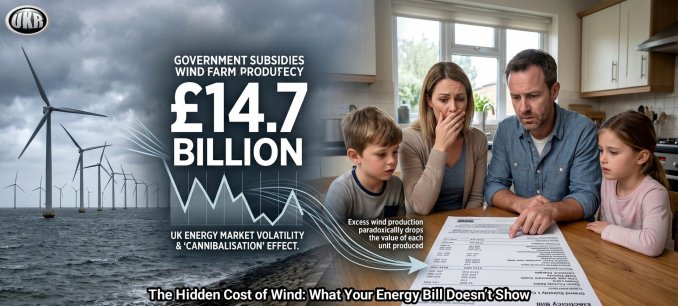
‘Cheaper Than Gas’, Until You Build It
Part two of a weekly series taking the UK’s energy subsidies apart, one scheme at a time, using the Subsidy Clock. This week: Contracts for Difference.
RICHARD LYONS
THIS WEEK ON the Subsidy Clock we are looking at the direct subsidy: Contracts for Difference. It stands at £14.7 billion. What that number means, and where it is heading, is the subject of this essay.

The occasion is an auction. In January the government held the largest offshore wind round in Europe’s history and called it a triumph, and by one measure it was: a record amount of wind, bought in a single sitting. But the price of new offshore wind came out of that auction higher than the last time anyone looked, not lower, and the analysts who follow the scheme most closely, Kathryn Porter among them, have spent the months since explaining why that should worry you.1 To see why, you need to know what a Contract for Difference is, because almost nobody who repeats the phrase ‘cheaper than gas’ can tell you.
What the scheme does
A Contract for Difference is a guarantee. The government fixes a price, the ‘strike price’, for every unit a wind farm generates, and holds it there for fifteen years, now twenty.2 When the wholesale price of electricity sits below the strike price, we pay the wind farm the difference. When it sits above, the wind farm pays the difference back. The money does not appear on your bill as a line of its own. It is a levy on suppliers, collected day by day by a government company, and folded back into the unit rate you pay for every kilowatt-hour.3 The point of it is to make wind bankable: promise a developer a fixed price whatever the market does, and it will build, and borrow cheaply to do it.
That is the whole case for ‘cheaper than gas’, and it is thinner than it sounds. Across the scheme’s entire decade the strike price has come in under gas in just eight months — the 2021–22 spike, when the fixed price did what a hedge should and beat a soaring market.4 Fair enough: that is insurance paying out. But it is insurance we cannot decline, its premium set by auctions that keep rising, and in the other 108 months we paid that premium for nothing — the ledger I set out in The Contract for Crisis.
And even that is generous, because of what the strike price measures. A strike price is the price of an electron as it leaves the blade: the cost of the energy at the turbine, and nothing else. It says nothing about carrying that energy to you, and nothing about what the market will pay for it once the grid is full of wind.
So a guarantee has two sides. The first is the strike price, the sum wind is promised. The second is the one the auctions never mention: how far below that promise the market actually falls. And the more wind you build, the further it falls. Why? A new word in your growing energy-skills lexicon: “cannibalisation”.
Cannibalisation
Wind farms do not choose their hours. When it is windy in the North Sea it is windy across the whole North Sea, so every turbine in the fleet generates at once, and they all try to sell into the same few hours. Electricity cannot be stored at the scale a country runs on, so a flood of supply in a single hour does one thing to the price: it drives it down. The windier it is, the more wind there is to sell, and the less each unit of it earns.
Wind is paid least, then, exactly when it is generating most. Average the price across everything a wind farm sells, and you get the figure that actually matters to it: its capture price — the price it truly earns from the market, as opposed to the headline average everyone quotes. Because wind sells so much of its output into the cheap hours it has itself created, its capture price sits below that headline average, and it slides lower the more wind you build.5 The industry has a blunter word for the slide: cannibalisation. Wind eats its own revenue.
Now put the two sides of the guarantee together. The strike price is fixed; the capture price falls as the fleet grows; and the subsidy is the space between them. So the more wind Britain builds, the wider that space becomes. The guarantee does not get cheaper to honour as the industry matures. It gets more expensive, for as long as the fleet keeps growing.
That is the opposite of what a subsidy is meant to do.
What the model shows
Last weekend, I announced grid-sim — my model of the British grid I’m creating as a research tool for my next book. It takes real demand and real weather, half-hour by half-hour, dispatches the fleet the way the actual system operator does, and prices each half-hour at the cost of the last plant needed to meet it. I wanted to see the size of the cannibalisation effect rather than assert it, so I asked it a single question: hold everything else at 2024 and vary only how much wind is on the system. What does each unit of wind earn?

Firstly: notice how electricity cost per megawatt-hour is flat up to somewhere in the mid-20s GW, then drops like a cliff. Why does it do that? The answer comes from a feature of electricity markets worth adding to the lexicon: marginal pricing — in every half-hour, the price is set by the most expensive plant needed to meet demand. Below that level, there is never quite enough wind, even with the nuclear and the rest, to cover demand, so gas is always that last plant and sets the price in almost every 30-minute period. But above it, wind starts overtopping demand in more and more periods — e.g. the windy summer weekend night. Then, gas is not needed at all, so the price falls to £0: the lobby’s famous ‘wind is free’. But we have contracted to pay the wind farm its strike price anyway. The less the market pays, the more we have to make up in our energy bill.
At today’s fleet of roughly 30 gigawatts, wind earns £67 of a £91 strike, so the top-up on a new contract is around £24 a unit. Push the fleet to 60 gigawatts — less than the wind the government’s own 2030 plans call for — and, on today’s grid, the capture price falls to about £20 and the top-up climbs past £70. Build to the 80-gigawatt fleet the 2050 pathways imply, and wind earns only a sliver of the strike price: the top-up is most of it.
Read the shaded band again. The strike price never moves, so the whole of that widening wedge is the falling capture price, cannibalisation, and the difference lands on your bill. The subsidy does not taper as we build; it approaches the entire contract.
The chart’s £91 is the new, “cheap” strike price. The scheme did not reach today’s £14.7 billion at £91 a unit. It reached it on the first wave of offshore contracts — Hornsea, Walney, Beatrice — struck near £150 in 2012 prices, when the fleet was small and cannibalisation barely bit; averaged over every unit those contracts have delivered, the top-up we have actually paid is nearer £70 a unit than £24. The chart’s lesson is that building more wind widens the gap even at a low strike price. So the “cheap” £91 contracts now coming online are not cheap to us: on a full grid the market pays barely a tenth of that £91, and we make up the rest. A low strike price is not a low subsidy — cannibalisation is the gap between the two. The £14.7 billion is the floor, not the ceiling.
What the model does and doesn’t say
Be careful what you take from this. The model holds today’s grid fixed and turns up only the wind, so the exact figures on the chart sit inside a bracket, pulled two ways.
Freezing everything but wind at 2024 makes the cannibalisation look worse than it need be. A grid actually running on 80 gigawatts of wind would not stand still: it would have far more batteries, more interconnectors to the Continent, more flexible and electrified demand, all built to swallow cheap wind in the very hours the price collapses. Add that flexibility and the capture price recovers some ground — Denmark, already past half its power from wind and wired into its neighbours, holds its capture rate well above where my frozen grid puts it.
Two things push the other way, though. To minimise the number of moving parts, this model run treats Britain as a single point, with no congestion between a Scottish turbine and a Kentish kettle; in reality the wires from Scotland to England are full, which is why we already pay wind farms hundreds of millions a year to switch off (last week’s essay) — a locational cannibalisation the single-point model cannot see. And it floors the price at £0, where real markets now go negative. That last one cuts subtly: the older contracts behind most of the £14.7 billion are still paid through short negative spells, so their real cannibalisation is worse than the chart shows — but the newest £91 contracts are paid nothing in a negative half-hour, so for them the wedge over-states the cash subsidy rather than under-stating it.
So this is not a floor with reality lying beneath it. The truth sits inside the bracket, and the figure at 80 gigawatts is not one I would defend to the pound. Flexibility — the storage and wires the market is building — does lift the capture price and shrink the top-up. But that flexibility is itself a bill we have barely begun to pay, and no plausible amount of it turns a fixed guarantee back into the temporary leg-up it was sold as. The subsidy is structural, whatever the last decimal.
The bill nobody totals
It is fashionable to say none of this is a reason not to build wind. Wrong. It is one: a commitment that grows dearer the more of it you honour is a commitment you total before you sign, not after. There is no year in which the CfD fleet stands on its own feet in the market, because the physics that suppresses its capture price is the same physics that makes it renewable — it runs when the weather says so, not when the price does.
The choice in front of the country is not between cheap wind and expensive gas. It is between a guarantee that widens as we build and a grid we have not paid to finish. The ‘increasingly troubling’ Secretary of State for Energy Security and Net Zero, Edward Miliband, doubled an auction budget mid-round to keep the first going, while promising the second would cut your bill by £300.6 One of those numbers is enforceable in a contract. The other is a hope.
The strike price is the cheapest part of the story. That is exactly why it is the part you are shown. £14.7 billion, £2.9 billion a year, rising.
Next Wednesday: the £75 billion scheme almost nobody remembers. It is five times the size of the one you have just met, it has been running since 2002, and it is sitting on the Subsidy Clock right now. See if you can find it.
The Energy Trap: Why the Renewable Energy Transition Can’t Work — And What Can is published by Swift Press in September.
The seventh Contract for Difference allocation round (AR7), results announced 14 January 2026, secured a record 8.4 GW of offshore wind, of which fixed-bottom projects cleared at a weighted-average strike price of £90.91/MWh in 2024 prices (five projects at £91.20; the Scottish Berwick Bank phase at £89.49). The 2022 record low was AR4’s £37.35/MWh in 2012 prices, which rebases to roughly £54 in 2024 money — so AR7 is about 69% higher on a like-for-like basis. DESNZ, CfD Allocation Round 7 results; Westwood, ‘Analysing the record-breaking AR7 offshore wind results’; analysts Kathryn Porter (Watt-Logic) and David Turver (Eigen Values) both read the result as evidence that new offshore wind is not, on the auction’s own numbers, cheap.
AR7 offered 20-year contracts for the first time, against the 15-year term of every previous round; a longer guarantee lowers the annual bid a developer needs for the same lifetime revenue, so part of the headline price is a duration effect rather than a fall in cost. The budget was raised mid-round from £900m to close to £1.8bn. Westwood, AR7 results.
A Contract for Difference is a contract between a low-carbon generator and the Low Carbon Contracts Company (LCCC), a government-owned counterparty. The generator receives the gap between a fixed strike price and a market reference price when the reference price is lower, and pays it back when the reference price is higher; the net cost is recovered from electricity suppliers through the Supplier Obligation, a compulsory levy under the Contracts for Difference (Electricity Supplier Obligations) Regulations 2014. The core charge is the Interim Levy Rate, a £/MWh rate LCCC collects from suppliers on a daily basis (with a quarterly reserve payment and quarterly reconciliation on top); suppliers recover it through the per-unit rate. There is no separate CfD line on a domestic bill. Low Carbon Contracts Company: how the CfD scheme works; GOV.UK: EMR CfD Supplier Obligation.
Count from the UK Renewable Subsidy Tracker, the open dataset behind subsidyclock.co.uk: monthly generation-weighted CfD strike price against a gas-fired counterfactual (existing-fleet CCGT at 55% efficiency, £5/MWh non-fuel operating cost, plus UK ETS carbon). The strike price fell below that gas cost in eight months of the scheme to date — December 2021, January to March 2022, July to September 2022, and December 2022 — every one of them inside the 2021–22 gas-price spike. Measured instead against the market reference price used to settle the contracts, generators returned money to suppliers in eleven months. Either way it is a brief window in a decade of monthly payments, and the scheme is a net cost of roughly £13–14 billion. Reproducible from the tracker; see The Contract for Crisis.
‘Capture price’ is the generation-weighted average wholesale price a technology actually earns; its ratio to the time-average price is the capture rate or value factor. For variable renewables the value factor falls as installed capacity rises, because output is concentrated in the hours the technology itself floods — the price-cannibalisation effect, documented across every high-penetration wind market (Germany, Denmark, Ireland). The chart is a run of my own grid model (open source; the engine behind subsidyclock.co.uk): the GB 2024 reference system — real half-hourly demand and ERA5 weather — dispatched on merit order, priced at the system marginal cost, sweeping installed wind from 10 to 80 GW with onshore and offshore scaled proportionally and everything else held at 2024. Capture price = capture ratio × mean system price. Holding the 2024 grid fixed while only wind grows isolates the cannibalisation channel, so the exact numbers are a bracket rather than a bound: freezing flexibility (storage, interconnection, flexible and electrified demand) overstates the fall in capture price, while treating the grid as a single unconstrained node and flooring prices at £0 (no negative prices) understates it. The robust result is the direction, not the last pound. Figures and code are reproducible from the pinned scenario and engine hash.
The £300 figure is the government’s stated ambition for the reduction in average annual household electricity bills by 2030 under its clean-power programme. DESNZ / Clean Power 2030.
This article (‘Cheaper Than Gas’, Until You Build It) was created and published by Richard Lyon and is republished here under “Fair Use”

••••
The Liberty Beacon Project is now expanding at a near exponential rate, and for this we are grateful and excited! But we must also be practical. For 7 years we have not asked for any donations, and have built this project with our own funds as we grew. We are now experiencing ever increasing growing pains due to the large number of websites and projects we represent. So we have just installed donation buttons on our websites and ask that you consider this when you visit them. Nothing is too small. We thank you for all your support and your considerations … (TLB)
••••
Comment Policy: As a privately owned web site, we reserve the right to remove comments that contain spam, advertising, vulgarity, threats of violence, racism, or personal/abusive attacks on other users. This also applies to trolling, the use of more than one alias, or just intentional mischief. Enforcement of this policy is at the discretion of this websites administrators. Repeat offenders may be blocked or permanently banned without prior warning.
••••
Disclaimer: TLB websites contain copyrighted material the use of which has not always been specifically authorized by the copyright owner. We are making such material available to our readers under the provisions of “fair use” in an effort to advance a better understanding of political, health, economic and social issues. The material on this site is distributed without profit to those who have expressed a prior interest in receiving it for research and educational purposes. If you wish to use copyrighted material for purposes other than “fair use” you must request permission from the copyright owner.
••••
Disclaimer: The information and opinions shared are for informational purposes only including, but not limited to, text, graphics, images and other material are not intended as medical advice or instruction. Nothing mentioned is intended to be a substitute for professional medical advice, diagnosis or treatment.
Disclaimer: The views and opinions expressed in this article are those of the author and do not necessarily reflect the official policy or position of The Liberty Beacon Project.


Leave a Reply