

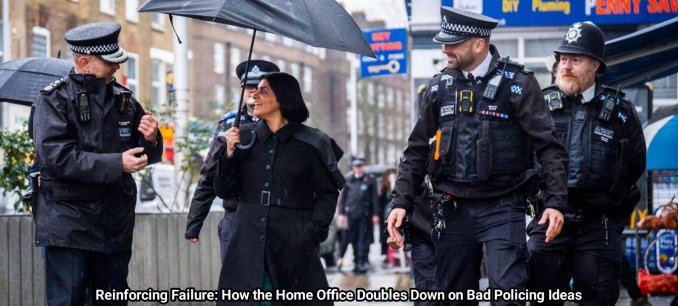
Reinforcing Failure
The Home Office loves it when a plan comes together
DOMINIC ADLER
During the Cold War I was taught Soviet tactical doctrine. When attacking, our instructor explained, the Russians worked to a simple principle: reinforce strength, never failure. If one division was making ground, they received reinforcements and extra resources. That became the spearhead. Failing divisions were expected to consolidate, reevaluate and make do.
I presume the British civil service never studied Soviet tactical doctrine. Or, if they did, considered it all rather silly. Not tolerating failure? It might upset the apple-cart. The direction of travel. The plan we agreed at that conference, remember? Which means, in Britain, the failing division – as long as it’s well-connected – gets all of the reinforcements and resources.
Which brings me to the Home Office and Police Reform.
I’ve written about this, predicting most of it, before. Not because I’m any kind of genius (I’m really, really not), but because I read their policy gumpf and understand the concept of second-order effects. The policy gumpf, incidentally, too many journalists seem to ignore. This week, for example, was big potatoes for police-watchers. There was a new report on police leadership. The Home Secretary indicated what new Local Policing Areas might look like. And we learned the identity of the next Chief Inspector of Constabulary.
What did the mainstream media report?
- Leadership: The police are finally debating whether they’re “woke” or not (they are). And police leaders, er, aren’t that great (who would have guessed, eh).
- Police restructuring: Shabana Mahmood wants to bring back Dixon of Dock Green-style neighbourhood policing (I know, that old chestnut).
- Chief inspector of what? By the way, it’s Sir Andy Marsh, the current boss of the College of Policing. This is like sending Harold Shipman to quality assure GP services.
Even funnier, the “We’re not Woke” article linked above (which was, of course, in The Guardian) was written by Matt Jukes, the senior copper who wore a thermal body sleeve to work… so he could experience the menopause on behalf of his female colleagues. He’s not woke. He’s sleepy – it’s a bit toasty in the office.
As for any mainstream analysis of what this all means? There wasn’t much. That leaves sad-sacks like me picking up the slack. After all, there’s football, Andy Burnham and Count Binface to write about. Our gradual descent into a third-world semi-police state? Who cares?
Presumably, you do. So listen in. Here’s what’s really happening:

I’ve written about the Home Office white paper on police reform before, you can find the article here. In short, the Home Office desires a three-tier police service loosely modeled on the continental system. It would involve local police (like the municipal police in France), regional police (a mixture of the French Police Nationale and Gendarmerie) and a National police (a monstrous, Sauron-like agency overlooking everything else).
Why?
Two primary reasons:
- It squares the age old circle of political control. British policing is unique – it’s a typically English common law compromise of local versus central. Dammit, Peel established our policing system to be as uncontinental as possible (they saw what happened in revolutionary France, where weaponised law and order got a little out of hand). British governments have forever tried to finagle ways of controlling occasionally bolshie police forces, but without taking responsibility for any fuck-ups. “Operational independence”, already shonkier than a charity shop sofa, would become window-dressing. Real decisions would be made through the Home Office, into the national police then percolate down to the sticks.
- Ever since 1997, Britain’s political and administrative elites favour a left-coded “conflict resolution” and “harm reduction” policing model. Something less kinetic. Less… nasty. Something warm and cuddly and consensual. A system that understands everyone, emoting like a leaky hosepipe. A system where a copper handcuffs a dying kid because he was accused of racism… oh, wait!
With that in mind, let’s look at this week’s news.
Police Leadership Review
The review, if you only read the headlines, seemed to concern crap senior bosses, “woke” and creating a new rank of “senior constable.” However, once you delve into the details, you’ll see it doubles-down on every failed Mayite-era shibboleth:
- More direct-entry senior management (shorthand for parachuting more civil service retreads into top jobs)
- More Degree entry schemes for new officers, to “change the culture”
- Licencing and passporting systems for police officers – which you know will include “DEI compliance quality control”
- “Ethics hubs” and yet more central units and bureaucracies
The panel consisted of policing’s Wokerati elite – the aforementioned Matt “it’s a little bit warm in here” Jukes, Maggie “I joined as a superintendent and the answer’s obviously fewer horrible policemen” Blyth and (Lord) Nick “wetter than an otter’s pocket” Herbert. Sir Stephen “clip ‘round the ear” Watson, chief constable of Greater Manchester Police, was presumably hired as token old-school copper. Eventually, Steve will tell us how badly he was tortured before signing off on such a load of old cobblers.
This means the people who are currently running our (failing) systems are the people reporting on them. Their conclusions? Reinforce failure. Of course, being the Home Office (and remember, the College of Policing is the Home Office, a thinly-disguised meat puppet) dissenting voices were presumably kept to a minimum.

Local Policing Areas
Dixon of Dock Green! Drool mainstream journalists, remembering Saturday evenings watching the telly. Boomer and late Gen Z types might remember the BBC series, which ended in the mid Seventies – but I doubt anyone else has. As I’ve pointed out before, Dixon never existed, never wore a video camera and never appeared on TikTok. If you gobbed on a Dixon-era copper, he’d give you a shoeing. Which, of course, runs contrary to the policing model the Home Office desires.
So Dixon’s wheeled out as a Boomer distraction device. In reality, what Shabana Mahmood is announcing is the lowest-tier of the proposed police reform model, Local Policing Areas. These are municipal police forces, aligned to local authorities. This might, ironically, lead to the establishment of hundreds of micro-constabularies, albeit overseen by regional police forces. This, bizarrely, echoes the model the Home Office dismantled in 1974.
So far, so administratively dull. Who cares who administers local plod? All we want them to do is wander around and deliver clips around the ear and stopping kids from scrumping apples, right?
Wrong.
Labour, in particular, are instinctively drawn to bringing police into the orbit of local authorities – the latter will end up controlling and influencing the former. Doubt me? I give you the rape gangs scandal and the West Midlands Police / Maccabi Tel Aviv affair.
Local councils, especially those in thrall to machine politics, are especially corruption-prone. Look at this absolute gem from Harrow, for example. Now, I’m sure some of the Marsham Street Melchetts who holiday in southern Italy rather like the place. I’m not sure they want to import their model of local policing though.
And, joy of joys, imagine what will happen in places lumbered with Green or “Gaza Independent” led councils? This reminds me very much of Labour’s attitude to devolution – given their traditional dominance of local government (as they once enjoyed in the Celtic fringe), they thought prima facie devolution was a cunning form of control. Until the SNP’s tartan Jacobins stormed Holyrood, of course, hiding in a moodily-purchased motor home.
Which means every gormless headline you see on police reform means little. The same people are in charge. The same plans are in place. The distraction plan changes occasionally, but that’s all. The reinforcements and resources travel in the same direction, too – towards failure.
What is an answer? I have an idea: Free Forces. Check it out here.


Leave a Reply