

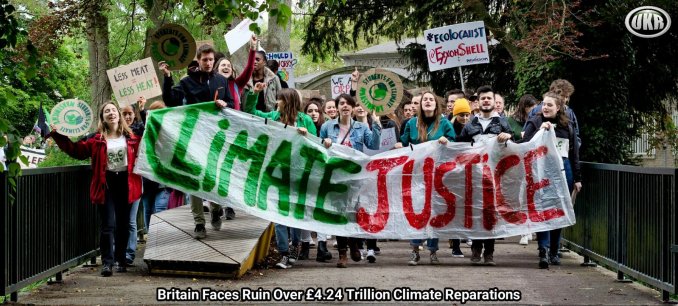
Climate change reparations could wreck Britain
As he walks into No. 10, Andy Burnham needs to be aware that the UK stands exposed to an avalanche of spurious and hugely expensive legal claims from other states – alleging breach of international obligations in relation to climate change and seeking massive reparations in consequence.
The International Court of Justice (ICJ) has created this risk. In its July 2025 ‘Obligations of States in respect of Climate Change’ advisory opinion, the court abused its advisory jurisdiction – as in its Chagos Islands advisory opinion in 2019 – and has opened up a new era of climate change litigation against developed states.
Worryingly, the UK is the most exposed state of all to these legal risks. My colleagues and I argue in a new Policy Exchange paper published today that without a sharp change in government thinking and practice, the advisory opinion may well prove catastrophic for Britain.
In March 2023, the United Nations General Assembly requested an advisory opinion from the ICJ in relation to the legal obligations of states in relation to climate change. Regrettably, the UK was one of 130 states to support this resolution. Hearings were held in the Hague in December 2024, in which a record 96 states and 11 international bodies made oral arguments.
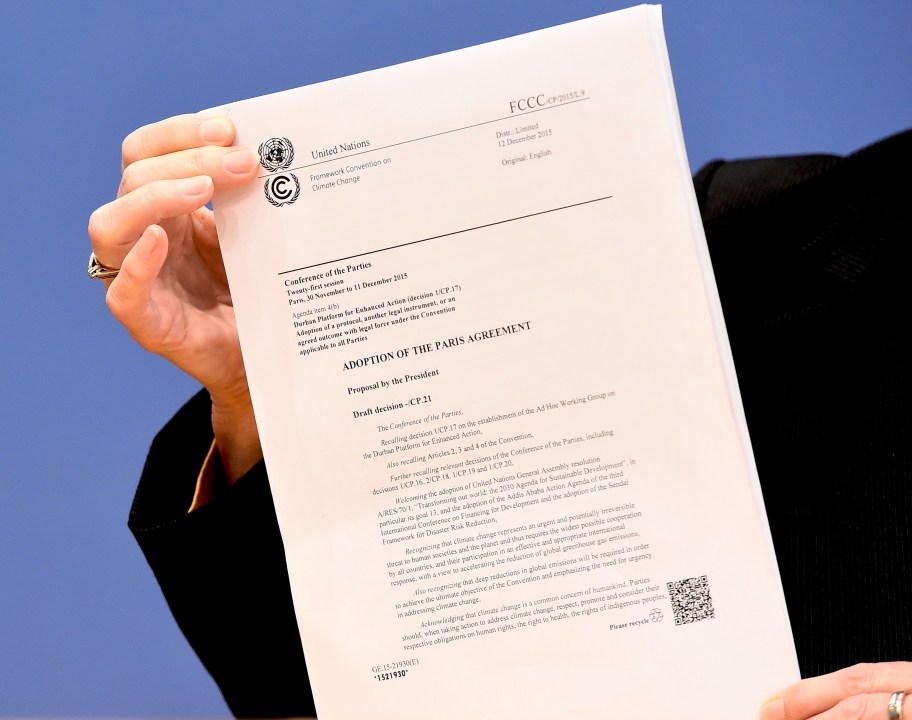
This was clearly no ordinary case. While some states argued that customary international law now requires developed states to make reparations for emissions, the UK argued, rightly, that the Paris Agreement established and exhausted the international legal obligations of states in relation to climate change.
The ICJ comprehensively rejected the UK’s position. The court reasoned that in addition to the 2015 Paris Agreement a number of other treaties, including notably the United Nations Convention on the Law of the Sea (UNCLOS), imposed duties on states in relation to climate change. The court reasoned further that there are duties in customary international law and in international human rights law in relation to protecting the climate system, by preventing activities that might harm it. And breach of these various duties, said the ICJ, would be an internationally wrongful act for which the remedies might include cessation, non-repetition, and reparations.
An advisory opinion is not a binding ruling and cannot establish that any state is liable to any other. But what the climate change advisory opinion does, quite deliberately, is to spur a further wave of litigation before international tribunals, including the International Tribunal for the Law of the Sea and the ICJ itself.
Whereas the Paris Agreement recognises that climate change must be addressed by cooperation and negotiation among states, what the ICJ has done is to say that the compulsory dispute settlement provisions of UNCLOS and other treaties empower international courts to bind states in relation to climate policy. This will not end well.
Several states, including Vanuatu which led the campaign for the advisory opinion, have made clear that they hold the UK especially responsible for climate change in view of its history as the birthplace of the Industrial Revolution, its contribution to global emissions since then, and its colonial role. It thus seems very likely that at some point, when they have their legal arguments fully prepared, those states will make claims against the UK, perhaps challenging decisions to reopen gas fields or to grant new licenses for oil production, or, especially, seeking reparations for the UK’s alleged breach of its international obligations in relation to climate change.
The risks are staggering. If high carbon countries owe low-carbon countries $192 trillion in reparations – as a paper in the journal Nature Sustainability calculated in 2023 – then even if the UK is only responsible for 3 per cent of emissions, it would be on the hook for $5.76 trillion (£4.24 trillion).
The significance of the new legal risks that the ICJ’s advisory opinion introduces do not seem yet to have registered with parliamentarians or the public. Astonishingly, in May this year, the UK actually voted in support of a resolution of the General Assembly welcoming the opinion and affirming it ‘as an authoritative contribution to the clarification of existing international law’.
What explains this apparent lack of interest in the risks that the ICJ’s opinion poses? The answer may be that the Sir Keir Starmer and his closest political ally – Lord Hermer KC – are ideologically committed to affirming whatever an international tribunal says, however brazenly it abuses its jurisdiction and however stark a danger it poses to the national interest.
The Spectator: continue reading

••••
The Liberty Beacon Project is now expanding at a near exponential rate, and for this we are grateful and excited! But we must also be practical. For 7 years we have not asked for any donations, and have built this project with our own funds as we grew. We are now experiencing ever increasing growing pains due to the large number of websites and projects we represent. So we have just installed donation buttons on our websites and ask that you consider this when you visit them. Nothing is too small. We thank you for all your support and your considerations … (TLB)
••••
Comment Policy: As a privately owned web site, we reserve the right to remove comments that contain spam, advertising, vulgarity, threats of violence, racism, or personal/abusive attacks on other users. This also applies to trolling, the use of more than one alias, or just intentional mischief. Enforcement of this policy is at the discretion of this websites administrators. Repeat offenders may be blocked or permanently banned without prior warning.
••••
Disclaimer: TLB websites contain copyrighted material the use of which has not always been specifically authorized by the copyright owner. We are making such material available to our readers under the provisions of “fair use” in an effort to advance a better understanding of political, health, economic and social issues. The material on this site is distributed without profit to those who have expressed a prior interest in receiving it for research and educational purposes. If you wish to use copyrighted material for purposes other than “fair use” you must request permission from the copyright owner.
••••
Disclaimer: The information and opinions shared are for informational purposes only including, but not limited to, text, graphics, images and other material are not intended as medical advice or instruction. Nothing mentioned is intended to be a substitute for professional medical advice, diagnosis or treatment.
Disclaimer: The views and opinions expressed in this article are those of the author and do not necessarily reflect the official policy or position of The Liberty Beacon Project.


Leave a Reply