

DR DAVID MCGROGAN
They’d rather have the poor poorer, provided the rich were less rich.
Margaret Thatcher
You are perhaps familiar with the early episode of The Simpsons in which we gain an insight into the thought-world of the family dog, Santa’s Little Helper. Unable to comprehend language, the dog simply stares blankly at human faces as they talk, hearing only “blah blah blah”. But just occasionally a word breaks through that it recognises: “blah blah ball, blah blah good boy!” and so on.
Well, this is what reading UN human rights materials is like. Your eyes begin to process the text but very soon you find them glazing over, and you enter a mental state a little like that of a canine half-dozing in the sun in the garden while a family gathering takes place around you. You are dimly aware of distant noises of human conversation, and of the fact that your whiskers are picking up slight movements in the breeze, but otherwise you are mentally empty – save perhaps for brief pangs of hunger that are insufficient to motivate you to make your way to your food bowl. ‘Blah blah fundamental values,’ the voices drone on. ‘Blah blah force for good, blah blah dignity, blah blah climate crisis, blah blah populism….’ The words wash over you and you are gradually lulled into a dreamlike state; the memory of what it is to be a human being, equipped with reason, recedes, and eventually you are reduced to a sort of empty senescence, ready only for a nice long nap in your basket where you can tune out for good.
Anyway, the other day, I noticed that the UN Office of the High Commissioner for Human Rights had just issued its annual report for 2025. I think the six month lag between the actual end of 2025 and the releasing of the report is a tacit admission by the OHCHR that absolutely nobody, except perhaps the criminally insane, reads the word salads it puts out. But I sat myself down to read the report in any case, fully expecting it to transition me into a semi-sentient fugue-state in short order.
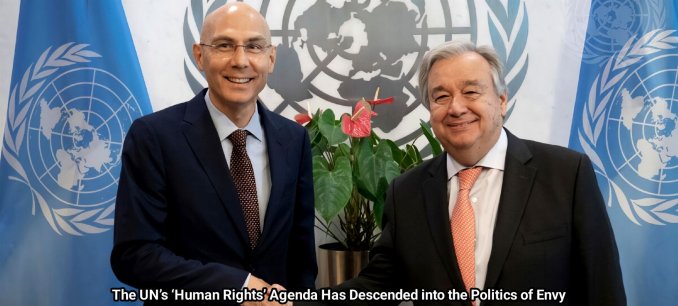
For once, however, the first sentence of the report was arresting. Now, I want you to bear in mind that this is the apex of the UN human rights apparatus that we are talking about here, and that the person writing is the High Commissioner for Human Rights himself, Volker Turk. I want you to bear in mind also the many dozens of human rights-related things that he could have chosen as the initial hook to draw in the reader: incipient genocide in Sudan or Nigeria; disappearing Christians in China; the way women are treated in Afghanistan or Niger; the disallowed second goal Egypt scored in their last-16 tie against Argentina last week; and so on. Okay, now that you are bearing all that in mind, are you ready? Here is what Turk begins his report by saying – the very first sentence:
Inequality is reaching new heights – together with the profits reaped by billionaires.
That’s right. Of all the things to worry about, it is people being rich that concerns Turk most. Billionaires, it would seem, are a major human rights problem.
Billionaires are rather in the firing line at the UN these days, as they are in domestic politics in most countries too. A strange notion has crept into the heads of policy wonks, which is that there are untold billions of billionaires who are all sitting around on huge stockpiles of untapped wealth which the rest of us could simply seize and use to construct for ourselves each a five-bed detached house made from solid gold – if only we had the gumption to get up and do it. Hence, we are repeatedly told, what we really just need is a wealth tax; the figure that is often bandied around (for instance, in a report commissioned by the G20 Presidency of Brazil in 2024) is 2% of billionaires’ presumptively ill-gotten gains.
This, plainly put, is all arrant nonsense. I find that a good rule of thumb is that if somebody’s solution to anything is ‘more taxes on billionaires’ they should immediately be excluded from serious public discussion and, preferably, bundled onto the next helicopter to Rockall with a one-way ticket. Anybody who doesn’t understand why, and is interested in the best easy technical explanation, could do a lot worse than read this post (clue: it isn’t ‘because the billionaire would all go and live elsewhere’, the worst Telegraph columnist-style argument against a wealth tax ever invented). But the essence of the point is simple: it isn’t the billionaires who are the problem, and since this is the case, nor are they the solution. Take the Yookay. The interest on our national debt alone costs us £120 billion a year. The amount we paid out in social security last year was £344 billion. There are not enough billionaires in the galaxy to solve the Yookay’s fiscal problems through wealth taxes, let alone the problem of global poverty. This is the beginning and end of the discussion from a common sense point of view.
But, of course, common sense is not the point, and nor is solving fiscal problems – that isn’t why people object to other people being billionaires; it isn’t why they are being singled out by the UN High Commissioner for Human Rights as the most pressing problem facing the world today; it isn’t why wealth taxes are proposed either at the domestic or international level.
The point, rather, is envy. And it is a particular kind of envy that is important to specify. It is not the envy of the poor. No doubt the poor, like all of us, are indeed often envious of the lifestyles of billionaires. But the poor do not tend to crew the bridge of the think-tanks like the Resolution Foundation or stride the corridors of the palace in Geneva where the UN OHCHR is based. No: the type of envy we are talking about here is the most poisonous envy of all, because it hides itself behind platitudes and sanctimony. It is the envy of the privileged, those with higher status already, towards those who have higher status yet. It is the envy of the well-educated and propertied classes for those who have attained wealth through other means. It is the envy, in short, of old money for new money. And it cloaks itself in concern for the poor. It is the type of envy that says, ‘I am admittedly wealthy, but I don’t have as much wealth as that vulgar Elon Musk. And in any case, I care about poverty, which makes me a good person. So trust me when I say that, in taking people who are wealthier than me down a peg or two, it is all in the interests of the poor.’ It is an envy that is licensed and excused by the appearance of compassion.
This may sound like a cynical and harsh reading of things (as if I could ever be accused of being cynical or harsh!) but it is I think borne out by the ludicrous conceptual framework that lies behind Turk’s comment, which I cited earlier – a notion that has come to be called ‘post-growth’, but which can be better understood as a kind of bizarro world cakeism, in which nobody has cake and nobody can eat any of it, either.
Post-growth in the human rights context is the brainchild of a man called Olivier de Schutter, well-known in academic human rights circles partly because he writes and updates a very big textbook used in teaching undergraduates and postgraduates around the world. De Schutter was originally an EU apparatchik and academic, but gradually slid into the UN human rights world, ultimately becoming the Special Rapporteur on Extreme Poverty and Human Rights, a post he held from 2020-2026.
UN Special Rapporteurs and Independent Experts are, essentially, UN-funded activists. Each holds a particular mandate (arbitrary detentions; rights of people with albinoism; rights of the disabled; whatever) and uses his or her position to champion its particular subject in whatever way he or she sees fit. De Schutter used his mandate as Special Rapporteur on Extreme Poverty chiefly to champion the concept of a ‘post-growth’ economy, which he is now elaborating as Chair of something called New Economies for Eradicating Poverty, or NEEP. I say “something” advisedly, as it is not exactly clear what NEEP is – its website does not really specify its legal structure or tell us about its funders, or anything much at all from an organisational point of view. And its relationship to the UN is opaque; it is not a UN entity but most of its staff appear to have previously worked with De Schutter in his role as Special Rapporteur, and it is obviously informally connected in some way with the UN ‘family’, so to speak: in all of its materials we find thanks and acknowledgements being extended to various UN agencies, including the OHCHR itself, the World Health Organisation, the United Nations University Centre for Policy Research, and so on.
What else we can infer, from some digging, is that NEEP’s budget may be largely or entirely underwritten by two big philanthropic entities, the Robert Bosch Stiftung and Partners for a New Economy (P4NE), who are named as having funded NEEP’s central activity, the ‘Roadmap for Eradicating Poverty Beyond Growth‘, unveiled to much fanfare at a large shindig in Geneva in spring 2026. Robert Bosch Stiftung is well known (it is a charity founded off the back of the wealth of Robert Bosch, who would in today’s money no doubt have been one of those pesky billionaires we keep hearing about); P4NE is a ‘re-granting’ entity which distributes a pool of donations from other philanthropic organisations such as the Oak Foundation, the Ford Foundation and the Swiss Philanthropy Foundation, the latter of which itself distributes funds for the Open Society Foundations, the Bill and Melinda Gates Foundation, etc. etc. etc.
The spectacle of foundations funded by billionaires funding projects designed to work against the interests of billionaires is itself curious, of course, but I think is readily explained by the fact that these people either don’t have the foggiest clue what their money is going towards or else simply do not themselves understand the underlying issues. They bung money to their own foundation and it is then distributed through complex ‘ecosystems’ which are almost impossible to properly untangle and almost seem designed that way (P4NE in particular seems to have been set up as a middle-man precisely to render opaque exactly how funds are being distributed – because grants are pooled and then re-granted, the original funders get plausible deniability if the money ends up anywhere dodgy). And the ultimate decisions about which projects get funded are then made by exactly the type of person you would expect – somebody very expensively educated, who comes from money him or herself and has developed a conscience, who has developed a career in the NGO world, and who is motivated by the ideological priors that are the inevitable outgrowth of that personal history.
But that is a digression and the subject for a future post; what I would like to draw your attention to today is the contents of the original mission statement which De Schutter delivered, when in his role as special rapporteur, to the UN General Assembly in 2024, and what it tells us about envy in particular. Here, we find elaborated the radical notion that it is possible to eradicate poverty beyond growth – that, indeed, not only is it possible to eradicate poverty without growth, but that growth is counterproductive to the goal of poverty-eradication.
Thus, we find De Schutter castigating as “growthism” the idea that the economy should grow and that the wealth produced through that growth should be to some extent redistributed through taxes and transfers. This, as you may have guessed, is bad for “the planet”, but also apparently is bad for human beings. What De Schutter wants to focus on is, rather, well-being. Waxing philosophical, he tells us that our problem is really that we are too keen to “equate economic growth with progress and improved well-being”. This, he says, suggests that we are obsessed with satisfying “limitless desires for more”, fuelled by “marketing” and “status competition” and the “search for ‘positional goods’”. What we need to do instead is focus on a “human rights-based norm of sufficiency” that would shift us away from “unrealistic expectations” and instead reconcile us to a “set of entitlements allowing individuals to flourish in a world of finite resources”. And in particular, we need to recognise that the “money-centric approach to poverty” needs to go. Rather, we need to think about “the reality of social exclusion”. Here is De Schutter, laying out this interesting theory (with my emphasis):
[The money-centric approach to poverty] fail[s] to capture the reality of social exclusion, which may result from the inability of certain households to meet social expectations, such as the need to organise decent funerals for their parents or decent weddings for their children, to pay for extracurricular activities for a child or to own a smartphone. Such social expectations change as overall affluence increases. As such [sic], economic growth (defined by an increase in GDP), if accompanied by rising income inequality, may ultimately prove counterproductive: by raising the bar within a particular society, it may in fact worsen social exclusion – the sense of shame and worthlessness that people in poverty will experience. In addition, if the rise in overall affluence leads to the increased commodification of certain services in areas such as health, education or transport, under the pretext that most people will now be able to afford paying for such services, the impacts of income poverty will be worsened. In that sense, economic growth can go hand in hand with the modernisation of poverty: even while extreme material deprivation is reduced, the number of socially excluded persons may increase.
There are two ‘tells’ here which you will I hope have noticed. The first is the emphasis on profoundly bourgeois concerns – organising ‘decent weddings’ for children, paying for extracurricular activities for offspring and affording the latest smartphones are almost the quintessential First World Problems: they are the stuff of school pick-up time conversations at primary schools in leafy suburbs, not the slums of Kinshasa. And it is almost painfully evident that the author and his advisors live in precisely the kind of milieu where this sort of thing matters: they obviously feel the sense of ‘social exclusion’ that comes from the relentless pressure of having to keep up with the Joneses viscerally and keenly. It is not the shame and worthlessness of people who are actually poor which bothers them, in other words. It is the shame and worthlessness of middle-class people looking at where their neighbours are going for their holidays this year.
The second is the extraordinarily cavalier way in which “extreme material deprivation” is treated, and the dismissiveness with which the dreadful notion that “most people” would be able to afford paying for health, education or transport is described. One can almost imagine De Schutter and his cronies walking the streets of a rougher neighbourhood Nairobi or Dhaka, stopping people to ask them about the concerns. ‘What bothers you isn’t extreme material deprivation, but social exclusion. I’m right, aren’t I?’
In scrupulous fairness, there is an acknowledgment in this document and in NEEP’s Roadmap that growth remains important in less development economies (although where the precise point at which growth ought to stop is never identified). But the snootiness is inescapable. What really exercises these people is not deprivation per se. It is the paradigmatic middle-class worry about being excluded, the bane of the bourgeoisie everywhere. The thing that haunts them is the idea, metaphorically, of not being invited to the right dinner parties. Having moved far beyond “extreme material deprivation” themselves, their concerns turn to social mobility. And so, lo and behold, social mobility become the central concern of their political economy – they lose interest in how to grow the pie, and worry themselves only with making sure they have a slice roughly the same size as everybody else.
Many years ago, Margaret Thatcher hit the nail on the head. There is a species of Leftist – these people, I’m afraid, must be categorised as being on the Left – for whom the important thing is not the poor getting richer but the gap between rich and poor getting smaller: “Provided that the gap is smaller, they’d rather the poor were poorer’” They would rather live in a world in which poor people lived happy, carefree, bucolic existences singing songs and frolicking about, fully reconciled to the “human rights-based norm of sufficiency” and unburdened by “unrealistic expectations”, and in which grubby nouveau riche types were put back in their place by the coercive power of the state and global institutions. And they would like to be lauded for their virtue and brilliance in imagining such a world into existence and carefully managing it in perpetuity. Not for them the vulgarities of ‘marketing’, but rather the wet dream of harried bourgeois people throughout the globe: liberation from “status competition” and a permanent focus on “well-being” –- a sort of operationalised version of Gwyneth Paltrow’s Instagram, all the time, everywhere.
In the real world, meanwhile, the Yookay is leading the way in demonstrating exactly what a post-growth economy looks like in practice: less money to spend on goods and services, more debt, generalised despair and low-level angst, a sense of shabbiness, a feeling of deterioration, and destabilised politics. It is almost as though what works at the individual household level (more money = better for well-being, all else being equal) also works at the societal level, too. I am reminded, years ago, of having watched an interview with the multi-millionaire entrepreneur James Caan; asked whether money could make a person happy, he paused briefly and then said, with the smallest of smiles on his face, “Let me put it this way, I’d rather have it than not.” In other words, money may not buy love or happiness, but life is still a darned sight easier when you have a lot of it. And that applies to countries as much as it does to people. No doubt we could all do with focusing more on our well-being and being kinder and less greedy. But all else being equal, it is far easier to do that from a position of economic comfort than decline.
But then again we wouldn’t need billionaire-funded activist-officials like Olivier De Schuter, or Chief Panjandrums of the OHCHR like Volker Turk, to tell us such things. And here perhaps lies the central problem of our age. As I have observed before, being dominated by a professional managerial class means inevitably that we would rather manage problems than solve them, with the reason for this being straightforward to understand. When problems are solved there is no need for them to be managed anymore, and hence no need for managers. It is at this stage that I would normally start talking about Machiavelli, but regular readers will have gone down that avenue already. Suffice to say, being lavishly funded to dream up hare-brained schemes for running the world is probably very nice work if you can get it.
Dr David McGrogan is an Associate Professor of Law at Northumbria Law School. You can subscribe to his Substack – News From Uncibal – here.
This article (The UN’s ‘Human Rights’ Agenda Has Descended into the Politics of Envy) was created and published by The Daily Sceptic and is republished here under “Fair Use” with attribution to the author Dr. David McGrogan
Featured image: The Daily Sceptic

••••
The Liberty Beacon Project is now expanding at a near exponential rate, and for this we are grateful and excited! But we must also be practical. For 7 years we have not asked for any donations, and have built this project with our own funds as we grew. We are now experiencing ever increasing growing pains due to the large number of websites and projects we represent. So we have just installed donation buttons on our websites and ask that you consider this when you visit them. Nothing is too small. We thank you for all your support and your considerations … (TLB)
••••
Comment Policy: As a privately owned web site, we reserve the right to remove comments that contain spam, advertising, vulgarity, threats of violence, racism, or personal/abusive attacks on other users. This also applies to trolling, the use of more than one alias, or just intentional mischief. Enforcement of this policy is at the discretion of this websites administrators. Repeat offenders may be blocked or permanently banned without prior warning.
••••
Disclaimer: TLB websites contain copyrighted material the use of which has not always been specifically authorized by the copyright owner. We are making such material available to our readers under the provisions of “fair use” in an effort to advance a better understanding of political, health, economic and social issues. The material on this site is distributed without profit to those who have expressed a prior interest in receiving it for research and educational purposes. If you wish to use copyrighted material for purposes other than “fair use” you must request permission from the copyright owner.
••••
Disclaimer: The information and opinions shared are for informational purposes only including, but not limited to, text, graphics, images and other material are not intended as medical advice or instruction. Nothing mentioned is intended to be a substitute for professional medical advice, diagnosis or treatment.
Disclaimer: The views and opinions expressed in this article are those of the author and do not necessarily reflect the official policy or position of The Liberty Beacon Project.





Leave a Reply