

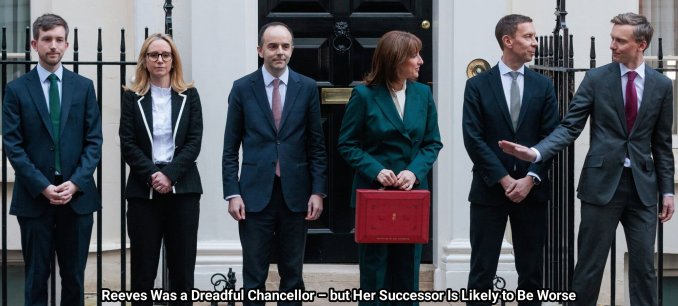
Rachel Reeves was a dreadful Chancellor – but her successor is likely to be worse
Not only incompetent, the Chancellor was one of the most Left-wing occupants of No 11 since the 1970s
For some reason Westminster never quite saw Rachel Reeves for what she was. In recent days, I have seen her called variously “cautious”, “timid”, and a “creature of Treasury orthodoxy”. But to view her as merely weak would be, to my mind, to misread her.
How about incompetent? The case there is stronger.
[…]
Winter fuel payments: announced, defended, reversed. The family farms tax: pressed, then softened under a revolt she should have seen coming. Fuel duty: threatened, then frozen again. The two-child benefit cap: dismissed for years as unaffordable, then lifted. I could go on.
This vacillation told the country this was a chancellor with no authority, but incompetence again falls short as a verdict. Beneath the bob, I actually see Reeves as one of the most Left-wing occupants of Number 11 since the 1970s.
Consider the numbers. She borrowed an extra £300bn over the plans she inherited, roughly a whole year’s income tax receipts. She raised taxes by £66bn, or £2,324 per family, across two Budgets. Each figure is historic in its own right. The freeze on tax thresholds alone – the stealth raid she had promised, in terms, not to extend – was the largest single tax rise in 60 years.
The overall tax burden is now set to reach 38.5 per cent of GDP, higher than at any point since records began in 1948.
This was no prisoner of the Treasury machine. This was a chancellor who shifted the fiscal architecture of the state, and she did it all, having presented herself as the continuity chancellor: promising no rise in income tax, National Insurance or VAT…
Instead, within weeks, she raised employers’ National Insurance, the jobs tax, to 15 per cent. She told businesses she would be their champion, then helped force through the Employment Rights Act, loading cost and risk on to every firm that hires.
This was the great feature of her tenure. Not the incompetence. Massive, unprecedented tax and spending rises.
The Telegraph: continue reading
See Related Article Below
Who will be the next Chancellor?
DAMIAN PUDNER
- Government borrowing does not become wise or productive because it is called investment
- The two most politically revealing names being briefed, Ed Miliband and Wes Streeting, send different signals about what to expect from the next government
- Markets will not price credibility by accent, attitude or impatience with Treasury orthodoxy. They will price the numbers
Keir Starmer is now an empty-vessel Prime Minister, nominally in office but visibly out of power. His fall from grace after Labour’s emphatic win almost two years ago brings an end to stage one of a government in collapse. Starmer has gone from weak leader to lame duck in a matter of days, and Andy Burnham is the Prime Minister-in-waiting.
Only a fool would run against Burnham, and the parliamentary Labour Party has little appetite for a contest it already knows who will win. By July, Britain will have its seventh Prime Minister in ten years.
James Purnell is reported to be the new chief of staff. A Blair-era figure, former Work and Pensions Secretary and Flint Global chief executive, his presence is a sign of a programme of institutional reform, regional renewal, disciplined investment and grown-up intervention.
“The two most politically revealing names being briefed, Ed Miliband and Wes Streeting, send two very different fiscal signals about what to expect from the next government.”
Burnham is plainly a better politician than Starmer. He even sounds human rather than robotic. He thinks on the go, talks off the cuff and does not doggedly recite the autocue produced by a 27-year-old PPE SpAd. Radical, I know. But the serious question is not whether Burnham can sound warmer than the outgoing Prime Minister. That bar is on the floor. The question is whether he can define a credible economic programme before the markets define it for him.
That is why his pick for Chancellor matters. The two most politically revealing names being briefed, Ed Miliband and Wes Streeting, send two very different fiscal signals about what to expect from the next government. Miliband would be a very clear lurch to the left, towards public ownership, green industrial activism and a more combative Treasury. Streeting would be the reassurance play, a signal to investors that Labour has not handed economic policy to the borrowing-crazed left.
Even Labour’s radicals now understand the basic lesson of recent years, which is that you do not get to challenge the bond market until you have first persuaded it you are not fiscally incompetent. The more sensible choice therefore, is Streeting. After all, Burnham needs someone who can calm the gilt market while he creates political room for a more interventionist programme. But be warned. Streeting’s own approach to tax and spend is much closer to Burnham’s than some in the City may want to believe. He has advocated increasing taxes on wealth rather than earned income, including equalising capital gains tax with income tax as a ‘wealth tax that works.’
There is also talk of greater public control of water and energy, intervention in failed utilities through special administration, “bonds for shares”, state-backed competitors, more council housing, and stronger regional government. That is what makes Burnhamomics perhaps more seductive than Corbynism ever was, but taking control is not the same as fixing the system.
It’s easy to forget that before socialism turned into a national bureaucratic machine of targets, regulators, and spending other people’s money, it often meant something much more concrete.
In the 1870s Joseph Chamberlain’s Birmingham took gas and water into municipal control, arguing that essential utilities should serve public health, price discipline and reliable service rather than private monopoly. It was interventionist, yes, but it was not the modern state fantasy of unlimited borrowing, blurred accountability, failed delivery and nobody ever being responsible. It was local, disciplined and commercial. That is the part the ruling class always forgets.
Britain in 2026 is not Birmingham in 1874. Chamberlain municipalised utilities from a strong local base, with one eye permanently on the accounts. Burnham would be doing it against the backdrop of a heavily indebted, low-growth, high-tax state with far less room to absorb the cost of getting it wrong.
Some public investment is essential if Britain is to build the energy, water, transport and housing infrastructure a serious economy requires. But government borrowing does not become wise or productive because it is called investment.
The deeper danger is that Burnhamomics appears to be aimed at the economy Britain used to have rather than the one now being built around us. Too much of a focus on re-industrialisation is economically dangerous.
Burnham would be wise to remember that the UK’s digital sector generated £177.2bn of gross value added in 2024, meaning economic value created after subtracting bought-in inputs, and accounted for 6.8% of the economy. It grew 3.3% that year in real terms, roughly three times the pace of the wider economy. Digital-sector GVA has grown by more than 150% since 2010, compared with about a quarter for all industries. That’s where the growth is. Software, AI, compute, data, automation, chips, and firms that can scale.
The Government’s own AI strategy says adoption could add £400bn to the UK economy by 2030. The number may be heroic but the direction is not. If Britain is to compete in AI compute and advanced manufacturing it needs cheap, abundant and secure energy. A country trying to lead the AI revolution while tolerating some of the highest industrial electricity prices in the developed world is not serious about growth.
Yet the emerging Burnham agenda looks worryingly thin on technology, AI and capital formation. There is plenty on devolution, utilities and public control of the so-called cost-of-living essentials. There is far less on how Britain competes with the United States and China in the industries that will define the next decade.
If the Westminster chatter is right, we can expect higher capital gains tax, tighter treatment of private equity, an exit tax and a modest EIS-style relief for backing British businesses. If true, Britain’s current managed decline will only accelerate. If Burnhamomics means looser fiscal rules, more off-balance-sheet liabilities, higher taxes on enterprise and a larger unreformed state, the markets will not be impressed for long.
Burnham may give Labour a better voice than Starmer, but markets will not price credibility by accent, attitude or impatience with Treasury orthodoxy. They will price the numbers. Municipal socialism for the gilt-market age will survive only if it means reform, discipline and delivery. If it means spending tomorrow’s money to dodge reforming today’s failing state, Britain will once again be arguing about who controls yesterday’s industries while tomorrow’s industries are built somewhere else.
This article (Who will be the next Chancellor?) was created and published by CapX and is republished here under “Fair Use” with attribution to the author Damian Pudner

••••
The Liberty Beacon Project is now expanding at a near exponential rate, and for this we are grateful and excited! But we must also be practical. For 7 years we have not asked for any donations, and have built this project with our own funds as we grew. We are now experiencing ever increasing growing pains due to the large number of websites and projects we represent. So we have just installed donation buttons on our websites and ask that you consider this when you visit them. Nothing is too small. We thank you for all your support and your considerations … (TLB)
••••
Comment Policy: As a privately owned web site, we reserve the right to remove comments that contain spam, advertising, vulgarity, threats of violence, racism, or personal/abusive attacks on other users. This also applies to trolling, the use of more than one alias, or just intentional mischief. Enforcement of this policy is at the discretion of this websites administrators. Repeat offenders may be blocked or permanently banned without prior warning.
••••
Disclaimer: TLB websites contain copyrighted material the use of which has not always been specifically authorized by the copyright owner. We are making such material available to our readers under the provisions of “fair use” in an effort to advance a better understanding of political, health, economic and social issues. The material on this site is distributed without profit to those who have expressed a prior interest in receiving it for research and educational purposes. If you wish to use copyrighted material for purposes other than “fair use” you must request permission from the copyright owner.
••••
Disclaimer: The information and opinions shared are for informational purposes only including, but not limited to, text, graphics, images and other material are not intended as medical advice or instruction. Nothing mentioned is intended to be a substitute for professional medical advice, diagnosis or treatment.
Disclaimer: The views and opinions expressed in this article are those of the author and do not necessarily reflect the official policy or position of The Liberty Beacon Project.


Leave a Reply