

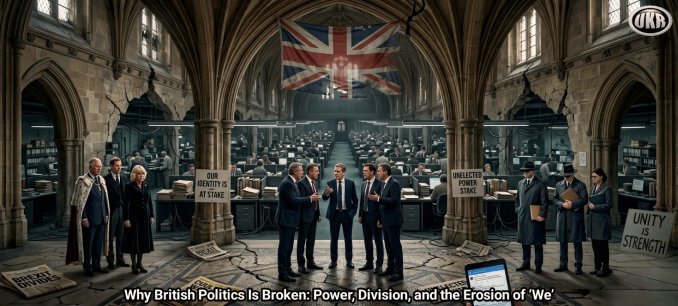
Why British Politics No Longer Works
The Third Court, the Politicisation of Everything, and the Erosion of the Pre-Political ‘We’
THE TRADITIONAL PRAGMATIST
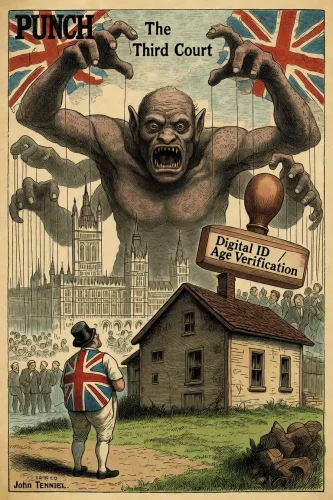
On the 15th of June, the government announced that, by early 2027, tech companies will be required to ban under-16s from using platforms including TikTok, Instagram, Snapchat and YouTube. Age verification, likely involving facial recognition, photo ID or Digital ID, will in practice apply to everyone and reach deep into personal and family life. The stated aim is to protect children from addiction and harmful content. At first glance this appears a classic modern political intervention – government stepping in to solve a genuine social problem that parents and families would once have handled themselves. Look more closely, however, and it reveals something about why the British political game has ceased to function as an effective means of directing the country.
The Erosion of the ‘Pre-political “we”’
What Roger Scruton called the pre-political “we” – that shared sense of belonging, mutual loyalty and inherited way of life which precedes and makes possible legitimate government – has been steadily politicised and worn away in the process. Decisions that once belonged to families, local communities and civil society have been centralised in Westminster. At the same time, large-scale immigration, identity politics and culture wars have fractured the underlying “us-ness” that once allowed opponents to accept being governed by one another.
“Democracies are held together by something stronger than politics. There is a ‘first-person plural’, a pre-political loyalty, which causes neighbours who voted in opposing ways to treat each other as fellow citizens, for whom the government is not ‘mine’ or ‘yours’ but ‘ours’, whether or not we approve of it.”
— Roger Scruton
The result is a state that has generated Singapore-level demands for coordination and long-term management across a complex, diverse society, without Singapore’s small scale, top-down cultural confidence, or technocratic discipline. Singapore maintains competent governance of a highly advanced, multicultural city-state through deliberate, apolitical authoritarianism. Britain, by contrast, has a much larger, historically layered society, a frayed high-trust inheritance, and a millennium-long expectation of accountable self-government. We now face Singapore-level demands for coordination without its advantages.
As I argued in these pages last month, the postwar settlement, entrenched under Tony Blair, has led to a system too large to sustain or steer competently. More seriously, it has eroded the shared “we” that once made such steering possible at all.
How British Politics Used to Work
This marks a pronounced change from how British politics traditionally operated. For most of its modern history, the system functioned as a contest between competing interest groups and worldviews within a deliberately constrained sphere. Tories defended established institutions, the church and landed interests; Whigs and later Liberals championed constitutional reform, commerce and individual liberties; in the twentieth century, Conservatives and Labour represented broader class and economic cleavages. Politics concerned the general direction of the state within relatively limited bounds – defence, justice, some public works, trade policy, imperial affairs, and light regulation. One side could set the overall trajectory without micromanaging everyday life or imposing detailed visions on the other. Voters could support a broad philosophy and then largely get on with their own affairs, confident that a shared sense of nationhood, mutual loyalty and inherited way of life sat beneath the contest. Even when one party lost, the victor’s government remained recognisably “ours”. This is not to romanticise nineteenth-century Britain as a conflict-free society. Class, religious and national divisions were often severe. The difference was that political government nonetheless occupied a narrower sphere, leaving much of social life outside direct political contestation.
The Three Structural Failures
That older, limited model has been entirely overwhelmed. What was once a contest over direction of travel within a constrained sphere has become an all-encompassing enterprise. The postwar state, entrenched and expanded under governments of both major parties, now attempts to direct outcomes across energy, economics, education, planning, welfare, culture, family incentives, and a hundred other domains. In doing so, it has made governance technically unmanageable and has politicised and fractured the circumstances that once made accountable politics possible. The results are three connected structural failures that render competent, legitimate government almost impossible.
First: The Impossible Scope of Modern Governance
The sheer scope of political decision-making has become an impossible exercise. Central government now claims authority over an astonishing range of everyday matters, from the design of household bins and the acceptable efficiency of tumble dryers to the content of school lessons, the rules of playground games, and even who may open a social media account. As Hayek warned, no central authority can hope to have the dispersed, local knowledge required to direct such complex, fast-changing systems effectively. One might legitimately question the standard of today’s parliamentarians, but the real problem in governance is at least as much quantitative as it is qualitative.
Second: The Collapse of Meaningful Democratic Choice
This complexity also makes a serious manifesto and programme for government almost impossible to construct. Parties are therefore forced to campaign on the same kind of broad “direction of travel” manifestos that were adequate in the era of limited government, but the vagueness that once sufficed for setting a general philosophical tone is wholly inadequate when the state claims comprehensive responsibility across hundreds of interlinked domains. Voters are left choosing on “vibes” and team affiliation, even though the complexity of modern governance makes such superficial signals dangerously insufficient. Once in office, vibes and mission statements meet reality and governments face the inevitable complaint that “this wasn’t in the manifesto,” reducing democratic choice to something close to farce.
Third: The Rise of the Third Court
“The conduct of affairs, for the Rationalist, is a matter of solving problems… The assimilation of politics to engineering is, indeed, what may be called the myth of rationalist politics.”
– Michael Oakeshott
Because no cabinet can realistically master the technical detail and second-order consequences across so many fields, real policy-making therefore defaults either to outright incompetence, disjointed technocracy or timid preservation of the flawed status quo. Because elected ministers cannot possibly grasp the full brief, real policy-making is outsourced to civil servants, quangos, arm’s-length bodies, charities, and lobby groups. What was intended as neutral administration has, in practice, become a permanent, parallel power structure that increasingly operates alongside (and often against) elected governments. This is the third court of modern British politics.
When Robert Walpole consolidated the office of Prime Minister and First Lord of the Treasury, it’s been said that he created a new power base as a second court, to sit alongside that of the monarch. In a piece of historical irony, the attempt, beginning in the Blair and Brown era, to remove decision-making and delivery from partisan politics, through the massive expansion of the quangocracy and the formal “independence” of the civil service, instead gave birth to a third court within the British state.
What was branded as an effort at depoliticisation rapidly became a permanent, highly politicised, embedded power centre with its own institutional worldview, agenda, and momentum. This third court – the senior civil service, arm’s-length bodies, regulators, and associated policy ecosystems – now often wields more day-to-day influence than elected ministers. It is every bit as political as any government, but far harder for voters to remove or redirect. Critically, it possesses both the manpower and the tenure in office better to manage the knowledge problems that cripple transient cabinets. Senior officials and regulators often remain in post for decades, accumulating expertise, networks, and institutional memory that no minister serving for two or three years can match. As a result, a minister arriving with a policy agenda not to the third court’s liking can be outmanoeuvred, diluted, or simply outlasted – sometimes for good reason, but often to protect institutional preferences.
In practice, this manifests in selective implementation (or non-implementation) of elected priorities, strategic leaks to shape public debate, and the gradual accretion of rules and norms that entrench a particular managerial-progressive outlook on issues from net zero delivery to speech regulation and institutional diversity targets. In this way, the third court actively shapes and narrows the boundaries of what is considered possible or acceptable, further eroding the pre-political “we” by turning contested cultural and social questions into technocratic faits accomplis. The political direction chosen by the electorate thus becomes secondary to the preferences of the third court.
The Politicisation of Everything
These three systemic failures – impossible scope, unworkable democratic mandates, and the rise of the third court – are mutually reinforcing. By vastly expanding the state’s reach while diffusing real power into unelected institutions, they have turned the machinery of government into something that simultaneously overpromises and underdelivers. More critically, they have politicised domains of life that were once largely private or local. When the state claims comprehensive responsibility across education, welfare, culture, speech, and social outcomes, previously organic or private differences, like values, customs, family patterns, or senses of loyalty, become matters of public policy and distributional contest. In this way, the expansion of politics erodes the very pre-political “we” that once made accountable government possible. We become culturally estranged from one another, and large-scale immigration intensifies this dynamic by increasing visible diversity of worldview and attachment within the polity. In such conditions, identity politics emerges as both a natural response and a self-reinforcing mechanism, since groups are incentivised to organise and compete politically around their particular identities and claims for recognition or resources. The private becomes a central axis of political mobilisation.
Culture wars are the inevitable result. National memory, moral norms, symbols, and everyday social expectations are no longer largely inherited and implicit, but actively contested and renegotiated through the political process. The shared “us-ness” that once allowed losers to accept being governed by winners is steadily replaced by rival conceptions of who “we” even are. This leads, of course, to voters being courted as blocs along both ethno-religious lines and across cultural fractures. This is chiefly a problem because it suggests different visions of the Good, rather than a shared agreement. Without that, arguments become about ends rather than means, about the nature of the polity rather than how that polity should be steered, and it becomes intolerable to be governed by your political opponent if you don’t believe they share your vision of the Good.
From Shared Framework to Rival Visions of the Good
Voters, confronted with an unmanageable state and a fraying common substrate, increasingly default to ideological menus and team allegiance. The framework that needs to be broadly accepted for politics to function itself becomes the subject of political contest.
This dynamic produces agendas at either end of the spectrum that appear increasingly ideological. While elements on the left can draw on older doctrinal traditions such as socialism or Islamism, much of what is emerging, particularly on the right, is better characterised as identitarian, as it focuses on questions of belonging, sovereignty, group interests, and cultural cohesion rather than abstract ideological systems. What looks like a classic purity spiral is in fact a centripetal flight from the centre, driven by fundamentally different and increasingly incompatible visions of the Good. High-profile events that expose fractures in public safety, integration, or cultural cohesion now tend to produce sharply divergent reactions along identitarian lines, with each side interpreting them through its own conception of the national interest. Mainstream politics has long attempted the impossible balancing act of offering something to every bloc without fully committing to any; but once groups see themselves as competing for recognition, resources, and status, they naturally demand policies that explicitly favour their own vision, even at the expense of others. The result is a continued erosion of the pre-political and an ever-more fractious debate in the public square.
Broken Feedback Loops and the Illusion of Choice
The combined effect of these failures is that the inherited political game continues its rituals, while steadily losing its ability to produce coherent, accountable governance and failing to demonstrate legitimacy. Feedback loops have broken. When responsibility is so widely diffused across quangos, regulators, global markets and legal constraints, it becomes almost impossible for voters to attribute outcomes clearly to elected governments. Bad policies no longer generate clear, timely signals of failure, and successful ones rarely receive credit. Democratic accountability, the central corrective mechanism of the old system, is therefore weakened.
What remains is essentially an illusion of choice. Governments of different colours often find themselves locked into similar trajectories on the major structural questions, because the state and its third court create powerful inertial forces that elected ministers struggle to redirect. The theatre of partisan combat masks political convergence. The result is chronic disillusionment. Voters sense that politics has become managerial theatre, so trust erodes, turnout among the moderate and competent declines, and volatility abounds. Instead of a broad philosophical contest within a shared framework, politics is increasingly a zero-sum struggle between rival conceptions of the national Good. This further accelerates the erosion of the pre-political “we” and toxifies political debate. When politics includes absolutely everything you care about, the stakes are too high to accept compromise.
Conclusion: Restoring Subsidiarity and the Pre-Political “We”
In short, the postwar expansion of politics has simultaneously inflated what government is expected to do and eroded the social and institutional foundations that once made accountable democratic government workable. The machine continues to turn, but it no longer steers.
The urgent task is therefore twofold. First, we must reduce the sheer scale of the Director State, which is driving both the practical collapse of public services and the country’s fiscal insolvency. Second, and no less important, we must reverse the politicisation of everything – the process that has eroded our capacity for civil disagreement and undermined the very legitimacy of government. The proposed under-16s social media ban, with its centralised age-verification apparatus reaching into every family and every adult’s digital life, is a textbook illustration of the problem: a genuine social concern met with a solution that further entrenches the Director State at the expense of the pre-political “we”.
Rebuilding that shared first-person plural cannot be achieved through yet more central direction. It must instead begin with a deliberate return to the principle of subsidiarity: restoring real power and responsibility to families, local communities, and civil society wherever possible. This will not be the only step required, but without it, the slow disintegration of accountable politics — and of the inherited way of life that once sustained it — will continue.
The choice before us is not between activism and quietism, but between a politics that consumes everything and one that knows its proper, limited place.
If this diagnosis resonates, I’d welcome your thoughts in the comments. What practical steps, whether institutional, cultural, or political, might begin to restore accountable government and a shared sense of belonging?


Leave a Reply