

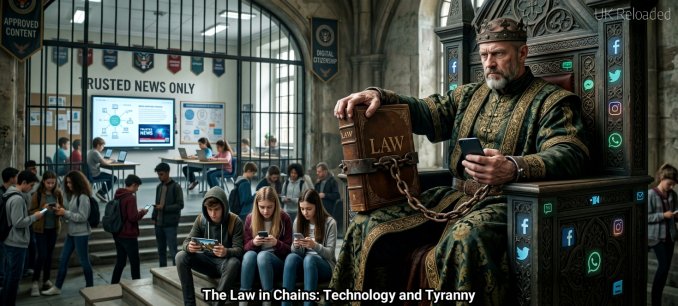
I Own the Law
On the Leviathan and the Smartphone
DAVID MCGROGAN
Nomos, the king of all,
of mortals and immortals alike,
leads them on, making just the most violent deed
with sovereign hand.Pindar
This is a short post about a big and much misunderstood subject: the ownership of law. The gist of the argument is easily stated. We have forgotten what it means to be governed by law that is held in common, and instead imagine law to be the possession of those who rule. The result is disorder: ad-hoc, arbitrary decision-making in which law appears, at best, as a managerial tool, and at worst simply operationalises tyrannical command.
You could not ask for a better illustration of this than the UK’s ongoing attempts to make the internet ‘safer’, the latest iteration of which is a putative set of regulations which will, we are told, ban social media for the under-16s. You will be familiar with this, no doubt, if you live here in Britain, as it has been Big News in recent weeks.
I should say first of all that my own opinions about legal restrictions on the use of technology as such are divided. On the one hand, I consider myself to be further to the libertarian end of the spectrum than Ayn Rand on most issues of public policy. Smartphones, and social media, have only really been in widespread use among the young for a decade. In the grand scheme of things, this is nothing much at all, and we are already seeing social norms emerge that at least exhibit disapproval of overuse of these types of technology in young people. Given time, I would expect that behaviour will cluster around a norm of minimal use of smartphones prior to the age of 16, that this will become an elite habit fairly quickly (if it is not already) and that it will filter down to the aspirational classes after that.
I also am not so sure that social media is the main problem we face. For boys, it is video games that do the most damage in terms of fried attention spans and distraction from productive behaviour. For girls, I would be just as concerned about any form of tech that allows groups of friends and fake friends to share instant messages in any form. Both sexes, meanwhile, are just as exposed to brain-squelchingly inane content on YouTube and TV than they are on social media proper. The genocide of the pre-adolescent brain cell is a phenomenon that far transcends TikTok and Instagram. And don’t get me started on what happens in school classrooms through what is misleadingly named ‘EdTech’.
On the other hand, I can sympathise with the alternative argument. Smartphones have been a disastrous invention, and I think most people would rather they hadn’t been invented, all things considered. And, for all that I am contemptuous and despairing of the way in which the mooted social media ban is being handled by the current UK government (and I will come to this in further detail in due course) I do not have vigorous die-on-a-hill objection in principle (these words are important) to the idea that the state should legislate to control children’s use of smartphones – and perhaps tablets and smart TVs while they’re at it. Note that I am being careful not to say that I think the state should control access to social media, and there is a reason for this to which I shall come. But for now, it is sufficient to say that I am not an absolutist when it comes to these matters.
Yes, in an ideal world it would not be necessary for the state to interfere in the private sphere in this way, and parents would make the right decisions if left to their own devices (no pun intended). But I have two daughters under the age of 10. While I am perfectly willing to be a tyrannical ogre and be complained at on an hourly basis for the next 6-10 years for not allowing them to have smartphones (‘Such-and-such a girl at school has one already, Dad. My cousin has one and she’s fine, Dad. I’ll get bullied if I don’t have one, Dad. It’s of educational value, Dad. I’ll only use it to learn things, Dad. What if I need to contact you in an emergency, Dad? You must hate me, Dad. Why do you hate me, Dad?’), they live in a world in which 99.9% of other parents lack my sheer bloodymindedness. And for my daughters’ sake I would rather live in a world in which – off the top of my head – adolescent boys are exposed to as small an amount of misogynistic pornography as is humanly possible, and in which friends and peers are able to grow up to function as thoughtful, sociable, autonomous adults. Since it is not in my power, nor that of any other individual parent, to control what other people allow their children to do, except through law, the justification for some form of restriction on smartphone use for children, given effect in law, becomes persuasive.
In other words, I haven’t entirely made up my own mind. I would prefer to live in a society in which it is parental authority and social norms which limit smartphone and social media use for children. I think that, if our society was left to its own devices, the culture would shift towards less use of devices among adults and children alike. But I understand the countervailing argument that in the meantime young lives may be being irrevocably damaged and that the law should prevent that insofar as it is possible to do so.
The problem, however, is that funny word ‘law’ and the way in which it is interpreted. Most politicians – and this is I think at the root of almost all of our problems – don’t really know, or care, what law is. They think law is a managerial method, when actually it is the opposite of that. Allow me to explain.
The question of what law is for, and how it emerged, is a vexed one, and in many ways is the wrong one to ask: all human societies have customary ideas about what is or isn’t done, and as they develop they appear to enshrine these in formal, institutional rules which in English we call ‘law’. They don’t do this because people sit around discussing whether or not it would be a good idea to have a legal system, and debating what law is designed to do or why it exists. It’s just something we human beings, apparently, do when our societies attain a certain level of sophistication.
This problem of figuring out what law is for is further complicated by the fact that English only really uses one word, ‘law’, to cover lots of different concepts. The rule which makes murder a crime is a law just as much as the Sunbeds (Regulation) Act 2010 is a law, but there is something very different about the two things, and the use of the same word to categorise them results in a certain muddiness of thought. In the first instance, the legal rule is an institutionalised version of a moral and customary precept that already existed. Hence, the traditional definition of murder, given by Coke back in the 17th century, is ‘when a man of sound memory, and of the age of discretion, unlawfully killeth within any county of the realm any reasonable creature in rerum natura under the King’s peace, with malice aforethought, either expressed by the party or implied by law, so as the party wounded, or hurt, &c. die of the wound or hurt, &c. within a year and a day after the same.’ Coke was not cutting this rule from whole cloth – he was simply writing down what was already widely known, and had been for many generations.
In the second instance, the legal rule creates a discretionary power – in the case of the Sunbeds (Regulation) Act 2010, the power to regulate the use of sunbeds. Although the Act does do some other things, its main purpose is to provide a Minister with the wherewithal to issue Statutory Instruments (a fancy word UK public law uses to refer to edicts or decrees) to ‘make provision requiring a person who carries on a sunbed business’ to do various things relating to supervision of sunbed use, the use of protective eyewear, and so forth. In other words, the law mostly just says that at unspecified future times there may be new regulations coming – and if you want to operate a sunbed business you will just have to wait and see what those are. Some day you are going to have to, for instance, ‘secure that protective eyewear meeting prescribed requirements is made available in connection with any use of a sunbed to which [your] business relates’, but you will not know when that is or what the prescribed requirements will be. Yet.
So on the one hand we have the formalisation or institutionalisation of an existing practice or rule on which there is near-universal consensus and understanding. And on the other we have a standing legitimation of continuous rule-by-edict, which seems to spring from nowhere and provides an indefinite, open-ended basis on which the government is given power to regulate a particular aspect of life in an ad hoc way. And these we refer to under the umbrella of ‘law’, even though they look very different and are in some respects even opposites.
As, it seems, is often the case, the Greeks can help us, here. The Greeks used lots of different words for what we call ‘law’, and it is not always helpful to apply these too programmatically, as their use evolved over the centuries. But Greek thinkers were consistently keen to draw a distinction between law which was held in common (meaning a communal or shared possession of the people) and that which was owned by the ruler, with the former being important to protect or preserve in the interests of equality or freedom, and the latter being associated with tyranny.
Hence, in Euripedes’ Suppliants were are told that there is ‘no worse foe’ for a city than a tyrant who ‘rules possessing the law’; in Oedipus Tyrannus the contrast is between those laws which ‘stand high’ and are eternal, and those which are authored by the tyrant; in Antigone Sophocles describes the ‘proclamations’ of Creon, the new ruler of Thebes, as inferior to the eternal customs of the gods, which are of no known authorship; and so on. The Greeks clearly had an understanding that there was something dangerous, and different, about a ruler who makes laws by his own design rather than securing and protecting the laws which stood above our outside of him, and which represented something important and distinctive about the people as such.
This is partly to do with identity – the idea that a people’s law is what gives that people its distinctiveness – but mostly, as I said, to do with equality and freedom. Those two concepts are, at face value, oppositional. In order for two people to be equal with one another it is necessary to curtail the freedom of one to the extent that it interferes with the equality of the other, and vice versa. But law in the proper sense, law held in common, helps the two to be harmoniously balanced. If the law applies in the same way to everybody then they are, it goes without saying, formally equal. But they are also free, because they know where they stand. They do not have to fear arbitrary power of the ruler, nor might-makes-right of other individuals, because all are subject to the same relatively fixed and unchanging set of rules. They can live secure in the knowledge that there is a general, minimal framework of law which everybody understands and accepts – the rules of the game, as it were – within which they can do more or less whatever they like. Although this involves some limits placed on freedom in the sense of not being able to do literally anything, the alternatives – anarchy and arbitrary rule – are far worse and far less free.
When the ruler owns the law, on the other hand, it follows that freedom and equality are undermined. This is because there is now one person (or a regime of people) more equal than others. But it is also because the law becomes unpredictable. Since it is owned by the ruler, and authored by him, what he says goes – and, in effect, he rules by his own discretion. From day to day he can issue new commands and give them binding effect in law. And from day to day people must therefore live in a sense of limbo, unsure what the law will look like tomorrow and unable to plan for the future or orient themselves in the present.
This all finds a curious elaboration in English political thought in the theory of Thomas Hobbes. In the Leviathan, Hobbes made the case for the sovereign as the ultimate authority in all things – subordinating both church and the ‘public’ as such. Hobbes did not present an argument for totalitarianism (even if he could have imagined such a thing), but rather for the sovereign being the place where the buck stopped. I slightly oversimplify, but not by a great deal, when I say that the core of his case is that human beings are greedy, vengeful, grasping, and disputatious, and if they are left to their own devices they will quickly descend into a ‘war of all against all’. What stops this, and what allows them to live together in relative harmony, is their (implicit) mutual covenant to obey a sovereign, the eponymous Leviathan, who can act as the final decision-maker and impose order accordingly, and who generally does this indirectly or implicitly by dint of his presence. Since alternative sources of authority (such as the church) would undermine the Leviathan’s capacity to act as final decision-maker, they must be made inferior to it.
Hobbes at times appears to make the claim that this covenant to obey the sovereign holds true whatever the sovereign does: the alternative, anarchy, is always worse. It would be better to be ruled by a Mussolini, a Papa Doc Duvalier, or even an Ed Miliband, as long as he could maintain order and security, than nobody at all. This sounds extreme. But we can forgive Hobbes this when we reflect that he had no way to foresee what would unfold in 300 years’ time, and that he was writing in the aftermath of a series of civil wars which had killed almost 4% of the entire population of England. (For context, the proportion killed in the First World War is thought to have been around 2% and, in the Second World War, about 1%; 4% of the population of England in today’s money would be 2.3 million people.) It is easy to understand why, considered in context, he came to this conclusion – and too easy to sit in relative peace and comfort in the year 2026 and cast aspersions on it.
And it would be a mistake to describe Hobbes as having no concept of higher duty. He just didn’t think the sovereign should be disobeyed. The sovereign was the ultimate law maker in respect of positive law (in Hobbes’ conception, everybody has the right to do whatever they like, and the sovereign makes law to put limits on the exercising of that freedom), and what was ‘just’ for practical purposes was whatever the sovereign said was just. But the sovereign still had a duty to obey God. He could make whatever law he liked, and had to be obeyed by his subjects, but if he went against God’s commands, or otherwise ruled capriciously or arbitrarily, he was still betraying his office. This is unsatisfactory to the modern reader of Leviathan, who thinks it intolerable that people should be expected to blindly obey sovereign commands even while thinking them to be immoral or wrong. But Hobbes did appear to presume that whoever was in charge would be answerable in the end to God – there was something above and beyond him to which he ought to refer.
The result of this, given full bloom across the next three centuries, and shorn of its political-theological aspect, is the strange and quintessentially English almost-contradiction that lies at the heart of our constitution: Parliament may make any law it chooses (and by extension may expressly delegate any discretionary power it likes), but it is bound by unwritten and even unspoken conventions that make it answerable not just to the people in the sense of the electorate, but the people in the sense of the country. It can do whatever it likes but it ought not to do anything un-British. It has absolute power but its power is at the same time bound by something higher yet: a law which is held in common by the British nation and is defined by, and defines, its character.
One has to be careful here to make clear that this does not mean that the common law binds or constraints Parliament, because this is an idea that contains within it the potential for much judicial mischief. But it does mean that Parliament is fettered by commitment to ‘law’ in the very broad sense in which it is not itself author of society’s norms. Like Creon, it abides by the eternal customs of the gods, meaning, in part, literally God (certainly in ages past) but, also, the British people. It can legislate whatever it likes in theory, and yet at the same time, it will be very wise if it does not do so in practice. It must go with the grain of British society, or its legitimacy will dissipate.
This brings us back to the smartphone/social media issue. It seems to my eye that what most people want, the thing that would be in accordance with the settled ideas of the public, is that children should have relatively smartphone-free childhoods. I don’t want to say that people hold that idea universally by any means, and nor do I cast any judgment on parents who allow their children to use their devices in a monitored and sensible way, but I think that restriction of some sort has broad societal consensus behind it, and what prevents it happening is a collective action problem. Most parents don’t really want their children to have smartphones but feel they have to have them, and have a hard time saying ‘no’ when it seems that every other parent is saying ‘yes’. They would be much happier if their children had dumbphones. But they don’t want their own little Johnny to be the only kid in the neighbourhood carrying around a Nokia that can only call or send SMS messages.
If, then, there is to be a legal restriction of some kind, the obvious solution is for Parliament to do what Parliament has traditionally done. It should make generally applicable law that will hold true and which will allow everybody to live in a close approximation to freedom and equality beneath it. This would be the most simple solution of all: i.e., not letting children under the age of 16 have smartphones, in the same way we don’t let them smoke or drink alcohol. How do we do we restrict children’s access to cigarettes and alcohol? We criminalise actions which facilitate those products getting into the hands of children. And this, while by no means perfectly enforced or enforceable, for the most part works. It would work for smartphones too, if we were serious about it.
To legislate in this way would have to take place after being a manifesto commitment of a party winning a general election, of course, and it would, ideally, be the result of cross-party consensus. This would make it a law which the people of the country held in common. And enacting it in such a way would be an important signal that those who legislate are cognisant that they are answerable to a higher law – the need to conform to the customs, expectations and norms of the society which they rule.
And the result, it probably goes without saying, would be freedom and equality under the law. The rule would be clear, so that people would be able to orient their behaviour accordingly (including, importantly, businesses who make the relevant technology) in an autonomous way. And it would be general, meaning that it would apply to everybody – under-16, over-16s, parents and providers – in the same way.
This, however, is by no means what the government is proposing. What they are proposing is rather a much more complicated and, importantly, arbitrary method of regulation. When the social media ‘ban’ is given effect, you see, it will not happen through legislation at all but, you’ve guessed it, through regulations made through a discretionary power. Section 70 of the Children’s Wellbeing and Schools Act 2026, amending the Online Safety Act 2023, provides that:
The Secretary of State may, for the purpose of protecting relevant children from a risk of harm (including harm presented by content), make provision by regulations requiring providers of specified internet services—
(a) to prevent access by relevant children to specified internet services which they provide, or to specified functionalities or other features of such services;
(b) to restrict access by relevant children to specified internet services which they provide, or to specified functionalities or other features of such services.
And it is through this mechanism that the government plans to among other things restrict access to Snapchat, TikTok, YouTube, Instagram, Facebook, and X, as well as other things like age restrictions on ‘romantic companion’ AI chatbots and so on. Not through primary legislation passed by Parliament. But through the stroke of a ministerial pen.
There are two things to say about this. The first is conceptual: this is a government which, like successive governments before it for many years, considers law to be a tool which it possesses. Whatever regulations it ultimately enacts will not be law that is held in common by people and ruler alike, but law which is laid down by the ruler as an edict, of which he is the author. It is that form of law wielded, in other words, by the ‘worst foe’ that a society could have – a tyrant who governs simply as he sees fit. It may be a tyrant that thinks of itself as benevolent. But tyrants often do, and they have a tendency to start small.
The second is substantive. A great deal of fuss has been made about the fact that the regulations will likely make online age-verification a requirement for anybody to access social media. This is, no doubt, concerning. More concerning yet, I think, is that there is no generally accepted definition of ‘social media’; the list apparently does not include WhatsApp or BlueSky, for instance, or YouTube Kids, not to mention many gaming or music streaming sites where messaging and commenting (and live chat) may be functions. Is Discord social media? Is Telegram?
In other words, as soon as one gets into the messy business of deciding what exactly one wishes to regulate, the doorway is opened to arbitrariness and, ultimately, corruption. Why is BlueSky not ‘social media’, and hence accessible by under-16s, while X is? We all know the answer to this question. And we all, also, I think sense that once the government becomes involved in making decisions about ‘specified functionalities’ or ‘specified internet services’ there will be no end to its tinkering and no meaningful resistance to the temptation to do whatever seems politically expedient at any given moment (we are already, for instance, learning that part of the government’s plans involve making sure that BBC content – and that of other ‘trusted news sources’ – is promoted online above alternative media).
In other words, the pathway from the ruler treating law as his possession to the undermining of equality and freedom follows exactly the route our ancient sources would suggest. A society whose ruler treats law as his possession is not equal, because the ruler will be given to making arbitrary decisions which suit his own preferences and those of the regime which supports him. And it is not free, because the discretion he exercises is unpredictable and unstable – one cannot quite predict the ways it will change from one month to another, nor anticipate how frequently changes will occur. And whatever is changed will not be in accordance with the settled norms of the people (what they hold in common, such as a sense that privacy is very important) but rather in accordance with what the ruler desires (including, transparently, age-verification as a route to restricting access to information).
So while I can sympathise with the idea of restricting children’s access to smartphones in law, I object entirely to the manner in which the project is being carried out, including at the level of what is being restricted (i.e., social media rather than the device itself). What is needed, if a law is to be made at all, is a simple rule which everybody can understand and accept – no smartphones for under 16s. What we are getting instead is a messy, unpredictable, arbitrary mess (a quasi-ban of the nebulous concept of ‘social media’) that will leave society less equal and less free. But this is entirely to be expected from a political class that has ceased to think clearly about what law making really means, and which considers it to be a tool rather than a set of accepted rules that we hold in common.
This article (I Own the Law) was created and published by News from Uncibal and is republished here under “Fair Use”

••••
The Liberty Beacon Project is now expanding at a near exponential rate, and for this we are grateful and excited! But we must also be practical. For 7 years we have not asked for any donations, and have built this project with our own funds as we grew. We are now experiencing ever increasing growing pains due to the large number of websites and projects we represent. So we have just installed donation buttons on our websites and ask that you consider this when you visit them. Nothing is too small. We thank you for all your support and your considerations … (TLB)
••••
Comment Policy: As a privately owned web site, we reserve the right to remove comments that contain spam, advertising, vulgarity, threats of violence, racism, or personal/abusive attacks on other users. This also applies to trolling, the use of more than one alias, or just intentional mischief. Enforcement of this policy is at the discretion of this websites administrators. Repeat offenders may be blocked or permanently banned without prior warning.
••••
Disclaimer: TLB websites contain copyrighted material the use of which has not always been specifically authorized by the copyright owner. We are making such material available to our readers under the provisions of “fair use” in an effort to advance a better understanding of political, health, economic and social issues. The material on this site is distributed without profit to those who have expressed a prior interest in receiving it for research and educational purposes. If you wish to use copyrighted material for purposes other than “fair use” you must request permission from the copyright owner.
••••
Disclaimer: The information and opinions shared are for informational purposes only including, but not limited to, text, graphics, images and other material are not intended as medical advice or instruction. Nothing mentioned is intended to be a substitute for professional medical advice, diagnosis or treatment.
Disclaimer: The views and opinions expressed in this article are those of the author and do not necessarily reflect the official policy or position of The Liberty Beacon Project.


Evidence is prime. Whereas The Law is written by lawyers.