

Net Zero Strikes again
STU TURLEY
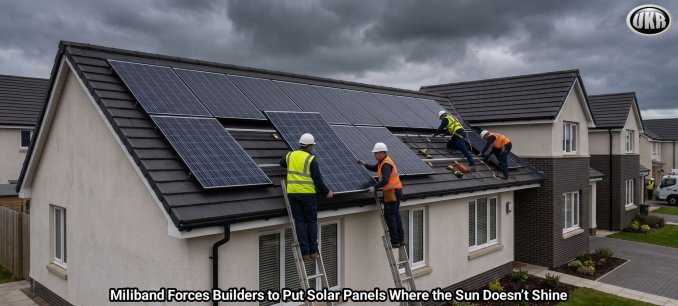
Energy Secretary Ed Miliband’s push to embed solar panels into every new home under the Future Homes Standard (FHS) is drawing sharp criticism from housebuilders, who argue the policy mandates installations even on roofs that receive little or no meaningful sunlight. The rules, which build on plans originally developed under the previous Conservative government but tightened under Labor, require solar photovoltaic (PV) panels covering the equivalent of 40% of a new dwelling’s ground floor area “where feasible.”
Where shade, orientation, or design constraints make the full target impossible, developers must still install a “reasonable amount” of solar.
The FHS, set to apply to new homes from around March 2028 (with a 24-month transition period), aims to ensure new dwellings emit at least 75% less carbon than those built to 2013 standards. It effectively mandates low-carbon heating (primarily heat pumps) alongside on-site renewable generation, with higher-risk buildings (e.g., high-rises) exempted.
Builder Backlash and Practical Concerns
Housebuilders warn the policy adds high costs — up to £8,000 per new home in some estimates — while delivering questionable returns in many locations. A senior executive at a major housebuilder described it as “a waste of money,” noting that panels are sometimes placed without regard for actual solar exposure: “We’re paying to put solar panels on a part of the house, not necessarily to generate much electricity. It’s just a case of how the sun works.”
Neil Jefferson, Chief Executive of the Home Builders Federation, stated that the Government had “ignored the practical realities” of imposing the 40% coverage requirement on every new roof. Many homes cannot meet the target due to orientation or design, and the lack of a clear, efficient exemption process risks creating “another barrier to increasing housing supply.”
Critics highlight the tension between aggressive net-zero targets and Britain’s acute housing shortage. Additional regulatory burdens, including infrastructure levies and the Building Safety Levy, compound the issue. One executive suggested the money would be better spent retrofitting older Victorian homes for greater overall efficiency gains.
A Government spokesperson countered that the FHS will help households save around £600 per year on energy bills and includes flexibility “where this is not practical or effective,” along with the transition period.
UK Net Zero Policies in Context
The FHS forms part of Labor’s broader net-zero agenda under Energy Secretary Ed Miliband. The UK has a legally binding target of net zero greenhouse gas emissions by 2050, with interim carbon budgets and a Clean Power 2030 mission aiming for a highly decarbonized electricity system.
Key elements include:
- Massive expansion of renewables (wind, solar) via auctions.
- Restarting a nuclear program.
- The £15 billion Warm Homes Plan for retrofits.
- Accelerated deployment of heat pumps, EVs, and on-site generation.
Emissions have fallen around 50% since 1990, and the UK is on track for the Fourth Carbon Budget (2023–2027). However, the Climate Change Committee’s 2026 progress report notes that progress is not fast enough in key areas like heating and transport, and risks remain for later budgets.
The power sector has decarbonized significantly, but policies like the FHS extend the transition into buildings at a time when new homes are already being built to be “zero-carbon ready” as the grid cleans up.UK Energy Costs Compared to Other Western Countries
UK households and businesses face some of the highest electricity prices in the Western world, a factor that makes the cost implications of the FHS particularly salient.
Domestic electricity: In the first half of 2025, UK prices were 23% above the EU average. They ranked among the highest in Europe, behind only Germany and Ireland in several metrics. Gas prices were relatively more competitive (28% below the EU average).
Industrial electricity: The UK has consistently had among the highest (often the highest) industrial electricity prices in Europe. For large users, prices have been reported as 125% or more above the EU-14 median in recent data. This puts UK industry at a competitive disadvantage versus France, the US, and others.
International benchmarks: US industrial and residential electricity prices are substantially lower (often roughly half or less of UK levels in comparable terms). France benefits from its nuclear fleet with lower prices. Germany has high prices due to its own Energiewende transition.
High UK electricity prices stem from a combination of network costs, policy levies supporting renewables and decarbonization, intermittency management, and historical reliance on gas. While renewables have helped reduce wholesale price volatility in some periods, the overall bill impact for consumers remains elevated compared to many peers.
UK Energy Mix: Progress and Persistent Realities
The UK electricity system has transformed rapidly:2025 full-year data (approximate shares of generation/supply):Renewables: 47% (record 152 TWh) — Wind ~27% (87 TWh), Solar ~6% (19 TWh), Biomass ~13% (41 TWh).
Gas: 28% (91 TWh).
Nuclear: 11% (36 TWh).
Net imports: 10%.
Coal: 0% (first full year with no coal generation).
carbonbrief.org
Low-carbon sources (renewables + nuclear) now dominate, with carbon intensity reaching record lows in many periods. Renewables hit over 53% in Q1 2026.
However, gas remains a critical flexible backup, and nuclear output has been low due to outages. Demand is rising again after years of decline, driven partly by electrification. The system is cleaner but still faces challenges with intermittency, grid constraints, and the need for significant new infrastructure.

The Bigger Picture
Mandating solar on new homes — even in suboptimal locations — is presented as a win for bills, carbon reduction, and energy security. In principle, on-site generation reduces grid demand and can lower household bills when paired with efficient fabric and heat pumps.
In practice, forcing panels onto shaded or poorly oriented roofs risks poor performance, higher upfront costs passed on to homebuyers, and added complexity for an industry already struggling with viability and delivery targets (the Government aims for 1.5 million new homes).
As the grid decarbonizes further, the marginal carbon benefit of every individual panel diminishes, while the immediate cost burden on new housing does not. Retrofits of the existing stock often deliver larger aggregate savings.
The controversy highlights a recurring tension in UK energy policy: ambitious top-down targets versus practical, cost-effective delivery. Housebuilders support sustainability in principle but question whether every new roof must become a solar farm regardless of the sun’s cooperation.
Nothing Ed Miliband has done for the UK has been good, and until they realize that he is a true believer in net zero and will do anything for his own power, and nothing to ensure the low-cost, reliable power for consumers in the UK.
How this Applies to the U.S.
We can learn from his commitment to net zero, and its total devastation of the UK economy and industrialization ability. In the United States, our Blue States are following the Ed Miliband playbook as if he were a sheep character in a Wallace and Gromit claymation show. He is committed, and should be commended for his dedication to his beliefs, but what should be checked is his bank accounts to see if he has been paid for by rebates from wind and solar companies.
Our Blue State leaders also need to be checked for corruption and paybacks on energy policies, and our Red States need to make sure we lead the charge and get the dang Save America Act passed so we have only legal citizens voting.
Second only to our elections are state-level energy policies. The Blue States are a crisis waiting to happen.
Appendix: Sources and Links
- Yahoo News / Telegraph coverage: “Miliband forces builders to put solar panels where sun doesn’t shine” (July 2026) — https://www.yahoo.com/news/politics/articles/miliband-forces-builders-put-solar-162539753.html
- Official Future Homes Standard announcement (gov.uk): https://www.gov.uk/government/news/rooftop-solar-for-new-builds-to-save-people-money
- Carbon Brief analysis of 2025 UK electricity generation: https://www.carbonbrief.org/analysis-uk-renewables-enjoy-record-year-in-2025-but-gas-power-still-rises/
- UK Government Energy Trends (Q1 2026 renewables share): https://assets.publishing.service.gov.uk/media/6a423e678cbc951a27d80dac/Energy_Trends_June_2026.pdf
- House of Commons Library: Gas and electricity prices comparison (2026 briefing): https://commonslibrary.parliament.uk/research-briefings/cbp-9714/
- Climate Change Committee Progress Report 2026: https://www.theccc.org.uk/publication/progress-in-reducing-emissions-2026-report-to-parliament/
- Ember UK energy data: https://ember-energy.org/countries-and-regions/united-kingdom/
- IEA Electricity Prices analysis: https://www.iea.org/reports/electricity-2026/prices
- Additional context on industrial prices: David Turver Substack analyses (various 2025–2026 reports)
All data reflects the most recent publicly available figures as of mid-2026. Policy details and statistics can evolve; readers should consult official DESNZ and MHCLG sources for the latest implementation guidance.
This article (Ed Miliband forces builders to put solar panels where the sun doesn’t shine) was created and published by Energy News Beat and is republished here under “Fair Use” with attribution to the author Stu Turley
See Related Article Below
Miliband forces builders to put solar panels where sun doesn’t shine
Construction company executive says new-build requirement is ‘waste of money’
Builders have accused Ed Miliband of forcing them to install solar panels on houses even when they do not receive any sun.
Under the Energy Secretary’s Future Homes Standard, the Government mandates that solar panels on roofs should cover 40pc of the ground-floor area of each new-build house.
The rule forms part of a push to ensure new houses emit 75pc less carbon than older properties. It will apply to homes built from March 2028 in buildings measuring under 18 metres.
However, a senior executive at a major housebuilder claimed that the requirement was a “waste of money” because some homeowners will end up buying homes with solar panels that do not generate meaningful amounts of electricity.
Previously, developers would plan to put solar panels where they would receive the most sun and generate enough energy to serve a whole development site, rather than on individual homes.
“We’re paying to put solar panels on a part of the house, not necessarily to generate much electricity,” an industry executive said, adding it was “just a case of how the sun works”.
They said the policy was “strange … when we’re trying to make homes more viable”. “We support making housing more sustainable, but some of the things they’ve done just don’t make sense.”
The executive said the rule would significantly add to build costs, estimating the cost of a “future” new-build house, which includes the enforced solar element, would cost up to £8,000 more.
“If you were to invest that money instead on upgrading Victorian houses to be slightly more efficient, that would be massive,” they added.
While the rule for 40pc coverage was devised by the previous Conservative government, it allowed property developers to bypass the need to install solar panels if there were design limitations or too much shade.
Labour’s rules stipulate that where 40pc coverage cannot be achieved if a roof is in shade or if it faces away from the sun, a “reasonable amount” of solar panels must still be fitted.

••••
The Liberty Beacon Project is now expanding at a near exponential rate, and for this we are grateful and excited! But we must also be practical. For 7 years we have not asked for any donations, and have built this project with our own funds as we grew. We are now experiencing ever increasing growing pains due to the large number of websites and projects we represent. So we have just installed donation buttons on our websites and ask that you consider this when you visit them. Nothing is too small. We thank you for all your support and your considerations … (TLB)
••••
Comment Policy: As a privately owned web site, we reserve the right to remove comments that contain spam, advertising, vulgarity, threats of violence, racism, or personal/abusive attacks on other users. This also applies to trolling, the use of more than one alias, or just intentional mischief. Enforcement of this policy is at the discretion of this websites administrators. Repeat offenders may be blocked or permanently banned without prior warning.
••••
Disclaimer: TLB websites contain copyrighted material the use of which has not always been specifically authorized by the copyright owner. We are making such material available to our readers under the provisions of “fair use” in an effort to advance a better understanding of political, health, economic and social issues. The material on this site is distributed without profit to those who have expressed a prior interest in receiving it for research and educational purposes. If you wish to use copyrighted material for purposes other than “fair use” you must request permission from the copyright owner.
••••
Disclaimer: The information and opinions shared are for informational purposes only including, but not limited to, text, graphics, images and other material are not intended as medical advice or instruction. Nothing mentioned is intended to be a substitute for professional medical advice, diagnosis or treatment.
Disclaimer: The views and opinions expressed in this article are those of the author and do not necessarily reflect the official policy or position of The Liberty Beacon Project.


Leave a Reply