

The Makerfield Election and Electoral Integrity
TOM ARMSTRONG
Now I’m a cynic and a confirmed conspiracy theorist, but try as I might to avoid confirmation bias, the size of Labour’s win at Makerfield smells fishy to me. The following isn’t a polemic, or pro-any party, but attempts to look at the result objectively. Tell me what you think in the comments.
The Makerfield election on 18 June 2026 obviously delivered a decisive win for Labour’s Andy Burnham, who secured 24,927 votes and 54.8% of the ballot. This represented an unlikely increase of +9.6 percent from the 2024 general election, widening Labour’s majority to 9,231 over Reform UK’s Robert Kenyon, who took 15,696 votes (34.5%). Restore Britain, ‘split the right’ with 3,111 votes (6.8%), while the Conservatives collapsed to just 997 votes (2.2%). Turnout rose to 58.8% from about 52.5% in 2024.
On the surface, this looks like a strong personal endorsement for Burnham, the former Manchester Mayor, in a traditional Labour. Yet a closer statistical look, especially at the role of postal votes, raises legitimate suspicions about how the result was achieved and whether it truly reflects the will of those who voted.
In the 2024 general election, Labour won with 18,202 votes (45.2%), against Reform’s 12,803 (31.8%) and the Conservatives on 4,379 (10.9%), the majority a modest 5,399. By 2026, the hugely unpopular Labour Party’s vote increased by over 6,700 despite the by-election context. Reform also grew its absolute tally by nearly 2,900 votes but could not close the gap.
Turnout rising to nearly 59% is highly unusual for a by-election. Possibly, Burnham’s celebrity status and local profile mobilised supporters, while minor Left-Wing parties (Liberal Democrats, Greens) virtually disappeared, likely swinging behind Labour to’ keep the racists out’. This, combined with the collapse of the Conservative vote, handed Labour an easier path than polling trends have suggested for Labour.
Also, recent local elections in May 2026 painted a different picture. Reform dominated Wigan council seats covering Makerfield wards, often polling around 50% to Labour’s 27%. This suggested momentum for the right that came nowhere near materialising in the by-election. The candidate effect matters, as Burnham is a well-known figure with, perhaps, broader appeal than a normal Labour candidate, but the scale of the shift is surprising.
Pre-election polls consistently showed a tighter race. Survation (late May) had Labour at 43% and Reform at 40%. Other polls from Convergent Opinion, More in Common, and Opinium placed Labour between 45-49% and Reform 37-41%, with Restore taking 5-8%. Yet the final result saw Labour outperform these polls by several points, while Reform underperformed relative to some expectations. This discrepancy is not unprecedented in by-elections, where local factors and higher-profile candidates can distort national trends. However, it invites scrutiny when combined with other anomalies, particularly around postal voting.
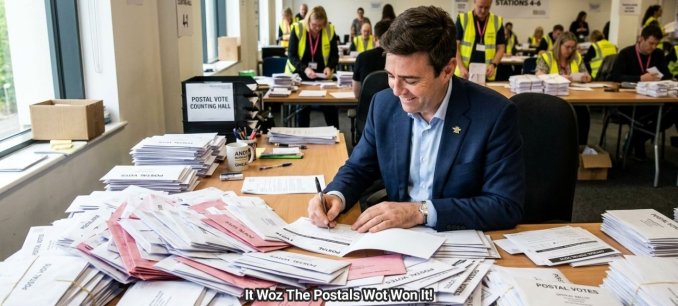
One of the most striking elements was the postal vote performance. No figures have yet been published, but reports suggest that the postal turnout reached up to 80% in the by-election, up from 74% in the 2024 general election. In a seat with an electorate of roughly 77,000, this means thousands of additional votes were cast via post, almost certainly overwhelmingly in Labour’s favour. The UK postal voting has long shown a suspicious partisan skew towards Labour. The system, expanded under previous Labour governments to “on demand” postal votes, allows parties to encourage applications and, in some cases, assist with returns. Labour has historically ‘organised’ postal votes more effectively and high completion rates among postal voters (often 60-80%) amplify this advantage compared to in-person polling.
So, while Uniparty policy has been to encourage postal voting, it has been oddly reticent about collecting and publishing postal vote statistics, ostensibly for ‘data protection and privacy’ reasons. Rich, isn’t it?
Critics have repeatedly highlighted vulnerabilities: ballot harvesting (where campaigners collect and return bundles), family voting under pressure, personation, and weak verification. Judges, including Richard Mawrey QC in high-profile cases, have described the potential for “industrial scale” fraud. Historical convictions, particularly in places like Birmingham in the 2000s, often involved Labour-linked actors exploiting postal systems. While proven cases remain relatively rare overall, detection is difficult, and under-reporting is widely acknowledged.
In Makerfield, if the postal turnout was as high as 80%, compared an overall turnout of 59%, it is quite possible that postal votes made up 40% – 50% of the votes cast. As an example, in the 2024 general election 47% of the total vote in nearby Oldham was postal. Of a total vote of 45,510, a 47% postal vote is 21,390 votes – well over double Labour’s majority. This almost certainly won the vote for Labour. In-person votes, which often reflect more motivated or spontaneous turnout, may have been much closer given Reform’s local strength. Without a full public breakdown of postal versus polling station votes, we cannot quantify the exact impact. But the differential—80% postal participation versus suggests postal votes formed a disproportionately large and Labour-heavy share of the total. Even a modest ‘skew’ of a few thousand votes could explain much of the 9,000+ majority.
Labour is not alone in benefiting from postal votes, of course, but the party has a documented history of maximising the system it helped create. In tight or symbolically important contests, the incentives are obvious. Makerfield was not just any by-election; it was a platform for Burnham to return to Parliament and position himself against Keir Starmer. A comfortable win bolstered his leadership credentials.
The right-wing split undoubtedly hurt Reform, yet the outcome feels at odds with May’s local results and some polling. Higher overall turnout did not produce the Reform surge many expected in a “Red Wall” seat disillusioned with national Labour. Instead, Labour consolidated and expanded. This pattern fits broader concerns about UK electoral integrity. Photo ID at polling stations addressed some in-person risks, but postal voting remains “wide open,” as critics put it. Applications lack rigorous ID checks in many cases, and harvesting persists despite rules. Greater transparency—separate counts or breakdowns for postal votes—would help, as would reforms like limiting applications, requiring witnessed returns, or even abolishing on-demand postal in favour of stricter criteria.
Scepticism here is not conspiracy-mongering but a call for evidence-based trust. When a method known for bias and vulnerability delivers a decisive result that exceeds expectations, questions are reasonable. Absent granular data, the heavy and possibly manipulated postal participation remains the most plausible explanation for Labour’s outsized margin.
Makerfield highlights other trends; Labour can still hold traditional heartlands through strong local candidates and postal mobilisation, even amid national challenges. Reform is growing but vulnerable to splits and needs broader appeal to convert local gains into parliamentary seats. The Conservative collapse continues.
For democracy, the by-election underscores the need for reform. High-stakes votes should withstand scrutiny. Full postal data, stricter safeguards, and perhaps moving towards all-postal with robust verification (or away from it) would build confidence. Until then, results like Makerfield will fuel suspicion that the system, rather than pure voter intent, tipped the scales.
In plain terms, Andy Burnham won fairly on paper. But the statistics—especially the postal surge—invite doubt about whether the victory was as resounding, or as reflective of in-person sentiment, as declared. In an era of low trust, elections must be beyond reasonable suspicion. Makerfield falls short of that standard.
This article (It Woz The Postals Wot Won It!) was created and published by Free Speech Backlash and is republished here under “Fair Use” with attribution to the author Tom Armstrong
Featured image: Free Speech Backlash


Leave a Reply