

MATT ROBERTS
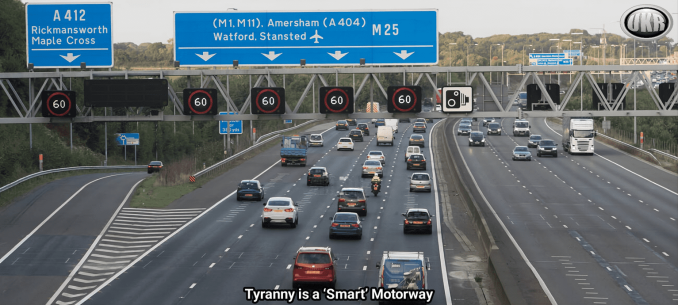
About once a year, I have to make the drive from my home in south London to the ferry terminal in Birkenhead, which involves taking the M25, the M1 and the M6. This makes up around 200 miles of a 250 mile drive. Maddeningly, I can almost never get my speed up above 50 miles an hour for that part of the journey because almost all of it is on motorways with variable speed limits and the limit is almost always set well below 70 mph. On one such journey, it occurred to me that variable speed limits on motorways are a very good example of the changing relationship between the British state and the people.
When I first started driving, a little over 30 years ago, these things didn’t exist. The speed limit on any given road was fixed and generally speaking, motorways were set at the national speed limit of 70. The concept was ‘trialled’ on the M25, starting in 1995. To absolutely nobody’s surprise, the trial was deemed a success in 1997 and this little tyranny began to be rolled out to other roads around the network, mutating over time into the so-called ‘smart’ motorways that we know and loathe today. The motorway is smart, war is peace, freedom is slavery, ignorance is strength.
Over the last 20 years or so, we’ve become very used to anti-traffic measures blighting our daily lives, introduced in the name of safety, cleaner air, Net Zero, healthy living, ‘won’t somebody think of the children’, or some combination of these. Particularly for those of us who live in urban Britain, or travel regularly into British towns and cities, we have had to learn to live with 20 mile-an-hour zones, segregated bike lanes, LTNs, LEZ, ULEZ, congestion charges and many other petty intrusions. The recent green light for the ’15 minute city’ in Oxford will no doubt rapidly metastasise through the country. These bureaucratic encroachments on the urban motorist are quite transparent in their intent – all of them are obviously revenue raising schemes for fiscally incontinent local authorities and designed to make sure that getting behind the wheel of your car is such an unpleasant and expensive prospect that you’ll only consider it under the direst of circumstances. Since we’re not incurably credulous, the sensible among us recognise that this is the work of minor technocrats with frustrated ambitions, using what little power they have to exert a little bit more control over us, make our lives just a little bit less free and enjoyable and raise some funds in the process. My local council recently introduced LTN cameras on several streets in the borough, ostensibly to stop those roads being used as ‘rat runs’. They held multiple consultation meetings, with overwhelmingly negative feedback from residents. Nonetheless, they then introduced a trial – again, with negative feedback. At the end of the trial, they declared success and made the set up permanent. Purely coincidentally, they raised several millions of pounds from fines issued during the trial period.
Doubtless, variable speed limits on motorways raise revenue from speed cameras and certainly they put you off using the road unless you absolutely have to get a family of four plus dog and luggage from point A to distant point B. More importantly, though, they are infantilising: they are the state as helicopter parent, terrified that if it leaves us to our own devices we might make bad decisions with bad consequences. Somewhere in a central control room, a computer program designed by experts for the purpose, makes a decision on your behalf based on information from road-surface sensors and constant CCTV. A specially selected and trained functionary keeps an eye on the system and intervenes when necessary or at whim. In big red and white lights, the state tells us: ‘We do not trust your judgement. You are an unruly child and it’s best if we set your boundaries.’ Big, black and white clip art cameras also say: ‘You are under supervision. Don’t forget it.’ Shabana Mahmood’s Benthamite panopticon in action.
This is also anti-localism in microcosm (unless that’s an oxymoron). A localist view would be that I, behind the wheel of my car, am closest to the road conditions around me and have the best knowledge of how I and my vehicle can react to them. The state insists that it will make better decisions centrally and I have no right of appeal.
In the Oxford History of England (1914-1945), A.J.P. Taylor famously wrote that, before the outbreak of World War I, a “sensible, law-abiding Englishman could pass through life and hardly notice the existence of the state beyond the post office and the policeman”. Now, on the M25, he is reminded of its existence once every half mile or so.
So much for what this says about the state’s view of the people, but every relationship goes in two directions. What do variable speed limits have to tell us about how we should view the state?
Most importantly, the system does not work. The speed you are told to travel at is almost never appropriate to the conditions in which you find yourself. You will be limited to 40 on a stretch of road clear enough that you could comfortably and safely be driving at 70. Similarly, the gantry will tell you that you could speed up to 60 when the traffic around you is barely moving. Secondly, the information the system uses to make its decisions is often flat wrong. The boards next to the speed limit signs will warn you of upcoming hazards that are not there and queues that don’t materialise. Often, you’ll pass through a stretch where the limit gradually reduces and then climbs again and you will come out the other side with absolutely no idea why any of the changes were imposed at all. It should come as no surprise that the state machinery makes bad decisions based on faulty information, but it’s always useful to have a reminder. In theory, the system is supposed to reduce congestion and stop-start traffic. It’s impossible to prove or disprove this, because the roads where it’s implemented are the busiest in the country and there is no control group, but it’s hard not to get the sense that the congestion is often caused by the changing limits themselves.
The example of variable speed limits and smart motorways might seem trivial, but just the three roads I’ve mentioned account for nearly half a million journeys a day, which adds up to an awful lot of people being having their agency removed on an annual basis. This kind of infantilisation by the Government is pernicious, because it teaches us to look to the state for protection and guidance and not to rely on ourselves. The fiscal, economic and social feedback loop we find ourselves in can be put down to an accretion of exactly these kinds of measures: the state intervenes in a new area of the life; people submit and increasingly look to the state for more guidance and intervention; the state grows into the space and becomes more expensive; taxes need to be raised and borrowing increased to pay for the expansion; economic activity slows because of taxation and regulation; people depend on the state for more support. If we don’t break this cycle, we really are in trouble.
With a background in history and political philosophy and after a long corporate career, Matt Roberts now writes on the political system and current affairs. Find him on Substack and X.
This article (Tyranny is a ‘Smart’ Motorway) was created and published by The Daily Sceptic and is republished here under “Fair Use” with attribution to the author Matt Roberts

••••
The Liberty Beacon Project is now expanding at a near exponential rate, and for this we are grateful and excited! But we must also be practical. For 7 years we have not asked for any donations, and have built this project with our own funds as we grew. We are now experiencing ever increasing growing pains due to the large number of websites and projects we represent. So we have just installed donation buttons on our websites and ask that you consider this when you visit them. Nothing is too small. We thank you for all your support and your considerations … (TLB)
••••
Comment Policy: As a privately owned web site, we reserve the right to remove comments that contain spam, advertising, vulgarity, threats of violence, racism, or personal/abusive attacks on other users. This also applies to trolling, the use of more than one alias, or just intentional mischief. Enforcement of this policy is at the discretion of this websites administrators. Repeat offenders may be blocked or permanently banned without prior warning.
••••
Disclaimer: TLB websites contain copyrighted material the use of which has not always been specifically authorized by the copyright owner. We are making such material available to our readers under the provisions of “fair use” in an effort to advance a better understanding of political, health, economic and social issues. The material on this site is distributed without profit to those who have expressed a prior interest in receiving it for research and educational purposes. If you wish to use copyrighted material for purposes other than “fair use” you must request permission from the copyright owner.
••••
Disclaimer: The information and opinions shared are for informational purposes only including, but not limited to, text, graphics, images and other material are not intended as medical advice or instruction. Nothing mentioned is intended to be a substitute for professional medical advice, diagnosis or treatment.
Disclaimer: The views and opinions expressed in this article are those of the author and do not necessarily reflect the official policy or position of The Liberty Beacon Project.


Leave a Reply