

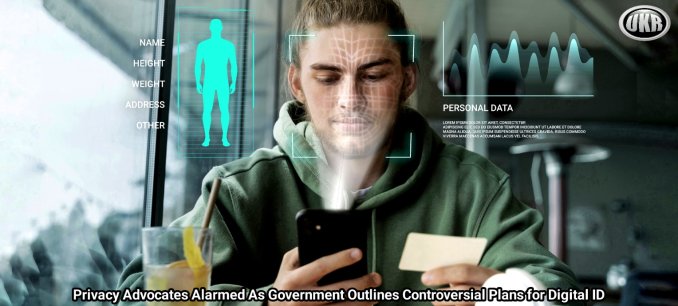
UK govt angers privacy advocates with digital ID consultation
The UK government wants feedback on its deeply unpopular plan to usher in a new era of state surveillance under the guise of a digital ID scheme.
NICK WOOD
Ideally, the government would like everyone to upload their full name, date of birth, address and a photo to its big database. Doing so, it claims, would “make public services quicker, easier and more secure to access.”
The public isn’t so keen – a petition opposing digital ID garnered nearly 3 million signatures. However, the Department for Science, Innovation and Technology (DSIT) seems to have ignored that, and has instead launched a consultation to ask the public to weigh in on its idea.
DSIT is obviously keen to emphasise the practical benefits of a so-called single source of truth for members of the public.
From a front-end perspective, rather than having to contend with different Websites for each department, users would be able to access and manage various government services – such as taxes, benefits, passport and driving licence renewal and so-on – through one, unified portal.
As for the back end, it avoids unnecessary duplication and the dreaded isolated data silos, leading to a simplified IT estate that is more effective and cheaper to run.
“People too often dread their interactions with public services. Endless telephone calls, complicated printed forms and having to tell your story multiple times to different parts of government,” said Darren Jones, chief secretary to the Prime Minister.
“I want to change that and make public services work for you. The new digital ID will make that possible, allowing you to log on and prove who you are to access public services more quickly, easily and securely.”
To drive home its point DSIT said the Driver and Vehicle Licensing Agency (DVLA) currently processes 45,000 letters a day; the Department for Environment, Food and Rural Affairs (Defra) uses 500 different paper forms; and His Majesty’s Revenue and Customs (HMRC) handles 100,000 phone calls a day.
However, more often than not, state-imposed ID schemes carry the stench of surveillance, government overreach, and the death of personal privacy. Try as DSIT might to obscure it, this one is no exception.
The consultation notes there is “a legal basis for police use of facial recognition, which may include access to biometric data held by government”. Under the current legal framework, law enforcement has the power to use photos of individuals to create a watchlist for a “valid policing reason”, which is nothing if not alarmingly ambiguous.
“Snuck into the consultation is an admission that the police would be allowed to repurpose our digital ID photos as mugshots to create a population-wide facial recognition database,” said Jasleen Chaggar, senior legal and policy officer at civil liberty advocate Big Brother Watch.
“It is for precisely this reason that the public is rightly sceptical of a sprawling ID system that has been sold to us under various guises – whether to ‘stop the boats’ or improve public services – but which invariably hands more power and more of our personal information to the state, at our expense.”
The government has already been publicly shamed into making digital IDs voluntary, and it insists that existing methods of accessing public services will remain in place. This only adds to the suspicion that this is primarily about keeping tabs on people.
In addition, it’s also worth remembering that the UK already has a de facto nationwide identity scheme in the form of the National Insurance number (NINO). It is used by various government departments, including HMRC for the pay-as-you-earn (PAYE) tax system, the electoral register and so-on, to identify individuals.
It is issued to everyone in time for their 16th birthday, you can’t legally work in the UK without one, and it functions without the necessity of storing an individual’s current address or any biometric data.
Would it be so difficult to enable people to use their NINO in combination with a password – and maybe two-factor authentication for good measure – to log in and administer their public services?
That the government would prefer to create and maintain a brand new repository brimming with personally identifiable information – providing access to the police, and what’s more dangling it like a piñata in front of every hacker on the planet – only adds to the air of suspicion surrounding this whole project.

••••
The Liberty Beacon Project is now expanding at a near exponential rate, and for this we are grateful and excited! But we must also be practical. For 7 years we have not asked for any donations, and have built this project with our own funds as we grew. We are now experiencing ever increasing growing pains due to the large number of websites and projects we represent. So we have just installed donation buttons on our websites and ask that you consider this when you visit them. Nothing is too small. We thank you for all your support and your considerations … (TLB)
••••
Comment Policy: As a privately owned web site, we reserve the right to remove comments that contain spam, advertising, vulgarity, threats of violence, racism, or personal/abusive attacks on other users. This also applies to trolling, the use of more than one alias, or just intentional mischief. Enforcement of this policy is at the discretion of this websites administrators. Repeat offenders may be blocked or permanently banned without prior warning.
••••
Disclaimer: TLB websites contain copyrighted material the use of which has not always been specifically authorized by the copyright owner. We are making such material available to our readers under the provisions of “fair use” in an effort to advance a better understanding of political, health, economic and social issues. The material on this site is distributed without profit to those who have expressed a prior interest in receiving it for research and educational purposes. If you wish to use copyrighted material for purposes other than “fair use” you must request permission from the copyright owner.
••••
Disclaimer: The information and opinions shared are for informational purposes only including, but not limited to, text, graphics, images and other material are not intended as medical advice or instruction. Nothing mentioned is intended to be a substitute for professional medical advice, diagnosis or treatment.
Disclaimer: The views and opinions expressed in this article are those of the author and do not necessarily reflect the official policy or position of The Liberty Beacon Project.


Leave a Reply