

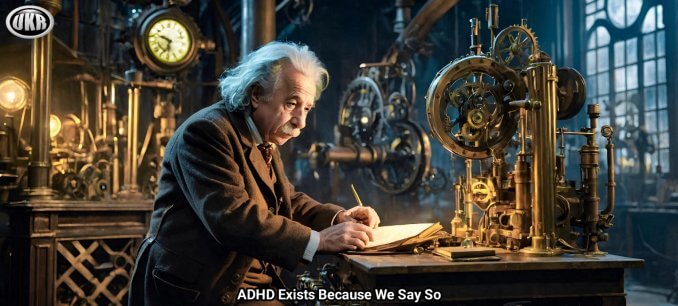
Albert Einstein would be labeled and drugged today
DR. ROGER MCFILLIN
In the early 1990s, I was what teachers called a problem student. No smartphones yet. No social media. No algorithm feeding me dopamine every thirty seconds. There was nothing to blame my restlessness on except me.
Under fluorescent lights, in plastic chairs bolted to desks, my body ached for movement while my mind wandered far past whatever was written on the board. The curriculum felt like a straitjacket tailored for someone else. I didn’t fit. I disrupted. I questioned. I got moved around the room, kicked out of class, sent to hallways. Not because I was incapable of focus, but because I refused to pretend that what was happening in those rooms deserved it.
Looking back, I was doing something specific in those classrooms: I was watching. I tracked how social hierarchies formed and collapsed. I noticed which teachers commanded genuine respect and which ones demanded it because they had nothing else. I was developing a clinical eye before I had any clinical training. What looked like distraction was actually a different quality of attention, one that didn’t match the environment but wasn’t broken.
That distinction matters. And today, we’ve lost it entirely.
If I were twelve years old now, I would be referred for an ADHD evaluation within the first semester. My restlessness would become a symptom. My questioning would become oppositional behavior. A psychiatrist would see me for fifteen minutes and hand my parents a diagnosis and a prescription. My teachers would thank them.
That is what we call progress.
ADHD Exists Because We Say So
The psychiatric establishment defends ADHD by pointing to its recognition as a neurodevelopmental disorder, as though recognition and reality are the same thing. They’re not. That argument is circular. “It’s real because we say it’s real” has never been a scientific claim; it’s an institutional one.

The comparison to diabetes and hypertension doesn’t hold. We measure blood sugar. We measure blood pressure. We identify the physiological mechanism, verify it, and treat it. ADHD has no equivalent. There is no biomarker. No blood test. No brain scan that distinguishes the diagnosed from the undiagnosed. The diagnosis rests entirely on behavioral observations filtered through the subjective judgment of adults, adults who are themselves operating inside a system with a strong financial interest in finding disorders to treat.
Stimulant drugs affect attention and behavior in everyone, not just those diagnosed with ADHD. That’s not how disease-specific treatment works. Insulin corrects a specific failure in a measurable physiological system. Stimulants change brain chemistry across the board. Pointing to the fact that medication “works” proves nothing about the validity of the diagnosis.
What the ADHD framework does well is identify a cluster of behaviors that make children difficult to manage in classrooms built on compliance. That’s not medicine. That’s administration.
Three Children. One Label.
Picture three boys sitting in the same classroom, flagged by the same teacher for the same behaviors: can’t sit still, can’t stay on task, acts before thinking.
The first boy eats processed food at every meal, spends four hours a night on a screen, hasn’t had sustained physical activity in weeks, and has never once played outside without a device in his pocket. His attention is fractured by his environment, his diet, his lifestyle. There are real, addressable causes here. The ADHD framework ensures we never pursue them. We “medicate” instead, and in doing so, create a child-sized version of how we handle every chronic illness: manage the symptoms, ignore the roots, generate a lifelong patient.
The second boy is intensely curious. He gets absorbed in mechanical systems, in how things work, in the edges of questions his teacher doesn’t want to take the time to explore. He struggles to sit through instruction that bores him because he’s already three steps ahead of it. His attention isn’t deficient. It’s selective. Given the right environment, the right problem, the right outlet, he thrives. Instead, he gets diagnosed, medicated, and taught that his mind is a disorder to be managed.
The third boy is living in chaos. There is violence at home. There is unpredictability. He has learned, through hard experience, to stay alert, to track adult behavior for signs of danger, to move fast and trust nothing. His hypervigilance looks exactly like ADHD on a checklist. It isn’t. It’s a survival response to an impossible situation. And yet, I have watched this happen, a psychiatrist will sit with this child for fifteen minutes, review the teacher’s behavioral report, and write a prescription. The trauma is never named. It is simply reclassified as a brain disorder and handed back to the child as his identity.
All three boys get the same diagnosis. None of them get what they actually need.
That’s the mechanism. The ADHD label is a cognitive stop sign. Once applied, it ends inquiry. There’s no longer a reason to ask what the child is eating, what’s happening at home, what kind of learning environment would actually serve this mind. The question has been answered: the problem is neurological, the solution is pharmaceutical, and the system rolls forward.
This isn’t incidental. It’s structural. The diagnostic process creates patients. Patients generate revenue, for psychiatrists, for therapists, for pharmaceutical companies, for school psychologists, for educational consultants. Every node in that network benefits from the diagnosis being issued early and often. No one in that network benefits from asking whether the classroom itself is the pathology.
I’m a psychologist. I trained in this system. I’ve watched colleagues I respect issue these diagnoses with complete confidence, never stopping to ask whether a child’s inattention might be a reasonable response to an unreasonable demand. The institutional blindness runs deep. And the children pay for it.
What Gets Lost
Albert Einstein daydreamed. He questioned authority. He performed poorly in conventional academic settings and resisted instruction that struck him as arbitrary. He needed to understand things on his own terms, in his own time, through his own internal logic.
Born today, he would not make it to his tenth birthday without a diagnosis. The divergent thinking that allowed him to reconstruct the nature of space and time would show up first as a behavioral problem on a teacher’s referral form. The same traits that made him Einstein would be treated as symptoms to suppress, and the suppression would begin before he had any way to understand what was being taken from him.
This isn’t hypothetical. I’ve seen versions of this story play out across twenty years of clinical work. Boys who couldn’t last an hour in a classroom who became gifted carpenters, electricians, mechanics, system disrupters. Men and women whose supposedly scattered attention turned out to be an ability to track multiple variables simultaneously in physical/emotional high-stakes environments. People who carried the diagnosis into adulthood like a sentence, still believing something was fundamentally wrong with them even as they excelled at everything they touched.
We did that. The diagnostic system did that. It took their natural way of engaging with the world and named it dysfunction, and many of them never fully recovered from that naming.
The Real Disorder
What focus requires, by its very nature, is the suppression of competing stimuli. Deep attention to anything means filtering everything else out. That’s not a deficit. That’s how consciousness works. The child who can’t track a geometry proof but can read a room with precision, who can’t sit through a history lecture but can hold every variable of a complex project in his head simultaneously, that child doesn’t have a broken brain. He has a brain shaped for a different environment than the one we’ve put him in.
Our failure isn’t just that we pathologize that difference. Our failure is double: we pathologize genuine strengths while simultaneously missing genuine suffering. The traumatized child and the sugar-addicted, screen-saturated child and the creative outlier all disappear into the same diagnostic category, and the category protects us from having to take any of them seriously on their own terms.
The real disorder is a system that would rather medicate children into compliance than ask what compliance is costing them.
Ask yourself, and take the question seriously, whether any child is naturally suited to sit motionless for six hours under artificial light, engaging with material they had no say in choosing, evaluated by metrics designed to reward obedience over intelligence. If the answer is no, then the disorder isn’t in the children.
It never was.
AWAKEN
Thank You!
Radically Genuine is a reader supported publication. No advertisers. No sponsors. No institutional funding. Your paid subscriptions make this work possible and allow me to continue dedicating time to what matters. More than that, we are building something here. A community of people who sense the shift and refuse to stay asleep. Thank you for being part of it.
This article (ADHD Exists Because We Say So) was created and published by Dr. Roger McFillin and is republished here under “Fair Use”

••••
The Liberty Beacon Project is now expanding at a near exponential rate, and for this we are grateful and excited! But we must also be practical. For 7 years we have not asked for any donations, and have built this project with our own funds as we grew. We are now experiencing ever increasing growing pains due to the large number of websites and projects we represent. So we have just installed donation buttons on our websites and ask that you consider this when you visit them. Nothing is too small. We thank you for all your support and your considerations … (TLB)
••••
Comment Policy: As a privately owned web site, we reserve the right to remove comments that contain spam, advertising, vulgarity, threats of violence, racism, or personal/abusive attacks on other users. This also applies to trolling, the use of more than one alias, or just intentional mischief. Enforcement of this policy is at the discretion of this websites administrators. Repeat offenders may be blocked or permanently banned without prior warning.
••••
Disclaimer: TLB websites contain copyrighted material the use of which has not always been specifically authorized by the copyright owner. We are making such material available to our readers under the provisions of “fair use” in an effort to advance a better understanding of political, health, economic and social issues. The material on this site is distributed without profit to those who have expressed a prior interest in receiving it for research and educational purposes. If you wish to use copyrighted material for purposes other than “fair use” you must request permission from the copyright owner.
••••
Disclaimer: The information and opinions shared are for informational purposes only including, but not limited to, text, graphics, images and other material are not intended as medical advice or instruction. Nothing mentioned is intended to be a substitute for professional medical advice, diagnosis or treatment.
Disclaimer: The views and opinions expressed in this article are those of the author and do not necessarily reflect the official policy or position of The Liberty Beacon Project.


Leave a Reply