

MARK LITTLEWOOD
Political Betting is a new weekly column by Mark Littlewood aimed at people who like gambling on politics.
Following the May 7th elections, most media coverage and punditry focused on the implications for our beleaguered Prime Minister and the continued success of Reform.
It was only a few days later, when I was joined on a panel for a radio interview by a journalist from Belfast, that it struck me that the bigger, longer-term consequences of last month’s elections might not involve Nigel Farage or Keir Starmer directly at all.
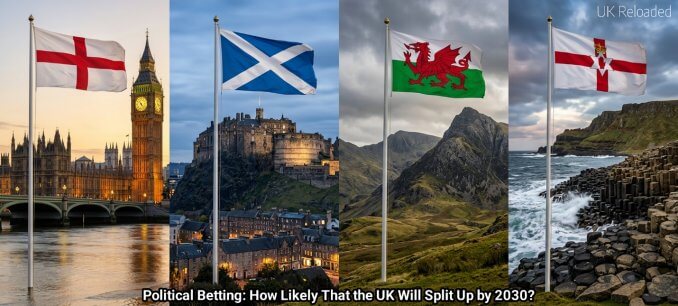
My co-panellist pointed out the blindingly obvious but surprisingly overlooked fact that three parts of the United Kingdom are now led by politicians who want to secede from the UK altogether.
Are we on course for a re-run of the Scottish independence vote and possibly the spread of such referendums to Wales and Northern Ireland as well?
Unfortunately, it is not yet possible to find any books currently open on either the prospects of any referendums being held or on their possible outcome. But I don’t think it will be long before we all have the opportunity to put our money where our mouths might be. That means I’m already trying to get my head around the various pathways and probabilities that might be involved.
Scotland obviously looms largest of all. The SNP might currently be reeling from its embezzlement scandal – the full horrors of which only came to light some days after the elections had finished – but it remains a formidable, indeed dominant, electoral force north of the border. John Swinney is a canny and calm operator who has been able to create some clear blue water between himself and his party’s recent troubled past. He will be spending a considerable amount of time calculating the optimal time to attempt to win a national vote for independence as well as the circumstances in which his request for a re-run is likely to be acceded to.
There’s no doubt in my mind that he would consider a decisive victory for the SNP at the next General Election (alongside a good showing for its Green allies) to be the trigger for insisting on a fresh vote. Unless you anticipate a major turnaround for Labour in the national polls, this seems to me a very plausible outcome. Although Labour and the Scots Nats fundamentally disagree on constitutional matters, there is a reasonable chunk of the electorate who are simply ‘on the Left’ and willing to switch between the two. If one is doing well, it follows by definition the other will be doing badly. At the next election, I expect the SNP to fall into the former camp and Labour into the latter.
Let’s add on to this hypothesis that the votes across the UK as a whole lead to a Farage-led government at Westminster. In public, Swinney will express horror at such an outcome. In private, he will be delighted. If the English (with some significant help from the Welsh) propel Reform into power, the Scots may start to think that the time for divorce has arrived. To be clear, Reform has made very impressive headway in Scotland, having now effectively replaced the Tories as the principal party on the Right-of-centre. Nevertheless, if asked whether they were happy with there being a Reform-led UK government, the overwhelmingly majority of Scots would say no, and a good chunk of those would be vehement in expressing such a stance.
Prime Minister Farage would also face a difficult task in refusing a referendum. What would be his grounds for doing so? He has been a long-standing supporter of the right to self-determination. How could he easily explain to John Swinney that such an overarching principle didn’t apply in this specific case?
Another route to a second Scottish vote is a messy hung Parliament in which the SNP bloc is critical to any feasible Leftist majority. Whilst I expect the Right to form a majority after the next election, the emergence of some incoherent – but just about mathematically feasible – rainbow coalition is well within the bounds of possibilities. The price to be paid to the Scots Nats would surely have to be a re-run of 2014.
I therefore think the chances of a second referendum on independence in Scotland before the decade is out are well above 50% and possibly as high as 70%. I’d still favour the unionists to win any such vote, but I’d rate the nationalists’ chances at more than one in three.
The pressures for a similar exercise in Wales or Northern Ireland are less obviously intense. Indeed, Plaid Cymru is not even in favour of immediate independence, seeing it instead as a very long-term goal. The strategy of Sinn Féin seems to be to try and edge towards a united Ireland incrementally (some might even say by stealth). However, if a Scottish plebiscite is given the green light, it becomes awkward for nationalists in other parts of the kingdom to say, ‘No thanks, we are fine as we are for the moment.’ So, I would expect referendums in other parts of the UK could also be held on the same day (say a 30% chance if Scotland is happening), although it may not be that the question on the ballot is as strictly binary – it may involve something about more devolved powers and a delinking from the Barnet formula or some such like.
There is a further possible pathway to referendums across the UK that are not based on nationalist electoral and constitutional pressure at all. This would be a big, bold, high risk move by a unionist-minded (and English-dominated) majority government in Westminster. It could put the argument that having different parts of the UK in various stages of contemplating divorce is destabilising and that we need to settle these matters once and for all. A new constitutional settlement for the UK, written by unionists and put forward at a time of their choosing, would be put to all four constituent parts of the country on a ‘take it or leave it’ basis, with the consequences of ‘leaving it’ being spelled out in no uncertain terms. Unlikely, but far from impossible.
Once some bookmaker actually starts quoting the odds, I’ll be placing a decent bet on a second vote in Scotland if I can find odds of better than 4/7. I’d be willing to wager on the vote being held – and then being for independence – if I can get better than 3/1. I’m less sure on the Welsh and Northern Irish eventualities but would be attracted by almost any reasonably plausible long odds bet.
If you think the current instability in British politics is already uncomfortably high, I’d still advise you to put your money on it getting even worse.
Mark Littlewood is a former director of the Institute of Economic Affairs and the Director of PopCon.
This article (Political Betting: How Likely That the UK Will Split Up by 2030?) was created and published by The Daily Sceptic and is republished here under “Fair Use” with attribution to the author Mark Littlewood

••••
The Liberty Beacon Project is now expanding at a near exponential rate, and for this we are grateful and excited! But we must also be practical. For 7 years we have not asked for any donations, and have built this project with our own funds as we grew. We are now experiencing ever increasing growing pains due to the large number of websites and projects we represent. So we have just installed donation buttons on our websites and ask that you consider this when you visit them. Nothing is too small. We thank you for all your support and your considerations … (TLB)
••••
Comment Policy: As a privately owned web site, we reserve the right to remove comments that contain spam, advertising, vulgarity, threats of violence, racism, or personal/abusive attacks on other users. This also applies to trolling, the use of more than one alias, or just intentional mischief. Enforcement of this policy is at the discretion of this websites administrators. Repeat offenders may be blocked or permanently banned without prior warning.
••••
Disclaimer: TLB websites contain copyrighted material the use of which has not always been specifically authorized by the copyright owner. We are making such material available to our readers under the provisions of “fair use” in an effort to advance a better understanding of political, health, economic and social issues. The material on this site is distributed without profit to those who have expressed a prior interest in receiving it for research and educational purposes. If you wish to use copyrighted material for purposes other than “fair use” you must request permission from the copyright owner.
••••
Disclaimer: The information and opinions shared are for informational purposes only including, but not limited to, text, graphics, images and other material are not intended as medical advice or instruction. Nothing mentioned is intended to be a substitute for professional medical advice, diagnosis or treatment.
Disclaimer: The views and opinions expressed in this article are those of the author and do not necessarily reflect the official policy or position of The Liberty Beacon Project.


Leave a Reply