

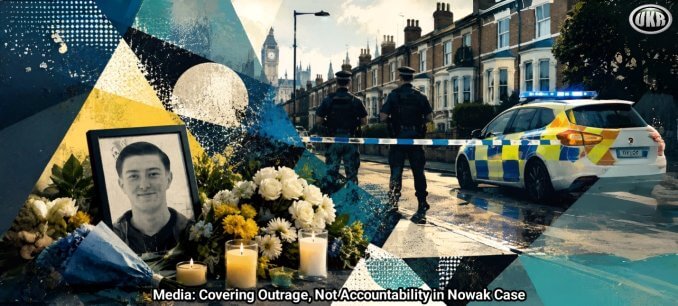
Henry Nowak and the politics of deflection
Rather than confront the failures of the police, much of the media has chosen to focus on those expressing outrage over the case.
ANDREW DOYLE
While the country is still reeling from the horrific murder of eighteen-year-old student Henry Nowak, an astonishing article has appeared in El País, Spain’s largest national newspaper. Rather than focus on the failures of the police officers, or the institutional bias within the force, the headline steers its readers away from the case and towards the outlet’s own obsessions. The headline translates as ‘Farage’s far right stirs up hatred in the UK after a young man is stabbed to death by a Sikh man’.
As Alejo Schapire (an Argentine journalist based in France) has pointed out, this is the first and only article produced by El País on the subject of the Nowak killing. Instead of an image of the victim, the newspaper has opted for a photograph of Nigel Farage. The Guardian was similarly histrionic and detached from reality in its coverage: ‘As ethnonationalist far right drives racist agenda, Reform UK leader felt need to weigh in on murder of Henry Nowak’.

It is one thing to take issue with those who seek to weaponise human tragedies for their own political gain, and quite another to dismiss legitimate criticism of a failed system. Reform UK is by no means a ‘far right’ party, but of course the term has been so promiscuously misused in the press that at this point it might be best to dispense with it altogether. But of course, this is not really about Farage or his response to the murder at all. It is a cynical means of deflecting from the fate of Nowak and what it reveals about the state of policing in the UK.
So what exactly did Farage say to have the Guardian fulminate about his ‘racist agenda’ and for El País to make him the focus of the story rather than the victim? During a live broadcast, Farage praised the Nowak family for their ‘extraordinarily dignified’ response following the conviction of their son’s killer, and went on to say: ‘I suggest the rest of us respond to this with pure cold rage’.
And why not indeed? Let’s not forget the shocking details of what happened in this case. Nowak was stabbed multiple times by Vickrum Digwa using a Sikh ceremonial dagger. His mother hid the murder weapon, and his brother called 999 claiming that Nowak had been racially abusive. When police arrived, Digwa repeated this lie. And when Nowak repeatedly told the officers he had been stabbed, one replied ‘I don’t think you have, mate’ and handcuffed him as he lay dying.
Labour MP Jonathan Hinder, a former police inspector, was asked on BBC’s Newsnight whether he could understand the behaviour of the officers that night.
‘To me it’s unfathomable… If you are presented with a situation like that as a police officer, we have emergency life support training which should be deployed immediately in those circumstances. You should be treating it as a medical emergency if someone is telling you those things repeatedly. And crucially, they are not a threat. So the use of the handcuffs is just impossible to explain.’
Sadly, it is possible. The police have been trained to automatically believe all accusations of racism, which inevitably has led to the term being misused as a means to settle scores or, in this case, to prevent a victim from receiving life-saving treatment. The College of Policing has long been captured by an activist mentality that insists that group identity should be the ultimate concern of law enforcement. The chief of Hampshire Constabulary – the force that handcuffed Henry Nowak as he died – proclaimed in 2022 that ‘being anti-racist, ethical and inclusive is top of our agenda’. One would have hoped that tackling crime without fear or favour might take priority.
Moreover, the Police Race Action Plan, published in 2022 by the National Police Chiefs’ Council (NPCC) repeatedly refers to the need for ‘equitable’ rather than ‘equal’ treatment. In other words, the public are to be treated unequally according to ethnicity in order to drive equal statistical outcomes. This is an activist agenda, and it involves a total undermining of the principle of equality before the law.
So when Farage argues that the Nowak case exposes the police’s ‘anti-white prejudice’, he is not wrong. Such prejudice is built into the system, and is there for all to read in the policy documents. While Farage’s point was expressed bluntly, it was certainly not ‘ethnonationalist’ by any serious definition of the term. You may not approve of Farage’s choice of words, but it will take more than infantile cries of ‘bigot!’ to disprove them.
The evidence of two-tier policing is by now so overwhelming that it is astonishing that members of the press have the gall to deny it. The grooming gangs scandal is the most egregious example of how identity politics has taken precedence over justice, but there are many others. As one senior police officer told journalist Allison Pearson: ‘What you have to understand is most chief constables would rather mess up a major murder inquiry than be accused of being racist’.
We should not be surprised to see ideologues at the Guardian and El País attempt to reframe Farage and the ‘far right’ as the real issue here. After all, such news outlets are partly responsible for cultivating the very climate in which accusations of racism are so inaccurately applied and have so much power to destroy lives. Rather than reflecting on their errors, they are seemingly intent on compounding them.
There are grave problems with law enforcement in this country. While police officers are being trained by activists, we are unlikely to see any rectification. It is intolerable that the principle of equality before the law has been rebranded as ‘far right’, and that the misleadingly branded ‘anti-racist’ movement has been allowed to stoke so much racial division.
The activist media will continue to deflect and claim that those who are outraged by the murder are more concerning than the murder itself. But the public can see through these tactics and patience is wearing thin. Any ideology that encourages the state to view citizens primarily through the prism of race is regressive in the extreme. As the tragedy of Henry Nowak demonstrates, it can also be dangerous.
See Related Article Below
‘You can keep your weapons in your trousers’: the dangerous state ideology behind Henry Nowak’s murder
NIALL MCCRAE
The sickening police video of the death of Henry Nowak has been seen by millions. It’s hard to watch. Officers automatically saw an innocent young white man as the criminal, because his attacker was of Asian ethnicity and religion. Then they handcuffed him and dismissed his desperate plea for help, while the fiend Vickrum Digwa stood watching over him. This should surely be a wake-up call for the country.
Already, however, we see the signs of the response to the horrific racist killings of three young girls in Southport in 2024. Legitimate anger of white working-class people will be criminalised, the Soros-funded ‘anti-fascists’ will hold their staged demonstrations, and it will be back to normal. The Guardian newspaper, which gave no coverage to the Nowak case until yesterday, when this was unavoidable due to an urgent statement in parliament, immediately focused on Nigel Farage and on ‘death threats’ to police.
The judge, when jailing the killer, made these comments: –
You have brought shame upon your family and your religion. Your actions have stirred up racial tension in Southampton and across the country, which have made many Sikhs worry about their safety.
The establishment always portrays its favoured ethnic minorities as the victims. Here is what the judge should have said: –
You have abused your religious right to carry a knife, and I strongly urge the government to review this special provision. Sikhs should blame you for this. You have made white people fear for their safety.
No chance of that being said by a judge. But it’s what most ordinary people think. Why should Sikh men be allowed to carry weapons in public? This is not the first time the ceremonial implement has been used to kill.
Home secretary Shabana Mahmood was quick to dismiss any calls for banning of the Sikh knife. If this is a right under the Equality Act, does that mean Sikhs carry it through airport security? Can they take it into nightclubs or football grounds without challenge? Does an employer have a right to stop Sikh workers being armed in the workplace?
Awful as they were, the police officers involved are not wholly to blame. They were acting as they had been trained, in the twisted ideology of institutionalised two-tier policing. Last year the National Police Chiefs’ Council issued guidance to pursue equity, thereby minimising arrests of black and brown people while treating white suspects with the full force of the law. This ideology was similarly the cause of a psychotic African man who killed three people at random in Nottingham three years ago, the court hearing that mental health practitioners were putting equity (reducing black sectioning) before public safety.

It’s a very disturbed view of equality that allows some men to carry knives but not others. After the Southport massacre, white protestors were confronted by angry Muslim mobs, who were defending what they regarded as their territory. In one video, a police officer told Muslims in Stoke-on-Trent that they should ‘leave their weapons in the mosque’.
The favouritism for Sikhs is more deadly than that. Despite the outrage and distress caused by Henry Nowak’s death, they have been assured that they can keep their weapons in their trousers. From now on, the turban will signify a man carrying a state-sanctioned knife, which he could use to kill you.
Postscript
Caroline Nokes, Conservative MP for Romsey and Southampton North, said: –
The Sikh community forms a significant part of Southampton’s social fabric, particularly within the Southampton North part of my constituency. Swaythling is home to one of the city’s gurdwaras, and I know how anxious members of the Sikh faith in the city feel right now.
Politicians don’t get it, because they are groomed and paid not to get it.
This article (‘You can keep your weapons in your trousers’: the dangerous state ideology behind Henry Nowak’s murder) was created and published by Niall McCrae and is republished here under “Fair Use”
Featured image: gazetadopovo.com.br/

••••
The Liberty Beacon Project is now expanding at a near exponential rate, and for this we are grateful and excited! But we must also be practical. For 7 years we have not asked for any donations, and have built this project with our own funds as we grew. We are now experiencing ever increasing growing pains due to the large number of websites and projects we represent. So we have just installed donation buttons on our websites and ask that you consider this when you visit them. Nothing is too small. We thank you for all your support and your considerations … (TLB)
••••
Comment Policy: As a privately owned web site, we reserve the right to remove comments that contain spam, advertising, vulgarity, threats of violence, racism, or personal/abusive attacks on other users. This also applies to trolling, the use of more than one alias, or just intentional mischief. Enforcement of this policy is at the discretion of this websites administrators. Repeat offenders may be blocked or permanently banned without prior warning.
••••
Disclaimer: TLB websites contain copyrighted material the use of which has not always been specifically authorized by the copyright owner. We are making such material available to our readers under the provisions of “fair use” in an effort to advance a better understanding of political, health, economic and social issues. The material on this site is distributed without profit to those who have expressed a prior interest in receiving it for research and educational purposes. If you wish to use copyrighted material for purposes other than “fair use” you must request permission from the copyright owner.
••••
Disclaimer: The information and opinions shared are for informational purposes only including, but not limited to, text, graphics, images and other material are not intended as medical advice or instruction. Nothing mentioned is intended to be a substitute for professional medical advice, diagnosis or treatment.
Disclaimer: The views and opinions expressed in this article are those of the author and do not necessarily reflect the official policy or position of The Liberty Beacon Project.


Leave a Reply