
JOANNA GREY
In psychology there is a concept known as agentic living: the idea that we have some sort of agency over our own lives. At heart it is a throwback to the age-old philosophical question: are we determinists who believe we live at the mercy of a fate already written, or do we, as Augustine hammered out, have freewill? On reading Alan Milburn’s excoriating interim report into ‘the moral crisis’ of one million 16–24 year-olds who are not in work or education (NEETs), it becomes obvious there is a sharp dividing line between determinists and those who attempt to exert agentic freewill.
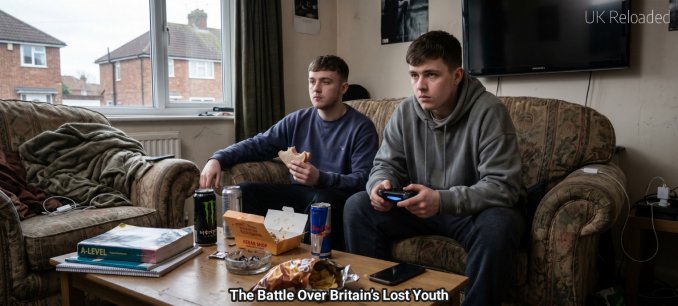
For the most part, the children and young people who are now effectively bed-bound – scrolling on their phones until 5am, applying for a few jobs and then giving up, who long ago ducked out of school because the experience was overwhelming – have become determinists. They have come to an early conclusion that their own efforts to succeed at life are marginal, so they may as well be pushed around by the education, mental health and welfare systems, big tech, their iPhones, the stagnant economy and the threat of AI. On the other hand, there are actors in this whole blood-chilling saga who have exerted powerfully destructive agency over society. By their individual actions and decisions, we have arrived at the inevitable situation which, as Alan Milburn writes, has created “a generational fault line” that costs the taxpayer £125 billion a year, with entrenched youth disengagement “fast becoming a strategic economic risk for Britain”.
While the report is superb in its articulation of the problem, it is wrong to blame “catastrophic systems failure”. Individual political and cultural actions have caused this mess. Only actions by brave individuals will end it. These are some of the guilty men responsible.
Hegel – the idea that the state is rational and beneficent: The 19th Century German philosopher elucidated the notion that “The State is the march of God in the world.” He explained to a rapidly de-Christianising world that the family was insufficient and that, with rational bureaucrats governing for the common good, the state could offer the ultimate realisation of human freedom and rationality on earth. Throughout Milburn’s report, he laments the lack of state help to support children back into school, into work or apprenticeships. His observation was widely reported, with implicit agreement, that the state should be playing a more active role in the lives of young people: “we estimate that in 2024/25 for every £1 that DWP spent on employment support for young people, around £25 was spent on benefits for young people”. While Milburn does say families need to play their part, there is no standalone chapter on family life or parenting. The dissolution of individual autonomy, personal responsibility and traditional family support structures in favour of an inadequate state has reached its inevitable fruition in those one million failing children.
Alan Milburn – as Health Secretary, he opened up the NHS to private health providers, thus creating a financial incentive for private companies to encourage certain conditions. As Health Secretary from 1999 to 2003, Alan Milburn oversaw the NHS Plan 2000, which established the private/public partnership model. After his parliamentary career, Milburn has made millions advising private healthcare companies. Ironically, Milburn has outlined that current healthcare models depend on providing ongoing treatment rather than returning young people to good health – a system that has come to flourish within the very NHS/private architecture he created. The financial incentives of private companies used by the NHS for ADHD and autism assessments, for instance, are rightly coming under increasing scrutiny.
Peter Hain and James Purnell shifted the welfare system from an ‘illness-based’ model to one focused on ‘capability’. The 2007 Welfare Reform Act ushered in a new model of acquiring benefits whereby recipients need not be actively or accurately diagnosed with an illness but must instead demonstrate what they cannot do. Such a shift towards work capability assessments enabled children and young people to learn via TikTok which incapacities would allow them to claim benefits. As one child said: “All I had to do in an online assessment was pretend I couldn’t pick up a mug of coffee for Mum to receive disabled carer’s allowance for looking after me.”
Iain Duncan Smith introduced PIP. Milburn identified that “a young person first claiming health and disability benefits in 2019 is a third more likely to be NEET five years later than those who first claimed in 2010. Today around seven in 10 young people claiming a health and disability benefit are still claiming a decade later.” The replacement of Disability Living Allowance with Personal Independence Payments – available from age 16 – by Iain Duncan Smith in 2012 ensnared a whole generation of young people into benefits that are easy to obtain but difficult to escape.
Jeremy Hunt equalised mental and physical health conditions. As Health Secretary, Hunt enshrined into UK law through the Health and Social Care Act 2012 “parity of esteem between mental and physical health”. Milburn’s report cites mental illness as a primary driver of this lost generation: over the past 15 years, the proportion of disabled NEET young people citing mental health as their main health problem has nearly doubled – rising from 24.3% in 2011 to 42.6% in 2025. In an interview with the Economist, Hunt explained: “Since the pandemic, Britain has been dishing out disability and incapacity benefits to more than a million more claimants… I am afraid I may be indirectly responsible.”
Tony Blair (among other miscreants) set up the National Low Pay Commission in 1997, which has been advising ever since on minimum wages for young people. Fears that minimum wages would price certain groups out of work were ignored but came to fruition – with Milburn citing that six in 10 NEETs have never had a job. Patricia Hewitt compounded the problem by establishing the 16–17 year-old minimum wage rate in 2004, leading to a decline in Saturday jobs available for teenagers. Michael Gove played his part too by lionising academic achievement without equally encouraging vocational and practical education and by removing the statutory duty on schools to provide work experience. Robert Halfon introduced the Apprenticeship Levy in 2017, which caused apprenticeships for those aged 16 to 24 to fall by 35%. Gavin Williamson closed schools unnecessarily during lockdown. Rachel Reeves has exacerbated the situation by raising employers’ National Insurance contributions and the minimum wage, making it increasingly expensive to hire young people.
Whether well-intentioned or not, the active steps that the aforementioned – and no doubt other misguided rogues – have taken have demonstrably changed the outcomes for one million children and young people. In a strange way, this should give us hope. With freewill and agency, it is possible for people to change their fate. None of us must wait meekly for Alan Milburn to supply his policy recommendations later this year and hope feebly that something will be done. Instead, the only way out of this moral morass is to act. To do. To help. Now. Give a young person an internship. Get your school-avoidant child back in the classroom. Be creative about finding voluntary work for young people. Waiting for the state to solve things is what got us into this mess in the first place. It will be individual action that gets us out of it. As Augustine said: “There is in man a free determination of will for living rightly and acting rightly.” This must be found – and fast.
Joanna Gray is a writer and confidence coach.
This article (The Battle Over Britain’s Lost Youth) was created and published by The Daily Sceptic and is republished here under “Fair Use” with attribution to the author Joanna Gray

••••
The Liberty Beacon Project is now expanding at a near exponential rate, and for this we are grateful and excited! But we must also be practical. For 7 years we have not asked for any donations, and have built this project with our own funds as we grew. We are now experiencing ever increasing growing pains due to the large number of websites and projects we represent. So we have just installed donation buttons on our websites and ask that you consider this when you visit them. Nothing is too small. We thank you for all your support and your considerations … (TLB)
••••
Comment Policy: As a privately owned web site, we reserve the right to remove comments that contain spam, advertising, vulgarity, threats of violence, racism, or personal/abusive attacks on other users. This also applies to trolling, the use of more than one alias, or just intentional mischief. Enforcement of this policy is at the discretion of this websites administrators. Repeat offenders may be blocked or permanently banned without prior warning.
••••
Disclaimer: TLB websites contain copyrighted material the use of which has not always been specifically authorized by the copyright owner. We are making such material available to our readers under the provisions of “fair use” in an effort to advance a better understanding of political, health, economic and social issues. The material on this site is distributed without profit to those who have expressed a prior interest in receiving it for research and educational purposes. If you wish to use copyrighted material for purposes other than “fair use” you must request permission from the copyright owner.
••••
Disclaimer: The information and opinions shared are for informational purposes only including, but not limited to, text, graphics, images and other material are not intended as medical advice or instruction. Nothing mentioned is intended to be a substitute for professional medical advice, diagnosis or treatment.
Disclaimer: The views and opinions expressed in this article are those of the author and do not necessarily reflect the official policy or position of The Liberty Beacon Project.


Leave a Reply