

Mother’s and father’s ruin
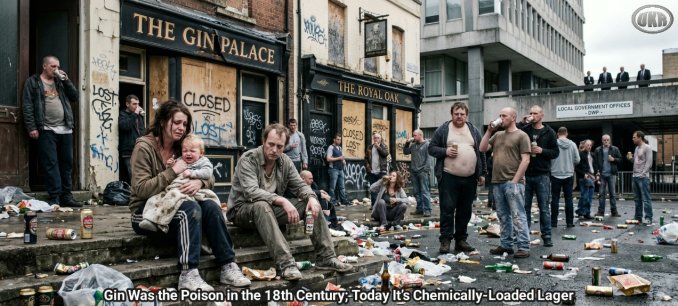
Gin was the poison in the 18th century; today it’s chemically-loaded lager
NIALL MCCRAE
Your government, your town council, your NHS and your BBC don’t really care about you. That should be obvious after the Covid-19 scam, but there are many other ways in which the institutions that are meant to protect us actually cause us harm. And often, as with the Covid-19 injections, the beneficiaries are a duality of commercial interest and state control.
For some decades of the eighteenth century, gin, a spirit distilled from grain and juniper berries, was taking a terrible toll on the masses. Cheap gin from the continent was flowing through cross-channel smuggling, an illicit trade that was reducing revenue for the exchequer and also harming the brewing industry. English folk had always drunk ale, partaking of the local brew in alehouses, but with increasing consumption of gin and other tax-free spirits from abroad, there was less demand for malt and the finished product of beer. In the smuggling counties of Kent and Sussex, gin was so plentiful that housewives used it to clean their windows.
Parliament decided to boost domestic distilling, which was properly taxed. This policy exacerbated the devastating change in drinking patterns in the populace. Potent spirits caused a sharp rise in mortality, as described in GM Trevelyan classic English Social History (1944): –
Both the rise of the death-rate and its subsequent fall have been attributed in part to the growth and decline of the habit of drinking cheap gin instead of beer. The dire consequences of that change in the habits of the poor have been immortalized in Hogarth’s famous delineation of the horrors of ‘Gin Lane’ contrasted with prosperous ‘Beer Street’. In the third decade of the century, the epoch of the Beggar’s Opera, statesmen and legislators had deliberately encouraged the consumption of gin by throwing open the distilling trade and by placing on spirits far too light a tax. Distilling, said Defoe, consumed corn and was therefore good for the landed interest, and so thought the Parliament of landlords. But as the appalling social consequences were gradually brought to their notice by the enlightened philanthropy of the age, a series of hesitating steps were taken to mitigate the evil. But it was not really checked until 1751, when spirits were heavily taxed and their retail by distillers and shopkeepers was stopped.
London’s population began to grow again after the change to taxation, Trevelyan noting that ‘at the height of the gin era, between 1740 and 1742, the burials in the London region had been twice as many as the baptisms!’ At that time, messages appeared across London warning of the deadly drink: –
Drunk for one penny
Dead drunk for tuppence
Straw for nothing
Gin was initially prescribed by physicians for ailments such as gout and indigestion. It became a self-medication for women, and was dubbed ‘mother’s ruin’, as described by Ellen Castelow on Historic UK website: –
Much of the gin was drunk by women; consequently children were neglected, daughters were sold into prostitution, and wet nurses gave gin to babies to quieten them.
Gin caused infertility and male impotence, leading to the birth rate being overtaken by the death rate. With my enlightened cynicism towards the misanthropic authorities past and present, I wonder whether a cull of the masses was facilitated.

A similar though less dramatic deterioration in public health has been allowed to happen in modern society, with the ascent of pasteurised and chemically-processed lager over traditional ale. The latter type of beer is healthful, being made from nothing but water, malt and hops, imparting beneficial vitamins and other trace elements.
As well as nutritional value (if drunk in moderation) drinking has considerable social benefits, and the public house plays a vital role in our culture. But the government doesn’t like pubs, and is doing everything it can to hasten the demise of this important social institution. The powers-that-be are not only killjoys: they don’t want us talking and alerting each other to the dastardly agenda.
Decades ago, the government inverted the tax regime so that beer drunk in pubs was taxed more heavily that that bought in off-licences. Supermarket trade surged, a major factor in the closure of pubs. Meanwhile the major brewing conglomerates bought and closed most of the local family brewers and imposed their brands of keg beer. Younger generations were weaned on lager, a product that was less perishable, needed no skill in the cellar, and lacked the beneficial ingredients of cask ale.
The beer drunk by the majority of people today – whether at home or in the pub – is a hazard, particularly to masculinity. For evidence of this, compare crowded beach scenes at British seaside resorts from the 1950s or 1960s to today. Slim, toned torsos have transformed into flab. Obvious factors are sedentary lives and a fatty and sugary diet. However, there is a specific problem in middle-aged men attributable to lager. This is not a result of high consumption: men drank more beer in the Fifties than they do today. .
The cause is not simply the high sugar content of mass-produced lager, but their elevating effect on female hormone, oestrogen. For all their banter and bravado in the company of fellow blokes, men are unwittingly emasculating themselves. Oestrogen is everywhere – in our water supply and in ubiquitous plastics, but heavy lager drinkers are particularly exposed.
In the journal Medical Hypotheses, Paul Cohen explained that ‘in males with increasing obesity there is increased aromatose activity, which irreversibly converts testosterone to estradiol resulting in decreased testosterone and elevated oestrogen levels’. The non-alcoholic content of beer does not cause abdominal fat gain in women.
A YouTube video by British Truth Reports gives gory detail on the constituents of mass-marketed beers. The first of many culprits is Carling, for decades the biggest-selling lager on these shores (although it is not quintessentially English; it was originally Canadian and now made by Molson-Coors). Instead of barley malt, Carling’s main ingredient is corn syrup; this is cheaper than malt but it is also used as a sweetener in confectionery – one reason why lager drinkers often have bad hangovers. In the brewing process, artificial foam is produced by the addition of modified maize starch. This is an industrial thickening agent, complicating the traditional simplicity of beer with its three basic ingredients of malt, yeast and hops. Hop extracts produce chemical bitterness, depriving drinkers of the beneficial antioxidant and inflammatory properties of natural hop flowers. A foam stabiliser used to prevent separation in shipping was identified in independent laboratory testing as propylene glycol alginate, which is also used in anti-freeze.
But as British Truth Reports stated, Carling is certainly not the worst. For example, cans of Foster’s and other mass-produced lager are lined with BPA. This chemical is not an intended ingredient but it can leech into the beer. BPA is a hormone disruptor, and exposure can damage reproductive and metabolic systems, as well as risking cancer. The warmer the can, the more leeching occurs, so drinking in the park or beach on a hot summer day are more hazardous.
The establishment knows of these toxic effects of lager, but just as in the eighteenth century they allowed gin to cause havoc, they do nothing to revive the healthier, traditional British draught beer, or the pubs where it is poured from hand-pumps. Lager is a convenient chemical suppressant of male virility, which pacifies and inhibits resistance to the creep of ‘nanny state’ authoritarianism.
If gin was mother’s ruin, mass-produced lager is the ruin of men. Your rulers are not displeased.
This article (Mother’s and father’s ruin) was created and published by Niall McCrae and is republished here under “Fair Use”

••••
The Liberty Beacon Project is now expanding at a near exponential rate, and for this we are grateful and excited! But we must also be practical. For 7 years we have not asked for any donations, and have built this project with our own funds as we grew. We are now experiencing ever increasing growing pains due to the large number of websites and projects we represent. So we have just installed donation buttons on our websites and ask that you consider this when you visit them. Nothing is too small. We thank you for all your support and your considerations … (TLB)
••••
Comment Policy: As a privately owned web site, we reserve the right to remove comments that contain spam, advertising, vulgarity, threats of violence, racism, or personal/abusive attacks on other users. This also applies to trolling, the use of more than one alias, or just intentional mischief. Enforcement of this policy is at the discretion of this websites administrators. Repeat offenders may be blocked or permanently banned without prior warning.
••••
Disclaimer: TLB websites contain copyrighted material the use of which has not always been specifically authorized by the copyright owner. We are making such material available to our readers under the provisions of “fair use” in an effort to advance a better understanding of political, health, economic and social issues. The material on this site is distributed without profit to those who have expressed a prior interest in receiving it for research and educational purposes. If you wish to use copyrighted material for purposes other than “fair use” you must request permission from the copyright owner.
••••
Disclaimer: The information and opinions shared are for informational purposes only including, but not limited to, text, graphics, images and other material are not intended as medical advice or instruction. Nothing mentioned is intended to be a substitute for professional medical advice, diagnosis or treatment.
Disclaimer: The views and opinions expressed in this article are those of the author and do not necessarily reflect the official policy or position of The Liberty Beacon Project.


Leave a Reply