

HOWARD COX
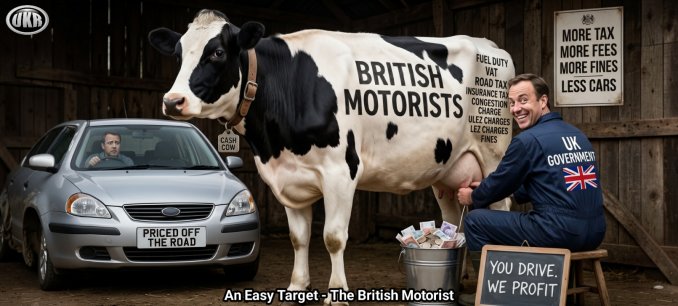
Why is it so difficult for this Labour Administration to recognise and truly understand that motorists are more than just a cash cow, and that, in objective fiscal and social terms, lower transport costs have been independently proven to aid economic growth? High taxation, high spending and massive borrowing dominate Labour’s pea-brained economic mentality. And as part of their fiscal ineptitude, all the evidence shows that this Government treats motorists as easy-to-fleece cash cows, as evidenced by their catalogue of anti-driver policies, all driven by an unhealthy, cult-like worship of an unattainable net-zero target.
Amid the 2026 global oil price spike triggered by Middle East tensions, the Iran conflict, and disruptions in the Strait of Hormuz from around March 1st, over 40 countries have taken fiscal measures to reduce petrol and diesel costs, mainly through tax and levy cuts, price caps, excise reductions, or subsidies. Most of these measures mitigate increases rather than deliver deep cuts below pre-crisis levels, even as global crude prices surge. But that is not the point; they have still helped motorists considerably. Some countries achieved actual reductions, year-on-year drops, or significantly lower increases than in other countries. Here are some examples of how astute political administrations have reduced some of the pain caused by high fuel prices.
South Africa reduced the general fuel levy by R3 per litre for petrol and diesel. Australia has halved the fuel excise tax for three months and paused road user charges for trucks. India has cut excise duties and had state oil firms absorb losses. Most EU countries have introduced targeted relief measures that have, in some form, reduced the cost of filling up, notably Spain’s €5 billion support package, which includes substantial VAT cuts. Italy continues to extend its fuel excise duty cuts. Vietnam scrapped some fuel taxes, leading to fuel prices falling by 20% from spiked levels. Nigeria periodically cuts wholesale/ex-depot prices.
I could list more examples of how government intervention by countries around the world has helped reduce rocketing pump prices caused by the Middle East conflict. But back here in Blighty, even though the Chancellor has relished in more than half a billion pounds of unexpected extra VAT since the geopolitical crisis started, she has done nothing to reduce the cost of filling up at the pumps. During Rachel Reeves’s period of fiscal inertia, UK drivers have had to pay an extra £3.6 billion at the pumps, giving the fuel supply chain a massive windfall in profits it would not have enjoyed had Iran and the USA not been at war.
Under considerable pressure from my 16-year-old FairFuelUK Campaign and the delivery of a 150,000-signature petition, initially turned away by a Treasury jobsworth but successfully delivered by nine Tory MPs to the Chancellor’s Parliamentary Office, the Chancellor reluctantly extended Rishi Sunak’s 5p per litre fuel duty cut until the end of 2026. Whoop-de-doo!
UK petrol prices remain above the EU average, with diesel, the commercial heartbeat of any economy, even higher. The UK average petrol price at the time of this article is 159p per litre, and diesel is 190p. Petrol is 20% higher than it was when the Iran Crisis hit us, and diesel is a massive 33% higher. In context, Malta’s petrol price is 47p per litre cheaper than the UK’s forecourt price. Germany’s diesel is 19p per litre lower than the UK’s, and Poland’s is a staggering 53p cheaper.
UK fuel prices have always been among the highest in the world, driven by high, less diesel-favourable taxation and global oil movements. However, maintaining the 2022 Budget 5p cut has provided meaningful relief, even though filling up today still leaves the UK in a higher-tax position than many of its peers, who reacted swiftly in 2026 by implementing fresh cuts or caps.
In summary, I will continue to try to engage with the Treasury and Labour’s front bench to show them, for the 17th year, that high pump prices, due mainly to high fuel levies, raise transport and production costs, feed inflation, and reduce household disposable income and spending, particularly for lower- to moderate-income, car-dependent households.
Lower transport costs can support economic activity by freeing up household and business spending and reducing input costs. Independent evidence shows that fuel price shocks slow growth and hit vulnerable groups hardest. It’s time for the creation of a 20-year-long-term road user strategy that not only protects the economy from recession but also puts drivers at the centre of any economic growth plan. Such a policy has never been produced.
And by the way, Net Zero must be scrapped too, and the UK must become self-sufficient in energy supply, which means we must ‘drill, baby, drill’. And we must start right now before the UK descends into economic oblivion!
Howard Cox, Founder of FairFuelUK, Political commentator and Member of the Advance UK College
This article (An Easy Target – The British Motorist) was created and published by Free Speech Backlash and is republished here under “Fair Use” with attribution to the author Howard Cox

••••
The Liberty Beacon Project is now expanding at a near exponential rate, and for this we are grateful and excited! But we must also be practical. For 7 years we have not asked for any donations, and have built this project with our own funds as we grew. We are now experiencing ever increasing growing pains due to the large number of websites and projects we represent. So we have just installed donation buttons on our websites and ask that you consider this when you visit them. Nothing is too small. We thank you for all your support and your considerations … (TLB)
••••
Comment Policy: As a privately owned web site, we reserve the right to remove comments that contain spam, advertising, vulgarity, threats of violence, racism, or personal/abusive attacks on other users. This also applies to trolling, the use of more than one alias, or just intentional mischief. Enforcement of this policy is at the discretion of this websites administrators. Repeat offenders may be blocked or permanently banned without prior warning.
••••
Disclaimer: TLB websites contain copyrighted material the use of which has not always been specifically authorized by the copyright owner. We are making such material available to our readers under the provisions of “fair use” in an effort to advance a better understanding of political, health, economic and social issues. The material on this site is distributed without profit to those who have expressed a prior interest in receiving it for research and educational purposes. If you wish to use copyrighted material for purposes other than “fair use” you must request permission from the copyright owner.
••••
Disclaimer: The information and opinions shared are for informational purposes only including, but not limited to, text, graphics, images and other material are not intended as medical advice or instruction. Nothing mentioned is intended to be a substitute for professional medical advice, diagnosis or treatment.
Disclaimer: The views and opinions expressed in this article are those of the author and do not necessarily reflect the official policy or position of The Liberty Beacon Project.


Leave a Reply