

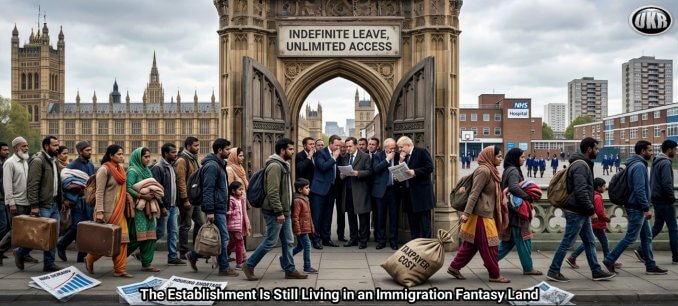
It is influential left-wingers, not the broader public, who have deluded themselves on mass migration
CHRIS BAYLISS
We can expect to hear a great deal about a new report from “British Future” over the coming weeks. The publication, titled “After the Fall: Why hasn’t falling immigration changed public attitudes?” concentrates on the public’s perceptions of the rate of net immigration to the UK in recent years, and their expectations regarding the change between 2025 and 2026. It has already prompted a flurry of opinion pieces in the New Statesman, and is likely to be quoted back at any pundit or politician appearing on television who mentions immigration for the foreseeable future.
The commentary so far has largely argued that the public don’t know what they’re talking about on immigration, and that the subject’s status as the dominant question in British politics is unwarranted. Furthermore, it argues that the fact that public perceptions are so clearly misaligned from reality is a barrier to reasonable debate and policy making, and therefore that rather than trying to address or pander to them, public concerns should be problematised or corrected. There are also hints at dark forces manipulating an ignorant and easily led public for nefarious political ends. It is very hard to imagine a story that better flatters the mythology of the SW1 class.
The paper considers the annual rate of net immigration, which is to say the number of people who move to the country, less the numbers that leave. This number has fallen considerably from its peak of just under one million in the 2023 calendar year, down to around 300k in 2024, and down to below 200k in 2025. The decline in that particular metric has not yet entered public consciousness — with around half of the people replying to the survey carried out by the authors believing the figure was rising, and a further third thinking it was steady. Only a sixth correctly identified it as having fallen. The authors also surveyed the percentage of net immigration that respondents believed was accounted for by those claiming asylum, which they tended to overestimate (33 per cent instead of the correct figure between 7 and 14 per cent).
The takeaway from this for many in Westminster will be that immigration has gone away as a problem, and that any further concentration on the subject lends salience and energy to the nativist Right. The correct response, many will reckon, ought to be an improved communications strategy by the government to emphasise the extent to which immigration has come down. To put it mildly, absolutely nothing that this piece of research has found justifies that interpretation, and such a response would backfire horrendously should anyone try to put it into effect.
Like many of the key metrics we use in public policy discussion, “net immigration” is a proxy that can be helpful to our thinking, providing we are mindful of what it is actually telling us. Net immigration is useful in a system dominated by a guest-worker model of migration, wherein people come into a country to work for a few years, before returning home. This was assumed to account for many of those coming to work in Britain from the newly joined members of the EU after 2004, and consequently the figure became the primary metric for immigration around that time. Handily, it was also a smaller number than the gross figure. It was the figure which David Cameron promised and failed to bring down to within the tens of thousands — a failure which further anchored it as the default point of reckoning in the British immigration debate.
But there is absolutely nothing obliging the British public to treat the net figure as if it is the only pertinent statistic relating to migration. The gross rate of immigration remains extremely high, at over 800k annually last year. Admittedly, this is also a decline from the astonishingly high figures seen at the peak in 2023 when it was 1.2 million (1.45m if you look at the year ending June 2023). But it is still very high. Limiting ourselves to the consideration of the net figure requires us to consider all individuals entering and leaving as functionally identical, which is very unlikely to be true.
Even if all of the outflow were recent immigrants going home, that would still constitute the replacement of people who have spent some time in the country, and acquired at least some familiarity with our norms, with people who haven’t. Indeed, increasingly, it appears to be the case that a substantial number of those leaving are not earlier waves of immigrants, but are in fact native British people looking for better opportunities and a safer place to raise young families. The net immigration figure asks us to consider such an emigrant on a like-for-like basis with a person arriving from Somalia or Eritrea. Thinking about immigration on a cultural basis, and in terms of the long term character of the nation, such a departure is aggravation rather than a mitigation of the impact of the new arrival.
For the sake of discussion, though, let us accept the paper’s assumption that the net figure is the one that counts. It is around two years since anyone who studied the figures closely might have noticed it coming down markedly, and around one year since the fact gained more general currency in wider political circles. It is pretty normal for the public to take a couple of years to cotton on to statistical trends of this kind. Certainly, many of them were not aware of the great increase of immigration until well after it had happened. Indeed, British Future themselves delighted in reporting in October 2022, at the very height of the Boriswave, that voters had grown relaxed about immigration, and chided elites for failing to keep up with the more liberal mood of the public on the subject. This would clearly not have been the case had the bulk of the public been aware of the sheer numbers that were pouring into the country at that point.
It is important to bear in mind that it took a herculean effort by online commentators, many of them initially anonymous due to the associated reputational and professional risks, for the political class to acknowledge the huge rise in immigration after the pandemic at all. Your average Westminster politico only really noticed the Boriswave when somebody pointed out to them that it was receding.
It is notable that one point of apparent horror for many commentators prompted by the paper is that net immigration might actually go negative at some point in the next couple of years. Personally, I will believe that when I see it and I suspect many voters will take a similar attitude. But this horror at negative net immigration is revealing of some of the rather odd assumptions of our political and media class toward immigration. Surely, in a system with some semblance of balance, we would expect a net positive figure of migration of nearly one million during one accounting period to result in a net negative figure, even if it were only of a much smaller amount, in at least one subsequent accounting period? But no — these people think that a return to net positives in the low hundreds of thousands is a reversion to the norm after such an inflow, and that anything less is a disaster for our economy and especially for public services.
We are a country with anaemic GDP growth, stagnant productivity, and a growing share of the adult population out of work
In essence, they see a constant inflow of people from less developed countries as a life support system for the economy in general, and for the health and social care sector in particular. This is not a normal thing for people to believe, either in historical or in international terms. Even countries like Saudi Arabia, where the workforce is dominated by guest workers and the local population are seldom employed in low skilled jobs, occasionally experience negative or balanced net migration in certain years. In specific places, such as the San Francisco Bay area, the emergence of very high productivity industries means that the locality has to draw in a steady flow of people to meet growing needs and to prevent wages becoming so high that basic needs cannot be met. But that absolutely does not describe Britain in the 2020s.
We are a country with anaemic GDP growth, stagnant productivity, and a growing share of the adult population out of work. We also have a reasonably high level of general education and plenty of capacity to train people to do various jobs. The fact our governing class seems to have absorbed the idea that we need to maintain permanent positive inflows in the hundreds of thousands is reflective of something very unhealthy and abnormal.
But as we can see from the persistently positive rate of net immigration even following such a large inflow in certain years past, large numbers of people are staying in the country in the long term. This is not a surprise, given that large numbers are coming in on visas that offer clear pathways to citizenship. In 2022, around 635k study-related visas were issued, which included around 150k dependents of students. Many of these switched to 2-year graduate visas on completion of their course of studies — following which they could seek employment in the skilled worker categories, starting the clock ticking on 5 years of work and residence, which entitled them to apply for Indefinite Leave to Remain, and then full citizenship.
In 2022, around 270k skilled worker visas were issued, including just under 150k under the special Health and Social Care pathway. Remarkably, over half of those issued for Health & Social Care were dependents rather than primary applicants, as were 41 per cent of the remaining skilled worker visas. All of those who arrived were immediately placed on a 5 year waiting period to claim ILR — notwithstanding the plans of the current Home Secretary, that remains the case today. For many of those coming in on those particular work visas, the point of getting ILR and full citizenship is that they are then no longer beholden to work in health and social care. Evidently, the British health and social care sectors are not a desirable or pleasant place to work, and they currently rely on a constant inflow of people with no better options, or the carrot of British citizenship for workers and their families. This is obviously completely unsustainable, but those operating on standard SW1 software are programmed to regard it as the default and unproblematic option.
In reality, the great wave is making its way through the system, pushed on steadily by continuing inflows
What all of this analysis misses is the difference between stock and flow. In the way that British Future seems to assume that we should be looking at it, net immigration is like a KPI on a dashboard — now that it has fallen to a level within presumed tolerances, we ought to stop worrying about the problem. The fact that people haven’t is just evidence that they don’t know what’s going on.
In reality, the great wave is making its way through the system, pushed on steadily by continuing inflows. Over the coming months, assuming that Shabana Mahmood’s extension to the waiting periods are not put into effect, we will begin to see the first Boriswave applicants for ILR, followed a year or so later by applications for citizenship. This is likely to be followed by a growing exodus of that cohort from the health and social care system, which will presumably be accompanied by alarming noises from the sector that they need more people.
And while the net rate of immigration into the country as a whole is stabilising (and for the sake of clarity once again; the gross rate is still very high), people who arrived over the last few years continue to move within the country, especially as the large student arrivals lose their attachments to their place of study upon graduation. This means that net inflows into certain towns and regions are still growing and may be yet to reach their zenith, which is why voters will continue to perceive that the rate of immigration is still going up. This comes at the same time as reporting of the movement of asylum seekers from hotels to HMOs in towns and cities. The public has been conditioned to think of legal immigrants as being high skilled or health and social care workers, so it is unsurprising that they assume an influx of Deliveroo riders and Uber drivers to their areas with varying ability to speak English means that those people arrived illegally. Though again, this is interpreted as simple ignorance.
The reason that the authors at British Future do not consider the issue of stock as opposed to the inflow of immigrants is that they believe that settlement and an award of British citizenship is a neat end to the process. At that point, they regard an arrival as no longer being an immigrant in any meaningful sense, but an indistinguishable member of the British public. In this view of the world, an official award of citizenship is akin to a religious sacrament, imbued with the power to change the nature of the individual recipient. In practice, this line of argument is simply going to devalue the notion of citizenship itself, as well as the credibility of those who make it.
As for the media and the political class more generally, the publication of this paper presents an opportunity to demonstrate some sincerity in their recent claims that they are now taking public concerns on migration seriously. If they can handle it with a degree of scepticism — conveying the finding that public perception of net inflows of immigrants is lagging reality, but acknowledging the limited relevance of that snippet of information — it might show they have turned a corner. Instead, what they are more likely to do collectively is to take it as a green light that public alarm about migration and demographics is an alarmist hobgoblin, and they can move on from a problem they are tired of talking about.

••••
The Liberty Beacon Project is now expanding at a near exponential rate, and for this we are grateful and excited! But we must also be practical. For 7 years we have not asked for any donations, and have built this project with our own funds as we grew. We are now experiencing ever increasing growing pains due to the large number of websites and projects we represent. So we have just installed donation buttons on our websites and ask that you consider this when you visit them. Nothing is too small. We thank you for all your support and your considerations … (TLB)
••••
Comment Policy: As a privately owned web site, we reserve the right to remove comments that contain spam, advertising, vulgarity, threats of violence, racism, or personal/abusive attacks on other users. This also applies to trolling, the use of more than one alias, or just intentional mischief. Enforcement of this policy is at the discretion of this websites administrators. Repeat offenders may be blocked or permanently banned without prior warning.
••••
Disclaimer: TLB websites contain copyrighted material the use of which has not always been specifically authorized by the copyright owner. We are making such material available to our readers under the provisions of “fair use” in an effort to advance a better understanding of political, health, economic and social issues. The material on this site is distributed without profit to those who have expressed a prior interest in receiving it for research and educational purposes. If you wish to use copyrighted material for purposes other than “fair use” you must request permission from the copyright owner.
••••
Disclaimer: The information and opinions shared are for informational purposes only including, but not limited to, text, graphics, images and other material are not intended as medical advice or instruction. Nothing mentioned is intended to be a substitute for professional medical advice, diagnosis or treatment.
Disclaimer: The views and opinions expressed in this article are those of the author and do not necessarily reflect the official policy or position of The Liberty Beacon Project.


Leave a Reply