

SAM LOWRY
There is a particular kind of political failure that is almost harder to forgive than corruption or scandal. It is the failure of a leader who was handed everything — a historic Parliamentary majority, an exhausted opposition, a public desperate for competent government — and still managed to squander it with the quiet, methodical thoroughness of a man who had clearly been planning to squander it all along. Keir Starmer is rapidly becoming the defining example of that failure for his generation.
When Labour swept to power in July 2024, the scale of the victory was intoxicating. Over 400 seats. A majority of 170. What was easy to miss in the euphoria was that Labour had achieved all of this on just 33.7% of the popular vote, with turnout barely scraping 60%. It was not a nation embracing Starmer. It was a nation exhausted by the alternative — and there is quite a difference between a country that wants you and one that has simply run out of worse options. Starmer never seemed to grasp this distinction, which may explain why he has spent the intervening period behaving as though he won a revolution rather than a weary national shrug.
A leader who understood the fragility of his position would have moved with urgency, clarity and purpose. Instead, Starmer has governed as he campaigned — cautiously, reactively and with a forensic attention to process that has proved entirely useless when what the moment required was instinct, conviction or the faintest flicker of inspiration.
His personal judgement has been, to put it charitably, catastrophic. His appointment of Peter Mandelson as ambassador to Washington — a man whose questionable judgement was already a matter of public record — ended in humiliation when the Epstein files forced a firing that should never have been necessary, accompanied by a Prime Ministerial apology to victims for a relationship his own ambassador had “repeatedly lied” about. Asked why he had made the appointment in the first place, Starmer had no convincing answer. That absence of convincing answers has become something of a trademark.
His deputy, Angela Rayner, was gone within 14 months over a stamp duty scandal that had been in the public domain before she took office. His welfare reforms were introduced with so little political preparation that they triggered a rebellion among his own MPs, leaving the bill a hollow shell. His response to almost every domestic crisis has followed the same pattern: initial denial, followed by a U-turn, followed by a reframing of the U-turn as courageous pragmatism. It is a governing style that might be described as principled, if the principles weren’t different each week.
It’s worth pausing, amid this catalogue of failure, to consider what might have been. Starmer’s instinct is not merely managerial, it is authoritarian. He declared, without apparent irony, that “the state will take back control of people’s lives”. In a single conference speech he used the word “control” 15 times. His Government has banned, proposed to ban or seriously considered banning smoking in pub gardens, energy drinks for under-16s, junk food advertising and disposable vapes — while introducing supervised toothbrushing in nurseries. One commentator observed that he is not trying to reform the NHS so much as trying to reform the public. He has reached, reflexively, for legislation and prohibition in response to problems that might better have been met with trust. The instinct, in short, is that of a man who genuinely believes the state knows better than the people it governs — and that the correct response to any problem is more control, more restriction, more Whitehall. It is, in its way, a coherent philosophy. It is also a deeply dangerous one. Which brings us to the only observation that might, in a perverse sense, count in Starmer’s favour: that his instinct to control has been substantially blunted by his inability to execute. A more competent authoritarian with the same convictions and the same Parliamentary majority would have done considerably more damage. Britain has been spared the worst of Starmer’s vision not because he abandoned it, but because he proved unequal to it. It is not the legacy he intended. It may be the most consequential thing he ever did.
Nowhere has his personal instinct revealed itself more clearly than in his approach to civil liberties. Two-Tier Keir — the nickname that has followed him since the post-Southport unrest, and which has now been immortalised in Skyebrows’ song ‘A Million Amelias‘ — speaks to something the public noticed early and has not forgotten: that under Starmer, the law appeared to apply with different vigour depending on who was doing the protesting. As director of public prosecutions he built a reputation for process and procedure. As Prime Minister he has demonstrated that process and procedure are considerably less appealing when they are being applied to you.
The Pathways affair was perhaps the purest distillation of his instincts. Somewhere in Whitehall, someone — presumably with the Starmer Government’s approval — decided that the best response to public concern about immigration was to fund a children’s video game in which the villain is a purple-haired girl named Amelia, designed to warn teenagers that looking up immigration statistics could get them referred to the counter-terrorism programme. The game was pulled. Amelia went viral as a symbol of British identity. The episode told you everything about a man who, when confronted with public opinion he dislikes, reaches not for persuasion but for management.
It is, in fact, his defining characteristic as a leader: a deep preference for controlling the conversation over engaging with it honestly. His response to the suggestion that he mishandled the first year was to say his government hadn’t “always told our story as well as we should”. His response to calls for his resignation following heavy local election losses in May 2026 was to tell cabinet that Labour’s “fundamentals are sound”. His response to warnings that he might be removed was to caution that doing so would plunge Britain into “utter chaos” — a remarkable claim from a man who has already delivered considerable chaos by remaining. In January 2026, while MI5 was publicly warning that Chinese intelligence agencies were actively attempting to recruit British MPs through social media, Starmer flew to Beijing for a state visit. He said the fundamentals were sound there too, presumably.
Then there is the communication itself — or rather, the performance of it. His speeches are carefully constructed and immediately forgotten. His public appearances radiate the anxious competence of a man who has prepared thoroughly for a different meeting. At his party conference, live on television, he declared there could be no peace in Gaza without “the return of the sausages” — correcting himself, after a beat, to “hostages”. A single slip anyone could forgive. The problem is that it felt completely in character.
He is, by all accounts, an intelligent man. He was a successful director of public prosecutions. His defenders insist he is not corrupt, not cruel, not stupid. The evidence, however, is not entirely on their side. On corruption: Starmer arrived in Downing Street having accepted more gifts than any other MP since 2019 — £107,145 worth, including designer clothes for himself and his wife courtesy of Lord Alli, the same donor who received a Downing Street security pass — all while asking ordinary Britons to tighten their belts. “Free Gear Keir” was not a nickname his communications team chose.
On cruelty: Lucy Connolly, a childminder with no prior convictions, was jailed for 31 months for an angry tweet posted in the immediate anguish following the Southport murders of three young girls — while Starmer’s Government was simultaneously releasing convicted criminals early to ease prison overcrowding. Starmer himself had publicly demanded swift and exemplary justice. He got it — applied, as ever, selectively.
On stupidity: flying to Beijing while MI5 publicly warned about Chinese intelligence recruiting British MPs, introducing an Employment Rights Act that predictably killed youth hiring, and commissioning a counter-extremism children’s game whose villain promptly became a national folk hero are not, individually, the actions of an unintelligent man. Cumulatively, they raise questions.
What Starmer has conspicuously lacked is the quality that separates managers from leaders: the ability to make people believe, against the available evidence, that things are going to be alright. He rose to prominence by not being Jeremy Corbyn. He won the election by not being the Conservatives. He has governed in the same spirit — defined entirely by negation, hollowed out by caution, sustained less by public confidence than by the absence of anyone willing to formally trigger the rules that would end his tenure.
With over 80 of his own MPs now calling for his resignation following the May 2026 local elections, and Reform UK leading in the polls, Starmer clings to office with the quiet stubbornness of a man who has confused not leaving with leading. He has promised he will be Prime Minister “this time next year”. He has said the corner will be turned. He has been saying these things, in various formulations, since he arrived in Downing Street.
That, in the end, is the legacy. Not a transformative figure who planted seeds for others to harvest, nor even a transitional one who steadied the ship. Keir Starmer will likely be remembered as the man who mistook caution for wisdom, process for leadership, and a 33.7% vote share for a mandate to govern without listening. A Prime Minister who was too uncertain to inspire, too inconsistent to trust, and too managerial to grasp that the country didn’t need its problems processed — it needed them solved. History tends to be kinder to leaders with the passage of time. Starmer may find that the evidence he has left behind makes even that cold comfort difficult to argue.
Sam Lowry is a senior manager in the software development industry with an interest in political and social issues. His name is a pseudonym.
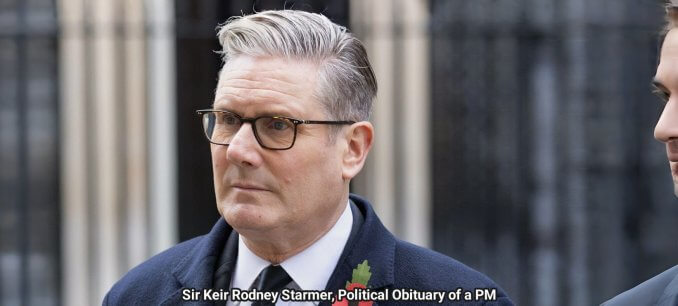
This article (Sir Keir Rodney Starmer, Political Obituary of a PM) was created and published by The Daily Sceptic and is republished here under “Fair Use” with attribution to the author Sam Lowry
Featured image: The Daily Sceptic


Leave a Reply