

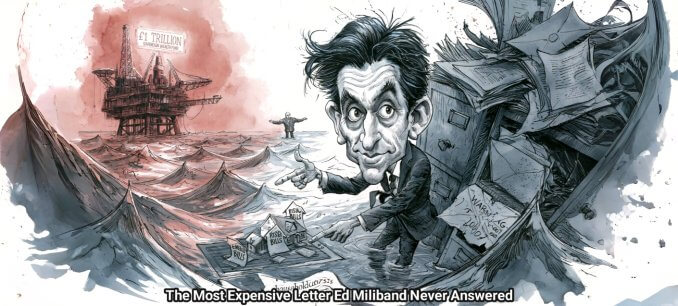
Part One: Ed Miliband was warned in writing. He is the Energy Secretary now. You are paying.
THE RATIONALS
Series Introduction
In 2008 a law was passed without the courtesy of disclosing its costs. Domestic gas production was quietly run down in the name of energy security. Import dependency grew. Bills rose. The borrowing required to fund the transition helped push up mortgage rates. Levies multiplied. Billions in subsidies flowed smoothly into the accounts of foreign shareholders. And each crisis this machinery produced was immediately presented, with an almost touching consistency, as conclusive proof that the policy must accelerate — more spending, more borrowing, more levies, more contracts, and more foreign dividends. The next crisis duly arrived. The same argument was made again, with undiminished sincerity.
The policy creates the crisis. The crisis justifies the policy. It is a perfect, self-reinforcing loop. The same men who built the machine are still running it, still explaining it to the public, and still quietly filing away the letters that once inconveniently calculated what it would cost.
Three articles. One mechanism. Every dot now connected — from the 2008 vote to your energy bill, your mortgage, your rent, your weekly shop, the foreign hands collecting the returns, and the case for repealing Net Zero.
The dots have always been in the public record. Until now, nobody has connected them.
Part One: The Men Who Built the Trap and Blamed the Weather
In 2008 a minister was warned that the law he was steering through Parliament would cost every household up to £20,000. He passed it anyway. He is the minister now. This, rather than Vladimir Putin or the caprice of global markets, is where your energy bill, your mortgage and your weekly shop actually originate.
On the evening of 28 October 2008 it was snowing in London—the first October snow in the capital for seventy-four years. Inside the House of Commons, honourable members were voting on the Climate Change Act, a measure premised in part on predictions of catastrophic warming.
Peter Lilley, one of only three MPs to vote against, rose on a point of order to observe the meteorological irony. The Speaker ruled it was not a matter for the Chair. The division proceeded.
Outside, snow. Inside, 463 votes for the most expensive domestic policy commitment since the welfare state, cast without the costs having been disclosed to those casting them.
Those costs are now arriving—in your energy bill, your mortgage statement, your rent, your food shop, the price of your car and your children’s first home. And the minister who passed that law, who was warned about its costs in writing the following year, who declined to discuss them, is the Energy Secretary today.
He attributes those costs to Vladimir Putin, to volatile markets and to the general turbulence of an uncertain world.
His name is Ed Miliband. This article is about the gap between what he knew and what he now says.
The Warning That Was Sent and Not Discussed

Before the vote Lilley had performed the unfashionable labour of reading the government’s own impact assessment—a document parliamentary convention requires to accompany any Bill but which, on this occasion, had mysteriously failed to reach members’ desks in any usable form. Its contents, he remarked with commendable understatement, were “dynamite”.
The Climate Change Act, the government’s own figures showed, would cost every British household up to £10,000—possibly rather more, since the assessment candidly admitted it had omitted several major cost categories. The burden, it noted with bureaucratic serenity, would fall disproportionately on the less affluent. The benefits would accrue largely to the rest of the world.
The House was not interested. It voted, congratulated itself and dispersed.
The following year, Lilley wrote to the Energy Secretary with an update that the government might have preferred to receive privately and discuss never. Revised official figures, he noted, had somewhat revised the earlier optimism. The Climate Change Act would now cost every British household between £16,000 and £20,000. He asked, with the careful courtesy of a man who had not yet given up on parliament as a mechanism for accountability, whether the House might find time to examine the arithmetic.
The Energy Secretary considered this request.
He did not act on it.
His name was Ed Miliband. He is, seventeen years later, the Energy Secretary again — the same office, the same policy, and a rather different explanation for why your bills look the way they do. The letter here, sits in the public record. The costs it predicted sit in your inbox. The minister who received it and declined to discuss it is now attributing them, with considerable confidence, to Vladimir Putin.
One notes this without further comment, on the grounds that further comment would be — to borrow a word Miliband might recognise from the impact assessment he also declined to discuss — superfluous.
The Contract That Was Signed and Not Mentioned
Miliband is not the only minister whose past and present are conducting an awkward conversation he has not volunteered.
In 2013 Ed Davey—then the Liberal Democrat Energy Secretary, representing a party that had entered government as the junior Coalition partner—agreed a Contract for Difference with EDF, the French state-owned energy giant.
The contract guaranteed EDF a strike price of £92.50 per megawatt hour for electricity from Hinkley Point C and cannot be cancelled without significant compensation to EDF. Once operational, that contract is expected to add roughly £1 billion annually to British household energy bills—for decades, regardless of what wholesale prices do, regardless of which party wins any subsequent election, and regardless of whether the minority per cent whose representative signed it ever votes Liberal Democrat again.
The China General Nuclear Power Group was handed a 33.5 per cent stake in the project — a stake the government has since been quietly attempting to unwind on national security grounds, without revisiting the contract terms that guarantee the costs to British households regardless.
Ed Davey has spent the thirteen years since signing it assuring the British public that clean energy would reduce their bills.
The contract he signed is adding £1 billion a year to those bills.
One notes this also without further elaboration.
The Machine They Built While Nobody Was Watching
The Climate Change Act did not merely set targets—targets, after all, can be missed. What Miliband’s legislation created was something far more durable, a self-executing statutory mechanism that, once enacted with those 460 votes and the warm mutual congratulations of a cross-party consensus thoroughly satisfied with itself, set methodically about dismantling every buffer, reserve and shock absorber in the British energy economy.
It did so quietly, legally, and over such a long period that by the time the consequences became visible, the machine was too deeply embedded in statute, regulation and long-term contract to be rapidly reversed.
This was not, one suspects, entirely accidental.
The Act established the Climate Change Committee to recommend the five-yearly carbon budgets now legally binding on government. Not advisory. Binding.
The Seventh Carbon Budget, covering 2038 to 2042, was laid before Parliament in February 2025—without a referendum, without a cost-benefit analysis distributed to the public, and without a serious parliamentary debate about what it would mean for the household budgets of the people it would affect.
Beneath its ceiling a thicket of enabling instruments has since accumulated. Each passed, each announced with appropriate gravity, each forgotten by the press within a fortnight.
The Zero Emission Vehicle Mandate requires 33 per cent of new car sales to be zero-emission this year—a compliance gap manufacturers recover by quietly raising prices on every conventional vehicle still being sold.
The Future Homes Standard adds £4,350 to every new dwelling—a cost that does not remain with the developer.
Minimum Energy Efficiency Standards require landlords to retrofit properties to ever-tightening specifications—costs that do not remain with the landlord.
Environmental Land Management schemes divert roughly ten per cent of British farmland from food production to woodland and peat restoration—with consequences for grocery bills requiring no advanced degree in economics to foresee.
None of this arrives labelled “Climate Change Act 2008—costs not disclosed to Parliament, warning from Peter Lilley not discussed.” It arrives as the number at the bottom of the page, attributed, when attributed to anything at all, to the weather in Eastern Europe.
Same Rock, Different Country — and What Might Have Been
The official explanation for Britain’s energy vulnerability is geology. The North Sea is a mature basin. Production declines. Nothing to be done.
Norway sits on the same geological basin, drills the same rock, contends with the same tides and gales. It produces significantly more gas per year than Britain now manages — the Norwegian Petroleum Directorate and NSTA production data place the disparity at several multiples in Norway’s favour.
The difference is not the seabed. Norway, perched upon the very same geological formation, declined to enact a Climate Change Act committing itself to the regulated extinction of its hydrocarbon industry. It does, it is true, levy a headline tax rate of 78 per cent on its producers — identical, as it happens, to Britain’s current combined rate — yet it structures that impost with investment allowances and exploration refunds expressly designed to keep capital flowing into the basin rather than fleeing it.
Britain’s 78 per cent arrived as a punitive windfall surcharge, stripped of any such courtesies and accompanied by a statutory pledge to wind the industry down entirely. Same number. Entirely different message. Capital, being neither sentimental nor slow-witted, read the message rather than the figure.
Britain created what investors politely term “terminal risk”, the rational expectation that your field will be regulated out of existence before its reserves are exhausted. Norway’s capital stayed. Britain’s left.
The North Sea Transition Authority’s figures, published February 2026, show UK Continental Shelf production down 12 per cent year on year, with a further 49 per cent decline projected by 2030. Britain — a net gas exporter within living memory — has contrived to become a price-taker on global LNG markets at the very moment those markets turned most volatile.
Norway’s sovereign wealth fund, nourished by the hydrocarbon revenues Britain chose to tax and legislate away, now exceeds £1 trillion. Norwegian households were spared the worst of the 2021 to 2022 gas price spike. They had not, it transpired, arranged to import their own energy from the market they were helping to tighten.
It is worth pausing on what the alternative looked like.
Had Britain maintained something approaching Norwegian production and fiscal policy from the mid-2000s onward, independent analysts suggest a UK sovereign wealth fund could have accumulated hundreds of billions of pounds by now. The precise figure varies by methodology, but the order of magnitude is not seriously disputed by those who have examined it.
Sufficient, in any reasonable estimate, to have cushioned every British household through the 2021 to 2022 energy crisis without emergency borrowing. Sufficient to have funded the energy transition without the gilt issuance that has kept mortgage rates elevated. Sufficient to have given the British public a material stake in the nation’s energy wealth rather than a quarterly bill for its absence.
Norway built a fund. Britain built a feedback loop. The difference between them is not geology. It is a vote taken on a snowy October evening in 2008, and the seventeen years of enabling legislation that followed it.
This comparison has been almost entirely absent from British coverage of the energy crisis. The reason for its absence is left as an exercise for the attentive reader.
The Committee Built to Mark Its Own Homework

At this point a reasonable person might ask whether anyone independent is keeping score of whether the policy remains affordable.
Someone is, the Climate Change Committee.
The CCC was created by Miliband’s Climate Change Act to recommend the carbon budgets. It is also the body ministers invoke when challenged on costs. Its estimate—0.2 per cent of GDP annually—serves as the parliamentary full stop on affordability debates.
This is the committee marking its own homework.
A body whose founding purpose is to recommend a framework will not, as an institution, conclude that the framework is unviable. This is not conspiracy, it is how institutions work.
The 0.2 per cent figure is a long-run average that conceals very large upfront costs falling on households with no capacity to borrow against distant savings. It assumes delivery on a timetable British infrastructure has not distinguished itself by meeting.
Crossrail opened nearly four years late. HS2 was originally budgeted at £32.7 billion, it is now expected to cost up to £102.7 billion, will not open until at least 2036, and no longer ventures north of Birmingham. The Swansea Bay tidal lagoon was hailed and then quietly shelved. Net Zero, we are assured, will be different.
Lilley noted in the House of Lords in 2024 that costs were never discussed during the passage of the Climate Change Act in 2008, nor during the ninety-minute debate committing Britain to net zero in 2019. He also observed that the BBC had published an apology for giving him airtime on the subject, removed the programme from iPlayer and sent the producers on a re-education course.
The national broadcaster apologised for allowing a parliamentarian to raise questions about the most expensive domestic policy commitment since the welfare state.
The CCC’s assessments are cited in Parliament and reported in the press with the serene confidence of holy writ. Their institutional provenance is not mentioned. The BBC apology is not mentioned. The letter to Miliband is not mentioned.
They are being mentioned now.
The System, Named
This is the point at which the individual facts cohere into something larger.
The man who drafted the legislation was warned about its costs in writing and is now its chief implementer. The man who agreed the most expensive contract it generated has spent thirteen years assuring the public that it would reduce their bills.
The committee charged with certifying the costs as acceptable was created by the very legislation whose costs it is busily certifying. The regulator implementing the charges describes them, with a straight face, as necessary infrastructure investment. And the national broadcaster felt it necessary to apologise for giving airtime to the parliamentarian who tried to have those costs discussed at all.
This is not a series of unfortunate coincidences. It is a system — one that has operated without serious interruption for seventeen years, kept honest accounting carefully out of public reach, and ensured that the machine, once built, keeps running regardless of the damage it causes.
And here the loop begins its next elegant revolution, the damage is never presented as evidence that something has gone wrong. It is solemnly declared proof that the policy must accelerate. More spending. More borrowing. More levies. The next crisis is already being prepared in the wings.
Which raises the question that Article Two answers.
If the system extracts money from your energy bill, your mortgage, your rent, your food shop and the price of your next car — and the people running it have every institutional incentive to keep it running — where, precisely, does the money go? Who is collecting it? And why has the answer to that question been almost entirely absent from the coverage of a crisis that has affected every household in Britain?
The answers are specific. They are documented. And, in several of the most instructive cases, they are foreign.
This article (The Most Expensive Letter Ed Miliband Never Answered) was created and published by The Rationals and is republished here under “Fair Use”
Featured image: The Rationals (modified)

••••
The Liberty Beacon Project is now expanding at a near exponential rate, and for this we are grateful and excited! But we must also be practical. For 7 years we have not asked for any donations, and have built this project with our own funds as we grew. We are now experiencing ever increasing growing pains due to the large number of websites and projects we represent. So we have just installed donation buttons on our websites and ask that you consider this when you visit them. Nothing is too small. We thank you for all your support and your considerations … (TLB)
••••
Comment Policy: As a privately owned web site, we reserve the right to remove comments that contain spam, advertising, vulgarity, threats of violence, racism, or personal/abusive attacks on other users. This also applies to trolling, the use of more than one alias, or just intentional mischief. Enforcement of this policy is at the discretion of this websites administrators. Repeat offenders may be blocked or permanently banned without prior warning.
••••
Disclaimer: TLB websites contain copyrighted material the use of which has not always been specifically authorized by the copyright owner. We are making such material available to our readers under the provisions of “fair use” in an effort to advance a better understanding of political, health, economic and social issues. The material on this site is distributed without profit to those who have expressed a prior interest in receiving it for research and educational purposes. If you wish to use copyrighted material for purposes other than “fair use” you must request permission from the copyright owner.
••••
Disclaimer: The information and opinions shared are for informational purposes only including, but not limited to, text, graphics, images and other material are not intended as medical advice or instruction. Nothing mentioned is intended to be a substitute for professional medical advice, diagnosis or treatment.
Disclaimer: The views and opinions expressed in this article are those of the author and do not necessarily reflect the official policy or position of The Liberty Beacon Project.


Leave a Reply