

MASTER RESOURCE
Guest Post from Robert Bradley at Master Resource.
An article in CleanTechnica by Michael Barnard, “Climeworks DAC & Fiscal Collapse & The Brutal Reality Of Pulling Carbon From The Sky,“ documents the failure of another anti-CO2 program. The article begins:
In 2024, Climeworks’ direct air capture (DAC) Mammoth plant in Iceland captured just 105 tonnes of carbon dioxide. That’s not per day, not per week, that’s total, across the year. For context, that’s less than the annual tailpipe emissions from a dozen long-haul trucks, or roughly one-thousandth of what the company said the plant was built to remove. In mid 2025, the company began laying off a minimum of 10% of its ~500 staff. For a firm that raised over $800 million in equity and subsidies, hailed as a pioneer of direct air capture, the numbers are sobering. But they are not surprising. They are merely the inevitable result of colliding hopeful techno-optimism with the brutal constraints of physics, economics, and scale.
Barnard then revisits the hyperbole that surrounds so many government-enabled projects.
DAC has always promised a seductive narrative: the ability to suck carbon out of the sky, store it underground, and buy ourselves a climate mulligan. It promised to clean up after fossil fuels without requiring too many lifestyle changes. It was a technology that said yes — to oil companies, to airlines, to governments slow-walking their emissions policies….
Private sector greenwashing was instrumental.
Big names like Microsoft, Stripe, and Shopify lined up to buy carbon removal credits at $600 a ton or more. Government agencies began pouring in cash. The US 45Q tax credit was sweetened to $180 per ton. Europe and Japan set aside funds. And dozens of startups bloomed. But beneath the marketing sheen, the physics was never on DAC’s side.

.
‘Thermodynamic Slog‘
“Removing CO₂ from ambient air is a thermodynamic slog,” continues Barnard. “The concentration is a measly 0.04% — less than one molecule in 2,500.” Enter the complications and cost:
Capturing it means moving vast volumes of air across chemically active surfaces, then applying heat, vacuum, or electric fields to regenerate the sorbents. The most mature systems, like Climeworks’ solid sorbent modules or Carbon Engineering’s hydroxide-calcination loop, require on the order of 2,000 to 3,000 kilowatt-hours of energy per ton of CO₂. Even newer concepts that promise electrochemical capture still hover around 700 to 1,000 kWh per ton. And that’s just to capture it. Compressing, transporting, and injecting it underground adds another layer of complexity and cost.
Barnard has done the calculations.
Back in 2019, I analyzed Carbon Engineering’s system in detail and concluded that it wasn’t ready for prime time. The energy requirements were steep, the system architecture was complex, and the economic case relied heavily on theoretical scale and generous subsidies.
Fast forward to today, and those conclusions still hold. Carbon Engineering’s Squamish pilot captured a few hundred tons over several years. Its first commercial plant, Stratos in Texas, is still under construction. Occidental Petroleum acquired the company in 2023 not because it had a viable climate solution, but because it had a narrative that could buy time for oil and gas. Stratos, too, will run on natural gas. The captured CO₂ will be injected underground and earn 45Q credits, while Occidental continues to sell hydrocarbons. This isn’t carbon removal. It’s corporate theater wrapped in a green ribbon.
Barnard documents the energy-intensive, carbon-intensive processes involved with the leading technologies (Climeworks; Carbon Engineering).
Why the Futility?
Why is there support for a boondoggle-in-progress that few really like? It is magical thinking, a “justification tool”.
Direct air capture, like the broader class of carbon capture and storage (CCS) projects, has been used less as a mitigation tool and more as a justification tool. Capture projects at the smokestack were supposed to save coal. They didn’t. DAC was supposed to save aviation. It isn’t.
Now it’s being positioned as the backstop for net-zero oil and gas production, a way to square the carbon ledger while the meter keeps running. The problem is that the math never adds up. To remove even one gigaton of CO₂ annually — the lower end of what IPCC pathways suggest we might need by mid-century — we would need thousands of DAC plants the size of the one Climeworks can’t get to work. That would require hundreds of terawatt-hours of energy annually, roughly equivalent to doubling the electricity use of a mid-sized industrial nation.
The Futile Crusade
“Meanwhile, global CO₂ emissions are still hovering around 40 billion tons per year,” Barnard allows.
DAC, across all companies, all technologies, and all years combined, has removed less than 20,000 tons to date. That’s 0.00005% of annual global emissions. It is, for all intents and purposes, noise. And it’s not getting better fast enough to matter. Mammoth’s 105 tons aren’t just a small number — they’re a warning. The technology isn’t scaling. It isn’t stabilizing. And it isn’t getting cheaper at the pace its proponents claim. The laws of thermodynamics are not falling into line. They’re enforcing a cost floor.
The economics are even more dismal. Climeworks’ removal credits have sold for between $600 and $1,000 per ton. Carbon Engineering’s contracts are rumored to be in the $400 range. Heirloom, another promising startup using carbonate looping, hasn’t released cost data, but is operating at similarly high levels. All are subsidized. Without the 45Q credit, few if any would be viable. As a reminder, the fossil fuel and tax cuts for billionaires Republican House bill working its way through Congress cuts IRA incentives for a raft of technologies, but leaves 45Q for carbon capture alone.
Eco-Mirage
Climate activists do not like direct air capture or carbon capture and sequestration more generally. Barnard gives the reasons why.
And yet, policy continues to encourage this fantasy. Climate plans, particularly from oil and gas states, are now riddled with assumptions about large-scale engineered removals beginning in the 2030s. It’s climate budgeting with monopoly money. It postpones the hard choices. It allows emissions to continue today in exchange for a speculative cleanup later.
Even when DAC does remove carbon, permanence is no guarantee. Some companies are experimenting with CO₂ utilization — turning it into synthetic fuels or chemicals. That’s fine if your goal is to recycle carbon. But it’s not removal. It’s delay. Others are pairing DAC with enhanced oil recovery, which is neither climate-aligned nor economically transparent. Only a handful of firms, like Charm Industrial with its bio-oil injection strategy, are actually delivering meaningful volumes of removed and stored carbon. And even Charm is still in the thousands of tons per year — not remotely near what’s needed at scale.
Conclusion
So where does this leave this modern day equivalent of synthetic fuels? “At best,” Barnard concludes, DAC is “a very niche technology with specific use cases:
legacy cleanup in overshoot scenarios after 2050, support for incredibly-expensive-to-decarbonize sectors …. But as a pillar of global decarbonization strategy, it is a fantasy. It’s climate alchemy: an expensive, energy-intensive attempt to undo what never needed to be done in the first place. Every ton of carbon avoided today is worth exponentially more than one captured tomorrow. And yet policy, funding, and media narratives continue to bet on the latter.
He continues as a climate activist who does not realize that false solutions and waste are the flip side of the anti-CO2 coin.
We’ve been here before. Carbon capture was supposed to save coal. It didn’t. DAC is supposed to save oil. It won’t. What will save us is electrification, efficiency, and prevention…. Every watt of clean electricity deployed today reduces the need for exotic techno-fixes tomorrow. Every avoided ton of CO₂ is one we don’t have to chase through the sky with a billion-dollar machine and a bag of subsidies.
To his credit, he is ready to pull the plug on a politically correct, economically/environmentally incorrect technology.
Climeworks’ 105-ton year should be a turning point. Not just for one company, but for an entire class of false solutions. If DAC ever works at scale, it will be as a backup — not as a plan. Until then, we need to stop pretending we can suck our way out of this problem. We need to stop lighting carbon on fire. Because that’s the only removal that truly works.
Better yet, with CO2 mitigation policies and technologies failing, it is time to reverse course on the whole climate crusade, redirecting resources toward adaptation to extreme weather (from any cause). Thirty-five years of misdirection and waste is enough.
Editor’s Note: I wholeheartedly agree. The fundamental cause of the futillity here is the blind acceptance of the corporatist climate narrative, namely that CO2 is somehow a problem. It’s not a problem, but an opportunity to pursue political power and riches and nothing more.
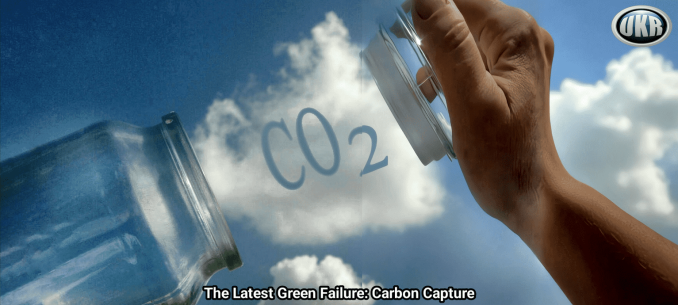
This article (The Latest Green Failure: “Hey, I’ve Got An Idea! How About We Pull CO2 Out of the Air and Put in Underground?”) was created and published by Energy Security and Freedom and is republished here under “Fair Use” with attribution to the author Master Resource
Featured image: Alamy

••••
The Liberty Beacon Project is now expanding at a near exponential rate, and for this we are grateful and excited! But we must also be practical. For 7 years we have not asked for any donations, and have built this project with our own funds as we grew. We are now experiencing ever increasing growing pains due to the large number of websites and projects we represent. So we have just installed donation buttons on our websites and ask that you consider this when you visit them. Nothing is too small. We thank you for all your support and your considerations … (TLB)
••••
Comment Policy: As a privately owned web site, we reserve the right to remove comments that contain spam, advertising, vulgarity, threats of violence, racism, or personal/abusive attacks on other users. This also applies to trolling, the use of more than one alias, or just intentional mischief. Enforcement of this policy is at the discretion of this websites administrators. Repeat offenders may be blocked or permanently banned without prior warning.
••••
Disclaimer: TLB websites contain copyrighted material the use of which has not always been specifically authorized by the copyright owner. We are making such material available to our readers under the provisions of “fair use” in an effort to advance a better understanding of political, health, economic and social issues. The material on this site is distributed without profit to those who have expressed a prior interest in receiving it for research and educational purposes. If you wish to use copyrighted material for purposes other than “fair use” you must request permission from the copyright owner.
••••
Disclaimer: The information and opinions shared are for informational purposes only including, but not limited to, text, graphics, images and other material are not intended as medical advice or instruction. Nothing mentioned is intended to be a substitute for professional medical advice, diagnosis or treatment.
Disclaimer: The views and opinions expressed in this article are those of the author and do not necessarily reflect the official policy or position of The Liberty Beacon Project.


Leave a Reply