

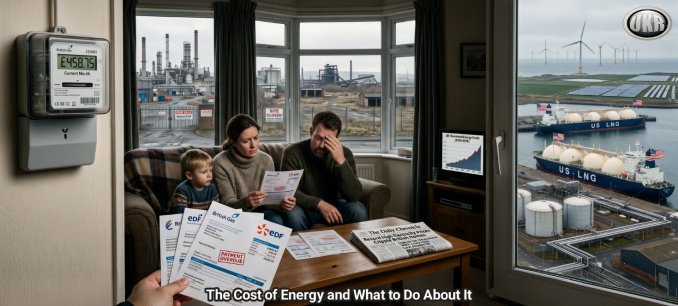
The cost of energy and what to do about it
PROFESSOR SIR DIETER HELM
1. Where we are
Ed Miliband and Boris Johnson have a lot in common when it comes to energy. Johnson asserted in a government document that the leaders of Russia and China would be looking to Britain’s energy policies so that they could learn how to emulate us.[1] Miliband presumably shares this view on the path to becoming a “clean-energy superpower”, with renewables that are “nine times cheaper” than gas,[2] grounded in “home-grown” energy and free from the grip of dictators. Britain will escape from “high and volatile” gas prices and customers will see a £300 fall in bills. Economic growth will be increased – it was one of the two pillars of growth in the 2024 Labour Manifesto (the other was housing). With world leadership (about which Johnson was especially enthusiastic), Britain is leading the way in tackling climate change. For nearly two decades these claims have been trotted out by the various guises.
Where we now are in 2026 is not a happy place. As with Ukraine, so with Iran, Britain has been harder hit than any major developed economy, despite taking virtually no gas from either Russia in 2022 or from Qatar and the Gulf States in 2026. Britain has amongst the highest electricity prices in the developed world for industry and domestic customers, a position where it is closely followed by Germany, whose Energiewende carried similar ambitions for Germany to become the world leader in renewables. Both share the consequence that they are critically dependent on US LNG (liquefied natural gas) to keep their lights on. Both had to resort to massive subsidies in 2022, and both now are rearranging the deckchairs to try to protect their industrial bases whilst still allowing costs to rise. Both are now in the realm of permanent subsidies.
Germany made two additional and spectacular energy policy mistakes. It closed down its operating and well-regulated nuclear power stations, switching from “home-grown” nuclear to imported nuclear from France and elsewhere, and it doubled down in its dependency on Russian gas, including the Nord Stream gas pipelines.
Britain is currently accelerating the closure of its North Sea gas production, switching from “home-grown” British gas to Norwegian North Sea gas and US fracked LNG gas. The industrial consequences have been dire. High electricity prices have contributed to the closure of Grangemouth refinery, the Exxon refinery in Scotland, one of the Hull refineries, the closure of most of the steel industry, the closure of the fertiliser and fibreglass industries, and severe problems for pottery and for glass-making. Car manufacturing is back to the 1950s’ levels. There is devastation amongst the SMEs, aggravated by the increase in employer national insurance contributions, enhanced workers’ rights, and increases in the minimum wage. The unfunded welfare spending has increased the cost of capital, with record gilt costs. Energy policy has reduced economic growth, not increased it.
As to the promised falls in the costs of renewables and the new enthusiasms for nuclear, the facts are not encouraging. The costs of offshore wind are rising, as witnessed in the latest AR7 auctions, and the system costs of solar and wind are rising as more excess capacity is needed to meet peak demand, and as the grid has to be doubled and all the batteries and storage added to keep the lights on for the same peak demand. (More on this later.)
These costs are made up of not just the overall system impacts, but also the very high construction costs. It now costs around £16 billion (bn) per gigawatt (GW) of nuclear power, for example.
On the domestic front, customer energy debts are now over £4bn (as at June 2025) for electricity and gas, and there are demands for yet more customer subsidies, moving the levies from customers to taxpayers, and reducing energy taxes. Some of this has begun, moving the costs around, but doing nothing to reduce the overall cost of electricity in Britain.
All this might be more bearable if it was reducing global warming, or at least leading to Britain no longer causing climate change; if all that “world leadership” was actually having an impact on climate change. The sad fact is that it isn’t making much difference. It is not just that the UK contributes a very small amount to the global total emissions, but rather that net zero carbon production is the wrong target, if this is what you want to do. It has to be net zero carbon consumption, and that is a different story. High prices accelerating the closure of large energy-intensive industries, and replacing “home-grown” production with foreign imports makes climate change worse not better. Making steel and cars and solar panels and refining minerals in China, which burns more than 50% of the world’s total coal, is not an obviously good climate change policy. The facts are clear and scary: the carbon concentration in the atmosphere has continued to increase at around 2 parts per million (ppm) since 1990, now accelerating to 3ppm. There isn’t a blip in this disaster, and certainly not a “British blip”. And, sadly for Johnson and Miliband, no world leaders are looking to Britain to find out how to make a difference. No one else wants the highest prices and stagnant economic growth.
In this context, it is worth also debunking the idea that the energy world is divided simplistically into “clean” and “dirty” energy, and that renewables in particular are “clean”. They are not. The supply chains are full of emissions and pollution – from mining to transport to refining to manufacture of the generation equipment and the transmission and distribution systems, and batteries can be very dirty. Take a look at the lithium, cobalt, nickel and copper and rare earth mines around the world. Renewables may be “cleaner” (although not always), but they are not clean and they are not zero emissions. Decarbonising the world’s energy systems is a much harder task than advocates of the simplistic notion of “clean energy” apparently believe.
2. Why we are where we are
How did it end up like this? The simple logic of the policies is based upon the concept of “clean energy” being mediated through electricity. “Clean power” is the start, and then if everything is electrified, the economy will be “clean”. To do this, renewables (and possibly nuclear) will generate the electricity, and the coming digital and AI technologies will facilitate the new electric industries of the future, along with electric transport and electric heating.
It sounds good. It does need a few other assumptions: that renewables and nuclear are actually “clean”; that batteries and storage will solve the renewables’ intermittency; that the batteries will also be “clean”; that renewables and nuclear are going to be cheap (to some, too cheap to measure); that the costs of a system based on renewables and nuclear will be cheaper; and that the costs of oil and gas and coal are going to go ever upwards.
It also helps to ignore the scale of the problem. The starting point is that electricity is about 20% of energy supply worldwide. In Britain, around 75% is oil and gas, some of it to generate electricity (plus, of course, all that coal and oil and gas embedded in the stuff now imported that was once produced by coal and oil and gas in Britain). For the world (remember we are “leading the world” to decarbonise), it is a stubborn 85%. It also helps to ignore the fact that there never has been a transition from one fuel to another. Each satisfies at best the extra demand. The coming of coal led to more wood being burned now than in the nineteenth century (including all those pellets in the Drax power station), more coal is burned globally with the coming of oil, and more oil is burned with the coming of gas.[3]
What Britain has done – and this is important as a lesson to the world – is got out of domestic coal burning (but not out of imported embedded coal, as noted above). Getting out of coal has had numerous benefits, and it is the prime reason for the fall in territorial carbon production in Britain. The lesson for others is in observing what happens without the baseload and flexible coal in the system. Britain is the first major country to try to rely on only gas and renewables (and a little declining nuclear so far). It is a gas + renewables example. It has been tested twice – in the Ukraine and the Iran wars. Other countries, faced with rising gas prices, could increase their coal burn. Britain could not. China had a huge coal buffer, and both Germany and Poland have had that option too. Britain does not, and that is a contributor to the largest negative impact amongst developed countries from these two gas price shocks.
Britain’s energy policy goes much further. It wants to get out of gas too, and hence it wants to run its electrified economy on just renewables and nuclear as the mainstays, with lots of interconnectors with Europe and a small residual of gas. It is indeed already getting out of gas. It is squeezing the British North Sea production through its windfall tax, and it is trying to stop new licences. It is also granting more and more fixed-price CfDs (contracts for difference) and RAB-based (regulatory asset base) contracts to renewables and nuclear, so that the wholesale price (and hence the gas price) determines less and less of the electricity price. Looking ahead into the 2030s, the cost of electricity in Britain will be overwhelmingly fixed. Gas will matter less and less.
This strategy is a bet on the future price of gas. Miliband knows that gas prices are going to go ever up, whilst renewables (and presumably nuclear) costs are going to go ever down. Thus CfDs and RAB-based contracts are going to get absolutely and relatively cheaper and cheaper.
As a general rule, it is a very dangerous strategy to base energy policy on a certainty about forecasts of future costs and prices. It happened in the late 1970s and early 1980s, after the OPEC shocks, when oil prices were assumed to go ever up, and it is happening now. In both cases, the initial spikes (caused by geopolitics and war and revolutions) were followed by price collapses. An oil price in 1979 of $170 (in today’s prices) was never seen again (and still has not been seen in the Iran war, by a considerable margin). And the gas price in Europe fell 90% from the peak in 2022, and 40% in 2025. Oil and gas prices have gone up as a result of the Iran war, but they are not on the scale of the 1979 experience. This is not, as the International Energy Agency (IEA) claims, the “largest energy crisis in history”.[4]
Miliband should reflect on what happens if and when the oil and gas prices fall this time around. A falling European gas price might help to begin to close the gap against the massive energy price competitive advantage the US has. Oil and gas costs in the US are around four times cheaper than those in Europe, with Britain at the top of the uncompetitive leaders’ board. As the new AI technologies unfold, no data centre is going to find Britain’s high costs for a highly intermittent-based electricity system an attractive competitive advantage.
Miliband can, however, claim that he has insulated British industry and households from global gas prices (a bit). This might be “good news” if the gas prices stay very high and very volatile, but it would be seriously bad news if they fall back in the face of excess supply. In this context, it is worth remembering that Qatar’s great LNG developments were designed to serve an assumed US market deficient in gas. The US is not short of gas now, having gone from needing Qatar to provide imports, to self-sufficiency and starting to export in 2016. Within ten years, the US has become the world’s largest exporter of LNG, keeping Europe supplied as Russian supplies were cut off, and mitigating the impact of the closure of the Strait of Hormuz. The US is also by far the world’s largest oil producer. For gas and oil, it is not the home of “high and volatile” prices. The US has cheaper gas, and cheaper oil, and lots of it, as well as lots of coal.
If gas prices fall, and British industry and customers are protected from any benefit, there will be a further impact on the British economy and impacts on poorer customers and on affordability. The CfDs and the RAB contracts are fixed – that is the point of them – and this means that British electricity costs are largely locked in until 2040 and beyond. Britain is going to be a high-cost electricity country for at least another 15 years on the current policy path, and speeding up AR8 will make it worse.
3. The cost of renewables
Let’s now turn to the argument that renewables are “cheap” and getting ever cheaper. There is a temptation from advocates and lobbyists for particular technologies to choose a measure of costs that gives them the answer they want. This is especially true for renewables and the wrong measure is embedded in the contracts for renewables generation. The advocates and lobbyists like to point out that wind and sunshine are free. If they are free, it must be obvious that they are cheaper. Reflect for a moment: so is rain from the sky “free” and so is the air that we breathe. In the case of water, perhaps you should have free water supplied to you? We treat the atmosphere as a free pollution dump, and this is one of the reasons we have climate change. We dump our carbon into the atmosphere for free – or at least until we introduce carbon taxes.
It is true that the marginal cost of wind and solar is effectively zero. So, too, for almost everything that comes through the digital technologies. There are lots and lots of zero-marginal-cost products and services. Nothing follows to suggest they are necessarily cheap to provide. Why? Because they need a system to get the free sunshine and free wind to the customer, and, in the case of electricity, so that supply and demand are instantaneously matched.
Whatever the right basis for comparing renewables with other electricity-generating technologies, the answer is not the marginal costs of the solar panel or the wind turbine. The right basis is to compare the system costs of the technological options. It is here that renewables hit a buffer: they are intermittent, whereas most of the demand is for firm power, 24/7, and for supply to match demand instantaneously. The intermittency of wind and solar are different. Solar is a summer energy and a daytime energy; wind varies throughout the day and night and across the seasons. Neither works for 50% of the time. Britain is a good place for wind flows and that makes the North Sea offshore wind better than in most other locations, but it does not provide firm power.
The implication of this is profound. Something else needs to be available to bridge the gaps in supply, and this comes in various guises – including gas, interconnectors, batteries, pumped hydro, and perhaps one day hydrogen. Some of these are short-duration storage, like batteries; some depend on surplus supply elsewhere (in Europe) at the required time.
Perhaps one day in a couple of decades’ time there will be batteries that fix this. But in the meantime, it is gas that is needed to be available at very short notice, and lots of it. To get a handle on the costs of a renewables system, consider what has already happened in Britain. The ballpark numbers are as follows. Peak electricity demand is around 45GW, and in the ‘bad old days’ we had around 60GW of capacity available comprising coal, gas and nuclear to meet this peak with a comfortable security margin. We had a well-developed electricity grid, and we needed no batteries and very little storage because coal, gas and nuclear were all firm power. This is what the British electricity system looked like, pre-intermittent renewables.
Now we have closed all the coal and have built out a big offshore wind generation capacity, as well as some solar and a bit of onshore wind. We now need around 120GW of capacity to meet the same 45GW peak demand (actually the peak has been falling as industry has been closing). That’s a big cost overhang. On the capacity side, it is not nine times cheaper. But this is not all the extra cost from the intermittent renewables-based system. There needs to be a much larger grid for the same peak demand. Electricity transmission may have to double. That is extra cost for the same outcome: the 45GW peak demand. Now we have to add the costs of all the extra batteries and storage.
The result is a comparison to the system costs of coal plus gas plus nuclear, on the one hand, and adding twice the capacity, twice the grid and all the extra batteries and storage, on the other. That cannot be nine times cheaper.
4. The problem of excess supply
There are lots of ways in which the intermittency could be better managed, including using active demand management. But they don’t tip the scales. In the scenarios of the National Energy System Operator (NESO) through to the end of the 2030s and beyond, they have around 300–450GW of capacity to meet a maximum expected peak demand of around 90GW (if demand doubles, if all the data centres and AI come and if Britain becomes “ an AI superpower”). That is more than three times the expected maximum peak demand. If demand falls short, it could leave Britain with four or more times the peak demand in capacity.
Why would anyone want to do this? This goes to the heart of the special deal the renewables get when it comes to contracting. The CfDs are awarded a fixed price for the output the wind turbines and the solar panels produce. They don’t pay anything for the intermittency and other costs they cause to the systems and they still get paid if their electricity generation is of no use to the system. Worse, they don’t pay for their connection to the grid on the basis of the value to the grid and hence there is no incentive to put them in the right places. Hence the absurdity of lots of offshore wind off the north-east coast of Scotland, some of which is paid to produce electricity which is strictly useless to the system and its customers. These offshore wind generators still get paid. Industry and households pay for this, but get nothing as a valuable output.
Suppose for a moment that all this generation is “on the system”, in the sense that it is not constrained off. There will be moments of massive excess supply. Think of all that 120GW working when peak demand is 45GW and hence actual demand might be, say, 30GW or even significantly lower? What happens to this surplus? In principal, this could be a bonus – electricity already paid for and effectively “free” to the system and hence “free” to any potential user.
The more likely safety valve for this “free” power is the interconnectors and effectively dumping it into Europe, at whatever the price is on the other side of the cable. Britain could be an export-earner, analogous to when Britain exported oil and gas. There is, however, a catch. Why would European electricity markets need it, when they, too, are building excess renewable capacity? There would have to be a mismatch of wind flows. Solar is better the further south it is generating electricity and hence it is unlikely that any European market would want British solar in summertime, and the similar time zone means there is no significant day/night arbitrage.
Perhaps Britain could build some electricity-consuming but intermittent extra demand? The problems with this are numerous. What sort of demand might this be? What would be the costs of the demand intermittency? Would some of it encourage socially useless projects?
With surplus electricity from time to time, it will be important to offer incentives to customers to use it. This is where the marginal price matters, and where it is important that customers see through the price to the demand. This needs to be combined with the charging to customers of the fixed system costs and the cost recovery of the CfDs and the RAB contracts. For the fixed costs, the natural analogue is the standing charge, so that there is no incentive to opt out of the system and its costs. This is where home solar generation comes in. If the price is made flexible, and if households do not pay a standing charge, then there is an incentive to add more and more domestic solar beyond its useful value. Recall that roof-top solar owners can and do sell their excess into the system, mainly in summer, even if the system does not want it. In the process, they escape some of the system’s fixed costs.
Note that the levelized cost measures, which add in the capital costs of solar panels and wind turbines over their lifetimes, suffer from some of the same defects of the marginal costs. Crucially, they also don’t include the system costs.
5. Equivalent Firm Power and security of supply
An energy system needs to be able to deliver secure and firm power. It needs to ensure that when the light switch is turned on, the lights do actually go on. We need electricity 24/7.
Once upon a time, power cuts were infrequent but not rare. Customers coped with them and so did industry. There were miners’ strikes and power station and substation failures. In an analogue economy, these might be inconvenient but they were part and parcel of industry and life. For companies, idle workers waiting for the power to come back on was a cost, and for households, a stock of candles might be required.
All this changes in a digital world, driven by IT and the internet and apps and online commerce, and even more so as AI takes centre stage going forward. Energy systems designed for analogue worlds do not fit well in always-on digital worlds. And yet the irony is that, just as firm power becomes more and more important, the switch is to more and more intermittent generation.
The central question for any electricity system is how good is it at delivering firm power and at what cost. It is not optional. A modern economy is utterly dependent on firm power.
In the Cost of Energy Review,[5] I made firm power the central concept and designed a market to ensure firm power and to reward firm power. This is the Equivalent Firm Power (EFP) market. Recognising that the marginal costs of intermittent generation are zero, the key focus is capacity not energy. The system requires sufficient EFP to cover the expected peak demand plus a comfortable margin. Let’s say that is currently 60GW. What the system operator does in the EFP market is offer EFP contracts, and generators all bid for these. Wind turbines cannot offer 100% firm power, but they do add something. Therefore, they will be derated according to the impact of their intermittency upon the system. As there is more and more intermittency on the system, the value of wind and solar will decrease. Their EFP will be lower in value. This is especially true for solar, which will be offering its power as more firm during the summer, precisely when it has least value to the system.
The system operator takes the bids, adds them up and cuts off when there is, in this example, 60GW of EFP – which might be represented by significantly more actual generation capacity, derated accordingly.
The great merit of this system, apart for its market efficiency, is that the costs of intermittency are borne by those who cause it, as opposed to the current CfD system in which those who cause intermittency bear no consequences of causing it – indeed, they even get paid when their output is useless to the system (as long as the wholesale price is above zero, something they can engineer to be just positive and hence get paid the full CfD strike price).
As was to be expected, the proposal for EFP was met with howls of protest from the renewables lobbyists and from the government department, which by then was thoroughly captured by these interests. The trouble with bowing to the lobbyists is that the problem does not go away: if intermittent generators do not pay the costs, there will be too much electricity and often in the wrong place. Pretending otherwise does not reduce the system costs, which can now be so clearly seen in the fact of the very high prices that have resulted.
EFP is the central market-organising concept to address the security of supply. It is the efficient answer, and the system operator has to deliver EFP to keep the lights on. The fact that the renewables do not currently pay for the intermittency does not avoid the costs and does not negate the need to arrive at sufficient capacity to meet expected peak demand. It is unlikely that the EFP answer would be 120GW now to meet 45GW of expected peak demand.
That leaves a problem. The renewables might not be very competitive in a pure EFP market, but they are argued to be the “solution” to addressing climate change. The pure EFP needs a carbon price, and this can be explicit, or the system operator and the government can ration the EFP contracts on the basis of assigning many (possibly most) of these to the electricity generation technologies that they believe most efficiently reduce overall carbon emissions. This is why the Cost of Energy Review recommends a two-stage auction: first, unconstrained by carbon; and second, with constraints applied to meet the overarching carbon-reduction targets.
6. Sabotage, cyber attack and cable and pipeline cutting
As has become apparent in the Baltic and in Ukraine, a serious risk to security of supply is hybrid war, deniable sabotage and the daily experience of hacks and cyber attacks to the core system. In the Baltic Sea, the Nord Stream gas pipes were blown up, severing instantly a major gas supply route to Europe. In the Baltic, too, there are now regular cases of interference with data cables and with electricity interconnectors.
Electricity and energy systems are now interwoven with the communications system. Analogue energy systems no longer work. There is therefore a “new” security of supply problem: how to protect the cables and pipes and how to prevent systems being crashed and hacked. Many of the threats are from quasi-state actors, but not all, and deniability has become a key feature of them. An anchor dragged in the Baltic, an unknown device fixing explosives to pipelines, and cyber criminals spun out from the ranks of the security forces in Russia, China and elsewhere are all part of the new game.
To these need to be added drone attacks and physical sabotage. German railways were disrupted by bombs from unknown sources. Drones can take out wind turbines and storage depots. These latter threats are all the more serious when each target is relatively low value (e.g. an individual offshore turbine) and when there are multiple targets (lots of wind turbines in a wind farm). The recent successes of Ukrainian drones in doing serious damage to Russian oil and gas installations point to the scale at which this new military technology can be deployed.
If the first duty of a government is the protection and defence of its citizens, the security of offshore assets – and especially cables and pipes – becomes a central requirement of energy policy. Unfortunately, this is almost entirely a missing element when it comes to Britain. The vulnerabilities are obvious. One pipeline from Norway conveys over 30% of gas to Britain. The electricity interconnectors are regularly surveyed by Russian ships, submarines and other covert operators. They are first in line in the event of a military action. For any government, it is not just carbon that matters for electricity generation, but also the security premium. The system as a whole has to be designed, operated and defended against a wide and growing range of possible threats.
These considerations play to the “home-grown” argument, and specifically with respect to gas. Why would any government prefer Norwegian gas to gas from the British North Sea, where the former is large, concentrated and dependent on a single pipeline. The added feature is that Norway has other markets. When the Nord Stream pipelines were blown up, Norway became Germany’s security. It is important to recognise that Britain is only one customer and that attacks on other parts of the European electricity and gas interconnectors, wires and pipelines play back to Britain’s own security.
These considerations raise issues about who pays the security premium, and how this is taken into account in the market design. The EFP auctions allow for this consideration, like that of carbon, to enter the second-stage auction. Firm power is not just 24/7 but also secure. It is secure EFP that should be determined in the auctions, hence incorporating the security costs.
7. The gas problem
The gas problem is not just about the Norwegian versus British North Sea supplies; it is about what the role of gas is and should continue to be in the British energy system.
Recall that Britain is pretty unique in wanting to be reliant on renewables plus eventually nuclear, without coal and with as little gas as possible. As a result, the government plans to gradually shut down the British gas networks, and is concentrating on how investors get paid for their legacy RAB as the industry shrinks. It is not so concerned with maintaining and enhancing the gas networks (and supplies) out into the future beyond the 2030s, and hence it is not concerned with the new RAB assets.
It is critical to understand how radical and brave the objective of getting out of gas is and its full consequences once Britain has nothing else other than batteries and pump storage to deal with the intermittency after the gas is closed. (Nuclear is a firm and not a flexible contributor to the system.)
It is even worse for the gas generation. Given the excess capacity of intermittent generation, when the wind blows and the sun shines, the gas is knocked off the system. The more renewables there are, the more often gas is knocked off. Under the NESO scenario for 2030, the result is that, although there still needs to be 35GW of gas generation capacity on the system, it is assumed to run about 4% of the time. Recall that peak demand is 45GW, so the gas capacity is almost always spare electricity generation on the system. This is an incredibly expensive insurance system, and there is a core question of why the market should keep this sort of capacity available unless it is given guaranteed capacity contracts that cover the costs of keeping it all ready to go. It is another additional cost of renewables.
As we will see under the “Go for broke” strategy below, there are all sorts of issues with a “Get out of gas” strategy. But before considering how much maintenance of, and replacement investment into, the existing gas system is required, and how keeping the system up and running with lower gas flows (and hence lower pressures) and how these fixed costs get paid for, the prior question is whether – whatever the government’s declared policies – gas will be needed as the new demand for firm power from data centres and AI is added to the system. Given the fixed cost of the CfDs and levies and networks, the incentives to defect from the system with own-generation from gas are significant. Given, too, concerns over intermittency and security of supply for 24/7 electricity to power data centres, why not at least build own back-up gas generation? The incident at Heathrow Airport in September 2025 might, for example, encourage all main airports to build standby gas.
To get an insight into how this may play out, look at the world’s leading developer of AI and data centres: the US. It is building lots of gas power generation on site as the existing system struggles to cope. That is a possibility that should be factored into scenarios for 2030 and beyond in Britain. This matters for the gas transmission and distribution system since, once it starts to be run down, it is practically irreversible to put it back together again. The policy question is how risk-averse any government should be to the protection and enhancement of a gas system that is not in its engineering very flexible. This is all before considering what an alternative government might do, which promoted new gas generation as part of an industrial and AI strategy.
8. The nuclear problem
Late to the table, the Labour government has become an avid convert to all things nuclear, but without thinking through how all this plays out within the electricity system. Miliband now mirrors Johnson’s approach, which is to be “gung-ho” about nuclear. This is in a context in which Britain has in fact been getting out of nuclear for three decades, not dissimilar to Germany’s exit from nuclear.
There are at least two problems with nuclear: the cost; and how it sits with renewables. On costs, new nuclear in Britain is amongst the most expensive in the world, currently at around £16bn per GW (compared to around £0.5–£1bn per GW for new gas, for example). This means that if the new nuclear power station (Hinkley C) is completed soon after 2030 and Sizewell C a decade later, around £100bn will have been spent on roughly 7GW of capacity, and of the existing nuclear capacity, perhaps only Sizewell B will still be on the system, at around 1GW.
A key reason why the costs are so high is that Britain has not adopted a programme of new build, as China and France have done; rather Britain builds one at a time. In the Hinkley C context, the initial plan was four new reactors, but one of each different sort to see which one worked best. But then only Hinkley C has been developed until now, with Sizewell C following on. There is a serious argument that Britain should either do nuclear properly, like France, or not at all.
Having lamentably failed to get a significant PWR (pressurised-water reactor) nuclear programme up and running, the government has now turned to SMRs (small modular reactors). The idea is that lots of small reactors will be built in factories and rolled out across the electricity system. Rolls-Royce leads on this as the British champion, but the chances are that the production of SMRs will be done at scale elsewhere, where labour and energy costs are cheaper and there are lots of orders. In the first round of SMRs, the plan is to put them on existing nuclear sites, and the first ones are not small but rather medium-sized PWRs. None of these is likely to be on the electricity system much before 2040.
The second problem is that adding firm-power, always-on, large nuclear power stations to a system overwhelmingly dominated by small-scale intermittent solar and wind – and one that will have massive excess capacity – means that when the wind blows and the sun shines, the surplus will drive the wholesale price to zero and something has to be constrained off the system. Since nuclear and wind and solar are all near-zero-marginal cost, nuclear would, if it ran in these circumstances, constrain off wind, reducing the economic value of wind further. Alternatively, the wind would render the nuclear intermittent as it has the gas, creating havoc to the economics of nuclear. As yet, there seems to be no serious recognition of this problem, and private investors have looked to guaranteed returns through a RAB, such that the intermittent problem for nuclear becomes a cost problem for customers, just as the CfDs make intermittent wind surpluses a cost for consumers.
9. Competitive pricing and subsidies
An electricity system that is dominated by fixed and sunk costs, and where the intermittent generation is not confronted with the system costs it causes, raises questions about who should pay these fixed and sunk costs.
Under the current system, suppliers to domestic customers are in the same position as large-scale industrial electricity users. The costs of the grid, the storage and the CfDs for the wind and solar and the CfD for Hinkley C and the RAB for Sizewell C get spread across all the customer base. This is the cost-recovery mechanism.
In a normal competitive market, things would be very different. The price of electricity would equal the competitive price on world markets and the affordable price for households. The price could not be higher because companies would go bust and households would not be able to pay. These prices would create the envelope of potential revenue to fund the system.
With this alternative perspective in mind, how would the existing system cope with this? The first answer is that the industrial price would equal the competitive price, and companies would pay for their variable costs and, where possible, make some contribution to their fixed costs. This would broadly follow Ramsey efficient pricing. In effect, competitive industrial customers would not pay the full pro-rata share of the fixed and sunk system costs, including the levies. They would pay some of the total cost, but not all.
The immediate reaction is to claim that this means that households would pay more than industry and hence their prices would go up. But this is not quite right. If industrial customers are forced to pay their pro-rata shares, some will go bust – as indeed has been happening. Then they would make no contribution to the fixed and sunk costs and levies. As such, households would be even worse off. This is indeed what is happening. It is a hard constraint.
Starting with the competitive price and working backwards sorts out the problems of inward investment, notably in AI and data centres, and in being able to match the energy costs in imports over domestic production. That leaves households and the £4bn of outstanding bills. Some households cannot pay. In a civilised society, all households should be able to access electricity at some minimal level, regardless of the ability to pay. The practical problem is sorting out who cannot afford to pay, as against those who can but don’t pay. Pre-payment meters have been one option, but in effect they force through power cuts on the poor. The alternative is to recover the fixed system and sunk costs from richer customers. This is, in effect, a taxation system, and that is what the recovery of the fixed and sunk costs is. It could come from direct government subsidies, from income support to enable the poor to be able to pay, or from a redistribution between rich and poor customers. The task for energy policy is to bear down upon the costs that have to be recovered – the system costs.
The constraint here is set where some combination of these allocations on the household side is politically acceptable. If not, the other alternative is to design the system within the budget of affordability. This would mean cutting out the highest costs from the system, and that is where the comparison between a system with a peak demand of 45GW is met with 60GW of conventional capacity, rather than 120GW, or somewhere in between. Contrary to the government’s claims, this would be met by going more slowly on wind and solar, and even nuclear, and relying more on gas in the absence of coal.
The obvious snag in this argument is that it would have an impact on the territorial carbon production emissions target, and hence that would have to give. It may just be that an affordable electricity price means that decarbonisation would have to proceed more slowly. Put another way, decarbonising at the British target rate is not only failing to meet the overall objective of addressing climate change, but also the target is more expensive. It is costly to have to pay for the pollution we are causing, and if we want to no longer cause climate change (and hence get to net zero carbon consumption), it is going to be costly and we will have to forgo other consumption to pay for this pollution. Lower-carbon electricity is more expensive and someone has to pay.
10. Three political strategies and their drawbacks
There are three broad political strategies for energy policy given the impasse we have reached. None is easy or brings immediate relief from the contracts the government has entered into. The energy future in Britain is largely baked in – indeed, that is what the architects of the Climate Change Act (CCA), and especially Miliband, intended. Yet, although we are where we are, there are ways to move forward. Three broad political approaches are debated: (i) change course and relax the net zero targets, focusing on security and affordability (the Tony Blair strategy – and also that of the Conservatives); (ii) go for broke and double down on the target, going faster to net zero carbon production (the Miliband strategy); or (iii) muddle through, applying ever more quick fixes and sticky plasters (the default strategy).
(i) Change course
As the net zero consensus has been broken for the first time this century, there is now the very real prospect that there could be a radical change of direction at the next general election. Given this possibility, it is worth exploring in some detail what this would entail, and then comparing it with the easier-to-define acceleration on the current pathway, and muddling through with it. The most radical strategy is to call a halt to the current strategy and start again. In many ways, it is the simplest. The CCA is repealed. The net zero targets are abandoned. This means that there are no carbon budgets, and that the Climate Change Committee (CCC) can be abolished.
There are some obvious obstacles. It would be difficult to re-join the EU because the EU legislation includes the directives and targets, and is linked to the COP (Conference of the Parties) processes and the nationally determined contributions (NDCs).
This is one reason why those committed to the British CCA and the CCC and the carbon budgets and the net zero targets might be particularly keen to get closer to the EU and ultimately re-join. In this pathway, the only relaxation on the net zero targets is where these are already more demanding in Britain than in the EU. Put the other way, a major motive for Euroscepticism is to get out of the net zero policies.
With the net zero targets gone, and no legal constraints via the carbon budgets, the next step is to relax the policy on not granting more North Sea oil and gas licences and to encourage onshore drilling and fracking. This would probably entail repealing the expected legislation the government has to ban fracking and permanently ban new offshore licences. Although there is no good reason to believe that future gas prices will be high or even particularly volatile, investment in new gas fields could be encouraged by offering long-term contracts if this is the worry.
The wall of CfDs could be reassessed. The Reform Party has made explicit its desire not to honour the AR7 contracts, writing to the bidders in advance, and presumably this will be repeated for AR8. There is much debate about what the legal protections are for the contractors and what the consequences might be for subsequent inward investment. On one level, there is the most radical option: just cease to honour them. This would no doubt lead to protracted litigation which might take years, and would pit the contractors and their returns against customer bills. But this might not be necessary: other instruments that a government might have available could be used, including windfall taxes (for example, linked to the wholesale price, which by the time of the next election will be undermined by an even greater wind and solar surplus capacity when the wind blows and the sun shines). Government could make intermittent generators pay for the intermittency they cause, and go for major market reform. There could be new seabed and land charges and fees. Faced with a determined government and a manifesto commitment, the investors might want to negotiate. It would be analogous to the current government’s windfall tax on the old renewables subsidised projects: pay the tax or renegotiate.
Would foreign investors stay away, boycotting Britain because what would be a democratically elected government challenged contracts – and specifically contracts that the newly elected government issued a warning about in advance, in the context of a manifesto commitment? It is not obvious. There have been other examples of investor wipeouts (Thames Water comes to mind) that have not led to a general exit of investors. There is, to use the analogy, little love lost between thieves, and this carries over to little unity and solidarity amongst private equity and sovereign wealth funds. There are many more reasons why investors might shun Britain, and the current high gilt rates indicate that this has little to do with specific contracts.
With the CCA abolished, with the CCC and the carbon budgets gone, and with some pressure on the existing CfDs, there would be no need for any more wind and solar auctions. The problem would be how to get a rebalance back towards gas in the context of the, by then, massive overhang of wind and solar. There would be nothing to stop further capacity auctions, and if on an EFP basis and without technology quotas, it is possible that almost all new investment in generation would be in gas.
More gas generation (and no more wind or large-scale solar) would mean that the surge in capacity because of the intermittency would not be needed. Hence, changing course, the doubling of the transmission grid could be brought to a halt. This would limit further increases in the fixed transmission costs coming through the bills. There would also be less need for grid batteries and storage. The extra capacity remains, as does the grid investment between now and the election. It would be an opportunity to sweat all these assets on the system, and in the context to focus on getting bills down.
Changing course might also incorporate a serious rescue operation for British industry. A government could actively offer special contracts for inward investors (like data centres) and to whichever energy-intensive British companies are left by the time of the election.
Energy taxation could be substantially reduced. The Emissions Trading System (ETS) would no longer be needed, and there would be no question of joining the EU ETS or even adopting a carbon border adjustment mechanism (CBAM). Taxation of petrol and diesel could be reduced. Implicit taxes on customers for “levies” and government spending schemes could be abolished by abandoning the schemes.
Nuclear remains a challenge under all three political strategies. Reform, Conservative and Labour are committed to new nuclear (and to nuclear deterrence). The Liberal Democrats have a confused position and a very confused record on nuclear. They were against going into the 2010 coalition, and then changed their minds. They have always had an anti-nuclear wing and hence what happens for them going forward on nuclear is unclear.
If nuclear was deemed just too expensive, then the RAB for Sizewell C could be halted, avoiding future spending – perhaps £40bn on bills. There are all sorts of provisions to protect investors in the event of an abandonment, but it is worth bearing in mind that the main investor is the government. The very limited private investors could get back their part of the RAB accumulated at the time.
If nuclear was halted, from a bills’ perspective, the savings would be greater than the largest number of gas CCGTs (combined-cycle gas turbines) that the system could possibly need. Recall that it is £1bn per GW for gas versus £16bn per GW for nuclear. The actual costs of gas will have to be paid, but so too will the nuclear fuels and the safety and waste disposal.
The more likely position for changing course is dropping the net zero targets and associated policies but sticking with nuclear. Within nuclear, there are options. One is to abandon Sizewell C and go for SMRs instead, rather than as well as. This could be accompanied by a Rolls-Royce + US companies strategy and an exit from France and French companies. This might come further into play if the French government makes life hard for Britain in tariffs, CBAMs and other wider policy areas, although it would also depend upon how far Britain might want to join forces with France on military matters or opt more for the US.
(ii) Go for broke
The Miliband strategy is the exact opposite of the changing course one described above. Certain that net zero and renewables and the phasing-out of gas are the roads to cheap home-grown energy and to energy security, on the path to becoming the clean-energy superpower, the practical question is why the government is not going much faster.
Going for broke is much easier to define than changing course. It involves accelerating existing policies. It includes bringing forward AR8, increasing the capacity included, accelerating the grid expansions, supporting and subsidising grid batteries and expanding subsidies for energy efficiency, electric vehicles (EVs), EV charging, and heat pumps. It involves moving hard against gas for heating and electricity generation (and industrial processes). It would ban fracking (if it could define it), reinforce its ban on new gas and oil licences in the British North Sea, maintain or even increase its windfall tax on oil and gas, and switch energy taxes and levies from electricity to gas. It would tighten up the powers of the CCA, and reinforce the Finch ruling against oil and gas developments. It would instruct NESO and OFGEM to regulate down on a fast track the closure of the gas transmission and distribution networks.
Going for broke is a rapid expansion of new wind and solar CfDs, combined with an aggressive anti-gas set of policies, to create the world’s first experiment in an energy system overwhelmingly based on wind and solar, and a bit of nuclear, diverging even further from the US (with gas, coal and nuclear) and China (with lots of coal and some nuclear and some renewables).
(iii) Muddle through
In numerous policy domains, the British approach is to avoid grand plans and sharp changes in policy, preferring an approach that tries to make the best of the status quo. In most policy areas, the British has opted for a “muddle through” strategy. It is only in crises that policies changes and typically after the crisis is over. In the grand scheme of politics, the crisis at the end of the 1970s led to the privatisation, competition and liberalisation change of direction, with greater emphasis on markets. In energy, it may take serious energy security crises and a crunch in affordability and the accelerating decline of British industry and the absence of much inward investment.
In the meantime, it is about dealing with each problem case by case, resorting to sticky plasters as necessary. This is not just in energy; water displays the same muddling-through approach. Think Thames Water as the paradigm exhibit. It is very British and it is the default option.
The immediate problems for the muddling-through strategy are bills and costs. Going for broke does not necessarily lead to the land of milk, honey and cheap electricity. So far, it goes in the exact opposite direction – the highest bills and, with it, industrial distress and customer affordability problems and bad debts.
Desperate not to admit that the net zero approach in Britain in a mistake, the sticky plaster box is fast running out. The industrial bills problem has resulted in lots of sticky plasters being applied to reduce the bleeding: new schemes to exempt some companies from some of the system costs (which others will have to pay); specific subsidies to some companies; and nationalisation and state supports for industries that are closing, like fertilisers and steel. The latest is to abolish the Carbon Price Support (CPS), introduced to prop up the UK ETS so that there would not be so large a gap with the EU ETS carbon price. The argument now is that Britain is going to re-join the EU ETS so we don’t need the CPS. But re-joining is a lot more difficult than many in government assume, especially if the negotiations are with a PM who might not be there for many more years, and the prospect of a government hostile to re-joining the EU by 2029 or before.
The problem with these sticky plasters is that they at best reduce the bleeding, but they don’t solve the underlying problem: the very high system costs of the renewables plus a diminishing gas electricity system. They do not go away because the deck chairs are rearranged.
On domestic bills, the sticky plasters are being rushed out. Gone are the extremely inefficient blanket bill subsidies as implemented by Liz Truss and Kwasi Kwarteng, but in their place is the promise of “selective” “targeted” subsidies. The problem with these is that they rarely end up as temporary; they get endogenized. The furore over the cuts in the winter fuel allowance is a case in point.
As bad debts build up, there are occasional write-offs, making other customers pay. The problem here is a bit like immigrant amnesties adopted in many countries from time to time – they get to be expected, creating a serious moral hazard.
Other sticky plasters get applied to core costs. A recent example is in effect reneging on the early renewables contracts by imposing a windfall tax, to force renegotiation. The Chancellor tells us that this sticky plaster is going to “break the link” between gas prices and wholesale electricity prices. It is intended to force the renewables companies to switch from a wholesale basis to a guaranteed minimum price, to a fixed CfD. But this is not enough to “break the link”. That needs a combination of market reform (which the government has identified as too difficult) and seriously getting out of gas. The problem with the latter is that there is only gas to handle the intermittency. Without a lot of gas, the lights might go out.
This latter problem plays across to muddling through on the North Sea and the gas and oil licences. Sticky plaster number one is to redefine what a “new” gas field might be, and blur the distinction between expanding around existing ones and genuinely “new” fields. Sticky plaster number two is to both approve licences and at the same time ban fracking, so it looks like it is all consistent with an anti-gas position. Then there is the possibility of relaxing the offshore windfall tax, linking it inversely to the oil and gas prices.
The trouble with muddling through is that almost all the sticky plasters that could be applied have been. The core problem is that there are not enough plasters to hold the line until the nirvana of cheap energy arrives. They are already struggling to stop the upward path of prices and the prospect of ever-higher prices further out as AR8 and the grid costs and nuclear add to the bills.
11. The day of reckoning
What is unsustainable will not be sustained, and it is very hard to see the go-for-broke strategy being sustainable. It is also hard to see bumbling through working much longer. The unsustainable bit is the industrial and household costs in a context of very low economic growth and fiscal deficits and high debts. The only way the government can stave off the day of reckoning is by bailing out and nationalising more companies and industries, and to subsidise customers. It also has the daunting task of trying to match other countries’ subsidies and cheaper energy for the new energy-intensive AI and related industries. The government does not have the fiscal room to do all this.
Changing course is much easier. It is primarily about repealing the CCA, abandoning the net zero targets and abolishing the CCC. The difficult bit is what energy and climate policies to put in their places. Changing direction raises the obvious question: where to? Answering this remains to be defined, and that is where the problems begin.
How might all this play out? One possible day of reckoning is a broader debt crisis. The government runs out of money and cannot do much to further raise tax. Put simply, it can no longer staunch the bleeding. Then something has to give. That is a macro crisis creating the room for an energy policy re-setting.
A second crisis comes in the energy market itself. The cost of capital for offshore wind has already increased a lot. AR7 was set in the context of the costs of capital of 2025. That has changed a lot. The UK ten-year gilt cost exceeded 5% in April 2026. It rose more than that in other leading developed countries. Britain has the highest government costs of borrowing and the highest electricity prices. For AR8, the CfD auction might clear at an even higher price (or the government may have to make the terms of the contracts even more generous). All the while, the costs of Sizewell C (and Hinkley C) keep going up. The investors might see the writing on the wall – that customers will not be able to pay, and the politics will move against them. They might realise that there is a building equity risk premium under any government. There are many other countries to put their money in, and in a context where private equity is, in any event, coming under pressure, as are the sovereign wealth funds of Gulf States needing to rebuild their home economies after the Iran war. China Investment Corporation (CIC) is already pulling back from British infrastructure.
A third crisis comes from the customers. Should the economy worsen (or even just not grow) and if welfare spending cannot be increased and might have to be reduced (in a financial crisis, for example), then bad debts may get even further out of hand. This might be the time when the energy system is driven by what customers and industry can actually afford, rather than by the necessary costs to meet the net zero targets. They might not be able to pay, and therefore cease paying.
There are other crises that may materialise. A financial crisis could be global, and if China invades Taiwan, there may be a crisis in the renewables and batteries and EV supply chains. Critical minerals could be curtailed. These are not remote possibilities; they are real threats. On the other hand, Ukraine and Russia could settle their differences, and Europe could return to Russian gas. Gas (and oil) prices could fall a lot. Indeed, they might, even if there is no resumption of Russian gas coming into Europe. That would relieve the affordability pressures, although the irony is (as discussed above) that the Miliband strategy ensures that customers in Britain will see little benefit from falling gas prices, as the CfDs and other fixed and sunk costs increasingly dominate bills.
A good energy policy does not depend on ill-founded predictions (like renewables being nine times cheaper than gas). It is designed to be robust against a number of possible scenarios and against shocks. Blowing up the Norwegian pipeline is one obvious one, as is a cyber attack, and drones and bombs taking out other bits of the energy infrastructure. Now is the time to think again about British energy policy, and now is the time for realism: Britain is not going to be a clean-energy superpower; it probably won’t hit the net zero 2030 target; net zero carbon territorial production targets do not map onto climate change and do not make much difference to it –in some cases, they may make it worse; renewables + a gas reserve working say 5% of the time is not a cheap energy system; and international businesses (notably in the new technologies) are not flocking to the north of Scotland to get access to cheap offshore wind. Britain is not going to be an AI global superpower, not least because of its very high energy costs.
Realism points up the need to urgently address the two immediate crises: the crisis in British industry as a result of the highest electricity prices in the developed world; and the crisis of affordability for households. To these can be added the climate crisis: there is no significant global progress on reducing the carbon concentration in the atmosphere, fossil fuels still make up 85% of global energy supplies, and there is no transition from coal, oil and gas globally. Britain may have got out of domestic coal, achieved by the Conservative governments, but it has not got out of coal consumption embedded in imports. It is still 75% fossil-fuel-dependent. There is no transition from fossil fuels taking place globally, and nobody is looking to Britain to find out how to do it – how to have the highest costs, and be the most vulnerable to shocks like those in Ukraine and Iran, even when it does not take much gas from either Russia or Qatar. There is a deep irony that Johnson and Miliband share the enthusiasm for the go-for-broke strategy which has resulted in the current problems.
[1] “[A]s we set an example to the world by showing that reaching Net Zero is entirely possible, so the likes of China and Russia are following our lead with their own net zero targets, as prices tumble and green tech becomes the global norm.” Boris Johnson, “Foreword” in HM Government (2021), “Net Zero Strategy: Build Back Greener”, October, p. 8.
[2] Ed Miliband post on X, 24th August 2022, www.x.com/Ed_Miliband/status/1562444641236316161.
[3] See Fressoz, J.B. (2004), More and More and More: An All-Consuming History of Energy, London: Penguin Books.
[4] IEA Executive Director Fatih Birol, https://news.sky.com/video/largest-energy-crisis-in-history-iea-chief-warns-as-global-fuel-fears-grow-13546804, 21st May 2026.
[5] Helm, D. (2017), “The Cost of Energy Review”, 25th October, https://assets.publishing.service.gov.uk/media/5a749c26ed915d0e8e39997a/Cost_of_Energy_Review.pdf.
This article (The cost of energy and what to do about it) was created and published by DHELM and is republished here under “Fair Use” with attribution to the author Professor Sir Dieter Helm

••••
The Liberty Beacon Project is now expanding at a near exponential rate, and for this we are grateful and excited! But we must also be practical. For 7 years we have not asked for any donations, and have built this project with our own funds as we grew. We are now experiencing ever increasing growing pains due to the large number of websites and projects we represent. So we have just installed donation buttons on our websites and ask that you consider this when you visit them. Nothing is too small. We thank you for all your support and your considerations … (TLB)
••••
Comment Policy: As a privately owned web site, we reserve the right to remove comments that contain spam, advertising, vulgarity, threats of violence, racism, or personal/abusive attacks on other users. This also applies to trolling, the use of more than one alias, or just intentional mischief. Enforcement of this policy is at the discretion of this websites administrators. Repeat offenders may be blocked or permanently banned without prior warning.
••••
Disclaimer: TLB websites contain copyrighted material the use of which has not always been specifically authorized by the copyright owner. We are making such material available to our readers under the provisions of “fair use” in an effort to advance a better understanding of political, health, economic and social issues. The material on this site is distributed without profit to those who have expressed a prior interest in receiving it for research and educational purposes. If you wish to use copyrighted material for purposes other than “fair use” you must request permission from the copyright owner.
••••
Disclaimer: The information and opinions shared are for informational purposes only including, but not limited to, text, graphics, images and other material are not intended as medical advice or instruction. Nothing mentioned is intended to be a substitute for professional medical advice, diagnosis or treatment.
Disclaimer: The views and opinions expressed in this article are those of the author and do not necessarily reflect the official policy or position of The Liberty Beacon Project.


Leave a Reply