

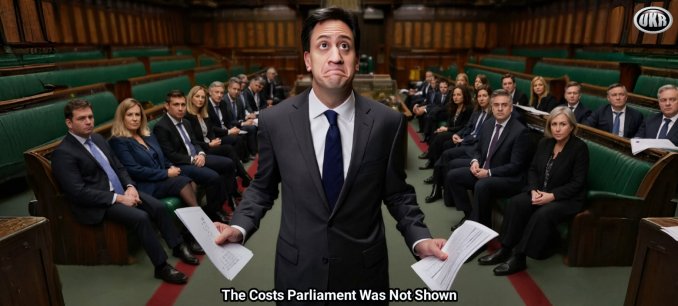
PartFour: The hidden costs behind Ed Miliband’s 87 per cent target
THE RATIONALS
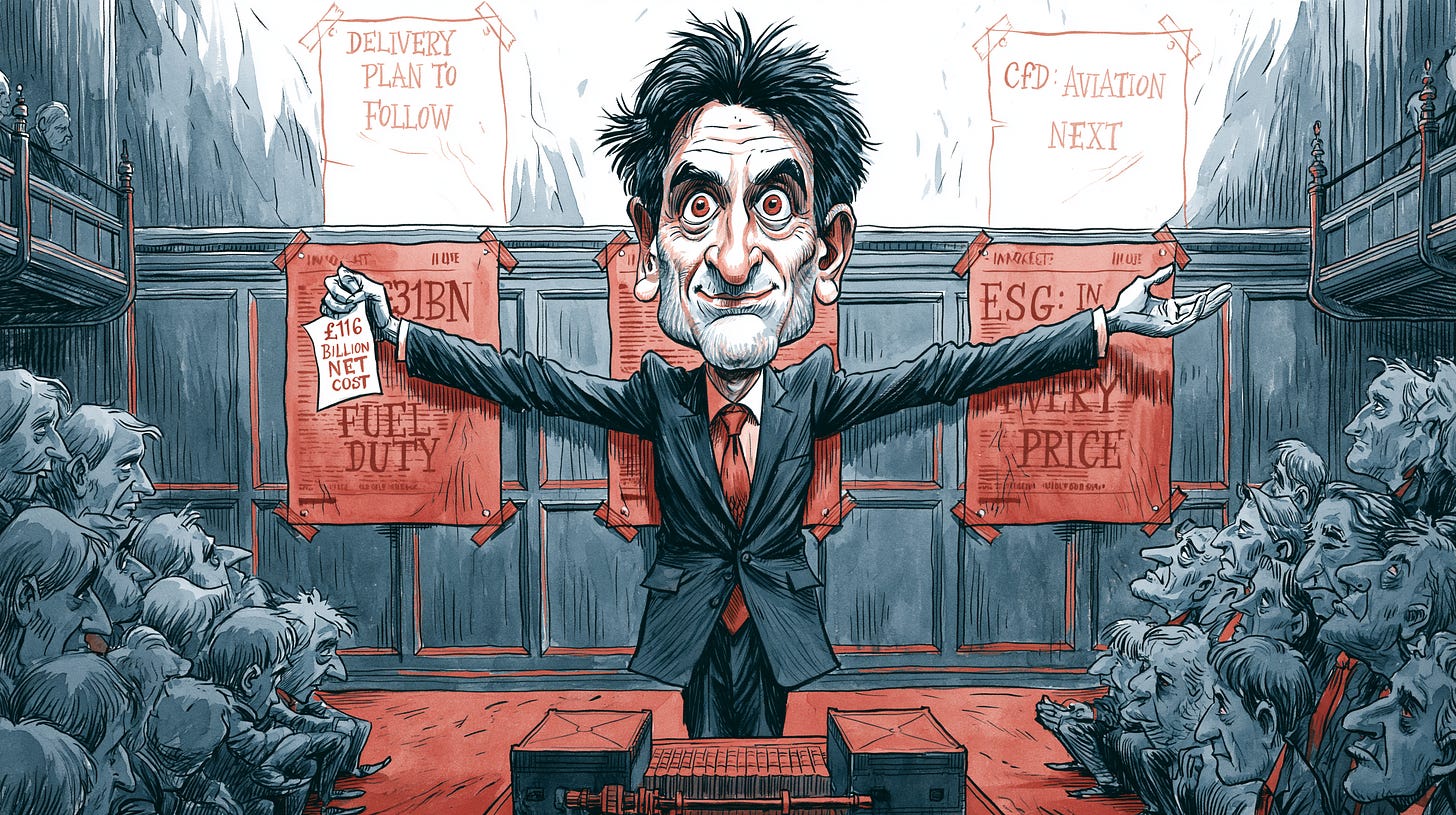
The series promised three articles. A parliamentary vote on 3 June 2026 produced a fourth. The three articles preceding this one connected every dot — from the 2008 vote to your energy bill, your mortgage, your rent, your weekly shop, the foreign hands collecting the returns, and the case for repealing Net Zero. This article identifies three fiscal consequences that were not in any of those dots.
On Tuesday 3 June 2026, Parliament voted on a legally binding commitment to cut Britain’s greenhouse gas emissions by 87 per cent by 2040. The government’s impact assessment contained one cost figure. There are at least three significant fiscal consequences of the Net Zero transition that were not in the room — and that will arrive on your doorstep regardless of how anyone voted.
The Recurring Pattern
The pattern now requires little elaboration. A shock to fossil fuel markets elevates household bills. The structural exposures that intensified the shock receive limited scrutiny. What receives urgent attention is the necessity of accelerating the very policies that increased vulnerability to such shocks. A new target is announced. The delivery plan will follow.
The conflict in Iran produced the second fossil fuel price spike of the decade. Ofgem duly announced an increase in the price cap for July 2026. On Tuesday June 3 2026 the Secretary of State for Energy Security and Net Zero, Ed Miliband, invoked the episode to justify the new 87 per cent target, characterising domestically generated low-carbon power as “the only way to protect family and business finances”.
Parliament is required to approve the target by the end of June, the delivery plan is to follow “as soon as is reasonably practicable” thereafter. That phrase has, in previous episodes, proved capable of considerable expansion.
Parliament is therefore asked to approve a legally binding target before any plan for its delivery has been published. The sequence — commitment before strategy, vote before arithmetic — replicates the approach taken in 2008, 2019 and February 2025.
It has now been observed with punctuality across four parliamentary occasions in eighteen years. One comes, reluctantly, to admire its consistency.
One further observation merits attention before turning to the figures. The DESNZ characterised the route to the 87 per cent reduction as “consumer choice-led”.
That pathway entails statutory requirements upon motor manufacturers as to the vehicles they may sell, upon landlords as to the heating systems they must install, upon airlines as to the fuels they must procure, and upon importers and producers as to packaging charges.
A regime of prescriptive regulation has been presented as an exercise in consumer sovereignty. The precise alchemy by which compulsion is transmuted into choice remains, in the supporting documentation, somewhat opaque.
Three Figures, One Parliamentary Vote
Parliament voted on Tuesday on the basis of one cost figure. Three exist in official or peer-reviewed sources. They have not previously been placed alongside one another in any parliamentary communication. They are therefore set out below — and translated into the household consequences that Parliament was not shown.
The Climate Change Committee’s current estimate of the net cost of achieving net zero between 2025 and 2050 stands at £116 billion — a reduction of 92 per cent from the £1.5 trillion figure that Philip Hammond, then Chancellor, conveyed to the Prime Minister in his May 2019 letter.
That letter, which warned of annual costs between £50 billion and £70 billion and specifically identified pressures upon heat pumps, home insulation and energy-intensive industry, entered the public record after being leaked to the Financial Times. Its cautions have since materialised with notable precision.
The reduction was achieved, in the analysis of David Turver’s January 2026 IEA briefing paper, largely by shifting from gross to net accounting and by relying upon assumptions about future technology costs that observed delivery has not supported.
The CCC projected offshore wind at £1,500 per kilowatt for projects delivering in 2030. Hornsea 3, already under construction and due online in 2028, carries a central forecast of £3,682 per kilowatt — more than double.
Government Boiler Upgrade Scheme statistics record median heat-pump costs above £12,000 in Q1 2025, again above the CCC’s earlier projection.
The LSE Grantham Research Institute has contested aspects of Turver’s methodology. The disagreement remains unresolved. Parliament received the £116 billion. It was not furnished with the surrounding dispute.
The Office for Budget Responsibility’s Fiscal Risks and Sustainability Report places total net zero costs to the public purse — lost tax revenue and additional public spending — at approximately £803 billion out to 2050, equivalent to 21 per cent of GDP by the early 2050s.
This is not an external critique but the assessment of the government’s own fiscal watchdog. It was not presented to Parliament on Tuesday 3rd June alongside the CCC’s more modest figure. The OBR notes that this figure assumes no replacement of lost revenues — if road pricing or equivalent taxes replace lost fuel duty, the public cost would be lower. The figure nonetheless represents the government’s own watchdog’s central estimate on current policy.
Turver’s IEA paper concluded that gross costs were likely to exceed the 2020 NESO estimate of £3 trillion and could reach £9 trillion once carbon costs were included. Even allowing for methodological dispute, the gap between the lower end of the range and the official £116 billion spans a factor of roughly 26.
The difference between the OBR’s £803 billion public cost and the CCC’s £116 billion net figure — £687 billion — equates to approximately £24,000 per household in Britain. This is a different calculation from the per-household cost of the transition identified across Parts One, Two and Three of this series — it represents the gap between two official estimates of the total public cost, not the annual household transmission cost.
Parliament was shown the smallest figure. The others were not in the room.
It is worth noting that the CCC has argued, in analysis published in March 2026, that the net benefits of reaching net zero outweigh the costs by 2.2 to 4.1 times, and that the total cost of a single fossil fuel price shock of 2022 magnitude is comparable to the entire net cost of the transition to 2050.
The reader may weigh that claim against the figures above.
The Confirmed £31 Billion Revenue Loss

The fiscal consequence that has received least attention — and that will arrive at every household regardless of Parliament’s decision on the present target or the Climate Change Act — is the confirmed loss of fuel duty receipts and the charge that replaces them.
The Exchequer currently collects approximately £24 billion annually in fuel duty. The Zero Emission Vehicle Mandate requires 80 per cent of new cars sold to be electric by 2030. Electric vehicles pay no fuel duty.
The OBR has confirmed that once the vehicle stock has fully turned over the policy will produce a peak annual revenue loss equivalent to 1.5 per cent of GDP — approximately £31 billion in today’s terms at maximum impact.
By 2030 some £13 billion of the existing £24 billion is expected to have disappeared, with the full loss accumulating as the fleet turns over across subsequent years. This is not a projection from a sceptic think tank. It is the government’s own fiscal watchdog, in a document available to every minister who has voted for the mandate.
The replacement has already been confirmed. In the November 2025 Budget, the government announced the electric Vehicle Excise Duty — eVED — a pay-per-mile charge on electric and hybrid vehicles taking effect from April 2028. The confirmed rate is 3 pence per mile for fully electric vehicles and 1.5 pence per mile for plug-in hybrids.
On 8,000 miles annually an EV driver pays £240, on 12,000 miles, £360. The government’s own calculation confirms an average EV driver will pay approximately £240 per year in eVED on top of existing Vehicle Excise Duty.
The government encouraged drivers to switch to electric vehicles with promises of significant fuel savings and no duty. Many households followed that advice.
From April 2028, those same drivers will begin paying the new 3p per mile eVED charge — a direct replacement for the fuel duty revenue the policy has deliberately eliminated. The net saving on fuel is therefore smaller than promised.
The policy was announced in the November 2025 Budget. The impact assessment for the Seventh Carbon Budget, published six months later, made no reference to it.
The policy operates simultaneously in two directions. It imposes a cross-subsidy upon purchasers of conventional vehicles — estimated by SMMT analysis at between £1,500 and £3,000 per car, embedded in the price and invisible on the invoice — while extinguishing the fuel duty base that has already produced a confirmed new charge upon electric motorists.
Both outcomes were foreseeable from the introduction of the mandate. Neither appeared in Tuesday’s impact assessment.
The OBR’s £31 billion peak revenue loss is confirmed. The government’s eVED replacement charge — 3p per mile from April 2028 — is confirmed. The ZEV mandate eliminating the revenue base is law. The fiscal circle is complete and official. Again, it was not in the room on Tuesday.
The Hidden Compliance Costs in Every Price
The second cost is more diffuse and correspondingly less visible.
When a householder engages a plumber, the quoted price incorporates the tradesman’s insurance, vehicle expenses and materials. TCFD-aligned climate reporting has been mandatory for listed companies since 2022, and the UK Sustainability Reporting Standards — proposed to become mandatory for listed companies from January 2027, with final FCA rules expected autumn 2026 — extend those obligations further.
An FCA (Financial Conduct Authority) review found that 80 per cent of large companies now include net zero statements in their annual reports. Smaller suppliers to those companies must increasingly provide their own emissions data as a condition of remaining in the procurement chain.
These compliance expenditures — audit fees, consultancy charges, reporting software and carbon accounting systems — run from approximately £3,000 for a small company to £30,000 to £80,000 for a medium-sized enterprise requiring third-party assurance. They propagate through every supply chain and are ultimately reflected in consumer prices.
A new washing machine, a supermarket delivery, a mobile telephone contract, home insurance renewal or building works will all carry, in their price, an element of upstream ESG compliance cost. Aggregated across a year’s purchases this may total £50 to £150 per household — invisible on any receipt, present in every price and not mentioned in Tuesday’s impact assessment.
The Same Mechanism Extended to Aviation and Building Materials

The third cost has received negligible coverage despite its direct relevance to any household that travels by air or commissions building work.
The Sustainable Aviation Fuel Revenue Support Mechanism proposes a Guaranteed Strike Price for domestic SAF producers. Those familiar with the energy bill problem documented in Part Two of this series will recognise the instrument immediately.
It is a contract-for-difference, producers receive a guaranteed above-market strike price for their output, the difference between that price and the market rate is recovered from end consumers, the floor is permanent and the consumer cannot opt out.
It was precisely this mechanism — applied first to nuclear power at Hinkley Point C in 2013, then extended to the renewable energy fleet — that locked household electricity payers into above-market charges running to 2038 and beyond, adding approximately £150 to £200 annually to every household energy bill — a figure documented in Part Two of this series.
The SAF mechanism will do the same for aviation fuel. A family taking two return flights to Spain each summer currently faces a hidden premium of roughly £6 to £10 on those tickets at the present 2 per cent mandate — estimated from the mandate percentage applied to typical aviation fuel costs per seat.
By 2030, at 10 per cent, this rises to approximately £30 to £50. By 2040, at 22 per cent, IATA analysis warns of airfare increases of up to 40 per cent, with SAF prices in mandated markets already running at up to five times the cost of conventional jet fuel.
None of these figures appeared in Tuesday’s impact assessment. The instrument that created the energy bill problem is being applied to flight tickets. The parallel has not been reported.
From January 2027 every building project using imported steel, aluminium or cement will carry a carbon levy embedded in the materials under the UK Carbon Border Adjustment Mechanism. Importers will pay a charge equivalent to the UK carbon price. That charge will pass into the cost of the steel lintels, concrete foundations and aluminium windows used in extensions, loft conversions and renovations across Britain.
On a typical kitchen extension the additional cost could be £800 to £2,000 — based on an estimated 16 per cent steel cost increase under CBAM and significant cement cost pressures — before a single door has been specified. The levy will not appear as a separate line on the builder’s quotation.
Steel costs are already the highest in Europe — a consequence of UK industrial electricity prices running at 125 per cent above the EU median. The CBAM does not address that underlying cost. It adds a further statutory levy on top of it.
The same policy that pays Drax approaching £1 billion annually to import wood from America and burn it for electricity has created industrial energy costs for British sawmills that make British-processed timber more expensive than it needs to be.
The government subsidises burning wood while simultaneously raising the cost of building with it. The household that chooses timber construction for environmental reasons is paying for both.
What It Is Actually Costing You
The government’s impact assessment contains no per-household cost figure. Neither do the CCC’s technical annexes nor the OBR’s fiscal assessments.
The three articles preceding this one assembled costs from six channels — energy bill levies, mortgage component, rent pass-through, food shop premium, vehicle mandate cross-subsidy and new home costs — producing figures of approximately £1,900 to £2,750 annually for a renting household and £2,900 to £4,200 for a homeowning household remortgaging this year.
Readers of Part Two will note these figures are higher than those published there. The difference reflects additional cost channels — the EPR packaging levy and Climate Change Levy business pass-through — identified after publication. This article adds three further channels on top of those.
The SAF mandate currently adds approximately £15 to £60 for a household taking one return flight annually — rising to £150 to £300 for two return flights by 2040.
The sustainability compliance cascade adds approximately £50 to £150 annually across consumer purchases.
The confirmed eVED charge adds approximately £240 to £360 annually for an electric vehicle driver at the government’s confirmed rate of 3 pence per mile on 8,000 to 12,000 miles driven — a confirmed charge announced in the November 2025 Budget, taking effect April 2028.
Consider also the household whose condenser tumble dryer has failed. Until 19 January 2027 a replacement condenser dryer costs approximately £300. Ed Miliband has since introduced minimum energy performance standards that remove conventional condenser dryers from sale — only heat pump models will remain on the market. A heat pump dryer costs approximately £450 to £600.
The government has applied identical logic to household heating, 48 per cent of electric underfloor heating models have been banned from sale, as have more than half of all electric towel rails. The towel rail that has operated contentedly in your bathroom for a decade will, when it fails, have no like-for-like replacement available.
The government’s own estimate of the annual saving from the new heating regulations is £8 per heater. The cheaper product has been legislated out of existence. The more expensive one has been legislated into necessity.
The process by which a household is compelled to spend an additional £150 to £300 on a slower tumble dryer in order to save approximately £21 per year — or replace a banned heating product to save £8 per heater annually, is described in the official documentation as consumer choice-led.
One admires the audacity, if not the arithmetic.
If you rent your home.
The complete annual Net Zero cost across all channels is approximately £2,400 to £3,700 — between 5 and 10 per cent of median renter household income, every year, rising, and not disclosed on any bill, receipt or government communication you have received.
If you own your home and are remortgaging this year.
The complete annual Net Zero cost is approximately £3,400 to £5,000. On a £250,000 mortgage the Net Zero component of the elevated gilt yield adds approximately £840 per year before the eVED charge, flight costs and the compliance cascade are added. Your mortgage broker did not mention this. Your lender did not mention this. The ministers announcing Tuesday’s 87 per cent target did not mention this.
These figures are Net Zero costs alone. They arrive on top of income tax, National Insurance, council tax, VAT, insurance premium tax and every other statutory deduction already removed from the household budget before a single levy, mandate or compliance cost is added.
The ordinary household does not experience Net Zero as a line item. It experiences it as the difference between a budget that works and one that does not — distributed invisibly across the bill, the invoice, the receipt and the mortgage statement, and attributed, when attributed to anything at all, to the weather in Eastern Europe.
All figures are conservative estimates derived from primary sources and presented as such. They do not yet capture the further increases as the SAF mandate rises, the CBAM embeds from 2027 and the compliance regime deepens.
The IFS has confirmed in peer-reviewed research that the costs fall hardest on the households least able to bear them — the spending of the poorest tenth of households carries 22 per cent more carbon cost per pound than the richest tenth.
The OECD has confirmed that redistributing 30 per cent of carbon tax revenue as a lump-sum transfer would make the majority of income deciles better off. Neither finding has appeared in any government impact assessment. Seven years of IFS recommendations have produced no corrective transfer.
What Parliament Was Not Told
You were not told that the £31 billion fuel duty gap has already produced a confirmed 3p per mile eVED charge on electric vehicles from April 2028 — announced in the November 2025 Budget and absent from Tuesday’s impact assessment.
You were not told that the mechanism already embedded in your energy bill is being applied to your flight tickets and the materials in your next building project.
You were not told that the compliance costs of every business in the supply chain are passing through to the price of everything you buy.
Parliament was not shown the OBR’s £803 billion alongside the CCC’s £116 billion. The £24,000 per household gap between those two official figures was not mentioned. The delivery plan for the commitment Parliament voted upon this week will be published after Parliament has voted.
Peer-reviewed research confirms that support for Net Zero policies declines when costs are disclosed.
The costs have not been disclosed — not in 2008, not in 2019, not in February 2025 and not on June 3 2026. The omission has been maintained with notable consistency across administrations of differing political complexions. It suggests that the relationship between disclosed cost and sustained public consent has been studied with some care.
The IFS has shown since 2022 that the costs fall hardest on those least able to bear them. The OECD has shown since 2022 how to redistribute the burden fairly. Neither finding has been incorporated into any government impact assessment. The policy that is most regressive in its current design could, with a single fiscal adjustment, become progressive.
The adjustment has not been made. Seven years have passed.
The figures assembled in this article reside in OBR fiscal reports, statutory instruments, peer-reviewed research, parliamentary records and published regulatory documents.
They are not hidden. They have simply not been brought together and presented to the households that will bear them.
The government has not done so. The Climate Change Committee has not done so. The Office for Budget Responsibility has not done so.
We did.
What you do with them is, as it always should have been, entirely your own affair.
This article (The Costs Parliament Was Not Shown) was created and published by The Rationals and is republished here under “Fair Use”

••••
The Liberty Beacon Project is now expanding at a near exponential rate, and for this we are grateful and excited! But we must also be practical. For 7 years we have not asked for any donations, and have built this project with our own funds as we grew. We are now experiencing ever increasing growing pains due to the large number of websites and projects we represent. So we have just installed donation buttons on our websites and ask that you consider this when you visit them. Nothing is too small. We thank you for all your support and your considerations … (TLB)
••••
Comment Policy: As a privately owned web site, we reserve the right to remove comments that contain spam, advertising, vulgarity, threats of violence, racism, or personal/abusive attacks on other users. This also applies to trolling, the use of more than one alias, or just intentional mischief. Enforcement of this policy is at the discretion of this websites administrators. Repeat offenders may be blocked or permanently banned without prior warning.
••••
Disclaimer: TLB websites contain copyrighted material the use of which has not always been specifically authorized by the copyright owner. We are making such material available to our readers under the provisions of “fair use” in an effort to advance a better understanding of political, health, economic and social issues. The material on this site is distributed without profit to those who have expressed a prior interest in receiving it for research and educational purposes. If you wish to use copyrighted material for purposes other than “fair use” you must request permission from the copyright owner.
••••
Disclaimer: The information and opinions shared are for informational purposes only including, but not limited to, text, graphics, images and other material are not intended as medical advice or instruction. Nothing mentioned is intended to be a substitute for professional medical advice, diagnosis or treatment.
Disclaimer: The views and opinions expressed in this article are those of the author and do not necessarily reflect the official policy or position of The Liberty Beacon Project.


Leave a Reply