

BELLA D’ABRERA
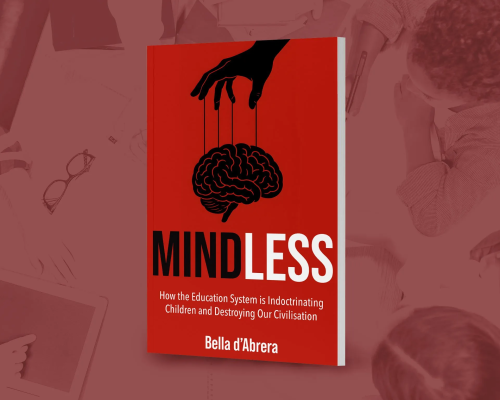
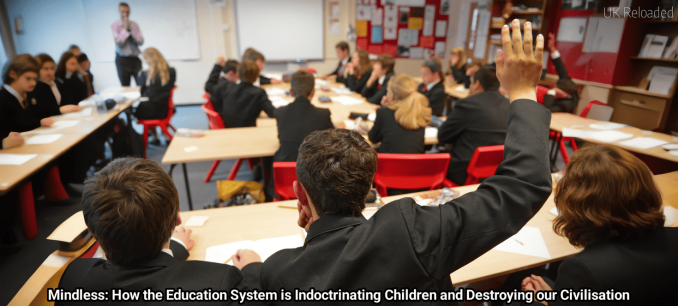
Dr. Bella d’Abrera, a founder of History Reclaimed, discusses her new book on the ideological indoctrination of children and young people in the school systems of the Anglosphere.
There are a great many dispiriting developments taking place in Western classrooms in 2026. Among them are the reckless de-prioritisation of literacy and numeracy; the teaching of identity politics, gender theory and race politics; the denuding of knowledge in the name of diversity, equity and inclusion; the replacement of reason with magical thinking; and lessons on climate change which are sending small children into paroxysms of despair.
Yet for readers of History Reclaimed, the most striking, and most alarming is the transformation of history itself in schools. It will come as no surprise that the subject has been repurposed in recent years under the banner of ‘inclusivity’ and ‘social justice’. History is no longer taught as an attempt to understand the past on its own terms, but as a vehicle for present-day moral instruction, which results not in a broadening of perspective, but a narrowing of it.
Across the Anglosphere, a common pattern is emerging across our nations. History has been whacked over the head with the decolonisation stick and dragged into the world of presentism, identity politics, Critical Race Theory, post-colonialism, social justice, diversity, and equity and inclusion. This is the history that children are now being taught.
When it comes to the British Empire and its legacy, one would be hard-pressed to find classroom materials which dare to even suggest that despite its many flaws, perhaps colonialism was not all bad. As Nigel Biggar has argued forcefully in Colonialism: A Moral Reckoning, the empire was a morally mixed phenomenon, responsible for both exploitation and emancipation.
The teaching of the slave trade is a case in point. Among progressive educators, there is a marked reluctance to acknowledge that it was the British Empire and its much maligned ‘white saviours’ like William Wilberforce, that ultimately abolished this appalling practice. This is nowhere more clearly illustrated than in the free classroom resource produced by Liverpool’s International Slavery Museum which leaves children with the distinct impression that Britain not only invented slavery, but that its eventual abolition came not from moral conviction or political courage, but from national shame.
We also find that since the death of George Floyd and rise of Black Lives Matter, schools have been falling over themselves to ‘diversify’ and ‘decolonise’ their history curricula. By 2021, 83 per cent had already ‘diversified’ their Key Stage 3 history programs, typically by adding Black and Asian British history, migration, women’s history, and LGBTQ+ themes. The top three motivations cited by teachers were: (1) a sense of social justice; (2) better representation in history; and (3) a direct response to the death of George Floyd.
At present, the loudest and most persistent voices calling for a de-Europeanised curriculum are leading us into the realms of fantasy and nonsense. We are witnessing in schools wholesale rewriting of the past in which white children are being denied the truth of their own story, while also being denied a unique cultural or ancestral claim to Britain. They are recast as simply another migrant group among many.
This message is now being introduced at the earliest stages of education. In Brilliant Black British History, a book by Nigerian-born author Atinuke, that has won many awards including Children’s Non-Fiction Book of the Year 2024, primary school children are told: ‘The first migrants to Britain had black skin. Yes, that’s right! – the very first Britons were Black!’ The book goes on to assert that: ‘Britain was a Black country for more than 7,000 years before the white people came – and during that time the most famous British monument was built: Stonehenge. Britain has been a mostly white country for a lot less time than it was a Black country – only about 4,000 years.’ And the final blow for any white child reading: ‘Every single British person comes from a migrant.’
Ultimately, the message being conveyed to white children is that they don’t belong. But the message to black children is that they don’t belong either. Both messages are false, and both are cruel. From Anglo-Saxon settlements to the Windrush generation, everything is filtered through the question: ‘Who gets to belong?’ The answer, it seems, is nobody. Is anyone really benefitting from their British history lessons? Not as they currently stand.
Nor is this problem confined to Britain. In Australia, no one is benefitting from Australian history lessons either. The country’s deeply progressive education establishment long ago abandoned the idea that history should illuminate young minds. Among academics, bureaucrats, and policymakers, there is now near-unanimous agreement: the story of modern Australia, though relatively short, is primarily a story of violence and genocide. They present the nation’s past not as a complex history, but as a crime scene, and in this version, there’s no mystery about the culprits. They lay the blame for the problems plaguing remote Aboriginal communities fairly and squarely on the arrival of the British in 1788.
A key feature of an Australian child’s education is that he or she must apologise for the sin of colonisation; this is called ‘reconciliation’, and it starts in kindergarten. On government orders, teachers are expected to recruit their young charges into a battalion of nappy-wearing ‘active citizens’ embarking on what is promised to be a lifelong ‘journey of reconciliation’. They are instructed to decolonise early childhood education by ‘reconsidering education spaces, acknowledging colonisation and its continued impacts, while seeking to disrupt and reconceptualise colonial understandings.’ This is extraordinary language to use in a kindergarten setting, but it reflects a teacher training system in Australia which is steeped in social justice ideology and the full apparatus of postmodern theory.
In primary and secondary schools, guilt runs through the National Curriculum like cracks in a facade, as Australian history is recast as a single, unbroken narrative of ‘frontier warfare, massacres, removal from land, and relocation to protectorates, reserves and missions.’ It is unrelenting and consistently negative. Everything is taught except the concept of nation-building.
The question at this juncture is a simple but profound one: what does the decolonisation narrative do to young minds? Increasingly, Western children are taught to see being British, American, or Australian as something shameful rather than complex, heroic, or worthy of admiration. They are being led to believe that their countries are morally compromised, and this in turn breeds anger and resentment. Polling data suggests that nearly half of Generation Z in Britain now regard their country as racist and backward, while surveys in multiple Western nations reveal a declining willingness among young people to defend their country in times of crisis. The implications are profound, not just for the individual and for society.
The curriculum that was once about understanding the past has become about dismantling it, and those who have absorbed the decolonisation story are taking their new understanding and moral code to the streets. Filled with righteous indignation, they believe that tossing a statue of a Bristol merchant, Edward Colston, who died 300 years ago, into a river will put an end to ‘systemic racism’, or that it is perfectly reasonable to saw through the ankles of a bronze likeness of Captain Cook as punishment for being a ‘racist coloniser.’
None of this is happening by accident. Among the architects of this ideological shift are activist historians, post-colonial theorists, and critical race educators whose goal is, and always has been, to sever loyalty to country. This is because they are postmodernists who believe that national myths are lies, that patriotism is a mask for oppression, and that emotional attachment to country reinforces injustice.
Children are to be denied the possibility of patriotism, as they are taught to view positive narratives not as a shared civic inheritance, but as tools of exclusion and control. Belonging to a nation gives people a framework of identity: a common history, culture, and set of values that root them in time and place. When these things are strong, they provide anchors in a fast-changing and uncertain world. Strip them away, and children are left unmoored, adrift in ideology, and vulnerable to whatever replaces it.
This article (Mindless: How the Education System is Indoctrinating Children and Destroying our Civilisation) was created and published by History Reclaimed and is republished here under “Fair Use” with attribution to the author Bella d’Abrera
See Related Article Below
Major changes for major reward: a rejoinder to education policy
War with the teachers is unavoidable and a ‘Patriotic Curriculum’ is only the start
PIMLICO JOURNAL
We were pleased to find ourselves largely in agreement with a recent Pimlico Journal article on educational reform. As two right-wingers in the depths of what is a near-uniformly hostile professional sector, it was indeed refreshing to hear some concrete policy proposals on how a prospective Reform government could seek to reverse some of the more harmful elements of existing political bias in the state education sector.
Without rehashing it in its entirety, the article proposed the wide-ranging centralisation and production of schemes of work and resources via the nationalisation of government-adjacent bodies like National Oak Academy. Make no mistake, this is the right type of policy prescription, and it would go a long way towards reducing workload and making it clear what should and should not be acceptable in the British classroom. The diagnosis and prescriptions of that piece worked on the assumption that Reform would not be able to give Education much attention on the grounds of limited fiscal and political bandwidth, and more comprehensive reforms could be left to, for instance, a second term.
However, it is the contention of this article that such recommendations do not go far enough. They are only palliative in nature, and don’t envision how the sector can be changed permanently. Its diagnostics are also only partially correct — while there is recognition of the personnel problem within the sector, there’s too sanguine an assessment of the threat posed by recalcitrant educators. Any efforts in education (and indeed outside of it in one crucial aspect) will be resisted by the vanguards of the lanyard class at every turn — by virtue of nothing more than Reform being, well, Reform. It is insufficient to try to minimise the backlash through soft-handed measures if backlash will occur with great strength anyway. Both political and real capital will very likely have to be spent. Therefore, we lay out a maximalist position for what a future meritocratic right-wing government could do to permanently change the sector for the better.
Removing politics from the classroom
The issue facing any long-term reform of the school system is that political bias is woven into the fabric of the education sector. Teachers, from the most junior to the most senior positions, track leftwards in ways which are highly unrepresentative of the pupils and families they ostensibly serve. This is an open secret within the profession and is only theoretically understood by those outside of it. Regrettably, both authors of this article can attest that the situation is worse than outside observers are aware.
Whilst completing a PGCE at a Russell Group university, I can recall a very senior figure in education openly comparing Michael Gove to Joseph Goebbels (and directly comparing the Conservative government’s 2013 reforms to the policies of the Nazi Party), declaring Policy Exchange a ‘far-right’ think-tank, and telling teachers they needed to ‘find ways around’ the recommendations of the government to ensure that the ‘correct’ interpretations of history were being put forward. Teachers simultaneously view left-wing bias in education as a far-right conspiracy theory, while also making it completely obvious that it exists and permeates the sector.
It is difficult to explain exactly why this happens — especially since other countries do not seem to suffer from this problem so clearly — but it should probably be attributed to:
- The incredibly politicised trade unions which, through systems like the PGCE, covertly control recruitment to ensure ‘the right sorts’ enter the profession — a phrase which was once deployed against one of the authors, in fact!
- The inherently self-sacrificial and ‘compassionate’ types who enter the sector here, as opposed to more small-c conservative disciplinarians common in countries like Asia and various parts of Eastern Europe.
- The broader class dynamics which have, over time, moved middle-class professionals away from right-wing political opinions and activism.
The non-substantive statutory guidelines in place, which commit teachers by law to political non-partisanship, do little to guard against the practical reality of leftist narratives seeping or being explicitly incorporated into curricula. More problematically, the classroom exposition of teachers’ opinions. The groupthink present in the sector means that it has not been enforced outside of extreme fringe cases, and short of a vicious campaign of pressure from the Daily Mail, no teacher would seriously be reprimanded for saying, for example, that Trump should be shot.
Many people within Reform and Reform-adjacent circles have little interaction with the large swathes of the public who subscribe to a hard-left worldview. They therefore tend to underestimate the psychological fallout that a Reform victory has for this type, which will be profound. Colleagues simultaneously revile and fear, but also downplay the likelihood of a Reform government. Whilst Brexit and Trump mentally prepared some for disappointment, the particular significance of Farage, the ‘Gammon Fuhrer’ (I quote) and visceral embodiment of ‘Nasty Britain’, becoming Prime Minister, will be uniquely traumatising.
We should anticipate school staff bodies to be active centres of opposition to a Reform government committed not only to mass deportations but also deinstitutionalising DEI. Many teachers will, perhaps due to their perverse sense of anti-nationalism and personal heroism, salivate at the thought of trying to ‘save’ illegal immigrant pupils from a ‘British version of ICE’ so they can live out their fantasy that they would have ‘made a stand’ against Hitler and the Nazis.
The first step towards preventing this would, unfortunately, be the most difficult — the neutering and eventual dismantling of the Trade Unions for educators, namely the NASUWT (originally short for National Association of Schoolmasters Union of Women Teachers, a name no longer really used) and the National Education Union. While the NASUWT is more moderate than the NEU, both are hotbeds of left-wing activism. Routinely, one of these unions will dump gems like these into my inbox:

If you are not yet convinced that the unions ought to be first on the chopping block, the following excerpts from NASWUT General Secretary Matt Wrack’s speech at their annual conference earlier this year should suffice:
‘Turning to the United States, the Government sends masked and heavily armed paramilitary forces into cities to round up people. Regrettably, schools, school students and their teachers are on the frontlines of this.’
‘We have seen the unlawful arrest of various school-aged US citizens, the infamous arrest of a five-year-old carrying his Spiderman backpack. And, of course, we have seen the murder, on the streets of Minneapolis, of two US citizens: Alex Pretti and Renee Good.’
The NEU, on the other hand, is led by far-left activist Daniel Kebede, whose very presence at the top of a trade union is an indictment of their existence. Aside from being former Labour MP Laura Pidcock’s baby daddy, Kebede is a committed Palestine activist, former keynote speaker at the Socialist Workers’ Party conference, and was responsible for his union’s conference passing a motion of opposition to the politics of Reform UK. He was quoted directly as saying that he ‘would like to see all education workers, really, in a trade union, to ensure that we can mount an appropriate defence’.
The first step would be to amend existing union legislation to further tighten their right to strike across trusts where unions are recognised. It is important to note that not all trusts recognise a union, and there will be allies within the top brass of the MATs (Multi-Academy Trusts) who would covertly support Reform on this measure. To ultimately sever the institutional relationship teachers have with the left, a right-wing government would have to clamp down on political funding from unions towards political parties — namely the Labour Party — and order a full audit of their assets and spending, using the ongoing corruption investigation into Unison as a precedent.
Relaxed hiring in the teaching sector
A second step to curbing union power and left-wing influence in education would be to relax hiring within the teaching sector. Currently, all state schools must perform a lot of admin when hiring new employees for safeguarding reasons, something that cannot feasibly be changed lest the headline becomes ‘Farage puts children at risk’. The process is extremely laborious and, frankly, pointlessly difficult for both schools and prospective workers.
It is difficult to enter the sector from private sector employment due to the need for Qualified Teacher Status, the lack of job adverts for teaching in open forums, and the generally abysmal salary compared to most other skilled professionals. Teaching also, unless one is a highly qualified individual working for a top-tier private school, does not value experience from outside sectors such as technology, finance, law, or really anything short of being a prison warden. Hiring is extremely stagnant, and happens for three reasons:
- Someone moved schools.
- Someone got promoted.
- Someone died.
This is not necessarily as true when it comes to STEM subjects, which have an ongoing teaching shortage and retention crisis. To reform hiring and reduce trade union influence, we propose the following changes:
- The phasing out of the PGCE within the first three years of government, to be replaced by a beefed-up TeachFirst programme (likely in the form of 1 or 2 months of ‘boot camp’ followed by full-time insertion into a school), as well as increased funding and flexibility for SCITT (School-Centred Initial Teacher Training) programmes led by MATs (likely, the starting salaries for SCITT would need to be brought in line with the £32,000 p.a. to incentivise recruitment).
- Legislation to allow teachers to be hired and fired with greater ease, alongside funding from the DfE to cover recruitment costs.
- Phasing out the teacher pay scales system, which prevents people from relocating jobs and taking a lower salary to do so, which — especially in the humanities — prevents senior staff from moving even if they are willing to take a pay cut.
How would these pay rises and wage liberalisations be funded? Reform could hollow out the teaching pension scheme. As it stands, based on the 2024/2025 report, the scheme brings £11.8 billion into the pot each year, and is currently liable for around £290.7 billion in England and Wales alone. Even headline cuts to this figure would pay for many of the policies outlined here. Indeed, this would cause a flight of many career teachers. But over time, freeing up the recruitment could transform teaching from a career mostly for the unambitious, into something talented people otherwise inclined towards the profession can enter and leave at various stages throughout their life, without having to make professional and personal sacrifices that simply aren’t worth it for many. This would, in turn, reduce some of the ‘groupthink’ and ‘glut’ the sector currently experiences, and ultimately put an end to the cottage industry of ideological self-selection through the PGCEs and the bunkum ‘education research’ job mill. It remains a problem that people who perhaps did not achieve high grades themselves (especially in some subjects, like Maths) are teaching the next generation. There are undoubtedly many more inspirational figures waiting in the wings.
Gove’s legacy and getting parents on side
The perversity of the right’s relationship with education is that the domain in which it has been most successful in pushing through reforms has been, in many respects, to its own detriment. The Govite emphasis on knowledge-rich curricula, didactic teaching and school independence produced tangible improvements in educational outcomes by some metrics; England’s PISA scores, particularly in mathematics improved, alongside recorded improvements in early reading ages.
It’s worth stressing that, despite the original intense hostility to the proposed reforms back in the early 2010s, they are now largely accepted uncritically as having been beneficial, and indeed the ‘traditionalist’ pedagogy motivating them is normative within the state sector (and more likely to be attacked within private school discourse). Indeed, all drives towards greater autonomy for teachers and schools (outside of the context of conservative-inclined faith schools) benefit the left by default. The proposal for centralisation in the first Pimlico Journal article in question is sound, but doesn’t discuss how action by hostile elements can be embedded into a pooled national resource. Unfortunately, leftist teachers will continue to seek to undermine the moral legitimacy of right-wing views amongst their pupils.
Probably the longest-lasting impact of Gove’s reforms was the shift towards academisation and the initiation of free schools, which were and are independent of local authority control. The drive towards decentralisation was reflective of the Cameronite emphasis on social pluralism, in which non-governmental bodies would take on an increased load of the delivery of a variety of services. The removal of schools from Local Authorities enabled the greater exercise of ‘Blob’ power with unsurprising results.
Academies and free schools’ behavioural and educational model are influenced by the 2010s turn against ‘child-centred’ learning. Within the last five years in particular, we have seen a proliferation of Learning Trusts (essentially confederations of self-governing schools) implementing quasi-behaviourist school ethos aimed at maximising students’ academic outcomes whilst combating an emergent behavioural crisis amongst pupils — notoriously the Michaela Free School. We could also throw into this policy cocktail mix increasing interventions against parents’ ability to freely take pupils out of school during term time for holidays, as part of dirigiste directives aiming to minimise pupil absences.
The education system, as it currently stands, is in many respects Gove’s child, and one could construe the emphasis on discipline and ‘conventional teaching’ as being implicitly right-wing. Absent the increased SENDification of the sector, schooling in the 2020s is the product of a semi-successful program of ‘conservative’ initiatives, which overall produced better standards in education, notwithstanding the challenges the sector still faces. However, no one on the right would look at the current state of education and conclude that this is a space sympathetic to us. While there are various strands which people favour within the education sector which are seemingly favourable to right-wing beliefs (e.g., Catherine Birbalsingh of Michaela), most, if not all of them, intersect comfortably with the hostile consensus, the purpose of which is to create material impediments to the dissemination of right-wing ideas — Gove is, therefore, the accidental father of The Longhouse in education.
The behaviourist neo-disciplinarian agenda which Goveism begets aligns with post-liberal and social-democratic drives to restrict young people’s access to social media, for the purpose of protecting people’s ‘wellbeing’ and guarding against ‘radicalisation’. The panoptically restrictive measures imposed on students, involving the extensive regulation or ban of the use of mobile phones in schools, reflect the broader agenda of the state to limit access outside of the education system. ‘No Nonsense’ educational shifts align with a crackdown on a cohort which is characterised as a latent nucleus of extremist beliefs, simultaneously rendered depressed and anxious by the algorithms, but also inclined towards becoming neo-Nazis and/or incels.
Beyond this, the increased autonomy for schools brought by free schools and academisation allows schools to determine aspects of the curriculum independent of national guidelines. This means that in practice, disciplinarian and aesthetically traditional schools have established school curricula to the left of what is loosely prescribed by the DoE. In a previous place of work, the History curriculum taught at KS3 uncritically presented claims that the industrialisation of Britain was a product of capital directly drawn from the slave trade. What we might consider as right-wing virtues — discipline and organisational independence — in fact favour the left in current circumstances! The success of a ‘Patriotic Curriculum’ envisaged by Suella Braverman and James Orr can not depend on a superficially aligned third sector.
So, what should a comprehensively right-wing response to educational reform look like? Unfortunately, the proposed mandate for schools to fly the Union flag and place portraits of King Charles III (an avowed public supporter of ‘diversity’) in classrooms is unsatisfactory. We are concerned that institutionalisation of symbolic patriotism will do a great deal to antagonise and therefore mobilise our enemies within the sector, whilst doing little to address the medium of left-wing bias within schools.
It’s perfectly possible to imagine schools in which children are forced to engage in ritualistic displays of allegiance to the Crown, and for schools to overtly and covertly push Afrocentric historical narratives and the gender identification-based grooming of children. This situation becomes surreal when we factor in the reality that these Uyoku Dantai initiatives will occur in the context of schools where there might be literally no native British children. How does forcing children in places where they have zero interaction with organic British culture (i.e. ‘white British’ culture) help advance the interest of national self-preservation?
The danger we will find ourselves in is that left-wing teachers and school governing bodies can present themselves as underdog champions against an interventionist right-wing government attempting to ‘brainwash’ children. If we conceptualise the politics of the education system as a triadic relationship of the state, teachers/SLTs/unions, and children/parents, we want the former to be aligned with the latter against the second faction. Discussions for waging a serious cultural war in schools need to recognise this dynamic and think of more insurrectionary avenues to undermine the legitimacy of left-wing teachers. The thrust of remaking the culture of schooling must be liberation, from the stifling imposition of Woke by self-interested (in this case, literal) schoolmarms against self-discovery and excellence.
Initially, Reform should lean into anti-Goveite populism, seeking to reverse the least popular aspects of his initiatives. Specifically, punitive fines for parents taking students out of school term should be abolished for the intrusive anti-familial Wokery they are. New statutory guidelines should also seek to prevent the spread of more extreme behaviourist policies (for example, detaining students in whole-day reflection sessions for repeat equipment infringements), which are becoming increasingly common in certain learning trusts. There should also be further regulations to prevent the ‘chromification’ of school sites in which schools and learning trusts seek to aesthetically standardise and corporatise the interior of classrooms.
It should be stressed that:
- The increased prevalence of the latter policies is the product of (left-wing) coalition agendas, which limited the number of expulsions schools could conduct. This has meant that the behavioural strategies of comprehensive schools have had to be tailored around the mitigation of the disruptive tendencies of the lowest common denominator, and has led to the general limitation of the liberties of pupils who have no need to suffer because of the imposition of violent and anti-social individuals upon everyone.
- There is a classist bias in the introduction of disciplinarianism. Private schools have increasingly relaxed behavioural sanctions, and indeed their attendees can leverage the growing range of SEND diagnoses, safeguarding procedures and anonymous pupil reporting sites to undermine their teachers. No Etonian has spent 8 hours in a ‘reflection’ room for failing to have the appropriate equipment with them. Likewise, fee-paying parents can take their children at will out of school during the height of term time (this is such a problem that private schools frequently must justify absences to Local Educational Authorities). It is clearly the case that there is a two-tier dynamic at play in the educational sector. Attendees at globally oriented and increasingly rarefied independent schools are afforded privileges not extended to the rest of the country.
Additionally, there is new ammunition to attack the left with the rollout of internal school bans, which reflect the wider attempts of the Labour Party to restrict young people’s access to social media (including bans not only in lesson time but also during recreational hours). Coupling this with opposition to the broader policies of age-walling selected major news sites, and potentially VPN bans, presents a multipronged opportunity to present Reform as the party of young people’s civil liberties. It’s worth stressing that the stupidity of Labour on this front cannot be underestimated. I anticipate the mandating of dumb phones for under-18s, and no party on the left will be willing to challenge this because they don’t want to be aligned with ‘fascist’ algorithms.
In terms of specifically ideological challenges to the current curriculum, whilst there needs to be a policy of dictating lesson content, weaponising student voice to combat ideological bias is one effective way of deterring teacher bias. Probably the only instance of a school being investigated for partisanship was the impromptu inspection of Rye College after two teenagers recorded teachers referring to their views as ‘despicable’.
Having a national reporting system, analogous to a ‘Whisper’ type program currently used for pupil safeguarding, would be present in all schools, with reports being deemed creditworthy, resulting in an investigation, and schools required to hand over existing lesson resources. This might not actually require frequent practical investigations of schools, and the threat of anonymous reporting might be enough to have a serious deterrent effect on classroom practices.
The government should be willing to withhold funding from schools deemed to engage in partisanship and to follow up on relevant internal reforms. We should also be willing to mandate training, embedded within safeguarding protocols, informing teachers of what substantive non-partisanship looks like (e.g. eschewing celebration of multiculturalism/diversity/equity, etcetera). None of this could guarantee the end of left-wing political bias in education, but it would engender a hostile environment for the expression. An effective tool of enforcement would be no-notice inspections administered independently of Ofsted.
Reforming content within the curriculum
Reform of the ideological content of the curriculum requires revision of all statutory guidelines for different Key Stages. Currently, guidelines for History mandate the studying of chronological narratives of the history of Britain (e.g. medieval, early modern periods, the nineteenth and twentieth centuries, as well as a comparative study of a non-European ancient civilisation). Ironically, it is the ‘parochialism’ of Gove’s attempt to revive the study of specifically British national history which has resulted in the prevalence of an inverted ‘Our Island Story’, focused on national self-flagellation and sustained the disproportionate focus on social history. Indeed, much popular left-wing historiography is naturally introspective, focusing on constructing a narrative of an insularly British identity, in which modern migration is erroneously situated into a grand historical narrative of demographic flux alongside the ethnogenetic migrations which lead to the foundation of the English state.
Whilst it is beyond the scope of this article to fully detail what this will look like systematically in practice, it will at least involve some comparative study of non-European episodes of conquests and slave trading systems, including those targeting Europeans (e.g. both trans-Mediterranean, trans-Saharan and trans-Volga slave routes) as well as the Islamic occupations of Iberia and the Balkans, and the subsequent liberation wars these regions experienced. This is not to litigate any ‘historical crimes’ but to place European colonial history in the appropriate context. It should also mandate the exposure of students to a full spectrum of historiographical interpretation, which by revisionist, Whig, liberal, and even Marxist frameworks, makes the condition of the dysfunction or ‘backwardness’ of colonised peoples comprehensible to pupils. Some will criticise this for being on the Nigel Biggar liberal apologia end of the empire spectrum, but historical debates of this kind do effectively challenge narrowly anti-white and anti-British narratives. Most importantly, it will enable pupils to understand that history is indeed complicated.
Children should not be denied exposure to the reality of anti-white violence during the multicultural postwar epoch of British history. Questions of race, migration and the deterioration of our civic life must be handled maturely, and a PSHE-led conversation about the experiences of communities in Britain should not ignore the majority group. Bear in mind that young people whose early infant years overlapped with the original Rotherham revelations have little idea what the ‘grooming gangs’ — and the worst crimes of magnitude ever committed on British soil — are.
Further recommendations: Grammar Schools and Pupil Referral Units
There are more structural projects of educational reform that the right should pursue. These could involve the creation of a systematically meritocratic educational system, the abolition of fee-paying schools and comprehensives, and the lowering of the school-leaving age to at least 16 without restriction.
These are longer-term projects. They require infinitely more costing and detailed analysis, which is outside of the scope of this article — and likely needs a full white paper. However, the most meaningful changes would be the national reintroduction of Grammar Schools and the expansion of Pupil Referral Units.
Because of the need for physical sites (and goodness knows building in Britain isn’t possible without spending millions on a bat tunnel), this would, unfortunately, be rather expensive and likely reserved for a second Parliamentary term. Broadly, the conversion of existing high-achieving schools into Grammar Schools (their de facto operation due to the often astronomical house prices near them) should be incentivised, and the creation of a national, mandatory version of the 11+ exam for all Local Education Authorities to implement from a given year. A consultation or review into what shape it will take is highly recommended, as some forms of the exam survive in areas like Lincolnshire and Kent, although they are administered differently and take different forms. Above all, it should be a more ‘holistic’ assessment than its namesake, chiefly to prevent the grammar schools from becoming battery farms for the tiger-parented who will learn the exams by rote, or rich parents paying to brute-force their child’s way into the school.
The Pupil Referral Units (PRUs), currently, are holding cells for people deemed too antisocial to be in mainstream education or in the outside world during school hours. Largely, they do not reform pupils, but they do move them away from people who actually want to do work and succeed. They are a good idea but need to be more prominent — at least one in each local area, if not more, staffed by people who will be offered a much higher salary and a bonus if they come from the armed forces/prison/immigration control sectors. The Borstal was, at the very least, a deterrent, but the current PRUs, to my knowledge, do little to discipline students. It is one of the ghastly failures of the current system that the majority of basically law-abiding children are subjected to the need to police the lowest common denominator and keep them, at all costs, within mainstream education to everyone else’s detriment.
Each PRU would need to be run, effectively, like Michaela School — without the need for performances of patriotism. While there are substantial criticisms of the model to be made, you cannot deny that it does keep a population at high risk of crime and violence in the area in which Michaela is situated on the straight and narrow. It clearly has some degree of rehabilitative effect, which is infinitely more socially beneficial than keeping problematic individuals together for 2 years to make one another worse, then released back into the wild. Once the average school has removed its worst students and the best students are all put in an environment where they are the focus, we can eliminate a high degree of social dysfunction from one group and ensure the best possible outcomes for the other.
Together, these reforms would ensure a functional and ideologically compliant education system for decades to come.
This article was written by George Ruska and Jan Ignatius, Pimlico Journal contributors. Have a pitch? Send it to [email protected].
If you wish to support what we do, please consider subscribing. If you are already subscribed, why not upgrade to a paid subscription?
This article (Major changes for major reward: a rejoinder to education policy) was created and published by Pimlico Journal and is republished here under “Fair Use”

••••
The Liberty Beacon Project is now expanding at a near exponential rate, and for this we are grateful and excited! But we must also be practical. For 7 years we have not asked for any donations, and have built this project with our own funds as we grew. We are now experiencing ever increasing growing pains due to the large number of websites and projects we represent. So we have just installed donation buttons on our websites and ask that you consider this when you visit them. Nothing is too small. We thank you for all your support and your considerations … (TLB)
••••
Comment Policy: As a privately owned web site, we reserve the right to remove comments that contain spam, advertising, vulgarity, threats of violence, racism, or personal/abusive attacks on other users. This also applies to trolling, the use of more than one alias, or just intentional mischief. Enforcement of this policy is at the discretion of this websites administrators. Repeat offenders may be blocked or permanently banned without prior warning.
••••
Disclaimer: TLB websites contain copyrighted material the use of which has not always been specifically authorized by the copyright owner. We are making such material available to our readers under the provisions of “fair use” in an effort to advance a better understanding of political, health, economic and social issues. The material on this site is distributed without profit to those who have expressed a prior interest in receiving it for research and educational purposes. If you wish to use copyrighted material for purposes other than “fair use” you must request permission from the copyright owner.
••••
Disclaimer: The information and opinions shared are for informational purposes only including, but not limited to, text, graphics, images and other material are not intended as medical advice or instruction. Nothing mentioned is intended to be a substitute for professional medical advice, diagnosis or treatment.
Disclaimer: The views and opinions expressed in this article are those of the author and do not necessarily reflect the official policy or position of The Liberty Beacon Project.




this is written as though it is a modern thing; nothing could be further than the truth; the real truth is that the western world is hebrew if you care to take a look at the facts; we are all complicit in what is happening, the whole human race for their innate ability to stick their heads in the sand as long as the remote keeps working; the chickens are now coming home to roost…