

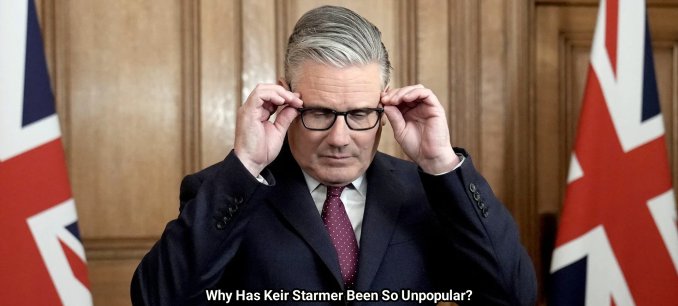
Why has Keir Starmer been so unpopular?
He was the perfect embodiment of a failing system
BEN SIXSMITH
Why did I like women’s breasts so much?” Kingsley Amis wrote in That Uncertain Feeling, “I was clear on why I liked them, thanks, but why did I like them so much?” With apologies for repurposing such a ribald quote while addressing a serious subject, the question I want to ask today is not why Keir Starmer is unpopular but why he is so unpopular.
As Keir Starmer announces that he is leaving Number 10, it can hardly be claimed that he has ruined the country. All the major problems Britain faces in 2026 predate his premiership. Indeed, the best defence of Keir Starmer — as I have written — is that he inherited such a dire set of circumstances. One reason Starmer is disliked that is actually unfair is that he is reaping what other governments sowed. The UK is creaking under a decades-long lack of infrastructure that he could hardly have reversed. Immigration has gone down but the effects of years of human quantitative easing — to borrow a concept from my esteemed colleague Tom Jones — are being experienced. I think it would be absurd to claim that Starmer is among the worst British PMs — if, at least, “worst” is defined as “most destructive”.
So, why is he so disliked? As someone who lives abroad — and thus has some distance from the day-to-day realities of British life — let me propose a theory. At a time when the system was failing, Prime Minister Keir Starmer was the perfect representative of the system.
When the Labour Party returned to government, one thing we heard from its admirers was that the grownups were back in charge. (“It’s nice, isn’t it. The quiet,” tweeted the centrist hysteric Otto English.) The idea, it seemed, was that the UK just needed to be managed more maturely. Get out the likes of Boris Johnson and bring in the pros.
Britain was suffering less from a failure to govern by the book than from being beaten around the head with the book
Keir Starmer seems to have had the same sense of his role in politics. A natural lawyer, he fetishised procedure. They didn’t call him “Mr Rules” for nothing. Well, with all due apologies to my long-neglected inner High Tory, sometimes the procedure is the problem. From the ECHR to planning law, Britain was suffering less from a failure to govern by the book than from being beaten around the head with the book.
Starmer believed in the system. He also believed in the people who had been favoured by the system. It should have been obvious to all sentient observers that giving Peter Mandelson a significant position would be catastrophic. His deep connections to Jeffrey Epstein were hardly the stuff of obscure conspiratorialism. They had been reported on by the Guardian. But while outsiders, like Jeremy Corbyn, could be shanked in the back, Peter Mandelson was the consummate establishmentarian. What could go wrong?
Starmer seemed to have no opinions of his own when it came to moral and epistemic issues. Britain was becoming an “island of strangers” until it abruptly wasn’t. Women could have penises until they suddenly couldn’t. Freedom of movement was going to return until it definitely wasn’t. A man can change his mind, of course, but Starmer never explained how he had changed his mind. He barely seemed to have a mind.
We can’t avoid a vibes-based discussion here because the fact is that Starmer’s vibes have been historically bad. He seems stiff and humourless — the sort of man who says that his guilty pleasure (his guilty pleasure) is a pint with friends — but there is a broader issue here. In an era where Britain should have been trying to avoid a fate of managed decline, Starmer seemed like a man who actively embraced it. So, he did odd things like trying to pay Mauritius to accept the Chagos Islands. But he also had the grim and awkward manner of someone brought in to manage a once great football team that, having been relegated from the Premiership, was now structurally destined to collapse through the leagues. Britain, to him, seemed to be Leicester City with an army — barely — attached.
The problem for Andy Burnham — or, if something crazy happens, whoever else replaces Keir Starmer — is that while Starmer has been an unusually fitting representative of the system, his departure will do nothing to remove systematic problems. There will be just as little money to spend, Britain will be just as short of infrastructure, Britain will be just as divided and so on. This is not to presumptively excuse indecision or bad decisions (both of which Keir Starmer can be faulted for). It is just to say that it will be difficult for any prime minister to win popularity contests after more than a few months in the job — and acting like an alternative, unless you really have an alternative, could make the backlash even more aggressive.
This article (Why has Keir Starmer been so unpopular?) was created and published by The Critic and is republished here under “Fair Use” with attribution to the author Ben Sixsmith
The Starmer Premiership: A Study in Rootless Power and the Westminster Rot
Starmer’s Swift Fall: A Directionless Elite in a Westminster Bubble
Keir Starmer’s time in Downing Street from the landslide of July 2024 to his resignation announcement today 22 June 2026 stands as a textbook case of a man who made it up as he went along. No fixed star. No moral anchor. Just secular moral idealism draped over a North London and Westminster confirmation bias bubble where the concerns of ordinary people and even his own backbenchers rarely penetrated.
He arrived promising national renewal and stability after years of Tory chaos. He leaves having accelerated the very delegitimisation of Parliament he inherited. In barely two years he became the sixth prime minister in a decade to depart prematurely. That carousel Cameron May Johnson Truss Sunak Starmer is not random misfortune. It is the direct consequence of both main parties reneging in their different ways on the spirit of the 2016 Brexit vote and the public’s demand for control over borders law making and cultural direction. The result is a hollowed out legitimacy that no amount of procedural theatre can restore.
Made it up as he went along
Starmer’s government lurched from one reactive position to another. The early decision to means test Winter Fuel Payments stripping support from millions of pensioners within weeks of taking office was the signature move of a man who had not thought through the political or human consequences. It was followed by U turns on disability benefits an immigration speech that invoked an island of strangers prompting internal revolt and a later apology and a series of tax rises in the October 2024 Budget that hit employers and farmers while claiming to deliver securonomics.
Policy was announced walked back or quietly abandoned when the backlash from within Labour or the country proved too strong. There was no coherent governing philosophy beyond a lawyer’s instinct for managing the next crisis and a politician’s fear of losing the next internal vote. The result was drift dressed up as pragmatism.
No moral anchor only secular moral idealism
Starmer presented himself as the grown up who would restore integrity after Partygate. Yet his premiership was quickly defined by its own sleaze file: the freebies scandal clothes glasses Taylor Swift tickets and hospitality from donor Lord Alli the Peter Mandelson appointment despite known Epstein connections and the broader perception that the new elite was every bit as comfortable with the trappings of power as the old one.
This was secular moral idealism in action the belief that abstract commitments to fairness renewal or international norms could substitute for rooted principles or simple consistency with the electorate that had just handed him a huge majority. When those abstractions collided with reality rising net migration grooming gang inquiries that still exposed failures to protect working class communities elite reluctance on two tier issues the response was either denial or a late unconvincing pivot. The public noticed the inauthenticity. The British State is, at present morally bankrupt and will continue to be so until it confronts the uncomfortable truth of the Rape Gangs, honestly and transparently. Nothing short of a truth and reconciliation after justice report ideally chaired by a senior Canadian, Australian or NZ Judge.
The bubble Westminster and North London confirmation bias
Starmer rarely seemed to leave the protective membrane of Islington adjacent assumptions and SW1 groupthink. Backbench rebellions over welfare cuts and immigration were treated as management problems rather than signals from the country. The same disconnect showed in the tone deaf timing of pensioner cuts the tractor tax on farmers and the failure to grasp why millions felt the political class had simply stopped listening on the issues that mattered most borders housing wages and the visible demographic transformation of towns and cities.
The comfortable commentators and politicians show contempt for working class people who simply want their country back people competing for housing school places and wages while elites sermonise from a safe distance. Starmer’s government embodied that contempt in policy and in attitude. The result was not just unpopularity but a collapse in trust so severe that his approval ratings fell to historic lows.
The democratic deficit made visible
The rapid turnover of prime ministers is the most obvious symptom of a deeper crisis. Both Labour and the Conservatives promised in their different idioms to deliver on the 2016 referendum. Both once in office found reasons to hedge delay or reinterpret the outcome in ways that left large numbers of voters feeling the vote had been nullified by procedural and cultural resistance inside the establishment. The consequence was not stable realignment but serial leadership failure and the rise of insurgent alternatives.
Starmer’s resignation today forced by internal revolt by election disasters cabinet exits and poll numbers that made continued leadership untenable is merely the latest confirmation that Parliament has lost the authority to command consent on the fundamentals. When governments of both colours treat the electorate’s clearest instructions as optional or embarrassing the system does not remain legitimate by inertia. It erodes.
Out of touch out of support out of contact out of ideas
That single sentence captures the Starmer years more accurately than any number of think tank papers. A prime minister who never built a durable relationship with his own parliamentary party let alone the country outside the M25 bubble. A government that arrived with a huge majority and frittered it away through a combination of tone deaf economics elite self indulgence and an inability to speak plainly about the issues that had driven the Brexit revolt in the first place.
The Westminster system has produced six prime ministers in ten years because it has stopped delivering the basic goods voters expect control of borders a sense that the law applies equally and leaders who appear to inhabit the same moral and cultural universe as the people they govern. Starmer was not an aberration. He was the logical product of that system in its current decayed form.
The question now is not who replaces him but whether the replacement will finally confront the democratic deficit rather than manage around it. History suggests the political class prefers the latter. The country is running out of patience for the former.
This article (The Starmer Premiership: A Study in Rootless Power and the Westminster Rot) was created and published by C.J. Strachan and is republished here under “Fair Use”

••••
The Liberty Beacon Project is now expanding at a near exponential rate, and for this we are grateful and excited! But we must also be practical. For 7 years we have not asked for any donations, and have built this project with our own funds as we grew. We are now experiencing ever increasing growing pains due to the large number of websites and projects we represent. So we have just installed donation buttons on our websites and ask that you consider this when you visit them. Nothing is too small. We thank you for all your support and your considerations … (TLB)
••••
Comment Policy: As a privately owned web site, we reserve the right to remove comments that contain spam, advertising, vulgarity, threats of violence, racism, or personal/abusive attacks on other users. This also applies to trolling, the use of more than one alias, or just intentional mischief. Enforcement of this policy is at the discretion of this websites administrators. Repeat offenders may be blocked or permanently banned without prior warning.
••••
Disclaimer: TLB websites contain copyrighted material the use of which has not always been specifically authorized by the copyright owner. We are making such material available to our readers under the provisions of “fair use” in an effort to advance a better understanding of political, health, economic and social issues. The material on this site is distributed without profit to those who have expressed a prior interest in receiving it for research and educational purposes. If you wish to use copyrighted material for purposes other than “fair use” you must request permission from the copyright owner.
••••
Disclaimer: The information and opinions shared are for informational purposes only including, but not limited to, text, graphics, images and other material are not intended as medical advice or instruction. Nothing mentioned is intended to be a substitute for professional medical advice, diagnosis or treatment.
Disclaimer: The views and opinions expressed in this article are those of the author and do not necessarily reflect the official policy or position of The Liberty Beacon Project.


Leave a Reply