

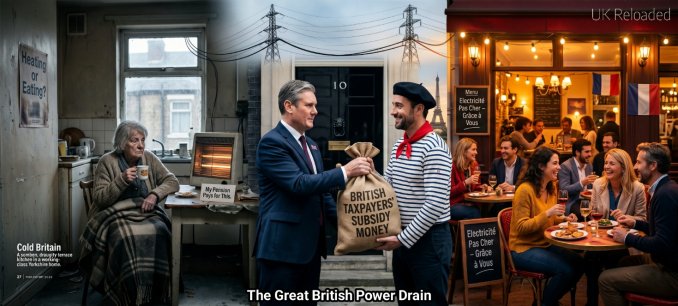
How Starmer is Bankrolling the French
HOTTENTOT
There is a distinct type of mandarin madness that governs contemporary Whitehall, but its latest manifestation deserves a special place in the annals of national self-sabotage. Imagine, if you will, an elderly pensioner in a draughty terrace in Yorkshire. She sits in her kitchen, lights off, nursing a single cup of tea, terrified to turn on her storage heaters because British electricity prices remain among the highest in the developed world. Now cast your eyes across the English Channel to a bustling bistro in Lille, bathed in cheap, reliable light. The punchline to this bleak tableau is that the Yorkshire pensioner is actively paying to keep the lights on in Lille.
This is not a Eurosceptic ghost story; it is the literal mathematical reality of Sir Keir Starmer’s grand diplomatic “reset” with the European Union. According to a devastating intervention from Octopus Energy, the UK’s largest energy supplier, our current “wasteful” cross-border energy trading rules are on track to bleed British taxpayers of a staggering £16 billion between 2030 and 2050. That breaks down to an annual £770 million tribute paid by British families to our continental neighbours.
Yet rather than grabbing a wrench to fix the plumbing, Starmer and his negotiators have arrived at a characteristically technocratic solution: they intend to formalise the arrangement, merging our electricity markets back into the EU’s internal network. In the name of progressive alignment, Downing Street is preparing to institutionalise a system where the British public functions as a permanent charitable trust for the French republic.
To understand how this spectacular fleecing occurs, one must delve into the physical and bureaucratic plumbing of Great Britain’s energy grid. On a clear, blustery day, the United Kingdom behaves exactly like the green energy superpower Whitehall press releases claim it to be. The great wind turbines of Scotland and the North of England spin furiously, generating immense amounts of clean, cheap electricity. This power does not emerge from a free market; it is heavily incentivised and heavily padded by multi-billion-pound subsidies extracted directly from British consumers through environmental levies stapled onto their domestic bills.
The farce begins when this power attempts to move. The British transmission grid is a creaking relic, starved of the infrastructure upgrades necessary to carry this massive surge of northern energy down to the English population centres and across the Channel. A severe bottleneck exists. The power is physically trapped in the North. Enter the bureaucratic genius of the cross-border market rules. On these high-wind days, French energy suppliers look at the wholesale market, see a mountain of surplus British power, and legally buy it at rock-bottom prices. But because our domestic grid cannot physically transport the northern wind energy down to the subsea interconnectors in the Southeast, the system enters a state of near-comedic crisis.
To honour the contractual export deal and stop the northern grid from blowing a fuse, National Grid is forced to execute a “balancing” act. It commands the northern wind farms to turn off, cutting them a massive “constraint payment” to stop spinning. Simultaneously, it turns to expensive, carbon-heavy, gas-fired power stations located in Southeast England. The grid operator pays these gas plants eye-watering premiums to fire up and generate the actual, physical electricity that is then piped across the Channel to France. The balance sheet of this transaction is an insult to the British public. The taxpayer pays once to subsidise the wind farms in the North, and a second time to fire up gas plants in the South to fulfil the export contract. And the beneficiary of this double-funded logistical nightmare? The French consumer, who receives cut-price, reliable electricity, with every single penny of the structural friction absorbed by the British public pocket.
Any government animated by a shred of economic patriotism would view these figures and immediately declare an emergency. They would halt exports, rewrite the trading mechanisms, and demand that British-subsidised energy serve British citizens first. But that is not the Uniparty way. For Keir Starmer, the abstract theological pursuit of “re-engagement” with Brussels trumps the vulgar material realities of domestic utility bills. His chief negotiators have spent recent weeks huddled with the European Commission, eager to “recouple” our markets. Whitehall mandarins speak of this with a characteristic, smooth-tongued optimism. They tell us that a digitalised, automatic stock-market system for electricity will “bear down on bills” by creating a de facto unified market. This is an elite delusion. Or a lie.
As Octopus Energy’s head of policy, Jack Pardoe, dryly noted to a House of Lords committee, the benefits of this EU integration are “marginal” at best. At worst, it risks exacerbating “the worst features of an inherently inefficient market”. By further tying our infrastructure to the EU before fixing our own internal transmission lines, Starmer is not solving the problem; he is opening the floodgates. He is giving European state-backed energy giants frictionless access to buy up our cheap renewable power the second it is generated, accelerating the very gas-balancing farce that fleeces our taxpayers.
There is a deeper, psychological sickness at play here. Labour’s energy policy under Ed Miliband has become a secular religion, a frantic crusade to build net-zero infrastructure regardless of whether the grid can actually support it. When this frantic building creates an unmanageable surplus, the government’s instinct is not to protect the domestic consumer, but to use that surplus as a diplomatic dowry to court favour in Brussels. The Shadow Energy Secretary, Claire Coutinho, captured the sentiment perfectly when she observed that the current framework protects wind developers and foreign buyers while the British consumer “gets shafted”. It is an arrangement that can only be tolerated by a political class that views the British electorate not as citizens to be protected, but as an inexhaustible ATM to fund their globalist and green credentials.
To defend this policy, as government spokesmen have attempted to do, by calling it a “two-way street” that allows us to import power on freezing, windless days, is pure gaslighting. France’s energy grid—anchored by a massive, state-protected nuclear fleet—does not suffer from our self-inflicted infrastructural blindness. They are playing a sophisticated game of economic realpolitik. We are playing the role of the useful idiot, subsidising their domestic comfort while our own heavy industries are hollowed out by punitive energy costs.
The late French statesman Jean-Baptiste Colbert once remarked that the art of taxation consists in so plucking the goose as to obtain the largest possible amount of feathers with the smallest possible amount of hissing. In Starmer’s Britain, the goose is not just being plucked; it is being served up on a silver platter to the French. A nation’s energy strategy should have a singular, unyielding focus: the provision of cheap, secure, sovereign power to fuel its own homes and factories. To allow our own state-subsidised infrastructure to be turned into a mechanism for lowering the cost of living in France, while British citizens face double-digit hikes in their bills, is an abdication of the basic duty of governance.
The £16 billion penalty staring us down over the next two decades is the price tag of diplomatic sycophancy. If Starmer continues to mistake alignment with Brussels for the national interest, he will find that the British public’s capacity for quiet endurance has its limits. It is time to halt the negotiations, plug the financial drain, and remind this government who actually pays their wages.


